Noble Birth
Born in Beijing into a prominent lineage, nurtured in classical studies and calligraphic arts.
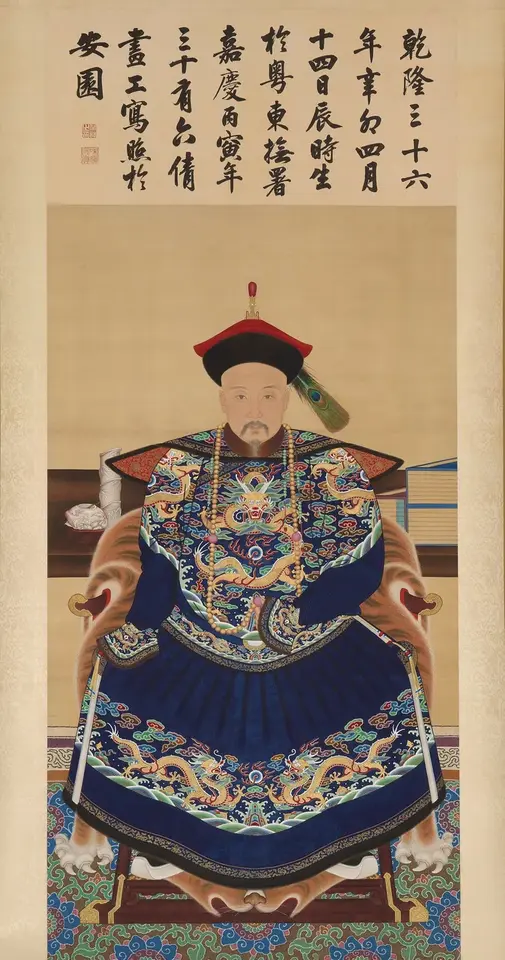
英和
Ying He (1771–1840), courtesy name Xuzhai, art names Jianzhai and Shizhi, of the Socoro clan, was a member of the Manchu Plain White Banner. He was a prominent senior statesman, calligrapher, bibliophile, and scholar of the mid-to-late Qing dynasty. Born into an illustrious bureaucratic lineage, he was the third son of Debao, the Minister of Rites. From a young age, Ying He displayed exceptional erudition in the Confucian…
Ying He (1771–1840), courtesy name Xuzhai, art names Jianzhai and Shizhi, of the Socoro clan, was a member of the Manchu Plain White Banner. He was a prominent senior statesman, calligrapher, bibliophile, and scholar of the mid-to-late Qing dynasty. Born into an illustrious bureaucratic lineage, he was the third son of Debao, the Minister of Rites. From a young age, Ying He displayed exceptional erudition in the Confucian classics and history, achieving nationwide renown for his calligraphic mastery modeled after Zhao Mengfu. In 1793 (the fifty-eighth year of the Qianlong reign), Ying He passed the imperial examinations as a Metropolitan Graduate, entered the Hanlin Academy as a Bachelor, and was appointed Compiler. He was subsequently summoned to serve in the Southern Study and the Grand Council. During the Jiaqing reign, he enjoyed the deep trust of Emperor Renzong, rising through senior posts to General Commandant of the Gendarmerie, Minister of Works, and Minister of Personnel. When the Eight Trigrams (Tianli Sect) rebels launched a surprise assault on the Forbidden City, Ying He was commissioned to secure the capital and successfully captured the rebel leader Lin Qing, for which he was awarded the title of Junior Guardian of the Heir Apparent. In the early Daoguang era, he was promoted to Minister of Revenue and Associate Grand Secretary, vigorously reforming imperial finances, initiating the groundbreaking maritime grain transport system from Jiangnan to Tianjin, and devising key strategic plans to suppress Jahangir Khoja's rebellion in Xinjiang. Later, he was severely cashiered and exiled to Tsitsihar in Heilongjiang due to severe water seepage in Emperor Daoguang's Baohuayu imperial mausoleum, an engineering project he had overseen. During his exile, he meticulously surveyed borderland geography and compiled works such as Bukuiji lue (Brief Records of Bukui). Pardoned in 1831, he passed away in 1840 and was posthumously granted the third rank brevet. Ying He was celebrated for his deep administrative wisdom, frequent service as chief imperial examiner, and an enormous library exceeding tens of thousands of volumes, with his family recognized as the pinnacle of Manchu scholar-gentry lineages.
Born in Beijing into a prominent lineage, nurtured in classical studies and calligraphic arts.
Passed the imperial examination as a Metropolitan Graduate, inducted into the Hanlin Academy as Compiler.
Emperor Renzong assumed direct rule, commended his father for having refused Heshen's marital proposal, and promoted him to Sub-Chancellor of the Grand Secretariat.
Appointed Minister of the Imperial Household, served as Vice Minister of Revenue and Works, and was appointed Probationary Grand Councilor.
When the Eight Trigrams rebels raided the palace, he was appointed Acting Commandant of the Gendarmerie, captured Lin Qing, and became Minister of Works.
Emperor Daoguang acceded to the throne; appointed Grand Councilor and Minister of Revenue to manage state finances.
Promoted to Associate Grand Secretary and Chancellor of the Hanlin Academy, superintending the compilation of the Veritable Records of Emperor Renzong.
Overcame conservative opposition to pioneer sea transport of southern grain to Tianjin, rewarded with the imperial purple bridle.
Condemned and stripped of all honors after the Baohuayu imperial tomb suffered severe water ingress, and banished to Tsitsihar, Heilongjiang.
Granted a full pardon to return to Beijing; his sons and grandson were restored to administrative appointments.
Passed away in Beijing at the age of seventy; posthumously conferred the third rank brevet.
Ying He was born on the fourteenth day of the fourth lunar month in 1771 (the thirty-sixth year of the Qianlong reign). His family, the Socoro clan, enjoyed generations of academic excellence and distinguished civil service. Both his grandfather Mingde and his father Debao were renowned patrons of classical learning. Debao rose to the post of Minister of Rites, providing Ying He with an exceptionally rigorous cultural education. Endowed with extraordinary memory and intellectual sharpness, Ying He devoured historical treatises from childhood. In calligraphy, he began with the style of Dong Qichang before mastering the elegant and rigorous aesthetic of Zhao Mengfu. The all-powerful minister Heshen once sought to marry his daughter to Ying He; Debao, recognizing Heshen's unchecked corruption and grasping ambitions, adamantly refused the offer, an act widely lauded by the contemporary scholar-official class.
In 1793 (the fifty-eighth year of the Qianlong reign), at twenty-three years of age, Ying He passed the Metropolitan Examination, was admitted as a Bachelor of the Hanlin Academy, and was soon appointed Compiler. Serving as a brilliant young talent in the literary academy, he demonstrated consummate command over institutional records and classical commentaries, rapidly rising to Reader of the Hanlin Academy.
In early 1799 (the fourth year of the Jiaqing reign), following the passing of the Qianlong Emperor, the Jiaqing Emperor (Renzong) commenced personal rule. Renzong, well aware of Debao's integrity in refusing alliance with Heshen, showered Ying He with imperial favor, promoting him to Sub-Chancellor of the Grand Secretariat, followed by appointment as Vice Minister of Rites and concurrent Deputy Lieutenant-General. In 1801 (the sixth year of the Jiaqing reign), Ying He was appointed Minister of the Imperial Household Department, successively transferred to Vice Minister of Revenue and Vice Minister of Works, and assigned to study administrative affairs on the Grand Council, while concurrent duties included Chancellor of the Hanlin Academy and duty in the Southern Study. Possessing a forthright temperament, Ying He was demoted on two occasions—first for submitting a confidential memorial accusing Grand Secretary Liu Quanzhi of favoritism, and later for clerical errors regarding temple names in imperial compilation transcripts—yet his exceptional talent quickly earned him reinstatement and further promotion.
In the winter of 1809 (the fourteenth year of the Jiaqing reign), an administrative scandal surfaced when Wang Shuchang and other scribes in the Ministry of Works forged official seals and fabricated vouchers, embezzling silver from the Imperial Household Treasury more than a dozen times. The emperor held supervising officials strictly accountable; Ying He, having previously served as Vice Minister of Works, received disciplinary demotion for administrative failure to detect the fraud, but was soon reassigned as Vice Minister of Rites.
In the autumn of 1813 (the eighteenth year of the Jiaqing reign), Ying He accompanied the imperial entourage to the Chengde Mountain Resort for the imperial autumn hunt. At that moment, Eight Trigrams sectarian rebels attacked the Forbidden City in Beijing, shaking the imperial court. Emperor Renzong immediately ordered Ying He to rush back to the capital and assume the duties of General Commandant of the Gendarmerie. Handling the crisis with calm authority, Ying He tightened perimeter defenses at all city gates, mounted systematic searches, and ultimately captured the supreme rebel commander Lin Qing at Songjiazhuang in Daxing. He then assisted in directing military campaigns that quelled rebel bands in Huaxian, Henan. In recognition of his decisive actions in safeguarding the dynastic capital, Ying He was formally confirmed as General Commandant of the Gendarmerie, elevated to Minister of Works, and honored with the rank of Junior Guardian of the Heir Apparent. The following year, he was transferred to serve as Minister of Personnel.
When Emperor Daoguang (Minning) ascended the throne, he was eager to reform administrative inefficiencies and appointed Ying He as Grand Councilor and Minister of Revenue to oversee imperial finances. Deeply moved by the emperor's trust, Ying He submitted candid proposals to eliminate fiscal rot. Addressing the widespread abuse where provincial and local magistrates, burdened by insufficient stipends, collected illicit customary fees, Ying He advocated a thorough audit of all anti-corruption allowances across provinces to standardize and eliminate illegal levies. However, because this reform encroached upon deeply entrenched bureaucratic interests across the empire, vociferous opposition erupted, forcing Emperor Daoguang to shelve the project; Ying He subsequently stepped down from the Grand Council to concentrate solely on Ministry of Revenue duties.
In 1822 (the second year of the Daoguang reign), Ying He was named Associate Grand Secretary while continuing as Minister of Revenue and Chancellor of the Hanlin Academy. In 1825 (the fifth year of the Daoguang reign), catastrophic floods ruptured the dikes of Lake Hongze, severely silting up the Grand Canal and bringing the grain fleet to an abrupt halt. With hundreds of thousands of piculs of tribute grain stranded in the south, the granaries of Beijing faced an acute crisis. Most grandees and regional governors, paralyzed by bureaucratic precedent, could only contemplate spending millions of taels on laborious river dredging. Ying He broke through centuries of inertia and proposed an audacious solution: transporting the grain via the open sea. He submitted a comprehensive memorial arguing that temporary cessation of canal transit would permit thorough river conservancy, while chartering commercial sea vessels would safely deliver provisions to Tianjin. He meticulously outlined contingency plans covering seafaring navigation, storage, transshipment, and the livelihood of displaced canal boatmen.
Despite stubborn resistance from conservative courtiers, Jiangsu Governor Tao Shu strongly endorsed and implemented the strategy. In the spring of 1826 (the sixth year of the Daoguang reign), over one million piculs of tribute grain embarked on commercial sea vessels from Shanghai, safely docking at Dagu in Tianjin within months. The operation saved immense expense and proved faster than inland transit. Delighted by the success, Emperor Daoguang lavishly rewarded the organizers and specially conferred an imperial purple bridle upon Ying He to honor his visionary initiative.
While Ying He was a bold and imaginative administrator, his resolute assertiveness occasionally invited severe royal displeasure. In late 1826 (the sixth year of the Daoguang reign), observing shortages in state revenues, Ying He petitioned to open silver mines in Yizhou, Zhili. Because Yizhou was situated adjacent to the Western Qing Tombs, Emperor Daoguang rebuked him for rashly disturbing geomantic veins and demoted him to Minister of the Court of Colonial Affairs. In 1827 (the seventh year of the Daoguang reign), censorate officials accused Ying He's domestic servants of raising residential rents in Tongzhou, resulting in his outward reassignment as Lieutenant-General of Rehe.
Meanwhile, a devastating catastrophe loomed. In 1821 (the first year of the Daoguang reign), upon ascending the throne, Daoguang had commissioned Ying He as chief superintendent to build the imperial mausoleum at Baohuayu in the Eastern Qing Tombs of Zunhua. In deference to Daoguang's frugality dictates, Ying He had curtailed various construction expenditures. In 1827, the tomb was finished, and the casket of Empress Xiaomucheng was entombed. However, in the autumn of 1828 (the eighth year of the Daoguang reign), during an imperial inspection, the emperor discovered that groundwater had severely seeped into the underground palace, completely submerging the empress's coffin.
The emperor was beside himself with fury, issuing scathing edicts accusing the superintendents of heinous negligence and holding Ying He principally liable as the director of the entire construction. The Board of Punishments uncovered that groundwater springs had been struck during excavation, yet Ying He had merely tamped down the earth rather than building standard subterranean drainage conduits. The Board proposed execution. However, an exhaustive investigation confirmed that Ying He had committed no embezzlement or personal graft; Emperor Daoguang commuted the death sentence, stripping him of all offices, confiscating his personal property, levying a staggering compensation fine of over two hundred thousand taels of silver, and exiling him to penal servitude in Tsitsihar, Heilongjiang. His sons Kui Zhao and Kui Yao were dismissed and ordered to accompany him into banishment, while his grandson Xizhi was stripped of candidate status.
Ying He accepted the severe decree without rancor, journeying calmly into the northern frontier with his sons. Many former proteges in Beijing shunned him for fear of imperial retribution, but Emushun'e, Chief Minister of the Court of Imperial Entertainments, traveled dozens of miles beyond the capital gates to bid him farewell—a gesture that moved Ying He profoundly. During his three-year exile in Tsitsihar (Bukui), Ying He embraced ascetic scholar life. He surveyed the northern frontier terrain, investigated indigenous customs, and authored the invaluable historical-geographical treatise Bukuiji lue and the descriptive rhapsody Bukuicheng fu.
In 1831 (the eleventh year of the Daoguang reign), recognizing Ying He's early strategic counsel during the Jahangir campaigns and moved by maternal intervention from the Empress Dowager, Emperor Daoguang granted a full pardon, allowing Ying He and his sons to return to the capital and restoring his sons' official ranks. In retirement, Ying He styled himself Shizhi Laoren, residing quietly in his Enfu Hall studio, dedicating his remaining years to collation of rare books, poetry composition, and calligraphy. On July 9, 1840 (the tenth day of the sixth lunar month in the twentieth year of the Daoguang reign), Ying He passed away in Beijing at the age of seventy. The imperial court issued an edict granting customary funeral honors and conferring the third rank brevet.
Since the founding of the Qing dynasty, the transport of tribute grain from Jiangnan to the northern capital had relied exclusively on the Grand Canal. By the mid-Qing era, recurring floods of the Yellow River and chronic siltation of the canal inflated transportation costs to unsustainable levels. In 1825 (the fifth year of the Daoguang reign), catastrophic levee breaches at Lake Hongze severed canal routes, leaving imperial granaries in Beijing vulnerable to acute famine. Most court ministers dogmatically urged the expenditure of millions of taels to patch embankments, viewing ocean shipping as prohibitively perilous.
Serving as Minister of Revenue, Ying He recognized that canal navigation had reached an impasse and decisively proposed maritime shipping. In a masterly memorial, he demonstrated that sea transport utilizing seasonal winds from the Yangtze delta could reach Tianjin in days rather than months; that chartering commercial sea junks cost merely thirty to forty percent of inland canal expenses; and that suspending canal traffic would free imperial resources to dredge the Yellow and Huai river systems without operational conflict. He drafted meticulous regulations governing naval escort, harbor transshipment, and alternative employment for displaced canal boatmen. Under the proactive execution of Jiangsu Governor Tao Shu, over 1.6 million piculs of tribute grain sailed across the Bohai Sea to Tianjin in 1826, completing the journey smoothly. Ying He's bold initiative resolved the immediate crisis and established the institutional foundation for the permanent adoption of maritime grain transit in late Qing times.
Holding high office in the Ministry of Works, Ministry of Revenue, and the Grand Council, Ying He was renowned for his financial acuity. In 1814 (the nineteenth year of the Jiaqing reign), when the dynastic treasury was severely drained following the White Lotus Rebellion, senior courtiers favored opening imperial sale of official titles. Ying He alone submitted a memorial strongly opposing reliance on office purchases, famously arguing that curbing expenditure was far superior to selling ranks, as the latter provided merely ephemeral revenue while institutional retrenchment generated enduring annual surpluses. He advised curtailing wasteful ceremonial expenses, pruning honorary military wages, and extending intervals between imperial ancestral pilgrimages and hunts.
Regarding state revenue generation, Ying He rejected conservative prohibitions on mineral extraction. Pointing out that frontier defense subsidies in Xinjiang consumed over a million taels annually from inner provinces, he advocated opening rich gold and silver mines in the Tianshan ranges through private merchant operations to finance military garrisons locally. When Jahangir Khoja invaded southern Xinjiang in 1826, Ying He submitted comprehensive military logistics proposals and urged the imperial court to appoint capable generals such as Changling and Wulong'a. The court adopted his operational blueprint, leading to the rapid pacification of the border rebellion.
Beyond his bureaucratic achievements, Ying He was among the most culturally accomplished Manchu scholar-officials in Chinese classical studies during the mid-Qing period. Devoting his surplus official salary to acquiring rare Song and Yuan editions and ancient rubbings, he accumulated tens of thousands of volumes housed in his studios, including Enfu Hall, Enqing Hall, and Cangsong Study. He personally transcribed and assembled hundreds of rare volumes from the imperial Yongle Dadian, and compiled the four-volume Enfutang shumu (Catalogue of Enfu Hall), cataloging over nine hundred rare titles with rigorous textual commentary.
His written corpus includes Enfutang biji (Notes from Enfu Hall), Enfutang shichao (Poetry of Enfu Hall), Changbai shengde zhi, Chunqiu Zuozhuan duben, and the frontier gazetteer Bukuiji lue. In calligraphy, Ying He absorbed the structural balance and grace of Zhao Mengfu and Dong Qichang, cultivating a robust, aristocratic brush style that placed him alongside Prince Yongxing, Liu Yong, and Tiebao as one of the preeminent calligraphic masters of the capital.
FIGURES ASSOCIATED WITH THIS DYNASTY