Birth in Changsha
Born in Changsha, Hunan, displaying early talent in traditional brush and ink painting.
易元吉
Yi Yuanji (active 11th century), courtesy name Qingzhi, was a native of Changsha County in Tanzhou (modern Changsha, Hunan). He was an extraordinary painter of animals, flowers, and birds in the mid-Northern Song dynasty, universally recognized as the supreme master of gibbons and deer in Chinese art history. Initially painting flowers and birds, Yi was so awed by the peerless mastery of contemporary floral painter Zhao…
Yi Yuanji (active 11th century), courtesy name Qingzhi, was a native of Changsha County in Tanzhou (modern Changsha, Hunan). He was an extraordinary painter of animals, flowers, and birds in the mid-Northern Song dynasty, universally recognized as the supreme master of gibbons and deer in Chinese art history. Initially painting flowers and birds, Yi was so awed by the peerless mastery of contemporary floral painter Zhao Chang that he resolved: "No painter in the world has yet captured gibbons and deer with perfection; I shall excel all men in this craft!" Abandoning comfortable studio life, Yi traveled alone into the remote mountain valleys of Hunan and Hubei for months, living alongside wild deer and gibbons to observe their natural instincts in the wild. In 1064, Emperor Yingzong summoned him to the Hanlin Academy of Painting in Kaifeng to execute imperial screen paintings for the Xiaoyan Hall. His lifelike depictions of soft fur, agile postures, and maternal tenderness among mountain primates astonished the court. His celebrated surviving works include Monkeys and Cats (Hou Mao Tu), Gathering Monkeys (Ju Yuan Tu), and Monkey with Fruit, marking the golden age of Song naturalistic animal painting.
Born in Changsha, Hunan, displaying early talent in traditional brush and ink painting.
Acknowledged Zhao Chang's floral supremacy and resolved to specialize exclusively in wild gibbons and deer.
Traveled deep into rugged gorges across western Hunan, living among wild primates for months.
Excavated ponds and planted forests at his Changsha residence, raising deer, gibbons, and waterbirds for daily sketching.
Summoned to Kaifeng by Emperor Yingzong upon his accession, appointed Painter-in-Waiting in the Hanlin Academy of Painting.
Executed the monumental One Hundred Gibbons screen for Xiaoyan Hall, winning royal praise.
Commissioned to paint One Hundred Horses, but died suddenly of acute illness in Kaifeng before completing the work.
Yi Yuanji was born in Changsha, Hunan, a region blessed with lush subtropical wilderness and mountain valleys. In his early years, he studied classical bird-and-flower painting, earning a respected regional reputation for delicate brushwork.
However, after examining the masterworks of Zhao Chang—the supreme floral painter of the era—Yi recognized that Zhao's color washes had achieved the absolute peak of natural perfection. Unwilling to spend his life as an inferior imitator, Yi exclaimed: "To borrow another's fame as one's own is not the action of a brave man! Among countless painters throughout the ages, none has ever captured the true spirit and playful nature of gibbons and deer; I shall master this path to stand alone across a hundred generations!" He thereupon devoted his entire creative career to animal painting.
To escape the lifeless conventions of studio copying, Yi Yuanji pioneered direct field sketching in the wild.
Carrying rations and scrolls, he ventured alone into the primeval forests of western Hunan, Hubei, and the Sichuan borderlands. For months at a time, he scaled crags and camped in mountain caves alongside wild primates and roe deer. Hiding behind thickets, he watched wild gibbons swing across cliffs, pluck fruit, nurse infants, and howl beneath the moon, absorbing their natural instincts.
Returning to Changsha, Yi converted his residence into an open-air menagerie. He excavated ponds, planted bamboo and pines, and kept deer, gibbons, cranes, and peacocks in his courtyard. Through concealed peepholes in his studio wall, he studied their movements, sketching spontaneous poses with breathtaking accuracy.
In 1064, Emperor Yingzong constructed the Xiaoyan Hall in Kaifeng and sought the empire's finest painters. Recommended by court ministers, Yi was summoned to the palace and appointed Painter-in-Waiting in the Hanlin Academy of Painting.
Emperor Yingzong initially tested Yi by commissioning screens depicting water birds and flowers in Xuande Hall. Overwhelmed by their natural brilliance, Yingzong commanded Yi to paint the primary ceremonial screen of Xiaoyan Hall on the theme of One Hundred Gibbons.
Drawing upon decades of wilderness observation, Yi created an unprecedented masterpiece featuring one hundred wild primates in diverse natural poses: swinging across tree branches, nursing babies, gazing into waters, and calling to companions across rocky chasms. The fur was so soft and fluffy that viewers felt compelled to reach out and stroke it. The imperial court hailed the painting as a divine work.
Delighted, Emperor Yingzong rewarded Yi generously and ordered him to begin a companion screen entitled One Hundred Horses. Tragically, after completing only a dozen steeds, Yi fell acutely ill and died in his official lodgings. Contemporary accounts recorded rumors that jealous court painters had poisoned him out of envy of his supreme skill.
Prior to Yi Yuanji, Chinese animal painters focused primarily on domesticated beasts such as horses, cattle, and imperial falcons. Yi elevated wild primates and woodland deer into prominent independent subjects in Chinese fine art.
In the tradition of Monkeys Painted by Yi Yuanji, his depictions did not merely reproduce biological anatomy; he conveyed the psychological and emotional lives of wild creatures with soft, tactile realism. Song art historian Guo Ruoxu wrote in Tuhua Jianwenzhi: "Yi Yuanji originally specialized in flowers and fruit, but upon seeing Zhao Chang's work, he resolved to paint gibbons and deer. Living in mountain forests among wild herds, he captured every nuance of movement with supreme subtlety; he was truly a peerless master across a hundred generations."
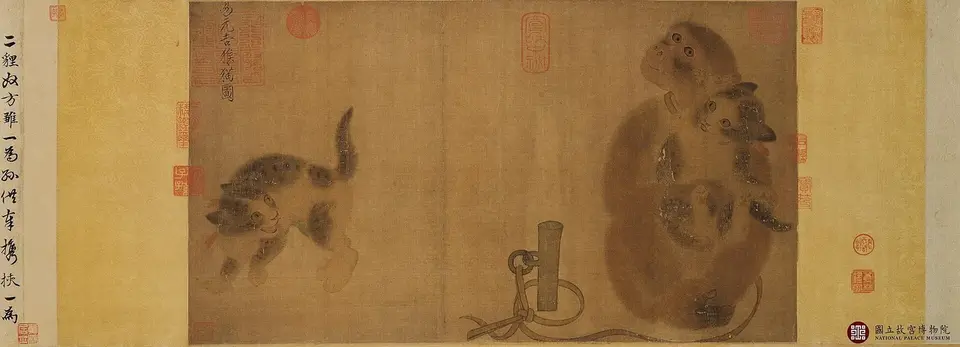
Yi Yuanji's brilliance survives in celebrated extant masterpieces. Monkeys and Cats (Hou Mao Tu), preserved in the National Palace Museum in Taipei, features a playful pet monkey wearing a red collar holding a kitten, while a second kitten watches warily from the side. Using gossamer-fine brushstrokes (yousi miao), Yi painted individual strands of hair with soft realism, creating an intimate vignette of Song domestic life.
Another masterpiece, Gathering Monkeys (Ju Yuan Tu), preserved in Japan, depicts wild primates gathering along ancient crags and mountain streams, demonstrating his profound understanding of wilderness ecology and winning global acclaim.
FIGURES ASSOCIATED WITH THIS DYNASTY