Royal Birth
Born into the Sasanian royal house as grandson of Khosrow II, raised in seclusion at Istakhr.
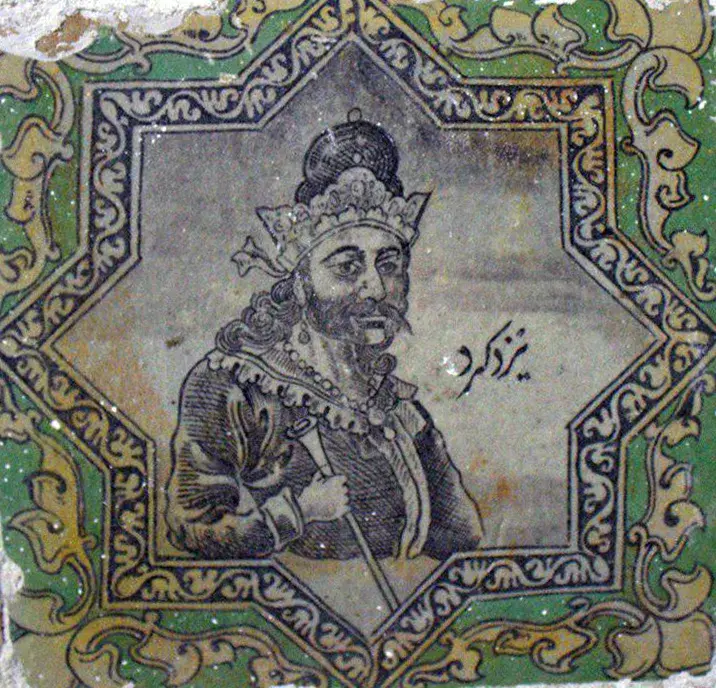
伊嗣俟三世
Yazdegerd III (伊嗣俟三世, 624–651), also romanized as Yazdagird III, was the thirty-eighth and final Shahanshah of the Sasanian Empire of Persia. A grandson of Khosrow II, he was crowned in 632 at the fire temple of Anahita in Istakhr following prolonged civil strife and devastating wars against the Byzantine Empire that left the Sasanian state financially exhausted and politically fractured.Ascending the throne at age eight,…
Yazdegerd III (伊嗣俟三世, 624–651), also romanized as Yazdagird III, was the thirty-eighth and final Shahanshah of the Sasanian Empire of Persia. A grandson of Khosrow II, he was crowned in 632 at the fire temple of Anahita in Istakhr following prolonged civil strife and devastating wars against the Byzantine Empire that left the Sasanian state financially exhausted and politically fractured.Ascending the throne at age eight, Yazdegerd immediately confronted the expansion of the nascent Rashidun Caliphate. Despite mounting determined resistance across two decades, catastrophic defeats at the Battle of al-Qadisiyyah and the Battle of Nahavand shattered Sasanian control over Mesopotamia and the Iranian Plateau. Retreating eastward before advancing Arab armies, Yazdegerd took refuge in Merv within the northeastern province of Khorasan, seeking military intervention from Central Asian Sogdian city-states, the Western Turkic Khaganate, and the Tang Empire of China. In 651, betrayed by the rebellious governor Mahoe and surrounded by hostile factions, he was assassinated by a miller on the outskirts of Merv, bringing four centuries of Sasanian imperial rule to a formal close. Following his death, his son Peroz and grandson Narsieh fled to Tokharistan and ultimately found asylum in Chang'an. Emperor Gaozong of Tang established the Persian Area Command in modern Zarang, appointing Peroz as Persian King and Tang general, which preserved the Sasanian royal lineage under Chinese imperial protection for decades.
Born into the Sasanian royal house as grandson of Khosrow II, raised in seclusion at Istakhr.
Crowned Shahanshah at age eight in Istakhr amidst aristocratic factions following brutal dynastic chaos.
Royal commander Rostam Farrokhzad was killed in action; Arab forces overwhelmed imperial defenses.
Sasanian capital Ctesiphon fell; Yazdegerd retreated eastward with the imperial court into the Zagros Mountains.
Sasanian coalition suffered total collapse at the Battle of Nahavand, dissolving organized imperial resistance.
Having lost the central provinces, Yazdegerd retreated to Merv to reorganize remaining loyalist forces.
Dispatched official embassies along the Silk Road to Chang'an requesting Tang military assistance against the Caliphate.
Betrayed by Governor Mahoe; murdered at age twenty-eight in a watermill near Merv, extinguishing the Sasanian Empire.
Yazdegerd III was born in 624, the son of Prince Shahriyar and grandson of the illustrious monarch Khosrow II. During his early childhood, the Sasanian Empire suffered through an exhausting twenty-year war against Emperor Heraclius of the Byzantine Empire. Following the overthrow and assassination of Khosrow II in 628, the empire plunged into an era of violent palace coups and warlord rivalry, during which more than a dozen claimants seized and lost the imperial throne in rapid succession, devastating state finances and central authority.
In 632, Sasanian magnates rallied around the eight-year-old Yazdegerd, crowning him King of Kings at the sacred temple of Anahita in Istakhr, the ancestral cradle of the Sasanian dynasty. Although the child-monarch lacked administrative experience, his coronation briefly unified aristocratic factions. However, this internal reconciliation arrived just as unified Arab Muslim armies under the Rashidun Caliphate launched their military campaign against the fertile borderlands of the Euphrates and Tigris valleys.
In 636, Caliph Umar dispatched a substantial military expedition led by Sa'ad ibn Abi Waqqas into Mesopotamia. Yazdegerd entrusted supreme command of the imperial forces to Rostam Farrokhzad, a seasoned general and governor of Khorasan. The two armies clashed in the pivotal Battle of al-Qadisiyyah. Over four days of brutal combat, a freak dust storm and the collapse of the Persian war-elephant vanguard led to a rout; Rostam was slain, and the imperial banner of Kaveh was captured. The defeat left central Mesopotamia defenseless.
In 637, Muslim armies entered Ctesiphon, the cosmopolitan Sasanian capital on the Tigris. Yazdegerd hastily evacuated his court and treasuries toward the Iranian Plateau, while imperial archives and royal wealth accumulated over centuries were looted. Refusing to yield, Yazdegerd assembled a fresh coalition army of provincial levies in the mountainous interior. In 642, the two sides engaged at Nahavand, south of Hamadan. Despite fierce initial resistance, the Persian forces were ambushed, resulting in an overwhelming defeat that Arab chroniclers hailed as the "Victory of Victories," permanently breaking the Sasanian military infrastructure.
Following Nahavand, western and central Iranian governors submitted or were subdued individually. Yazdegerd embarked on a desperate eastern flight through Fars and Kerman, eventually arriving in Merv, the capital of northeastern Khorasan. In this frontier citadel, Yazdegerd attempted to collect taxes, rebuild an imperial guard, and seek external intervention from neighboring Sogdian kingdoms, the Western Turks, and the Tang Empire of China.
Around 647, Yazdegerd dispatched diplomatic missions across Central Asian desert routes to Chang'an, appealing directly to Emperor Taizong for military intervention. Emperor Taizong, while receiving the Persian envoys with imperial courtesy and presenting rich gifts, judged that Central Asian distances and geographical barriers precluded direct Tang military deployment into the Iranian plateau. Deprived of foreign reinforcements, Yazdegerd faced mutinous resistance from Mahoe, the entrenched local governor of Khorasan, who refused to relinquish fiscal revenues and sought autonomy.
In the autumn of 651, Mahoe allied with Hephthalite and Turkic contingents, openly rebelling against the monarch. Yazdegerd's royal retinue was scattered in skirmishes outside Merv. Fleeing alone in the darkness, the twenty-eight-year-old Shahanshah sought shelter in a watermill along the Murghab River. While he was asleep, the miller murdered him to plunder his gem-encrusted dagger and imperial silk garments; contemporary accounts also indicate the miller acted under direct orders from the treacherous governor Mahoe.
The murder of Yazdegerd III extinguished four hundred and twenty-seven years of Sasanian dynastic rule. His body was later recovered and entombed by the local Christian Nestorian bishop. In the aftermath, his son Prince Peroz escaped to Tokharistan, eventually journeying to Chang'an. In 661, Emperor Gaozong instituted the Persian Area Command in the Western Regions, designating Peroz as military governor and preserving the royal Sasanian court in Chinese exile.
Ascending the throne during the twilight of imperial Sasanian power, Yazdegerd III dedicated his nineteen-year reign entirely to resisting the collapse of his civilization. Unlike client rulers who readily capitulated, he maintained his sovereign identity, orchestrating massive imperial resistance at al-Qadisiyyah and Nahavand. Though crippled by aristocratic disunity and tactical failures, his tragic defiance became celebrated in Persian national memory and immortalized in Ferdowsi's epic Shahnameh.
Yazdegerd's diplomatic appeals to the Tang court marked the first direct strategic collaboration between the Sasanian monarchy and the central Chinese imperial government. His desperate resistance directly facilitated the subsequent migration and integration of the royal family into Tang elite society. The establishment of the Persian Area Command and the settlement of Persian nobility in Chang'an and Luoyang enriched early Tang cosmopolitan culture along the Silk Road.
FIGURES ASSOCIATED WITH THIS DYNASTY