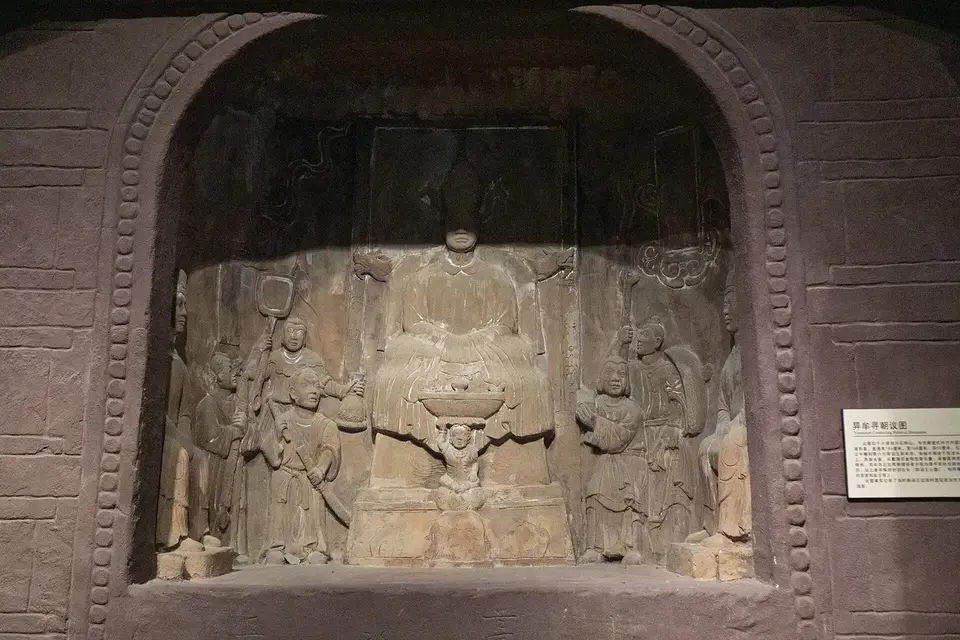
Biography
Royal Heir and Confucian Education
Yi Mouxun was the direct grandson of Geluofeng, the founding hegemon who consolidated the Nanzhao Kingdom, and the son of Fengjiayi, the Governor of Yangguazhou. He was born in Mengshechuan in 754 during the turbulent years of the Tianbao Wars, when intense conflicts with regional Tang governors drove Nanzhao into a military alliance with the Tibetan Empire.
Gifted with natural prudence and political intelligence, Yi Mouxun was placed under the tutelage of Zheng Hui, a former Tang magistrate captured in Sichuan whom Geluofeng had spared and elevated to Chief Counselor. Zheng Hui instructed the young prince in fundamental Confucian classics, including the Analects, Mencius, Book of Documents, and Zuo Commentary. This classical schooling instilled in Yi Mouxun a thorough appreciation for Central Plains statecraft, ritual propriety, and administrative organization. When King Geluofeng died in 779, Fengjiayi having predeceased him, the twenty-six-year-old Yi Mouxun duly ascended the Nanzhao throne.
Defeat in Sichuan and Relocation to Yangjumie
Inheriting a state policy bound to Tibet, Yi Mouxun complied with an imperial Tibetan demand to launch a massive combined offensive into Tang Sichuan in the autumn of 779. The Tibetan and Nanzhao forces fielded an estimated 200,000 troops that advanced toward Maozhou and Qionglai, threatening Chengdu itself.
Emperor Dezong mobilized imperial guards led by generals Li Sheng and Qu Huan to execute coordinated counterstrikes at Baimajin and Qipan Ridge. Caught in difficult terrain during winter snowfall, the allied armies suffered catastrophic losses, with casualties reportedly exceeding 100,000 men. The traumatic debacle convinced Yi Mouxun that acting as the vanguard of Tibetan territorial ambitions brought ruin upon his own realm without geopolitical gain.
To escape Tibetan military intimidation and outgrow the cramped topography of the old capital Taihe, Yi Mouxun relocated his court in 780 to Yangjumie (present-day Dali). Flanked by the nineteen rugged crests of the Cangshan Range and overlooking the expansive fertile plains of Erhai Lake, Yangjumie offered formidable natural defenses and ample farmland. There, Yi Mouxun constructed irrigation systems, lightened peasant levies, resettled displaced frontier households, and promoted sericulture, enabling Nanzhao society to recover rapidly from wartime exhaustion.
Tibetan Oppression and Covert Realignment
Despite their formal alliance, relations between Nanzhao and the Tibetan Empire steadily soured. Treating Nanzhao as a subordinate tributary vassal, the Tibetan court installed supervisors in key fortresses, demanded exorbitant levies of livestock and grain, and repeatedly impressed thousands of young Nanzhao warriors to serve as frontline fodder against Tang border defenses. Furthermore, Tibetan ministers detained Nanzhao princes as hostages at the imperial Tibetan encampment and openly addressed Nanzhao leaders with demeaning epithets.
Deeply embittered by these indignities, Yi Mouxun conferred closely with his mentor Zheng Hui. Zheng Hui argued forcefully that Nanzhao had originally pledged allegiance to the Son of Heaven and only sought Tibetan assistance due to the harsh exactions of rogue Tang officials. Pointing out the overextended and tyrannical nature of Tibetan rule, Zheng Hui urged Yi Mouxun to renew ties with the Tang, which would afford imperial protection while liberating the kingdom from relentless tribute burdens.
Concurrently, Tang general Wei Gao took command of the Jiannan Xichuan Commandery. Wei Gao recognized that severing the alliance between Nanzhao and Tibet was crucial to securing Tang China's southwestern flank. He initiated covert diplomacy, employing frontier merchants and traveling Buddhist monks to deliver cordial letters, medicinal remedies, and Shu silk brocades to Yi Mouxun. After several years of delicate intelligence exchanges, Yi Mouxun was persuaded of the Tang court's sincere intentions. In 793, he sent his confidential envoy Yang Boyuan to Chengdu with a carved wooden contract tally, formally asking to submit to the Tang empire.
The Diancang Covenant and the Fall of the Iron Bridge
Emperor Dezong welcomed the overture and appointed inspector Cui Zuoshi as imperial covenant commissioner to finalize the pact on site.
On the fifth day of the first lunar month in 794, the covenant ceremony took place before the ancestral altars of the Diancang Mountain shrine. Accompanied by hundreds of tribal chieftains and royal ministers, Yi Mouxun climbed the sacrificial altar alongside Cui Zuoshi to perform the rite of smearing blood on their lips. Yi Mouxun proclaimed his solemn oath, declaring that after forty years of war since Tianbao, Nanzhao wholeheartedly severed its ties with the cruel Tibetan regime and pledged eternal loyalty to the Tang throne, invoking heaven and earth to strike down any violator of the covenant.
One copy of the oath was deposited in the mountain shrine, another was cast into Erhai Lake, and a third was dispatched with Cui Zuoshi to Chang'an. Having concluded the ritual, Yi Mouxun struck immediately. Pretending to mobilize troops for defensive operations alongside the Tibetans, he directed tens of thousands of elite cavalry in a surprise offensive against the Tibetan citadel at the Shenchuan Iron Bridge on the Jinsha River.
Catching the Tibetan garrison unawares, Nanzhao troops severed the strategic iron suspension bridge, overran sixteen defensive towns, captured five Tibetan princes, liberated over 10,000 Chinese captives, and seized herds of cattle and horses. The victory dismantled the Tibetan defensive arc along the Hengduan Mountains and severed Tibet's southern military arm.
Imperial Investiture and Cultural Convergence
When news of the Shenchuan victory reached the Tang court, Emperor Dezong was overjoyed. In 795, he dispatched high commissioner Yuan Zi carrying the imperial patent and a solid gold seal reading "Zhenyuan Seal of Nanzhao Investiture" to confirm Yi Mouxun's status as King of Nanzhao, along with the title of Acting Minister of Works.
Yi Mouxun accepted the regalia in a grand public ceremony at Yangjumie, bowing nine times toward the north in homage to the Tang emperor. To cement the alliance, he sent his brother and crown heir Xun Gequan, together with thirty aristocratic youths, to the imperial capital on a tribute mission.
Over the subsequent decade, Yi Mouxun actively promoted cultural and administrative exchange with the Tang empire. He sent contingents of noble youths to study at the academy established by the Xichuan Commandery in Chengdu, where they mastered literature, music, classical poetry, and administrative law. Upon returning, these scholars staffed the central administration of Nanzhao, fostering the deep integration of Confucian philosophy, Esoteric Buddhism, and advanced agricultural techniques throughout the Erhai basin.
In 801, when a 160,000-strong Tibetan force besieged Yazhou, Yi Mouxun personally led an expeditionary force northward to coordinate with Wei Gao's Tang army. In a decisive pincer campaign in the highlands of Kangding and Yazhou, the combined armies crushed the Tibetan invaders, capturing thousands of prisoners. This decisive encounter permanently shifted the geopolitical equilibrium in the southwest in favor of the Tang Dynasty.
In 808, Yi Mouxun died in his palace at Yangjumie at the age of fifty-five. Emperor Xianzong suspended court audiences for three days in mourning, sent imperial envoys to conduct funeral sacrifices, and conferred the posthumous title King Xiaohui. His son Xun Gequan succeeded him, upholding his policies of peace with the Tang court. Yi Mouxun's visionary realignment firmly secured Nanzhao's enduring place within the multi-ethnic Chinese civilization.
Major Achievements
Relocation to Yangjumie and Institutional Consolidation
Following the military defeat in Sichuan in 779, Yi Mouxun displayed decisive statecraft by relocating the capital from Taihe to Yangjumie. This strategic migration positioned the kingdom within a secure, fertile basin capable of supporting long-term agrarian development and commercial expansion.
In domestic governance, he reformed irrigation works around Erhai, patronized regional sericulture, reduced compulsory labor service, and institutionalized administrative ranks guided by the Confucian expertise of counselor Zheng Hui. These policies enabled Nanzhao to recover from ruinous conflict and laid the foundation for the kingdom's golden age.
The Zhenyuan Allegiance and Regional Reintegration
The conclusion of the Diancang Mountain Covenant in 794 was a watershed moment in the history of ethnic relations in southwestern China. Confronting harsh Tibetan hegemony, Yi Mouxun had the political resolve to overcome domestic opposition and steer Nanzhao into the political orbit of the Tang Empire.
By securing the gold seal of the King of Nanzhao from Emperor Dezong, Yi Mouxun restored normal tributary relations between Yunnan and the Central Plains, ending four decades of hostility dating to the Tianbao period and cementing Nanzhao's role as a vital protector of the southwestern border.
Defeat of Tibetan Expansionism
Through the preemptive destruction of the Shenchuan Iron Bridge in 794 and the joint campaign at Yazhou in 801, Yi Mouxun dealt devastating blows to Tibetan military hegemony in the eastern Himalayas.
His military operations shattered the Tibetan line of fortifications, recovered lost territory, and liberated tens of thousands of border residents. In doing so, he not only safeguarded Nanzhao's sovereignty but also relieved imperial China from perpetual border incursions along the upper Yangtze basin.