Birth in Qizhou
Born into the scholarly Zhang clan of Shanchi, showing early spiritual precocity.
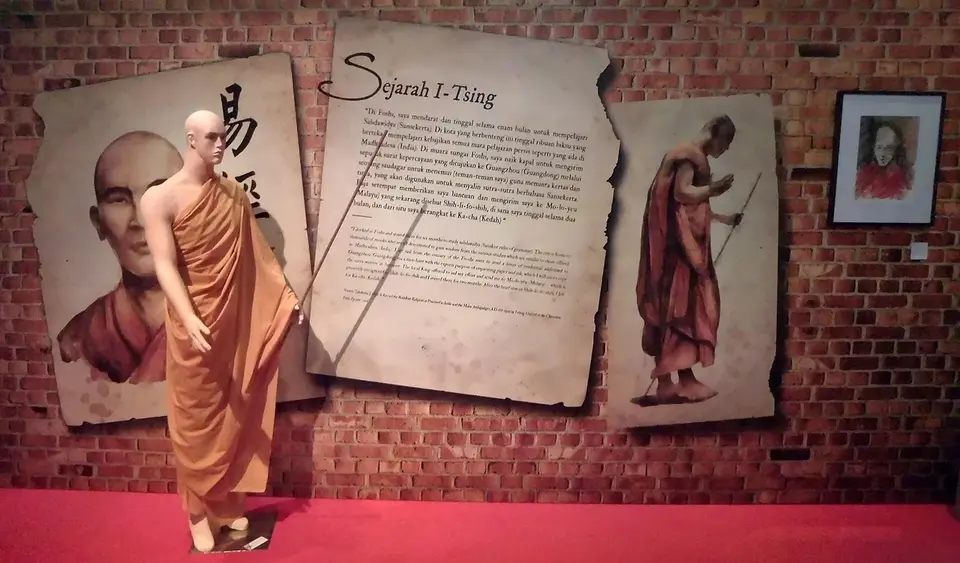
义净
Yijing (义净, 635–713), lay surname Zhang, courtesy name Wenming, was a native of Shanchi, Qizhou (modern Changqing District, Jinan, Shandong), and one of the most celebrated pilgrim-scholars, maritime explorers, translators, and Vinaya masters in Chinese history. He is venerated alongside Faxian and Xuanzang as one of China's "Three Great Pilgrim Monks," and alongside Kumarajiva, Paramartha, and Xuanzang as one of the "Four…
Yijing (义净, 635–713), lay surname Zhang, courtesy name Wenming, was a native of Shanchi, Qizhou (modern Changqing District, Jinan, Shandong), and one of the most celebrated pilgrim-scholars, maritime explorers, translators, and Vinaya masters in Chinese history. He is venerated alongside Faxian and Xuanzang as one of China's "Three Great Pilgrim Monks," and alongside Kumarajiva, Paramartha, and Xuanzang as one of the "Four Great Translators of Chinese Buddhism." Inspired from youth by Faxian and Xuanzang's journeys, he was ordained at Sizhan Monastery in Qizhou. In 671, at age thirty-seven, Yijing embarked from Guangzhou aboard a Persian merchant ship, pioneering the maritime Silk Road to reach India across stormy seas. Traveling abroad for twenty-five years, Yijing spent a full decade studying at Nalanda Mahavihara, the supreme center of Buddhist higher learning in medieval India. He mastered Buddhist monastic law (Vinaya) and toured over thirty kingdoms across the Gangetic plains, gathering over six hundred Sanskrit texts and three hundred relics. In 695, Yijing returned to Luoyang, where Empress Wu Zetian personally led the court ministers to welcome him at the eastern gates. Over the subsequent two decades at the imperial translation bureaus in Foxian Monastery in Luoyang and Great Jianfu Monastery in Chang'an, Yijing translated fifty-six Buddhist texts in 230 volumes, most notably the monumental fifty-volume Mulasarvastivada Vinaya, comprehensively supplying the missing monastic disciplinary code for East Asian Buddhism. Furthermore, his travel records, A Record of Buddhist Practices Sent Home from the Southern Sea and Memoirs of Eminent Monks Who Sought the Law in the Western Regions, stand as indispensable historical classics on medieval maritime and South Asian civilizations. Passing away in 713 at age seventy-nine, he was posthumously honored as Chamberlain for the Court of State Ceremonial.
Born into the scholarly Zhang clan of Shanchi, showing early spiritual precocity.
Ordained at age fifteen at Sizhan Monastery under masters Shanyu and Huizhi.
Sailed westward from Guangzhou aboard a Persian merchant vessel, beginning his maritime pilgrimage.
Landed at Tamralipti in eastern India via Srivijaya, spending a year studying Sanskrit.
Arrived at Nalanda University, residing there for ten years to study Vinaya and logic.
Returned to Srivijaya with over 600 Sanskrit manuscripts, commencing translation and drafting memoirs.
Welcomed at Luoyang by Empress Wu Zetian, establishing the imperial Foxian translation bureau.
Transferred to Great Jianfu Monastery, honored by Emperor Zhongzong's imperial preface.
Entered nirvana at seventy-nine at Great Jianfu Monastery; posthumously honored as Chamberlain.
Yijing was born in 635 in Shanchi, Qizhou. Gifted with a serene intellect, he began classical studies at seven, committing canonical texts to memory effortlessly. In 649, at age fifteen, he renounced secular household life to enter Sizhan Monastery in Qizhou under the guidance of Venerable Shanyu and Huizhi. Immersing himself in Abhidharma literature and Mahayana scriptures, Yijing was captivated by the epic pilgrimages of Faxian and Xuanzang. He took an inviolable vow: "Master Faxian braved the vast deserts, and Master Xuanzang shook his staff across the western lands; why should I not retrace their sacred footsteps to recover the untainted source of the monastic Vinaya?" At age twenty, he received full monastic ordination, spending five years in ascetic discipline and mastering canonical codes.
In 670, Yijing journeyed to Chang'an, agreeing with several fellow monks to undertake the western journey. However, upon reaching Guangzhou, his companions withdrew, intimidated by stories of shipwrecks and tropical fevers. Undaunted, Yijing stood alone. In the eleventh lunar month of 671, with support from Guangzhou's prefectural governor, the thirty-seven-year-old monk boarded an ocean-going Persian merchant ship. After twenty days of sailing, he reached the kingdom of Srivijaya on Sumatra (modern Palembang, Indonesia), where he remained six months studying Sanskrit grammar. Passing through Malaya and crossing the stormy Bay of Bengal, he arrived safely at the port of Tamralipti in eastern India in 673, where he spent over a year perfecting his Sanskrit under native scholars before advancing into central India.
In 675, Yijing arrived at Nalanda Mahavihara, the intellectual apex of medieval Buddhist Asia. Welcomed warmly by the international community of three thousand resident scholars, Yijing resided at Nalanda for a full decade. Under the tutelage of paramount Vinaya masters Baoshi and Zhixian, he meticulously examined the Mulasarvastivada Vinaya and Yogacara treatises. Beyond the lecture halls, Yijing undertook barefoot pilgrimages across thirty city-states throughout the Gangetic plains, visiting the Diamond Throne of Bodh Gaya, the Deer Park at Sarnath, Vulture Peak in Rajgir, and the Sal grove of Kusinagara. At every holy site, he conducted rigorous field observations regarding monastic administrative rules and geographic orientations, amassing an unprecedented library of over six hundred Sanskrit texts spanning thousands of palm-leaf manuscripts.
In 687, Yijing sailed eastward back to Srivijaya, where he spent several years translating foundational Vinaya manuals and drafting his monumental memoirs on South Asian customs. In the fifth lunar month of 695, Yijing returned to Guangzhou and proceeded to the eastern capital Luoyang. Empress Wu Zetian, deeply revering his achievement, personally led civil and military ministers outside the Shangdong Gate to welcome the sacred scriptures and the master. The empress ordered the establishment of an imperial translation bureau at Foxian Monastery.
Following the restoration of the Tang house under Emperor Zhongzong, Yijing was invited to Chang'an's Great Jianfu Monastery. Emperor Zhongzong personally penned the Imperial Preface to the Tripitaka Translations of the Great Tang Dragon-Ascent Era, appointing senior chancellors Wei Anshi and Xu Yanbo as editorial polishers. Day and night, Yijing recited Sanskrit originals and rendered them into refined Chinese prose, dedicating his final years to translating the complete Mulasarvastivada Vinaya. On the seventeenth day of the first lunar month in 713, Master Yijing passed away peacefully in meditation at Great Jianfu Monastery at age seventy-nine. Emperor Xuanzong issued an edict bestowing deep imperial mourning, posthumously promoting him to Chamberlain for the Court of State Ceremonial and interring his relics with full state honors on the northern plateau of Longmen in Luoyang.
Yijing's most transformative scholarly achievement was the translation of the monumental Mulasarvastivada Vinaya in fifty-six texts and 230 volumes. Prior to his return, Chinese monastic communities relied upon fragmentary disciplinary manuals with frequent contradictions. Having observed monastic administration at Nalanda, Yijing translated the entire code covering ordination liturgies, rain retreats, clothing standards, food distribution, medical care, and monastery property management. This monumental translation permanently unified the monastic behavioral standards of East Asian Buddhism.
In A Record of Buddhist Practices Sent Home from the Southern Sea, Yijing devoted dedicated chapters to systematically introducing ancient Indian medical systems and daily hygiene practices to China. He detailed the Eight Branches of Ayurvedic medicine (including acupuncture, pharmacology, pediatrics, and surgery) and advocated dietary fasting to clear toxins. Crucially, Yijing recorded the daily use of willow dental chew-sticks (chimu) for oral hygiene, regular bathhouse sanitation, and running water flush toilets—observational records that anticipated modern public health protocols by more than a thousand years.
Yijing authored the two-volume Memoirs of Eminent Monks Who Sought the Law in the Western Regions, documenting the courageous odysseys of fifty-six Chinese, Silla, and Goguryeo monks who journeyed westward following Xuanzang. With deep affection, Yijing commemorated the selfless sacrifices of pioneers such as Changmin and Xuanzhao, who perished at sea, in alpine blizzards, or in distant Indian monasteries. His work preserves an indispensable record of human exploration and spiritual dedication along the ancient Silk Roads.
Yijing authored A Record of Buddhist Practices Sent Home from the Southern Sea (four volumes) and Memoirs of Eminent Monks Who Sought the Law in the Western Regions (two volumes), which stand as monumental landmarks in international historical geography. Yijing provided the world's most precise contemporary documentation of the maritime trade routes connecting China, Southeast Asia, and India. His scientific recordings of maritime navigation, regional ethnography, and commercial ports remain the primary historical sources utilized by global South Asian and Southeast Asian historians to reconstruct seventh-century Asian society.
FIGURES ASSOCIATED WITH THIS DYNASTY