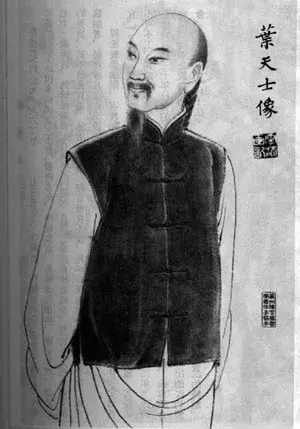
Life and Career
Medical Lineage and Studies under Seventeen Masters
Ye Tianshi was born in 1666 into a family of hereditary medical practitioners in Wu County, Suzhou Prefecture. His grandfather, Ye Shi (art name Zifan), had been a prominent physician renowned for pediatrics and internal medicine, while his father, Ye Chaocai, was widely respected for both his clinical skill and ethical character. Immersed in medical literature from early childhood, Ye Tianshi began reciting the Yellow Emperor's Inner Classic (Huangdi Neijing), Classic of Difficult Issues (Nanjing), and Shennong's Herbal Classic at age eight. By twelve, he attended to his father's clinical examinations, demonstrating exceptional comprehension of pulse palpation and differential diagnosis.
When Ye Tianshi was fourteen in 1679, his father succumbed to illness, leaving the family in economic hardship. In accordance with his father's final wishes, Ye Tianshi continued his clinical education under his father's pupil, Master Zhu. Unwilling to remain confined within the boundaries of family transmissions, he displayed an insatiable thirst for knowledge. Whenever he learned of a practitioner renowned for a particular specialty—such as throat diseases, gynecology, acupuncture, or external surgery—he immediately sought them out to receive instruction. Over roughly ten years, he apprenticed under seventeen distinct medical masters. By synthesizing the ancient classical prescriptions of Zhang Zhongjing with the later innovations of the Jin and Yuan masters—including the cooling methods of Liu Wansu, spleen-nourishing doctrines of Li Gao, and yin-enriching therapies of Zhu Danxi—he surpassed all his teachers and matured into a premier clinical virtuoso.
Clinical Practice in Suzhou and Miraculous Cures
Around 1690, Ye Tianshi formally opened his private medical practice at Taxuezhai near the Xuanmiao Temple in Suzhou. His diagnostic method was exceptionally thorough, combining meticulous observation of tongue coatings and tongue body coloration with delicate pulse diagnosis to discern deep organ pathologies. Unlike many contemporary physicians who routinely prescribed heavy, warming, and drying tonics, Ye Tianshi championed a distinctively agile, lightweight approach to pharmacotherapy. Utilizing carefully chosen, moderate doses of volatile and fragrant botanicals, he frequently revived patients whose conditions had been pronounced incurable by other doctors.
Numerous historical anecdotes highlight his diagnostic acumen. When the mother of a prominent physician suffered from postpartum fever, delirium, and severe obstipation, other physicians hesitated, fearing the patient's exhaustion; Ye Tianshi administered a concentrated decoction containing a modest amount of rhubarb, resulting in an immediate bowel movement and rapid cooling of the fever. In another case, an affluent merchant suffering from severe wasting-thirst disorder was healed over several months simply through a prescribed dietary regimen of fresh autumn pears and reed rhizomes. His clinical successes led locals to acclaim him as an earthly incarnation of the Heavenly Physician, inspiring the popular Suzhou adage that with Ye Tianshi present, King Yama himself had no power. Patients from throughout the realm, ranging from high-ranking mandarins to impoverished commoners, sought his consultation daily.
Foundation of Warm Disease Theory and Wenrelun
During the late Ming and early Qing dynasties, the densely populated Jiangnan region experienced frequent, devastating outbreaks of epidemic warm diseases, fostered by warm and humid regional climates and busy waterborne trade. Traditional clinicians, however, mechanically adhered to the six-meridian framework established by Zhang Zhongjing in northern China more than a millennium earlier. Applying pungent-warm diaphoresis—such as Ephedra or Cinnamon Twig decoctions—to warm-heat disorders invariably depleted internal bodily fluids, inducing fever delirium, hemoptysis, and avoidable fatalities.
Recognizing the urgent necessity of therapeutic reform, Ye Tianshi spent decades analyzing clinical responses to febrile conditions. He identified that while cold damage disorders originate from external cold and require pungent-warm release of the exterior, warm diseases are initiated by external heat and dryness that directly damage yin fluids and blood, rendering pungent-warm diaphoresis perilous.
In the summer of 1723, while traveling with friends and disciples on Lake Tai, Ye Tianshi systematically dictated his diagnostic insights to his student Gu Jingwen. This record became known as Wenrelun (Treatise on Warm Heat). Its opening thesis fundamentally redefined Chinese epidemiology: warm pathogens invade through the upper body, first attacking the lungs and potentially reversing inward to the pericardium; the lungs govern qi and defense, while the heart governs blood and nutrient; diagnosis must trace the pathogen's transition from defense to qi, from qi to nutrient, and finally to blood.
This groundbreaking doctrine formulated the four progressive levels of warm disorders—Defense (Wei), Qi, Nutrient (Ying), and Blood (Xue). It delineated how external warm pathogens advance from superficial chills and fever (Wei level), to interior heat and dehydration (Qi level), mental agitation and clouded consciousness (Ying level), and ultimately hemorrhage and convulsions (Xue level). It established matching therapeutic axioms: disinhibiting the exterior with pungent-cool remedies, clearing interior heat and generating fluids, venting heat from the nutrient level back to the qi level, and cooling and dispersing the blood. This theoretical milestone marked the formal emergence of the Warm Disease School as an independent pillar of Chinese medicine.
Final Admonition and Historical Legacy
In 1745, at eighty years of age, Ye Tianshi sensed that his life was drawing to a close. Gathering his descendants around his bed, he delivered a memorable family admonition: medicine is an honorable calling, yet a perilous one; only those endowed with natural brilliance and broad erudition should undertake it to heal society; otherwise, medical practice easily degenerates into manslaughter, which is why Shennong tasted hundreds of herbs himself; if one treats human life with levity, the crime is unpardonable; descendants must never lightly enter this profession. After uttering these words, he sat upright and passed away peacefully. Respecting his testament, his sons Ye Fen and Ye Zao pursued classical Confucian scholarship, though his grandson Ye Yizhen later inherited his medical knowledge.
Throughout his active career, Ye Tianshi focused primarily on treating patients and rarely wrote treatises himself. Following his death, his disciples Hua Xiuyun, Gu Jingwen, and Zhou Xin spent two decades collecting his prescriptions and case notes, compiling them in 1766 into the ten-volume masterpiece Linzheng Zhinan Yi'an (Clinical Guide to Medical Records). Categorized into over eight hundred disease headings, this work documented Ye Tianshi's clinical maneuvers across both external and internal conditions, setting a standard for detailed clinical documentation. His theoretical framework directly inspired later luminaries, including Wu Jutong's Systematic Differentiation of Warm Diseases (Wenbing Tiaobian) and Wang Mengying's Latitude and Longitude of Warm Diseases (Wenre Jingwei), securing Ye Tianshi's enduring reputation as the foremost pioneer of warm disease medicine.