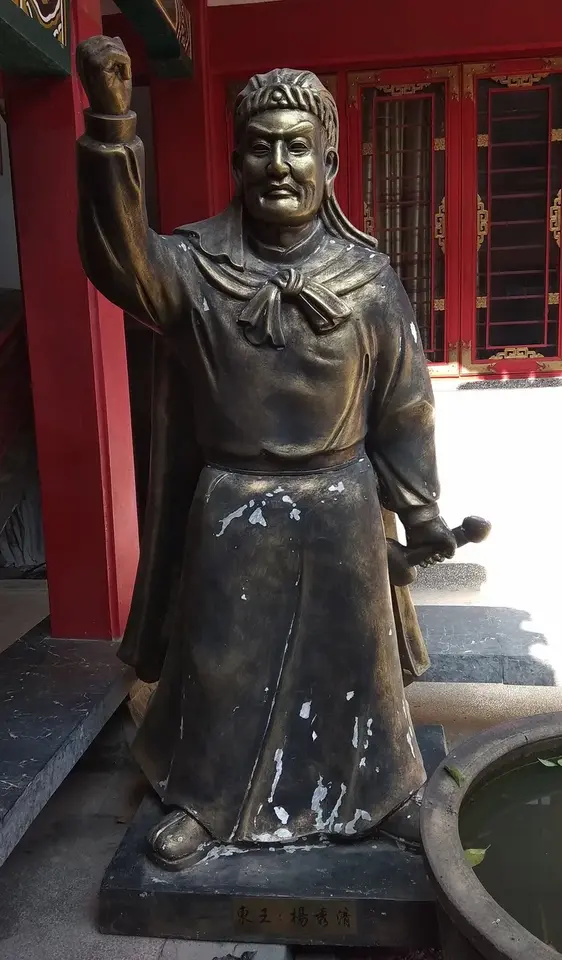
Biography
Impoverished Origins and the God Worshipping Society
Yang Xiuqing was born on September 23, 1823, in Dongwangchong, Ping'aishan (also known as Peng'aishan), Xuan'erli, Guiping County, Xunzhou Prefecture, Guangxi. His ancestors had migrated from Jiaying Prefecture in Guangdong during the Yongzheng reign to reclaim desolate mountain land in Guangxi, belonging to the impoverished Hakka tenant-farming stratum. Yang Xiuqing suffered severe personal adversity in childhood: his father, Yang Yaqi, died when he was five, and his mother, Lady Gu, died when he was nine. Raised by his uncle Yang Qingshan, the young orphan endured harsh poverty and malnutrition, growing up completely illiterate.
Reaching adulthood, Yang Xiuqing inherited his family's livelihood, cutting timber and firing charcoal kilns deep in the rugged mountains of Ping'aishan. Decades of heavy physical labor and constant smoke took a terrible toll on his health, leaving him short, emaciated, and afflicted with chronic infections that blinded his right eye. Nonetheless, the brutal struggle for survival endowed him with a steely willpower, keen political intuition, and natural decisiveness. Known for using his modest charcoal earnings to purchase wine for local wanderers and martial outcasts, he harbored a deep-seated rebellious ambition against Qing bureaucratic oppression long before joining organized rebellion.
In 1843, Hong Xiuquan and Feng Yunshan founded the God Worshipping Society in Guangdong. Seeking a secure sanctuary, Feng Yunshan entered the Zijin and Ping'aishan mountains in 1844, working as an itinerant village schoolteacher and secretly preaching among Hakka charcoal laborers and miners. Around 1846, Yang Xiuqing joined the society through family connections. Because of his extensive clan network and leadership among local charcoal burners, he quickly rose to become the primary communal leader of the congregation in the Ping'aishan region.
The Descent of the Heavenly Father and Rise to Power
By late 1847, the rapid expansion of the God Worshipping Society alarmed local gentry and militia landlords in Guiping. A regional magnate, Wang Zuoxin, accused the society of treasonous conspiracy, prompting local magistrates to arrest and imprison Feng Yunshan. Panicked by the crackdown, Hong Xiuquan departed for Guangzhou to secure legal assistance. With both founding leaders absent and Qing constables raiding villages, the congregation fell into disarray, threatened by internal betrayal and immediate dissolution.
At this critical juncture, Yang Xiuqing executed a daring religious and political intervention. In April 1848, utilizing the familiar local tradition of shamanistic spirit possession (jiangtong), he collapsed into convulsions during a congregation meeting. Rising with solemn and terrifying majesty, he spoke in the persona of God the Heavenly Father, rebuking faint-hearted followers, commanding absolute loyalty, and promising divine deliverance. This calculated trance steadied the movement's morale and instantly established Yang's sacred authority over the terrified flock.
Later that autumn, Xiao Chaogui emulated this practice by claiming possession by Jesus the Heavenly Elder. Upon their return to Guangxi, Hong Xiuquan and Feng Yunshan had no practical choice but to recognize the divine legitimacy of Yang's and Xiao's trances. This theological accommodation placed Yang Xiuqing above Hong Xiuquan in the spiritual hierarchy whenever the trance was invoked, as the Father outranked the second son. Through this mechanism, Yang effectively captured ultimate executive authority within the society, marginalizing early founding elders and securing supreme political and military control.
The Jintian Uprising and Yongan Royal Decrees
Throughout 1850, as open confrontation with the Qing authorities neared, Yang Xiuqing and Xiao Chaogui directed preparations for general armed insurrection. They commanded members across Guangxi to sell their lands, liquidate possessions, and gather with their families at Jintian Village for communal military mobilization. Although stricken by a debilitating illness that left him deaf and mute for two months, Yang continued to direct military deployments from his sickbed. In November 1850, he orchestrated the Siwang operation, dispatching forces under Meng De'en to smash imperial troops under Vice Brigade Commander Li Dianyuan, safely escorting Hong Xiuquan and Feng Yunshan to the Jintian stronghold.
On January 11, 1851 (11th day of the 12th month of the Xianfeng accession year), Hong Xiuquan proclaimed the founding of the Taiping Heavenly Kingdom at Jintian. Yang Xiuqing was designated Commander-in-Chief of the Central Army and Left Auxiliary Senior Strategist, directing central staff and military planning. As the Taiping army broke out of imperial encirclements across Guangxi, Yang enforced strict discipline and organized logistical supply, utilizing divine trances to unify peasant morale and transform ragged militias into a formidable army.
In autumn 1851, the Taipings captured the walled city of Yongan. During the consolidation at Yongan, Yang Xiuqing introduced administrative institutions and exposed a treasonous conspiracy by infiltrator Zhou Xineng through a public trance. On December 17, 1851 (25th day of the 10th month), Hong Xiuquan conducted the formal investiture of kings: Yang Xiuqing was named Eastern King and Nine Thousand Years; Xiao Chaogui, Western King; Feng Yunshan, Southern King; Wei Changhui, Northern King; and Shi Dakai, Wing King. Crucially, the imperial edict mandated that all other kings were subject to the Eastern King's operational control, formalizing Yang's position as the supreme civil and military director of the Taiping state.
The Downstream Strategy and Founding Tianjing
In April 1852, the Taiping army broke out of Yongan and marched north toward Hunan. During the arduous trek, Southern King Feng Yunshan and Western King Xiao Chaogui were killed in action. With Hong Xiuquan increasingly absorbed in mystical contemplation, Yang Xiuqing assumed undivided leadership of the campaign. Following an unsuccessful siege of Changsha, the Taiping rank and file—mostly Guangxi natives—grew demoralized and clamored to return to their home province to conduct localized mountain warfare.
Yang Xiuqing decisively rejected this provincial mindset. He argued forcefully: "We have already mounted the tiger's back; how can we look backward? The supreme strategy today is to abandon the south, drive straight ahead down the Yangtze River, bypass small fortresses, and concentrate entirely on seizing Nanjing as our permanent imperial foundation!" Hong Xiuquan endorsed Yang's vision. Abandoning Changsha, the Taipings captured Yuezhou, seized thousands of river craft, swept through Wuchang and Jiujiang, and sailed eastward down the Yangtze with unstoppable momentum.
On March 19, 1853, the Taiping forces captured the historic southern capital of Jiangning (Nanjing). While Hong Xiuquan briefly considered establishing the capital in Henan, Yang Xiuqing, advised by an experienced river pilot on the strategic superiority and grain wealth of the lower Yangtze, convinced the Heavenly King to make Nanjing the imperial seat. Renamed Tianjing (Heavenly Capital), it became the revolutionary capital of the Taiping Heavenly Kingdom.
Absolute Authority, Strategic Campaigns, and Victory at the Great Camps
Following the establishment of Tianjing, all state apparatus was centralized within the Eastern King's Court. While Hong Xiuquan secluded himself within his palace, Yang Xiuqing managed every aspect of military commands, judicial sentencing, and diplomatic relations. Despite his illiteracy, Yang possessed a formidable memory; he listened intently as clerks read official correspondence and delivered immediate, precise oral verdicts, ensuring remarkable administrative efficiency across the realm.
To topple the Qing court and safeguard Tianjing's frontiers, Yang launched two grand strategic offensives: the Northern Expedition led by Lin Fengxiang and Li Kaifang, and the Western Expedition headed by Shi Dakai, Hu Yihuang, and Qin Rigang. Although the Northern Expedition eventually perished in Zhili due to isolation and winter cold, it diverted massive imperial forces away from the south. In the West, Yang orchestrated the crushing defeat of Zeng Guofan's Xiang Army fleet at the Battle of Hukou in 1855, enabling the Taipings to retake Wuchang and bring extensive areas of Jiangxi and Hubei under their control.
By early 1856, Qing imperial forces under Commissioners Xiang Rong and Tuoming'a had entrenched the Jiangnan and Jiangbei Great Camps outside Tianjing, subjecting the capital to severe pressure. Yang Xiuqing conceived an elegant counter-offensive combining inner-line defense with external maneuver warfare. He ordered Qin Rigang to lift the siege of Zhenjiang, crossed the river to shatter more than one hundred and twenty forward posts of the Jiangbei Great Camp, and then recalled Shi Dakai's elite divisions from Jiangxi. Converging on Xiaolingwei, the Taiping armies smashed the Jiangnan Great Camp in a general assault, forcing Xiang Rong to flee to Danyang, where he committed suicide. The crushing of both camps relieved Tianjing from danger, raising Yang Xiuqing's military prestige to its absolute zenith.
Hubris and the Demand for Imperial Honors
However, the unprecedented military triumphs inflamed Yang Xiuqing's authoritarian arrogance. Intolerant of dissent, he enforced absolute personal submission through tyrannical surveillance. Whenever he processed through Tianjing in his massive fifty-six-bearer palanquin, accompanied by a thousand armed guards, civil and military officials who failed to clear the path were summarily beheaded. In imperial court assemblies, he claimed the unique prerogative of standing while all other kings were forced to kneel.
Worse still, Yang routinely instrumentalized the descent of the Heavenly Father to humiliate and terrorize his colleagues. He summoned Hong Xiuquan to kneel before him in the street to receive divine rebukes regarding palace management, threatening the Heavenly King with forty lashes. He subjected Northern King Wei Changhui, Wing King Shi Dakai, and Yan King Qin Rigang to arbitrary floggings, reduced Qin Rigang to a household slave over a domestic dispute, and imprisoned Hong Xiuquan's brother Hong Renfa. These abuses generated venomous resentment among the leadership, isolating Yang entirely from his peers.
In August 1856, riding the wave of his triumph over the Great Camps, Yang Xiuqing resolved to supplant Hong Xiuquan completely. In a staged trance at the Eastern King's Court, he summoned Hong Xiuquan and demanded: "Who accomplished the conquest of this realm?" When Hong replied that it was his fourth brother Yang, Yang declared: "Since he has achieved such monumental merit, why is he only titled Nine Thousand Years?" Intimidated by Yang's power, Hong was forced to concede: "The Eastern King shall also be hailed as Ten Thousand Years, and his heirs shall inherit the title forever." This direct assault on imperial sovereignty sealed Yang's fate.
The Purge and Slaughter at the Eastern King's Mansion
Recognizing that his life and throne were in imminent peril, Hong Xiuquan initiated a counter-coup. Evading the Eastern King's spies, he dispatched secret edicts to Northern King Wei Changhui, Wing King Shi Dakai, and Yan King Qin Rigang, summoning them to return to Tianjing to execute the treacherous Eastern King.
On the night of September 1, 1856, Wei Changhui arrived outside Tianjing with three thousand elite troops, linking up with Qin Rigang. In the predawn hours of September 2 (4th day of the 8th month), Wei and Qin sealed the city gates and stormed the Eastern King's mansion. The sleeping guards were swiftly overrun. Awakened by the din, Yang Xiuqing ascended his watchtower to sound the alarm, but Wei's shock troops scaled the building. Fleeing into the residential quarters, Yang was captured and dragged before Wei Changhui. When Yang protested that they had begun the rebellion together at Jintian, Wei retorted that he was executing an imperial order to punish treason, ordering his executioners to hack Yang to pieces.
The assassination unleashed an uncontrollable bloodbath. Wei Changhui systematically butchered Yang Xiuqing's family, his fifty-four consorts, and his official retinue. Over the following weeks, Wei lured thousands of Yang's elite veterans into the palace under the pretext of reconciliation, slaughtering an estimated twenty thousand experienced officers and soldiers. Although Hong Xiuquan later executed Wei Changhui and restored Yang's posthumous honors to pacify public outrage, the loss of its supreme military strategist and tens of thousands of veteran soldiers crippled the Taiping Heavenly Kingdom, setting it on an irreversible path toward eventual destruction.
Major Achievements
Devising the Shamanic Divine Trance to Consolidate Supreme Power
Yang Xiuqing's most decisive political innovation was his introduction of the Heavenly Father's descent to resolve existential leadership crises. In the spring of 1848, facing the collapse of the God Worshipping Society following Feng Yunshan's arrest, Yang co-opted local shamanistic trance rituals, claiming direct embodiment of God the Father. This dramatic performance not only preserved communal cohesion but fundamentally inverted the movement's chain of command by placing Yang's divine words above Hong Xiuquan's prophetic status.
Throughout the march from Jintian to Nanjing, Yang utilized divine edicts to enforce draconian military discipline, weed out turncoats such as Zhou Xineng, and maintain religious fervor among peasant recruits. By merging religious charisma with administrative authority, he established an absolute dictatorship that provided the nascent Taiping state with unified command and exceptional organizational resilience.
Masterminding the Downstream Strategy and Establishing Tianjing
Following the breakout from Yongan, Yang Xiuqing demonstrated strategic genius by overcoming internal dissension and provincial parochialism. Rejecting demands to retreat to Guangxi or scatter across western mountain provinces, he formulated the grand strategy of capturing the lower Yangtze River and seizing Nanjing as the permanent imperial capital.
Under this guidance, the Taiping army capitalized on riverine transport, capturing Yuezhou, Wuchang, and Anqing before capturing Nanjing in March 1853. This strategic pivot transformed the Taipings from isolated regional insurgents into a national regime commanding China's wealthiest agricultural and trading heartland, establishing the territorial base required for prolonged resistance against the Qing empire.
Centralized Command and the Annihilation of the Great Camps
Yang Xiuqing stood as the finest operational commander produced by the Taiping movement. Operating from the Eastern King's Court, he supervised simultaneous continental theaters in the Northern and Western Expeditions while authoring the comprehensive military manual Xingjun Zongyao (General Essentials for Military Marches), standardizing unit formations, scouting protocols, and signaling codes across the armed forces.
In the spring of 1856, Yang orchestrated a masterclass in operational maneuver to break the siege of Tianjing. Orchestrating the movements of Qin Rigang, Chen Yucheng, and Shi Dakai, he struck the Jiangbei Great Camp, relieved Zhenjiang, and executed an inward double envelopment that destroyed Xiang Rong's Jiangnan Great Camp at Xiaolingwei. This triumph eliminated the immediate threat to Tianjing and established Taiping military supremacy throughout the lower Yangtze basin.
Tempering Ideological Dogmatism with Pragmatic Governance
In governing the Heavenly Capital, Yang Xiuqing displayed remarkable administrative realism, counteracting Hong Xiuquan's destructive religious fundamentalism. Recognizing that the radical communalism of the Land System of the Heavenly Dynasty was unworkable during wartime, he instituted the pragmatic policy of collecting customary grain taxes and protecting urban commerce, ensuring stable tax revenues for the state.
In cultural policy, Yang halted the indiscriminate destruction of ancient Chinese texts in 1854, ruling through a divine trance that the Confucian Four Books and Five Classics contained essential moral truths, and establishing an official Bureau of Book Editing to revise rather than destroy classical literature. Furthermore, he abolished the rigid segregation of men's and women's camps, permitting normal marital cohabitation and preserving fundamental social order in the occupied territories.