Birth in Western Shu
Born in Pi County, Shu Commandery, into a humble farming family with five generations of single-son lineage.
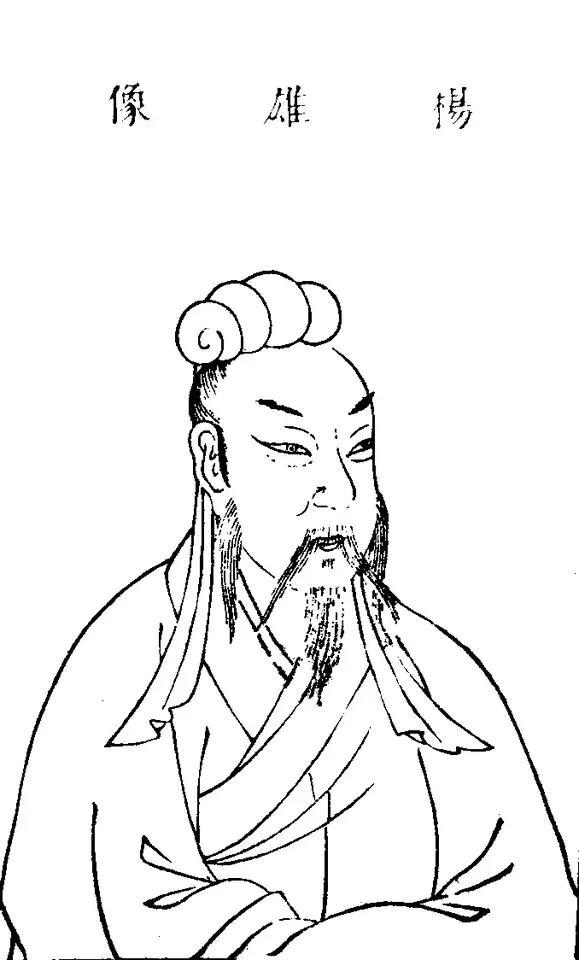
扬雄
Yang Xiong (扬雄, 53 BCE – 18 CE), courtesy name Ziyun (子云), a native of Pi County in Shu Commandery, was a towering thinker, master of classical rhapsody (fu), and pioneer of comparative linguistics during the late Western Han and Xin dynasties. In his youth, Yang pursued deep learning and shunned superficial scholastic debates, studying classical texts and cosmological principles under the renowned Shu hermit-scholar Yan Zun.…
Yang Xiong (扬雄, 53 BCE – 18 CE), courtesy name Ziyun (子云), a native of Pi County in Shu Commandery, was a towering thinker, master of classical rhapsody (fu), and pioneer of comparative linguistics during the late Western Han and Xin dynasties. In his youth, Yang pursued deep learning and shunned superficial scholastic debates, studying classical texts and cosmological principles under the renowned Shu hermit-scholar Yan Zun. Renowned for his solemn disposition and stutter, Yang disliked frivolous discourse and remained steadfastly indifferent to worldly prestige and wealth. In middle age, his majestic rhapsodic style earned him a recommendation from General of Chariots and Cavalry Wang Yin, bringing him to the imperial capital Chang'an. As an attendant to Emperor Cheng of Han, he composed monumental rhapsodies including the Rhapsody on the Ganquan Palace and Rhapsody on the Plumed Hunt, using grandiloquent descriptions to veil subtle remonstrance against courtly extravagance. Disillusioned with the inability of rhapsodic literature to enact moral reform, he later dismissed the genre as petty carving of insects and devoted his later life to philosophy and lexicography. He composed the Classic of Supreme Mystery to articulate a cosmological framework centered on the Mystery (Xuan), modeled the Model Sayings upon the Analects to defend Confucian orthodoxy with his doctrine that human nature is an amalgam of good and evil, and compiled the Regional Speech, foundational to Chinese dialectology.
Born in Pi County, Shu Commandery, into a humble farming family with five generations of single-son lineage.
Studied the Book of Changes and Daoist philosophy under master Yan Zun at the Hengshan Study Terrace on Mount Pinfu.
Mourning Qu Yuan's tragic drowning, composed Countering the Encountering Sorrow and cast the text into the river.
Employed as an aide under Wang Yin and recommended to Emperor Cheng by fellow townsman Yang Zhuang to serve in waiting.
Accompanied the Emperor to Ganquan Palace and submitted rhapsodies; appointed Gentleman and Attendant at the Yellow Gate.
Submitted the Rhapsody on the Changyang Palace to critique the disruption of agriculture caused by imperial hunts.
Submitted a memorial urging the emperor to accept the tributary visit of the Xiongnu Chanyu, preserving border harmony.
Renounced rhapsodic composition as trivial wordplay and began crafting the Classic of Supreme Mystery and Model Sayings.
Implicated in the talisman conspiracy of Liu Fen; leapt from the library tower to avoid degradation, surviving with severe injuries.
Reappointed Senior Grandee; lived in austere scholarly seclusion while student Hou Ba arrived with provisions to study under him.
Died in Chang'an at age seventy-one; buried by his devoted disciple Hou Ba, who observed three full years of filial mourning.
Yang Xiong was descended from Bo Qiao, a scion of the royal Ji house of Zhou who held the fief of Yang in the State of Jin. During the Warring States period, the Yang lineage fled political turmoil to Mount Wu in Chu, subsequently migrating upriver into Ba and Shu during the Chu-Han Contention. His ancestor Yang Ji served as Administrator of Lujiang, and during the Yuanding era of Emperor Wu, the family relocated to Pi County in Shu Commandery. Across five generations, the family maintained a single-son lineage, subsisting on farming and sericulture without extensive clan networks.
From childhood, Yang Xiong was studious and exceptionally perceptive. Unlike contemporaries who focused solely on minute textual divisions, he sought fundamental understanding of classical glosses and profound principles. Afflicted with a stutter that precluded fluent public disputation, he developed an inward, deeply contemplative temperament. Content with plain fare and possessing modest assets, he took no interest in transient honors, reading only works of ancient sages and declining any engagement with corrupt prosperity.
During his formative years, Yang traveled across the Shu mountains to study under the reclusive master Yan Zun. Operating as a diviner in the marketplace to earn a modest living, Yan Zun spent his leisure expounding Laozi and the Book of Changes. Under his guidance, Yang mastered cosmological dynamics and quietude, integrating Daoist metaphysics with Confucian statecraft and establishing his life's scholarly direction.
Admiration for his fellow provincial Sima Xiangru inspired Yang to master the rhapsody. Yet reading Qu Yuan's Encountering Sorrow, he lamented the poet's decision to cast himself into the river when rejected by his sovereign. Believing that a superior person acts when the times allow and remains concealed like a dormant dragon when they do not, Yang wrote Countering the Encountering Sorrow, casting the manuscript into the river from Mount Min to comfort the departed soul.
During the middle of Emperor Cheng's reign, Yang Xiong's literary reputation spread beyond Shu. General of Chariots and Cavalry Wang Yin recognized his elegant erudition and recruited him as a clerk. Soon after, his fellow provincial Yang Zhuang recommended him directly to Emperor Cheng, who summoned him to the imperial library to serve in waiting.
In the second year of the Yuanyan era, Yang accompanied the imperial retinue to the Ganquan Palace for sacrificial ceremonies. Confronted with the immense expenditures of imperial pomp and palace luxuries, he crafted the Rhapsody on the Ganquan Palace in imitation of classical masterpieces. While the surface text dazzled with opulent descriptions of celestial pavilions, the conclusion subtly urged frugal governance and reverent piety, earning high imperial praise.
In the winter of the same year, Emperor Cheng staged an expansive winter hunt that conscripted thousands of commoners to herd wild beasts. Accompanying the expedition, Yang submitted the Rhapsody on the Plumed Hunt. He depicted the magnificence of the hunt with vibrant imagery, only to shift focus at the end to depict the Son of Heaven halting the spectacle, releasing prisoners, opening royal preserves for peasant cultivation, and attending to state affairs. Pleased by the composition, Emperor Cheng appointed him Gentleman and Attendant at the Yellow Gate.
The following year, during an imperial hunt at Changyang Palace featuring foreign cavalry, Yang submitted the Rhapsody on the Changyang Palace. Employing a dialogue between fictional personas, he celebrated imperial unity while denouncing the depletion of public resources for royal diversion. Although the Emperor marveled at his eloquence, the court remained entrenched in luxury, proving to Yang that ornate rhetoric seldom swayed imperial governance.
Following the accession of Emperor Ai, court power shifted to the imperial in-laws and the emperor's favorite Dong Xian. High officials vied to forge alliances with powerful figures, and sycophants were rapidly elevated to high nobility. Yang Xiong steadfastly held to his principles, associating with neither Dong Xian nor Wang Mang. Throughout the reigns of Cheng, Ai, and Ping, he remained in his modest office without advancement for decades.
Observing the relentless factional strife, Yang composed Dissolving Ridicule to articulate his philosophy of life. Answering an interlocutor who mocked his low post and poverty, he laid bare the brutal reality that those in power ascend to clouds while those out of favor perish in ditches. Declaring his resolve to endure neglect in the imperial library rather than compromise his integrity, he affirmed the enduring supremacy of moral cultivation over transient political favor.
During this period of hardship, he also wrote the humorous Rhapsody on Expelling Poverty, personifying poverty as a relentless companion that nonetheless protected the scholar's inner purity and moral rectitude. He also authored the Admonition on Wine, contrasting fragile utilitarian water vessels with resilient wine jars to satirize the precarious fate of righteous men in a corrupt bureaucracy.
In 2 BCE, when the Xiongnu Chanyu requested an imperial audience, courtiers suggested refusing the visit to save the imperial treasury from lavish entertainment expenses. Recognizing the strategic importance of frontier stability, Yang submitted a memorial arguing forcefully that alienating northern allies would undermine peace. Emperor Ai recognized the wisdom of his counsel and granted the tributary audience, securing border stability.
When Wang Mang established the Xin Dynasty, scholars scrambled to manufacture auspicious omens and flattering texts to secure honors. Yang remained aloof from such opportunism. Recognizing his eminent scholarship, Wang Mang promoted him to Senior Grandee and assigned him to collate imperial texts at the Tianlu Pavilion.
In 10 CE, a conspiracy involving fabricated omens orchestrated by Zhen Xun and Liu Fen came to light. Determined to suppress independent claims of supernatural mandate, Wang Mang unleashed ruthless inquisitions, ordering the summary arrest of anyone named in confessions. When imperial bailiffs stormed Tianlu Pavilion to seize Yang, fearing brutal torture and humiliation, he leapt from the upper story of the library, sustaining severe injuries that nearly proved fatal.
Upon hearing of the event, Wang Mang intervened, recalling Yang's lifetime of political non-involvement. Interrogation revealed that Liu Fen had merely sought instruction from Yang in ancient script forms and rare seal characters, leaving Yang entirely ignorant of the plot. Wang Mang issued an imperial pardon, dropping all charges. Though physically broken, Yang was preserved from execution, though gossips in the capital mocked his dramatic fall.
Following the ordeal, Yang retired due to injury, but was later recalled as Senior Grandee. Desiring no part in public administration, he lived in quiet poverty, spending his days drinking wine and writing in relative isolation. The dedicated scholar Hou Ba traveled from Julu to dwell with Yang, studying his complex philosophical texts with filial devotion. In 18 CE, Yang passed away in Chang'an at the age of seventy-one. Hou Ba personally constructed his tomb and observed mourning for three years.
Yang Xiong's paramount philosophical legacy rests upon his creation of the Classic of Supreme Mystery. Confronting the speculative omenology and rigid pedantry of contemporary Han scholarship, he broke through the traditional binary model of the Book of Changes to forge an independent metaphysical framework grounded in the concept of Xuan (the Mystery).
Defining Xuan as the ultimate primordial source of Heaven, Earth, and Humanity, Yang designed a ternary mathematical cosmology. Instead of sixty-four hexagrams, his system comprised eighty-one tetragrams structured across three regions, nine provinces, twenty-seven divisions, and eighty-one families, corresponding to the solar calendar of three hundred and sixty-five and a quarter days. Through this rigorous mathematical matrix, he tracked seasonal alternations and the cyclical rise and decline of cosmic energy.
Crucially, Yang asserted a rationalist worldview, maintaining that all living beings inevitably face death and that all beginnings conclude in endings. By dismissing the prevalent superstitious quests for physical immortality and celestial omens, he introduced an intellectual rigor that profoundly stimulated the development of third-century Neo-Daoism and Song Neo-Confucian cosmology.
Observing the erosion of classical moral standards, Yang modeled the twenty chapters of his Model Sayings upon the Analects of Confucius, reaffirming the ethical imperative of adhering to canonical authority and sage kingship.
Yang venerated Confucius as the supreme teacher and characterized the Five Classics as the sole vessel capable of navigating the boundless river of truth. He sharply condemned opportunists who reduced classical learning to pedantic memorization for civil appointments, comparing them to sheep wrapped in tiger skins. Within this framework, he formulated his seminal doctrine that human nature is an admixture of both good and evil. He posited that cultivating inherent goodness yields a moral person, while nurturing inherent wickedness produces an immoral individual.
By transcending the polarized debates between Mencian innate goodness and Xunzi's assertion of original evil, Yang elevated the indispensable role of self-cultivation, education, and ritual practice. Centuries later, Tang essayist Han Yu celebrated Yang as an authentic inheritor of classical Confucianism, describing his scholarship as fundamentally pure with only minor blemishes.
In linguistics and lexicography, Yang established foundational milestones in world scholarship. Over twenty years, he surveyed speech patterns across the empire to produce the Regional Speech, recognized as the world's first comparative dialectological treatise.
Leveraging his position in the imperial capital where envoys, merchants, and soldiers gathered from every corner of China, Yang interviewed informants and methodically transcribed local vocabularies using standardized script. He compared dialectal variants with the standard imperial language across regions such as Qin, Jin, Qi, Lu, Chu, and Shu, recording regional differences and tracing semantic transformations over time.
Additionally, while collating texts in the imperial archives, he compiled the Chapters on Instructional Compilation, standardizing classical seal scripts and clarifying obsolete characters. His rigorous philological methodology served as a direct inspiration and vital source material for Xu Shen's monumental dictionary, Explaining Graphs and Analyzing Characters.
While Yang's early rhapsodies defined the pinnacle of Han grand rhapsody with their formidable vocabulary and sweeping majesty, his lasting contribution to literary criticism arose from his mature rejection of ornamental excesses.
In the Model Sayings, he reflected upon his early work, candidly observing that excessively ornate descriptions inherently undermined moral intent, prompting audiences to admire luxury rather than heed ethical warnings. Consequently, he branded the rhapsody as petty carving of insects unsuitable for mature scholars.
Yang went on to formulate the influential aesthetic dictum that the rhapsody of true poets is elegant yet restrained by moral standard, whereas the rhapsody of mere rhetoricians is luxurious and licentious. This profound critique established a standard that guided Chinese literary theory for centuries, leaving an indelible imprint upon Liu Xie's The Literary Mind and the Carving of Dragons.
FIGURES ASSOCIATED WITH THIS DYNASTY