First Investiture as Empress
Following Jia Nanfeng's execution, installed as Empress of Emperor Hui by regent Sun Xiu.
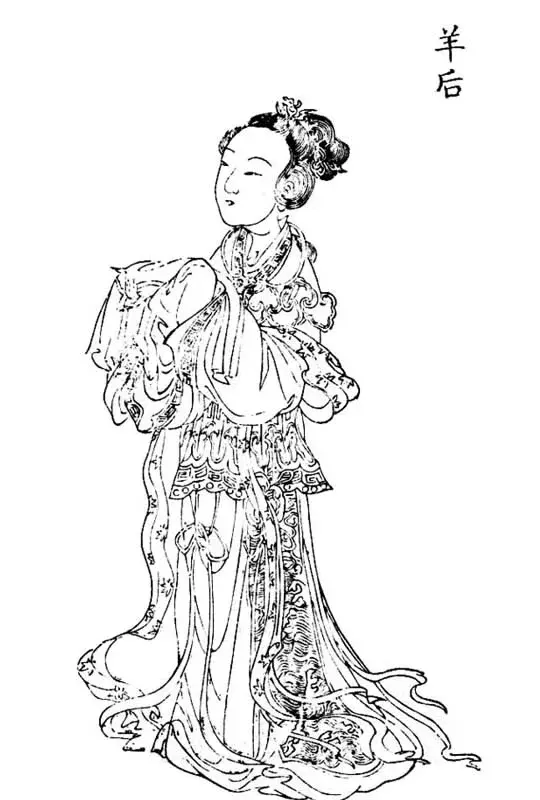
羊献容
Yang Xianrong (羊献容, ?–322), honored posthumously as Empress Hui in Jin and Empress Xianwen in Former Zhao, was a noblewoman from Nancheng County in Taishan Commandery (present-day Xintai, Shandong). She was the daughter of Chamberlain Yang Xuanzhi, grand-niece of Western Jin founding general Yang Hu, second empress consort of Emperor Hui of Jin (Sima Zhong), and empress consort of Emperor Zhaowen of Former Zhao (Liu Yao).…
Yang Xianrong (羊献容, ?–322), honored posthumously as Empress Hui in Jin and Empress Xianwen in Former Zhao, was a noblewoman from Nancheng County in Taishan Commandery (present-day Xintai, Shandong). She was the daughter of Chamberlain Yang Xuanzhi, grand-niece of Western Jin founding general Yang Hu, second empress consort of Emperor Hui of Jin (Sima Zhong), and empress consort of Emperor Zhaowen of Former Zhao (Liu Yao). Following Empress Jia Nanfeng's execution in 300, she was installed as Empress of Western Jin by regent Sun Xiu. During the catastrophic War of the Eight Princes, she became an involuntary pawn of rival warlords, enduring an unprecedented ordeal in Chinese imperial history by being deposed and imprisoned in Jinyong Castle five separate times, restored five times, and narrowly escaping assassination by poison. In 311, when Han-Zhao armies sacked Luoyang during the Yongjia Disaster, she was captured by the general Liu Yao, who treated her with deep respect and boundless affection. Following Liu Yao's accession to the imperial throne in 319, he formally proclaimed her Empress of Former Zhao. Highly influential at court, she participated in supreme administrative decisions and bore three imperial sons, with her eldest son Liu Xi created Crown Prince. She passed away in 322 and was interred in the Xianping Mausoleum. As the sole woman in Chinese history to have served as empress consort to sovereigns of two rival, sovereign dynasties, her extraordinary survival embodies the tumultuous collapse of the Western Jin and the dawn of the Sixteen Kingdoms.
Following Jia Nanfeng's execution, installed as Empress of Emperor Hui by regent Sun Xiu.
Sima Ying captured Luoyang, executing Sima Ai and deposing Yang Xianrong to Jinyong Castle.
Restored by Chen Zhen; deposed by Zhang Fang; restored by the Luoyang loyalist regency under Xun Fan.
Deposed by Zhang Fang; briefly restored by Zhou Quan before He Qiao deposed her; saved from Sima Yong's poison decree by loyal ministers.
Sima Yue escorted Emperor Hui back to Luoyang, restoring her as Empress; retired to Hongxun Palace upon Hui's death.
Captured by Han-Zhao general Liu Yao during the Yongjia Disaster; won his profound devotion and became his wife.
Following Liu Yao's enthronement in Chang'an, formally invested as Empress of Former Zhao.
Passed away in Chang'an; awarded the posthumous name Empress Xianwen and interred at Xianping Mausoleum.
Yang Xianrong hailed from the Taishan Yang lineage, one of the most venerated aristocratic houses of northern China. Her great-grandfather was Yang Xu, the famed incorruptible Administrator of Nanyang during the Eastern Han; her grandfather was Yang Dan, Administrator of Taishan under Cao Wei; her grand-uncle was Yang Hu, the legendary Grand Tutor and conquering general of Western Jin; and her father was Yang Xuanzhi, who served as Vice Director of the Masters of Writing and Grandee of the Golden and Purple. Reared in high cultural elegance, Yang Xianrong was celebrated for her physical beauty, literary refinement, and poise.
In April 300 (Yongkang 1), Prince of Zhao Sima Lun launched a coup, executing the tyrannical Empress Jia Nanfeng. Seeking to stabilize the inner court and expand his factional base, Sima Lun's chief advisor Sun Xiu arranged to select a new empress for the developmentally challenged Emperor Hui. Because Yang Xianrong's maternal grandfather Sun Qi was a clan relative of Sun Xiu, Sun Xiu orchestrated her imperial selection. On December 4, 300, she was proclaimed Empress of Western Jin. Historical chronicles note an ominous omen: as she donned her ceremonial imperial robes, they spontaneously caught fire, which onlookers regarded as a portent of unprecedented adversity. During her marriage to Emperor Hui, she bore a daughter, Princess Qinghe.
Emperor Hui's mental infirmity left him incapable of governing, causing the imperial princes to engage in bloody civil conflict. Yang Xianrong was transformed into a political football, subjected to five depositions and five restorations:
First and Second Cycles: In 303 (Tai'an 2), Prince Sima Ying of Chengdu and Prince Sima Yong of Hejian laid siege to Luoyang, defeating and executing Prince Sima Ai. On March 10, 304 (Yongxing 1), Sima Ying stripped Yang Xianrong of her imperial rank and imprisoned her with Princess Qinghe in the desolate Jinyong Castle, driving her father Yang Xuanzhi to die of despair. On August 18, 304, Prince Sima Yue and general Chen Zhen defeated Sima Ying's garrison, restoring her to the throne.
Third Cycle and Second Exile: Following Sima Yue's defeat at Dangyin, Sima Yong's brutal commander Zhang Fang stormed Luoyang in September 304, deposing Yang Xianrong a second time to Jinyong Castle. In December, Zhang Fang abducted Emperor Hui to Chang'an, leaving behind an interim administration in Luoyang under Xun Fan and Liu Tun, who promptly restored Yang Xianrong a third time to maintain dynastic continuity.
Fourth Cycle and Near Death by Poison: In May 305 (Yongxing 2), Zhang Fang returned, deposing her for the third time. In December, local commander Zhou Quan forged imperial decrees and restored her a fourth time, but within days, Prefect He Qiao attacked and killed Zhou Quan, deposing her for the fourth time. At this juncture, Sima Yong in Chang'an, incensed that Luoyang loyalists repeatedly used Empress Yang to mobilize resistance, issued a forged imperial edict commanding minister Tian Shu to travel to Luoyang with poison to execute her. Confronting the death squad, loyal ministers Liu Tun, Xun Fan, and Zhou Fu risked their lives to submit an impassioned joint memorial arguing her innocence. An enraged Sima Yong ordered Liu Tun's arrest, but Liu Tun fled to Qingzhou, and Yang Xianrong miraculously survived execution.
Fifth Restoration and Hongxun Seclusion: In July 306 (Guangxi 1), Sima Yue defeated the western princes, returning Emperor Hui to Luoyang and restoring Yang Xianrong as Empress for the fifth time. On January 8, 307, Emperor Hui died from poisoned bread. Realizing that the accession of the emperor's younger brother Sima Chi (Emperor Huai) would relegate her to the status of an imperial sister-in-law rather than Empress Dowager, she attempted unsuccessfully to enthrone former heir Sima Tan. Emperor Huai honored her as Empress Hui, installing her in Hongxun Palace.
In June 311 (Yongjia 5), Han-Zhao forces under Liu Yao, Wang Mi, and Huyan Yan captured Luoyang, massacring thirty thousand officials and abducting Emperor Huai. In this apocalyptic sack of the capital, the former Empress Yang Xianrong was captured by the prominent general Liu Yao.
Liu Yao, a nephew of Han-Zhao founder Liu Yuan, was a formidable military commander celebrated for his physical strength and scholarly literacy. Encountering Yang Xianrong within the ruined palaces, Liu Yao was captivated by her extraordinary beauty, elegance, and noble bearing. Rather than treating her as a war captive, Liu Yao took her as his legitimate primary wife, treating her with profound devotion. In 318, following the Jin Zhun rebellion, Liu Yao ascended the imperial throne. In 319, he moved the capital to Chang'an, established the Former Zhao dynasty, and formally invested Yang Xianrong as his Empress.
In Former Zhao, Yang Xianrong enjoyed singular imperial favor and exercised extensive influence over state affairs. The Book of Jin explicitly records that "Lady Yang enjoyed extraordinary devotion within the palace and participated actively in state governance." Liu Yao regularly consulted her on military and administrative matters, ultimately designating her eldest son Liu Xi as Crown Prince, while creating her younger sons Liu Xi and Liu Chan as territorial princes.
During an intimate moment, Liu Yao asked her: "How do I compare to that Sima boy?" Yang Xianrong replied with candid dignity: "How can the two ever be compared? Your Majesty is a sagacious monarch who founded a vast empire; he was a foolish degenerate who ruined his realm. As a sovereign over ten thousand chariots, he could not even protect himself, his wife, and his infant daughter, allowing them to suffer vile humiliation at the hands of common brutes. In those days, I wished only to die; how could I have imagined today? Born into a noble family, I once believed that all men under heaven were weak and pitiful like Sima Zhong; only since serving Your Majesty have I realized that true men actually exist in this world!" Touched by her sincerity, Liu Yao treasured her all the more.
In 322 (Guangchu 5), Empress Yang passed away peacefully in Chang'an. Stricken with uncontrollable grief, Liu Yao suspended court audiences and decreed an elaborate state funeral, awarding her the posthumous name Empress Xianwen. When senior minister You Ziyuan remonstrated against the immense expense during wartime, Liu Yao refused to curtail the rites, mobilizing vast resources to build the monumental Xianping Mausoleum.
Later, when Liu Yao's eldest son Liu Yin (born to his first wife Lady Bu) returned from exile displaying brilliant military and personal virtues, ministers urged Liu Yao to make the adult Liu Yin heir apparent. However, out of lifelong devotion to the memory of Yang Xianrong, Liu Yao adamantly refused to demote her son Liu Xi, preserving her son's imperial succession until the fall of the dynasty.
During the War of the Eight Princes (304–306), she survived five separate depositions, five restorations, and a close escape from execution by poison, serving as an involuntary symbol of dynastic survival through the collapse of Western Jin.
Captured during the Yongjia Disaster, she won the devotion of the founding sovereign of Former Zhao, achieving an unprecedented sixth investiture as Empress in 319, making her the sole woman in Chinese imperial history to reign as empress consort in two hostile sovereign dynasties.
She participated extensively in the civil administration of Former Zhao, consolidating imperial in-law influence and ensuring the elevation of her son Liu Xi as Crown Prince, bridging cultural divides between Han and nomadic elites.
FIGURES ASSOCIATED WITH THIS DYNASTY