Birth in Eastern Zhejiang
Born into a prominent scholarly lineage in Quantang, Zhuji; great-grandfather was the celebrated Song physician Yang Wenxiu.
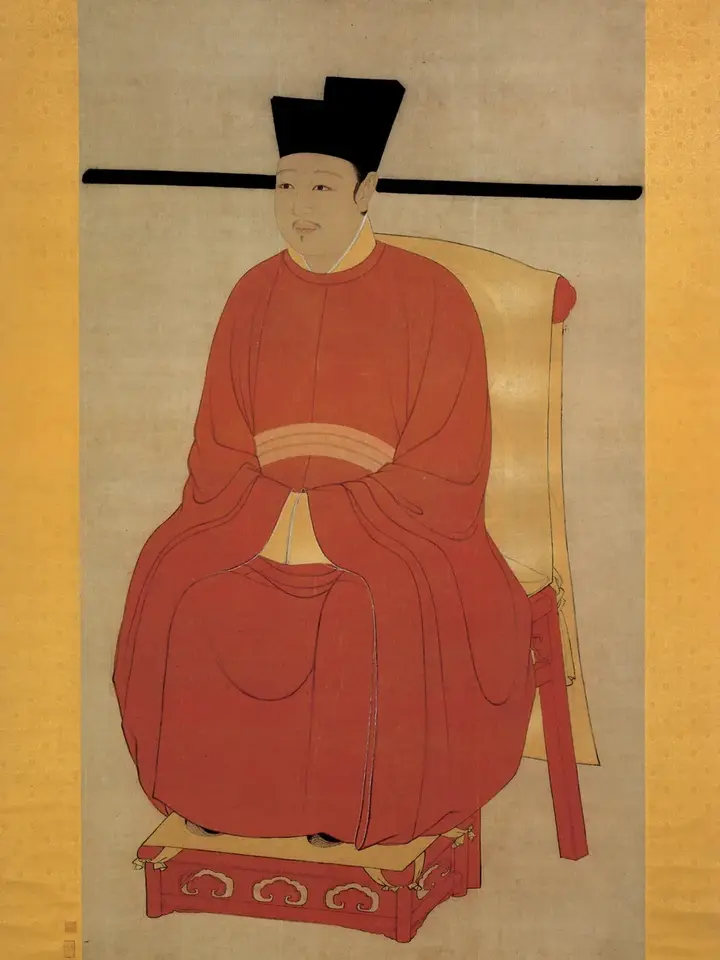
杨维桢
Yang Weizhen (杨维桢, 1296–1370), courtesy name Lianfu, art name Tieya, and also known as Tiedi Daoren (Iron Flute Daoist) and Dongweizi, was a native of Quantang Village in Zhuji, Shaoxing (modern-day Zhuji, Zhejiang Province). He was an illustrious literary master, poet, dramatist, calligrapher, and art connoisseur of the late Yuan and early Ming dynasties, revered as the undisputed arbiter and flagbearer of the Jiangnan…
Yang Weizhen (杨维桢, 1296–1370), courtesy name Lianfu, art name Tieya, and also known as Tiedi Daoren (Iron Flute Daoist) and Dongweizi, was a native of Quantang Village in Zhuji, Shaoxing (modern-day Zhuji, Zhejiang Province). He was an illustrious literary master, poet, dramatist, calligrapher, and art connoisseur of the late Yuan and early Ming dynasties, revered as the undisputed arbiter and flagbearer of the Jiangnan cultural world in late Yuan China. Inheriting a distinguished family tradition, Yang studied at the foot of Mount Tieya, where his father Yang Hong erected an isolated library surrounded by a hundred plum trees, removing the ladder to enforce five continuous years of monastic scholarship. Passing the imperial examinations as a jinshi in 1327, Yang successively served as Magistrate of Tiantai, Superintendent of Qianqing Salt Yard, and Judicial Vice Magistrate of Jiande Route. As an official, he exhibited unbending rectitude, punishing extortionist clerks and surrendering his seal to secure significant tax reductions for impoverished salt-making families, enduring a decade without promotion as a consequence. When the Yuan court engaged in contentious debates over compiling the official dynastic histories of the Song, Liao, and Jin, Yang boldly authored the Treatise on Legitimate Succession in the Three Histories, vigorously demonstrating that the Song dynasty was the sole legitimate orthodox dynasty of China. His compelling treatise won acclaim from Chief Compiler Ouyang Xuan, who praised it as an enduring historical consensus. During the widespread insurrections that unseated the Yuan dynasty, Yang wandered through the scenic landscapes of West Zhejiang, spurning invitations and veiled threats from regional warlords Zhang Shicheng and Fang Guozhen. In his twilight years, he settled in Songjiang, where he designed the Pengtai garden, adjudicated the prestigious Yingkui Literary Society, and sailed the scenic waterways playing an iron flute. Following the establishment of the Ming dynasty, Emperor Taizu dispatched emissaries with imperial seals to summon him to codify state rituals. Yang initially declined by declaring that an old woman does not remarry, but in 1370 he traveled to Nanjing as a commoner, formulated the structural editorial principles for the ritual canon within one hundred and ten days, and departed peacefully without accepting imperial office. Renowned for creating the singular "Tieya style" of yuefu verse and pioneering an expressive, idiosyncratic cursive calligraphy, Yang left an indelible monument in Chinese cultural history.
Born into a prominent scholarly lineage in Quantang, Zhuji; great-grandfather was the celebrated Song physician Yang Wenxiu.
Father Yang Hong built a library on Mount Tieya and removed the ladder, enforcing five years of secluded study; earned the sobriquet "Yang Tieya".
Traveled to Dadu and passed the metropolitan and palace examinations as a jinshi; appointed Magistrate of Tiantai County.
Appointed Superintendent of Qianqing Salt Yard; petitioned persistently for tax relief and surrendered his seal, spending a decade without promotion.
Authored the Treatise on Legitimate Succession in the Three Histories, asserting Song orthodoxy over Liao and Jin.
Refused multiple summonses from regional warlord Zhang Shicheng, composing satiric poems and sending letters warning of impending ruin.
Fled warfare to reside at Huating in Songjiang, constructing the Pengtai garden and presiding over the Yingkui Literary Society.
Ming Emperor Taizu sent officials summoning him to compile ritual codes; Yang composed Ballad of the Old Matron to signify refusal to serve a second dynasty.
Traveled to Nanjing to meet Emperor Taizu, agreeing solely to compile editorial guidelines without official rank; completed work in 110 days.
Returned to his native Quantang in the fifth month, dictated Record of Returning to Quantang, and passed away at age seventy-five.
Yang Weizhen was born into a distinguished and virtuous scholarly lineage in Quantang Village, Zhuji County, within the Shaoxing Prefecture of eastern Zhejiang. For generations, the Yang family practiced medicine and cultivated classical learning. His great-grandfather, Yang Wenxiu, was a famous physician during the Southern Song dynasty known as "Yang the Living Buddha", authoring influential medical works including Developments in Medicine and Geographic Sand Divination Charts. His father, Yang Hong, was an upright and learned Confucian gentleman who placed supreme importance on classical education for his sons.
Yang Weizhen was the second son. He exhibited brilliant intellectual gifts from early childhood, possessing an extraordinary photographic memory capable of memorizing over a thousand characters of classical prose daily. Recognizing his prodigious talents, his father sought to shield him from superficial urban distractions and cultivate an indomitable character, constructing a special library at the foot of Mount Tieya near Quantang. Hundreds of red plum trees were planted around the retreat, and the upper floor was stocked with tens of thousands of volumes spanning the Confucian classics, historical chronicles, philosophical treatises, and literary compendia.
Once the library was completed, Yang Hong led Yang Weizhen and his cousin Yang Weihan up to the study and immediately removed the wooden staircase, cutting off physical access to the ground. Meals, tea, and seasonal garments were raised and lowered daily via a pulley and bucket mechanism. Suspended above worldly concerns, Yang remained in this aerial sanctuary for five uninterrupted years, immersing himself day and night in classical literature. This rigorous discipline provided him with unparalleled erudition. Because of his famous retreat, contemporaries called him "Yang Tieya", and because he loved playing a resonant iron flute, he took the sobriquet "Tiedi Daoren" (Iron Flute Daoist).
In 1327, during the fourth year of the Taiding era under Emperor Taiding of the Yuan dynasty, thirty-one-year-old Yang Weizhen traveled to the capital Dadu, where he passed the metropolitan and palace examinations, receiving the jinshi degree. The court assigned him as Magistrate of Tiantai County in Taizhou Route. Entering civil service with high Confucian ideals, Yang devoted himself to benevolent administration and the eradication of official abuses.
At that time, local government clerks in Tiantai had entrenched networks of corruption, extorting vulnerable peasants and colluding with landed gentry. Unintimidated by vested interests, Yang launched comprehensive investigations, strictly enforcing statutory laws and severely penalizing corrupt sub-officials. His upright governance earned universal acclaim from the local citizenry. However, disgruntled clerks conspired with provincial supervisors to manufacture malicious charges, leading to Yang's abrupt dismissal from office.
Shortly thereafter, the court reappointed Yang as Superintendent of the Qianqing Salt Yard in Shaoxing Route. Salt administration in late Yuan Jiangnan was notoriously oppressive, with astronomical production quotas imposed upon hereditary saltern households. Families were regularly bankrupted, driven into flight or forced into selling their children. Moved by their misery, Yang repeatedly submitted formal memorials to provincial superiors requesting substantial reductions in salt quotas. When senior officials rejected his pleas, an indignant Yang threw his official seal onto the desk and resigned in protest. Fearing a popular uprising, provincial authorities relented, granting a three-thousand-unit quota reduction. Although he successfully protected the salt makers, his defiance alienated high-ranking bureaucrats, condemning him to minor provincial posts without promotion for an entire decade.
In 1343, during the third year of the Zhizheng era under Emperor Huizong of Yuan, the court issued an imperial decree to organize compilation bureaus for the official dynastic histories of the Song, Liao, and Jin. However, heated philosophical debates erupted among the compilers. Mongol and Semu academicians insisted that the Song, Liao, and Jin dynasties should be treated as parallel, independent regimes of equal legitimacy, while many Han scholars advocated for the single moral orthodoxy of Chinese dynastic lineage. The dispute dragged on for months, paralyzing editorial progress.
Serving in an obscure regional capacity, Yang Weizhen was deeply stirred. He believed that the principle of legitimate dynastic succession (zhengtong) was paramount to the transmission of Chinese civilization and could not be compromised for political expediency. Yang took up his brush and composed his celebrated, multi-thousand-word masterwork, the Treatise on Legitimate Succession in the Three Histories.
In this treatise, Yang cited the moral historiography of Confucius's Spring and Autumn Annals and Sima Guang's Comprehensive Mirror in Aid of Governance, forcefully arguing that the Song dynasty directly inherited legitimate dynastic succession from the Later Zhou of the Five Dynasties. Despite the Jingkang catastrophe and the relocation to Lin'an, the Song preserved the moral tradition, ritual systems, and political legitimacy of the Chinese ecumene. In contrast, the Liao and Jin were regional northern conqueror regimes that could never claim parity with the universal Song dynasty.
Yang delivered his treatise to Ouyang Xuan, Academician Recipient of Edicts and Chief Compiler of the Three Histories. Ouyang was overwhelmed by the brilliance and moral cogency of the argument, praising it enthusiastically: "A century from now, the definitive consensus on the Three Histories will surely rest upon the judgment of Yang Lianfu!" The treatise brought Yang national acclaim. The court promoted him to Judicial Vice Magistrate of Jiande Route General Administration Office and later named him Commissioner of Jiangxi Confucianism. However, widespread peasant rebellions soon erupted across the empire, severing transport routes and preventing him from assuming his post.
After 1351, the Yuan dynasty collapsed into systemic civil war as the Red Turban rebellions flared across the Huai River and Jiangnan basins. Accompanied by his household, Yang Weizhen took refuge along the Fuchun River, Qiantang River, and the rugged mountains of western Zhejiang, living an itinerant life aboard boats.
During this period, salt smuggler turned insurgent leader Zhang Shicheng captured Pingjiang (Suzhou), establishing the kingdom of Dazhou across the affluent plains of western Zhejiang. Seeking cultural legitimacy, Zhang courted prominent Jiangnan scholars to adorn his court. Aware of Yang's towering prestige, Zhang sent envoys bearing gifts of gold and brocade into the mountains to invite him to become his prime strategist. Yang discerned Zhang's narrow ambition and lack of statecraft, refusing with satirical verse: "Beacon fires flare throughout Jiangnan, yet tribute wine arrives across the seas each year; amid such beacon smoke and such sweet wine, when could this old man ever open his heart?"
Rebuffed, Zhang dispatched his younger brother and chief military general, Zhang Shide, to personally seek counsel. Yang handed Zhang Shide an unsparing letter analyzing the regime's fatal flaws, censuring Zhang Shicheng for arbitrarily handing out offices without imperial authority and squandering state granaries. He warned that Zhang's officers were self-serving, and that complacency would invite external invasion and internal ruin. Although enraged, Zhang dared not harm the venerable scholar. Eastern Zhejiang warlord Fang Guozhen likewise attempted to force Yang into his service, but Yang steadfastly maintained his moral independence.
In 1360, seeking complete insulation from warlord factions, Yang relocated his household to Huating in Songjiang (modern Shanghai). He laid out a garden retreat named Pengtai (Canopy Terrace), where he spent his final decade in bohemian seclusion.
Outside his study at Pengtai, Yang audaciously posted a humorous manifesto: "If guests arrive and I do not descend the stairs, forgive an old man's indolence; if guests salute and I do not return the courtesy, forgive an old man's infirmity; if guests inquire and I do not reply, forgive an old man's silence; if my speech causes offense, forgive an old man's bluntness; if I drink wine without pause, forgive an old man's madness." This eccentric declaration delighted literati society. In Songjiang, Yang formed deep bonds with Lu Juren, Lyu Liangzuo, Qian Weishan, and Yang Qian of Zhangyan, spending his days in poetic exchanges and musical revelry.
When wealthy merchant Lyu Liangzuo inaugurated the Yingkui Literary Society, Yang was unanimously elected presiding arbiter. Promising scholars and retired gentlemen flocked from across the empire to attend the gatherings. Sitting on the dais, Yang critiqued essays and promoted talent, transforming Songjiang into a cultural oasis during the chaotic late Yuan era. Clad in Daoist feather robes and a Huayang cap, Yang frequently cruised the lakes of Sanmao and the Nine Peaks aboard painted boats, blowing his iron flute over the water and dancing with joyous abandon, celebrated by onlookers as an immortal descended to earth.
During these years, Yang assiduously collected and annotated ancient manuscripts and paintings. His library accumulated tens of thousands of rare volumes, stamped with his personal seals "Lianfu" and "Yang Lianfu". Literati considered receiving even a single line of his calligraphy an invaluable treasure, and his magnetic personality revitalized the morale of the southern scholar-official class.
In 1368, Zhu Yuanzhang declared the founding of the Ming dynasty in Yingtian Prefecture (modern Nanjing). Seeking to consolidate imperial legitimacy, Emperor Taizu recruited renowned surviving scholars from Jiangnan to codify imperial rituals, astronomical calendars, and official dynastic records. Aware of Yang's towering status, the emperor dispatched Hanlin Reader-in-Waiting Zhan Tong with imperial credentials to Songjiang to summon Yang to the capital.
Adhering to his moral vow of loyalty to the fallen Yuan dynasty, Yang refused to serve the new court, famously replying to Zhan Tong: "How could an old woman approaching her coffin arrange a second marriage?" He penned his defiant Ballad of the Old Matron and slipped away to hide in his ancestral village of Quantang. When questioned by patrolling soldiers along the way, he feigned senility and confusion, prompting them to dismiss him as a harmless old recluse.
By 1370, exasperated by the delays, Emperor Taizu commanded local authorities to convey Yang to Nanjing without fail. Recognizing that continued evasion would imperil his entire lineage, an ailing Yang boarded a boat for Nanjing. Granted an imperial audience, Yang stood proudly in plain commoner robes, declaring: "If Your Majesty demands only that which lies within my capability and does not compel that which violates my conscience, I shall gladly exert my humble effort; otherwise, I have no recourse but to cast myself into the ocean!"
Moved by his moral stature, Emperor Taizu granted his request to assist in an unofficial capacity without taking bureaucratic rank, lodging him comfortably at the Taoyuan gardens and providing daily delicacies. For one hundred and ten days, Yang worked tirelessly alongside Song Lian, drafting the overarching editorial structure and narrative guidelines for the ritual canon. Once the frameworks were established, Yang petitioned to return home.
Emperor Taizu respected his unyielding fidelity, granting him generous monetary gifts and imperial wines. Upon his departure, literary grandee Song Lian composed an admiring farewell poem featuring the memorable lines: "Rejecting the sovereign's five-colored edicts, summoned as a commoner in white, as a commoner in white he returns." Returning to Quantang in the fifth month of 1370, Yang realized his end was near. Lying on his couch, he dictated the Record of Returning to Quantang, dropped his brush, and passed away peacefully at the age of seventy-five.
Yang Weizhen's supreme literary achievement was shattering the delicate, stagnant formalism of middle-to-late Yuan poetry and establishing the dynamic, historically resonant "Tieya style" of ancient yuefu folk verse.
Yang advocated that poetry should directly express innate human sensibility rather than slavishly imitating High Tang metric models. His verses drew upon the heroic romanticism of Qu Yuan's Elegies of Chu, the rugged rustic sincerity of Han and Wei yuefu melodies, and the baroque imagery of Li Bai and Li He. His poetic compositions featured startling imaginative leaps, fierce and incisive phrasing, and surging, unpredictable rhythms. Works such as Red-Headed Ducks, Ode to the Iron Flute, and Ballad of the Old Matron intertwined spectral visions with profound laments over dynastic collapse and human suffering.
The appearance of the Tieya style caused a sensation across China. Scholars eagerly copied and recited his verses, coalescing into the expansive "Tieya school" of poetry. Prominent disciples including Qian Weishan, Song Xi, Yuan Hua, and Gu Ying followed his aesthetic footsteps. His verse dissolved rigid distinctions between poetic eras, integrating myth, historical anecdote, and social critique into ancient narrative song. Although orthodox early Ming neo-Confucian moralists disparaged him as a "literary sorcerer" due to his unconventional imagery, his boundless creative audacity earned him an enduring rank alongside Li He and Wen Tingyun in the history of Chinese lyric poetry.
Amid the ruinous wars of the late Yuan dynasty, the Jiangnan cities of Pingjiang and Songjiang served as primary havens for displaced intellectuals. Leveraging his immense erudition, personal charisma, and bohemian spirit, Yang Weizhen served as the spiritual patron of this southern scholar-official community.
Yang actively guided and participated in celebrated literati gatherings, notably Gu Ying's Yushan Thatched Hall Assemblies in Kunshan and Lyu Liangzuo's Yingkui Literary Society in Songjiang. At the Yingkui gatherings, Yang presided as the chief arbiter, formulating rigorous adjudication standards and composing poetic themes. Aspiring scholars and retired elders considered a single word of commendation from Master Tieya the greatest honor of their lives. At each meeting, dozens of poets composed verses according to assigned rhymes, which Yang evaluated on the spot with incisive wit.
Through poetic exchanges and extensive epistolary networks, Yang collected scattered classical manuscripts, regional historical records, and literary compositions, mentoring an entire generation of youthful southern scholars. Amid the devastation of war, he forged a resilient cultural sanctuary in Songjiang, ensuring the continuity of Chinese intellectual culture through a violent dynastic transition and preparing the fertile ground for the early Ming cultural renaissance.
Beyond his literary renown, Yang Weizhen was a visionary pioneer in the history of Chinese calligraphy, deliberately breaking away from prevailing stylistic orthodoxies.
Following Zhao Mengfu's influential promotion of archaic classical revivalism, fourteenth-century calligraphy was dominated by the graceful, refined elegance of the Two Wangs (Wang Xizhi and Wang Xianzhi), which gradually degenerated into predictable, placid conformity devoid of monumental force. Disdaining this placidity as ill-suited to an age of upheaval, Yang forged a fiercely independent style, drawing inspiration from Han and Wei dynasty draft cursive (zhangcao), Suo Jing's Monthly Ceremonial Model, and the expressive freedom of Yan Zhenqing and Su Shi.
Yang's calligraphy was celebrated for its wild running and cursive scripts. His brushwork was deliberately erratic and angular, featuring dramatic variations in character scale, off-axis dynamism, and rapid contrasts between dry and saturated ink. His lines radiated rebellious energy and unbridled vitality, prompting connoisseurs to describe his work as resembling "an iron immortal riding a crane across the sky, impossible to restrain". He painted with coarse brushes soaked in ink while drinking wine, achieving breathless dynamism. Extant masterpieces such as Chengnan Changhe Shijuan, Zhenjing'an Muyuanshu Juan, Youxian Changhe Shice, and Zhangshi Tongbo Qianbiao Juan are revered as priceless national treasures, exerting profound influence on the individualistic, wild cursive masters of the late Ming, including Zhang Ruitu, Huang Daozhou, Ni Yuanlu, and Xu Wei.
In historiographical theory and the philosophy of dynastic legitimacy, Yang Weizhen's Treatise on Legitimate Succession in the Three Histories marked a watershed moment in traditional Chinese historical criticism.
Confronting the Yuan court's imperial initiative to grant equal dynastic legitimacy to the Liao, Jin, and Song regimes, Yang intervened decisively. Employing the rigorous moral categories of Confucian historiography, he declared that true legitimacy rested not merely on territorial conquest, but upon moral virtue, cultural continuity, institutional transmission, and universal allegiance. He established that the Song dynasty was the direct heir to the Later Zhou, standing as the authentic repository of Chinese civilization, while the Liao and Jin were regional barbarian conquerors disqualified from claiming orthodox imperial lineage.
Yang underscored that the mandate of heaven could not be warped to flatter transient political realities. He analyzed the Song's contributions to ritual refinement, legal codification, and Confucian philosophy, refuting the simplistic assertion that territorial extent alone conferred legitimacy. His treatise not only won over Chief Compiler Ouyang Xuan, but directly shaped official Ming historiographical orthodoxy. The ideological rationale through which Emperor Taizu and subsequent Ming official historians affirmed Song legitimacy originated directly in Yang's treatise, illustrating his enduring historiographical vision.
FIGURES ASSOCIATED WITH THIS DYNASTY