Born in Fujian
Born on the ninth day of the twelfth lunar month in Jian'an County, Fujian, originally named Daoying.
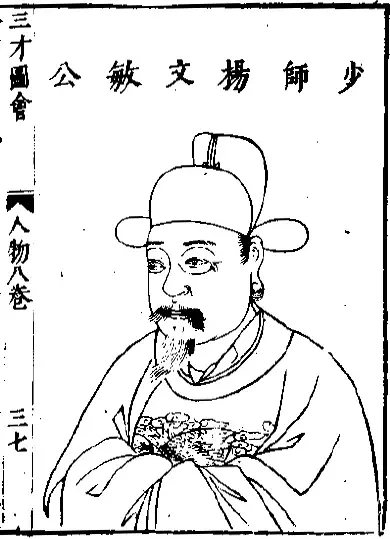
杨荣
Yang Rong (杨荣, January 15, 1372 – July 30, 1440), originally named Daoying and Zirong, courtesy name Mianren, was a native of Jian'an County, Jianning Prefecture, Fujian. He was a paramount statesman, military strategist, and writer of the early Ming Dynasty. Serving five successive monarchs—Jianwen, Yongle, Hongxi, Xuande, and Zhengtong—he served inside the Grand Secretariat at Wenyuan Pavilion for thirty-eight years. Along…
Yang Rong (杨荣, January 15, 1372 – July 30, 1440), originally named Daoying and Zirong, courtesy name Mianren, was a native of Jian'an County, Jianning Prefecture, Fujian. He was a paramount statesman, military strategist, and writer of the early Ming Dynasty. Serving five successive monarchs—Jianwen, Yongle, Hongxi, Xuande, and Zhengtong—he served inside the Grand Secretariat at Wenyuan Pavilion for thirty-eight years. Along with Yang Shiqi and Yang Pu, he was celebrated as one of the "Three Yangs" and distinguished as "East Yang" due to the eastern location of his capital residence. In 1400, Yang Rong attained the second rank in the palace examination as a metropolitan graduate, entering imperial service as Senior Compiler in the Hanlin Academy. When Zhu Di captured Nanjing in 1402 at the conclusion of the Jingnan Campaign, Yang Rong stepped before the conqueror's horse, asking whether the prince intended to pay homage at Emperor Hongwu's mausoleum before ascending the throne. Zhu Di took the advice and selected Yang Rong into the newly created Grand Secretariat, making him an indispensable founder of early Ming cabinet governance. During the Yongle reign, Yang accompanied Zhu Di on northern steppe campaigns, serving as chief military strategist. In 1424, when Zhu Di died during his retreat at Yumu Stream, Yang Rong kept the death secret, preserved the imperial corpse in tin, and rode to Beijing, securing Emperor Renzong's peaceful succession. Under Emperors Renzong and Xuande, Yang Rong advanced to Junior Preceptor. In 1426, when Prince of Han Zhu Gaoxu rebelled, Yang convinced Emperor Xuande to lead an imperial expedition in person, crushing the revolt without casualties. He later collaborated with Yang Shiqi to terminate the costly occupation of Annam, fostering the peace of the "Rule of Ren and Xuan." Following Xuande's death, Yang served as senior regent for the young Emperor Zhengtong alongside Grand Empress Dowager Zhang. In 1440, Yang died while returning from ancestral rites in Fujian at the age of sixty-eight, posthumously honored as Grand Preceptor with the posthumous title "Wenmin."
Born on the ninth day of the twelfth lunar month in Jian'an County, Fujian, originally named Daoying.
Placed first in the Fujian provincial examination (Jieyuan); his classical lectures impressed examiner Xia Yuanji.
Ranked third in the metropolitan examination and second in the second class of the palace examination, appointed Senior Compiler.
Advised Zhu Di to visit the Hongwu mausoleum before taking the throne; selected into the newly created Grand Secretariat.
Dispatched on an imperial mission to inspect Gansu frontiers, submitting detailed strategic cartography.
Accompanied Emperor Yongle on his first northern expedition against the Tatars, drafting military dispatches on horseback.
Promoted to Hanlin Academician and Chancellor of the National University, co-directing official ideological compendia.
Concealed Zhu Di's death at Yumu Stream and rode north to Beijing, securing Renzong's succession without incident.
Promoted to Junior Tutor to the Crown Prince, Grand Secretary of the Jinshen Hall, and Minister of Works under Renzong.
Convinced Emperor Xuande to personally command the expedition against rebel Prince Zhu Gaoxu at Le'an, crushing the revolt.
Advocated alongside Yang Shiqi the termination of military operations in Jiaozhi (Annam), conserving state resources.
Following Xuande's death, served as senior regent for nine-year-old Emperor Zhengtong alongside Grand Empress Dowager Zhang.
Completed the Veritable Records of Emperor Xuande and was elevated to Junior Preceptor, reaching the height of ministerial honor.
Died of illness in Wu'an while returning from ancestral tomb ceremonies in Fujian; posthumously created Grand Preceptor with the title Wenmin.
Yang Rong was born on January 15, 1372, into a cultured family in Jian'an County, Fujian. His grandfather Yang Daqing noticed his deep cry at birth and renamed him Zirong, predicting that he would bring renown to the family. Entering the prefectural academy at seventeen, Yang displayed acute mastery of Confucian exegesis. In 1399, while inspecting Fujian education, Vice Minister Xia Yuanji heard Yang lecture on the Mencian concept of cultivating the vital spirit and was struck by his logical depth. Later that year, Yang placed first in the provincial civil examination. In 1400, he passed the metropolitan examination third, took second place in the second tier of the palace examination, and was appointed Senior Compiler in the Hanlin Academy.
In July 1402, Prince of Yan Zhu Di breached the Jinchuan Gate of Nanjing, ending the civil war. As Zhu Di prepared to ride straight into the palace to claim the throne, the thirty-one-year-old compiler Yang Rong stepped in front of Zhu Di's warhorse and bowed, inquiring whether His Highness intended to pay homage at the mausoleum of Emperor Hongwu first or mount the throne immediately. This counsel reminded Zhu Di of the paramount importance of filial legitimacy. Zhu Di turned his horse toward the Xiaoling Mausoleum to perform imperial sacrifices. Acknowledging Yang's political wisdom, Zhu Di retained him as an inner advisor. When the Grand Secretariat was formally established in 1402, Yang Rong was inducted alongside Xie Jin, Hu Guang, Yang Shiqi, and Jin Youzi. Zhu Di bestowed upon him the personal name Rong and the courtesy name Mianren.
In 1404, when border officers reported unrest among northwestern nomadic leaders, Emperor Yongle dispatched Yang Rong to Gansu. Travelling lightly across the frontier, Yang examined mountain fortifications, inspected garrison conditions, and mapped border topography. Upon his return, he presented strategic terrain maps and proposed frontier defense garrisons that stabilized the border.
Yang Rong stood out among early Ming cabinet scholars for his mastery of military logistics and strategic timing. Between 1410 and 1424, Emperor Yongle launched five massive northern expeditions across the Gobi Desert, keeping Yang Rong continuously at his side. On horseback during grueling marches, the emperor summoned Yang late at night to discuss tactical maneuvers. During the fierce Battle of Kherlen in 1414 against the Oirats, when imperial vanguard units were pressed hard, Yang advised a coordinated encirclement backed by modern firearms, turning the engagement into an imperial triumph.
In July 1424, the sixty-five-year-old Emperor Yongle died at his frontier camp at Yumu Stream during the return march from his fifth campaign. Thousands of li from Beijing, imperial commanders panicked; Mongol cavalry hovered nearby, while Prince of Han Zhu Gaoxu plotted in the capital to seize the throne. In this crisis, Yang Rong and fellow Grand Secretary Jin Youzi acted with courage. They instituted a news blackout, placed the emperor's body in a sealed tin coffin inside an imperial carriage, and continued regular daily meal deliveries. Simultaneously, Yang Rong led horsemen on an exhausting day-and-night dash to Beijing, secretly briefing Crown Prince Zhu Gaochi and securing the capital gates. When Zhu Gaoxu attempted to mobilize, Emperor Renzong was safely enthroned.
Emperor Renzong rewarded Yang Rong's decisive loyalty with promotions to Minister of the Court of Imperial Sacrifices, Grand Secretary of the Jinshen Hall, and Junior Tutor to the Crown Prince. When Renzong died after only ten months on the throne, Emperor Xuande assumed power. In August 1426, Prince of Han Zhu Gaoxu revolted at Le'an. While timid courtiers suggested dispatching generals, Yang Rong insisted that the emperor take personal command, predicting that the rebel prince would collapse when confronted by imperial presence. Xuande adopted the advice, leading imperial armies to encircle Le'an, where Zhu Gaoxu surrendered without a battle.
In foreign policy, Yang Rong demonstrated pragmatic statecraft. Following the conquest of Annam, Ming forces had become bogged down in prolonged guerrilla conflict that drained state grain supplies. In 1427, Yang Rong and Yang Shiqi persuaded Emperor Xuande to abolish Jiaozhi Province and withdraw all imperial garrisons, ending an exhausting military entanglement. This strategic retrenchment conserved immense fiscal resources, laying the foundation for the prosperity of the "Rule of Ren and Xuan."
In 1435, Emperor Xuande died, leaving the nine-year-old Crown Prince Zhu Qizhen to ascend the throne as Emperor Zhengtong. Grand Empress Dowager Zhang respected dynastic precedents by declining formal regency, delegating state administration to the Three Yangs: Yang Shiqi, Yang Rong, and Yang Pu.
Contemporaries characterized their collaboration: "Yang Shiqi possessed scholarly wisdom, Yang Rong possessed tactical decisiveness, and Yang Pu possessed moral integrity." Whenever frontier emergencies arrived, Yang Rong drafted concise imperial directives. Together, they maintained bureaucratic discipline, curbed royal relatives, and kept court eunuch Wang Zhen in check.
In 1440, approaching seventy years of age and weakened by decades of administrative labor, Yang Rong received permission to visit his ancestral tombs in Fujian. After completing the rituals, he began his return to Beijing, falling gravely ill at a posthouse in Wu'an County. He died on July 30, 1440, at the age of sixty-eight. Emperor Zhengtong suspended court, posthumously bestowed the office of Grand Preceptor, and granted the honored posthumous name "Wenmin."
Following Emperor Hongwu's abolition of the Central Secretariat, imperial governance was strained by overwhelming administrative burdens. As an inaugural member of the Wenyuan Pavilion cabinet, Yang Rong served for thirty-eight years under five emperors, shaping the evolution of the Grand Secretariat from a secretarial pool into an effective cabinet council.
Yang maintained equilibrium between autocratic imperial power and ministerial counsel. He developed systematic procedures for reviewing memorials and drafting imperial endorsements, establishing institutional conventions that governed Ming central administration for centuries.
Yang Rong possessed strategic gifts that made him Emperor Yongle's most trusted military advisor. Serving as the emperor's traveling counselor during five northern expeditions, he drafted battlefield decrees directly from the saddle.
His military doctrine emphasized defensive fortifications, combined-arms coordination, and artillery suppression, guiding imperial forces across the steppe. His memoirs, Northern Expedition and Later Northern Expedition, provided eyewitness accounts of terrain, troop movements, and supply lines, serving as valuable strategic manuals for later border defenses.
Zhu Di's unexpected death at Yumu Stream in 1424 presented the early Ming Dynasty with a dangerous succession crisis. Frontier troops were demoralized, and ambitious princes plotted armed insurrection.
Yang Rong orchestrated the deception that concealed the emperor's death while riding north to coordinate with Crown Prince Zhu Gaochi. His prompt action ensured the first orderly dynastic succession between father and son in Ming history, preventing civil war.
Beyond statecraft, Yang Rong was a central figure in early Ming literature and official scholarship. He served as Chief Compiler for the Veritable Records of Emperor Taizu and supervised the compilation of the official annals for the Yongle, Hongxi, and Xuande reigns, as well as the Great Compendium on the Five Classics and Four Books.
In literature, Yang Rong, Yang Shiqi, and Yang Pu pioneered the influential "Taige" (Cabinet) style of poetry and prose. Reflecting national peace, economic prosperity, and imperial grandeur, Yang's verse was dignified, lucid, and broad in vision. His collected works, Yang Wenmin Ji, were preserved in the Complete Library of the Four Treasuries.
FIGURES ASSOCIATED WITH THIS DYNASTY