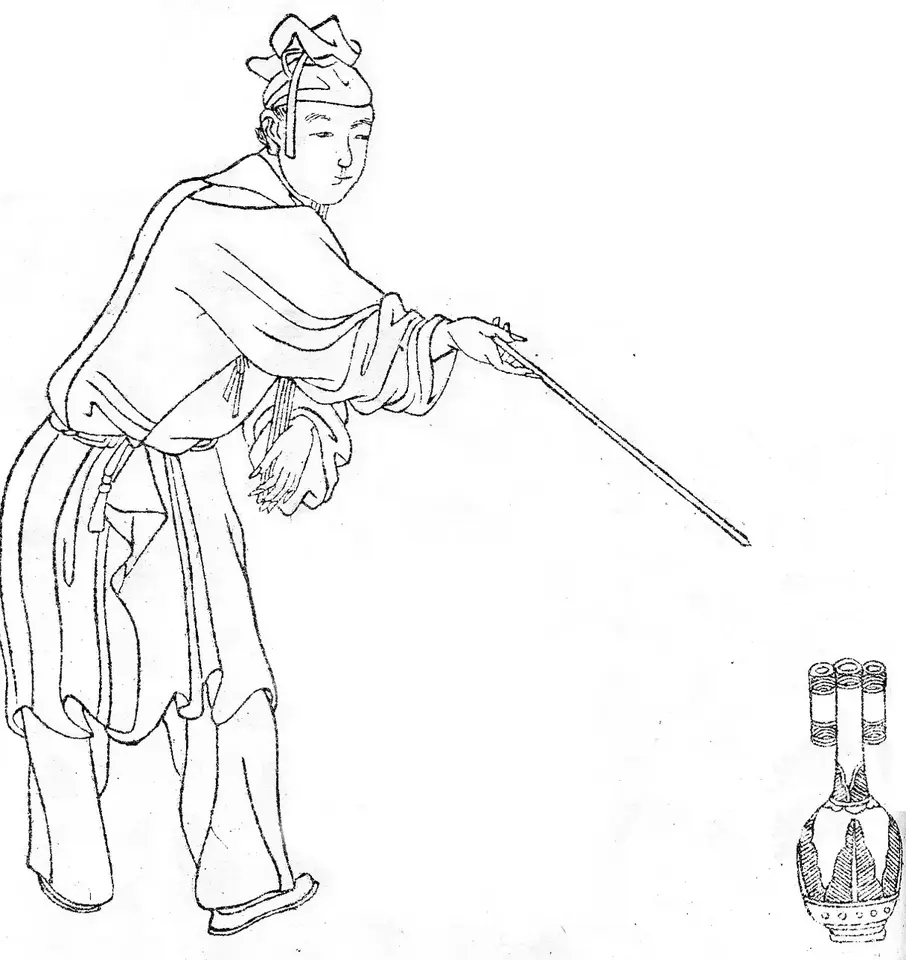
PROFILE
Yang Jiong (杨炯, 650–692), a native of Huayin in Huazhou (present-day Huayin, Shaanxi) originating from the prestigious Yang clan of Hongnong, was an eminent writer and poet of the Early Tang dynasty, celebrated alongside Wang Bo, Lu Zhaolin, and Luo Binwang as one of the Four Paragons of the Early Tang. Precocious from childhood, Yang passed the special Child Prodigy examination in the fourth year of the Xianqing era (659) at the age of ten, receiving appointment as Collator in the Palace Library and earning national acclaim as an unmatched prodigy. In the third year of the Shangyuan era (676), he was selected through civil examinations to serve in the Eastern Palace as Scholar in the Institute for the Advancement of Literature under Crown Prince Li Xian. In the first year of the Yongchun era (682), recommended by Chancellor Pei Yan, he was appointed Secretariat Drafter and Imperial Reader to Prince Li Boqin. In 685, implicated by his cousin Yang Shen'e's participation in Xu Jingye's rebellion against Wu Zetian, Yang was demoted to Judicial Administrator in Zizhou. Following the establishment of the Wu Zhou dynasty in 690, he was recalled to Luoyang to instruct court scholars. In 692, he was appointed Magistrate of Yingchuan, where he suppressed outlawry with rigorous discipline and benevolent governance, passing away in office; posterity honored him as "Yang Yingchuan."
In Chinese literary history, Yang Jiong was a primary architect in overthrowing the decadent palace-style poetry of the Six Dynasties and inaugurating the vigorous aesthetic of the High Tang. His masterpiece Campaign Ballad sounded the clarion call of the Early Tang with its famous declaration: "Rather become a centurion than remain a cloistered scholar," expressing the era's martial enthusiasm. His frontier music bureau ballads were marked by heroic pathos and structural concision, pioneering the Tang frontier poetry school. In parallel prose (pianwen), Yang was widely regarded as the foremost stylist among the Four Paragons; his preface to the Collected Works of Wang Bo displayed magnificent eloquence and critical depth, tracing the liberation of Tang literature from Qi-Liang affectation. Highly confident in his own literary prowess, Yang once famously remarked that he felt "ashamed to precede Lu, but humiliated to follow Wang." His literary innovations were pivotal in catalyzing the golden age of High Tang poetry.
- Date of Birth
- 650 (Tang Dynasty, 1st year of Yonghui)
- Date of Death
- 692 (Wu Zhou Dynasty, 1st year of Changshou)
- Age at Death
- 43
- Ancestral Home
- Huayin, Hongnong (present-day Huayin, Shaanxi)
- Highest Office
- Magistrate of Yingchuan (Yingchuan Xianling)
- Identity
- One of the Four Paragons of the Early Tang, eminent writer, and Magistrate of Yingchuan
BIOGRAPHY
Chronology
- 650 (Tang Dynasty, 1st year of Yonghui) | Birth into Aristocratic Clan | Born into the prominent Yang clan of Hongnong in Huayin, demonstrating extraordinary intellect and memory from early childhood.
- 659 (Tang Dynasty, 4th year of Xianqing) | Passing the Child Prodigy Exam | Passed the imperial Child Prodigy examination at age ten, receiving immediate appointment as Collator in the Palace Library.
- 676 (Tang Dynasty, 3rd year of Shangyuan) | Service in the Eastern Palace | Selected through civil evaluations to serve Crown Prince Li Xian as Scholar in the Institute for the Advancement of Literature.
- 682 (Tang Dynasty, 1st year of Yongchun) | Appointment as Secretariat Drafter | Recommended by Chancellor Pei Yan to serve as Secretariat Drafter and Imperial Reader to Prince Li Boqin.
- 685 (Tang Dynasty, 1st year of Chuigong) | Demotion to Zizhou | Implicated by his cousin Yang Shen'e's participation in Xu Jingye's anti-Wu rebellion, demoted to Judicial Administrator of Zizhou.
- 690 (Wu Zhou Dynasty, 1st year of Tianshou) | Recalled to Luoyang | Pardoned by Wu Zetian upon the founding of the Wu Zhou dynasty, recalled to Luoyang to instruct court scholars in ritual literature.
- 692 (Wu Zhou Dynasty, 1st year of Ruyi) | Governing Yingchuan County | Appointed Magistrate of Yingchuan in Wuzhou, establishing incorruptible administration and eradicating local bandits.
- 692 (Wu Zhou Dynasty, 1st year of Changshou) | Passing in Office | Passed away from overwork at his yamen in Yingchuan at age forty-three; local residents erected a memorial temple in his honor.
Life Course
Aristocratic Pedigree and Child Prodigy Triumph
Yang Jiong was born in the first year of the Yonghui era (650) in Huayin, Huazhou (present-day Huayin, Shaanxi). His household belonged to the renowned Hongnong Yang clan, an illustrious lineage spanning generations of Guanlong aristocrats and high scholars. Endowed with exceptional brilliance and photographic memory, Yang mastered the Zuo Commentary, the Classic of Poetry, and ancient philosophers during his earliest childhood, displaying rare literary perception.
In the fourth year of the Xianqing era (659), the imperial court conducted a special Child Prodigy examination. Ten-year-old Yang journeyed to Chang'an under family guidance. In the imperial examination pavilion, Yang answered searching questions on canonical exegesis with effortless fluency and scholarly maturity, astonishing the senior court examiners. The court immediately issued a decree awarding him the Child Prodigy degree and appointing him Collator in the Palace Library (Mishu Sheng Xiaoshulang). Attaining official rank at age ten, Yang became a celebrated prodigy throughout Chang'an and Luoyang.
Service in the Palace Library and the Eastern Palace
Serving in the Palace Library for over a decade, Yang immersed himself in the imperial archives, reading through canonical treasures, imperial genealogies, and dynastic histories, immensely enriching his scholarly foundation. In the third year of the Shangyuan era (676), the court restructured the household of Crown Prince Li Xian. Passing the civil placement evaluations, Yang was promoted to Scholar in the Institute for the Advancement of Literature. Li Xian deeply admired Yang's learning, frequently engaging him in discussions of classical governance while commissioning formal palace compositions.
In the first year of the Yongchun era (682), Chancellor Pei Yan recognized Yang's monumental prose and deep statecraft erudition, submitting an urgent memorial recommending him to Emperor Gaozong. The emperor appointed Yang Secretariat Drafter (Zhongshu Sheren), charging him with drafting sovereign decrees, while naming him Imperial Reader to Prince Li Boqin. At thirty-two, Yang occupied the inner corridors of executive administration, his literary fame flourishing alongside companions Wang Bo, Lu Zhaolin, and Luo Binwang.
Political Implication and Demotion to Zizhou
In the first year of the Chuigong era (685), Dowager Empress Wu Zetian assumed executive control of the throne, provoking fierce resistance from Tang loyalists. In Yangzhou, Xu Jingye launched a rebellion against Wu Zetian, with Luo Binwang authoring the famous manifesto calling the empire to arms. During this political convulsion, Yang's cousin Yang Shen'e joined Xu Jingye's military staff. Following the suppression of the uprising, Wu Zetian ordered sweeping purges. Although Yang Jiong had no personal involvement in the rebellion, his close kinship with Yang Shen'e led to severe political punishment.
Wu Zetian stripped Yang of his central office, demoting him from the Secretariat to Judicial Administrator (Sifa Canjun) of Zizhou (present-day Santai, Sichuan). Plunged from the imperial center to an obscure southwestern prefecture, Yang endured immense psychological shock. During his years in Zizhou, he managed criminal investigations with scrupulous fairness, observing local customs and common hardships. This frontier exile eradicated earlier aristocratic superficiality, guiding his writing toward profound historical reflection.
Recalled to Luoyang and Final Governance in Yingchuan
In the first year of the Tianshou era (690), Wu Zetian formally proclaimed the Wu Zhou dynasty. Seeking to consolidate her regime by enlisting renowned scholars, she pardoned Yang and recalled him to Luoyang. Appointed to instruct palace scholars in ceremonial compositions, Yang returned to court life. However, possessing an aloof and unyielding temperament, he openly disdained the sycophants and secret police agents who dominated the Zhou bureaucracy, resulting in administrative isolation.
In the first year of the Ruyi era (692), Yang was dispatched to Wuzhou as Magistrate of Yingchuan (present-day Gaojia Town, Qujiang District, Quzhou, Zhejiang). Confronting entrenched local clans and rampaging bandits, Yang enforced rigorous judicial discipline, personally directing constables to eliminate outlaws without fear of influential families. Concurrently, he promoted agriculture, repaired waterworks, and sponsored local schools, restoring order and civic peace. Exhausted by administrative labor and lingering illness, Yang passed away in office in 692 at the age of forty-three. Mourning his loss, local citizens built a memorial temple to commemorate his benevolent rule, honoring him as "Lord Yang of Yingchuan."
Major Achievements
Heroic Poetic Style and Frontier Ballads
In the literary reformation of the Early Tang, Yang Jiong served as a vanguard commander dismantling the effeminate legacy of Six Dynasties court verse. Since the Qi and Liang periods, poetry had degenerated into a frivolous palace diversion, preoccupied with boudoir cosmetics and formalist social verse. Yang deployed robust, solemn brushwork to redirect poetry toward sweeping frontier horizons, beacon fires, and the heroic realities of military life, establishing a vigorous aesthetic for Tang poetry.
His five-character regulated masterpiece Campaign Ballad stands as an immortal monument in frontier literature. Opening with sweeping imagery: "Beacon fires illuminate the Western Capital; within my heart indignation rises unbidden. Jade tallies bid farewell to phoenix gates; iron cavalry encircles the flag pavilions. Snow darkens, withering banner paintings; wind howls, mingling with drum beats. Rather become a centurion than remain a cloistered scholar." The poet captured the urgency of border crises and the patriotic fervor of scholars. The middle couplets depicted military mobilization amid driving snow, while the final declaration shattered centuries of aristocratic disdain for martial valor, becoming the signature motto for Tang youths seeking military service.
Works such as Battling South of the Walls, Marching beyond the Border, and The Purple Steed exhibited similar grandeur. His frontier ballads combined patriotic devotion with sober reflection upon the bloodshed of war, characterized by dense structural bone and elevated tone. Ming anthologist Gao Bing praised his regulated verse in Tangshi Pinhui as orthodox, noting its solemn resonance and elevated diction, directly inspiring the High Tang frontier school of Gao Shi and Cen Shen.
The Four Paragons and Literary Revolution
Alongside Wang Bo, Lu Zhaolin, and Luo Binwang, Yang Jiong was celebrated as one of the Four Paragons of the Early Tang. As pioneering figures in classical Chinese literature, they launched a collective revolution that swept away the stagnant habits of the Six Dynasties. Yang held immense pride in his position, and when contemporaries ranked the four as "Wang, Yang, Lu, Luo," he famously commented: "I feel ashamed to precede Lu, but humiliated to follow Wang."
This celebrated remark reflected his distinct critical standards. He revered Lu Zhaolin's senior moral authority and tragic elegiac depth, feeling humble to be placed before him; conversely, while acknowledging Wang Bo's swift genius, he considered his own classical erudition, parallel prose architecture, and musical discipline fully equal to Wang's, feeling indignant to be placed behind him. This creative rivalry demonstrated the dynamic vitality of Early Tang literati.
Du Fu encapsulated their historical legacy in Playful Quatrains: "Wang, Yang, Lu, and Luo created the style of their time, yet superficial critics mock them without end. You critics will perish along with your names, while their glory endures like great rivers flowing eternally." The Four Paragons broke aristocratic monopolies over literature, expanding poetic themes to include frontier life and broad social realities, paving the way for Li Bai and Du Fu.
Parallel Prose Mastery and the Preface to Wang Bo's Works
Beyond poetry, Yang Jiong enjoyed peerless authority in Early Tang prose and parallel prose (pianwen). Renowned as the most erudite of the Four Paragons, his memorials, inscriptions, and prefaces possessed sweeping rhetorical power, opulent diction, and immense structural strength, representing the zenith of Early Tang parallel prose.
Among his surviving writings, the most celebrated is his Preface to the Collected Works of Wang Bo, composed following Wang's untimely death. This masterpiece is both a moving elegy for a lost friend and an essential manifesto of Early Tang literary criticism. Yang traced the evolution of classical literature from Qu Yuan, Song Yu, Sima Xiangru, and Yang Xiong through the Wei, Jin, Qi, and Liang periods, analyzing how parallel prose succumbed to excessive decorative ornament, before praising Wang Bo and his generation for revitalizing Han-Wei vigor.
Characterized by rigorous architecture, immaculate parallelism, and natural melodic cadence, the preface has long been revered as a supreme masterpiece of Tang prose. Qing editors placed dozens of Yang's steles and memorials at the forefront of the Complete Tang Prose, while Ming theorist Mao Kun acclaimed his writing as possessing unmatched vigor, rich diction, and profound thought, representing the finest prose of the Early Tang.
Benevolent Governance in Yingchuan
Although celebrated primarily as a literary titan, Yang demonstrated the integrity and firmness of an exemplary magistrate during his regional administration. Appointed Magistrate of Yingchuan in 692, he governed a strategic water transport hub plagued by entrenched local gentry and lawless bandits. Recognizing that disordered regions required decisive measures, Yang enforced strict legal discipline, personally directing constables to apprehend outlaws and subduing local tyrants without fear of powerful families.
Alongside judicial firmness, Yang demonstrated tender compassion for vulnerable citizens. He inspected rural communities, supervised irrigation projects, overturned false accusations fabricated by wealthy clans, and established lectures on Confucian ethics at the county yamen, transforming local customs. When Yang died in office, he left no personal estate, his funeral expenses provided through donations from citizens and colleagues. Grieving residents erected the Lord Yang Temple beside the yamen, maintaining annual sacrifices across centuries. His benevolent administration remains deeply etched in the historical memory of western Zhejiang.
Related Figures
- Wang Bo: One of the Four Paragons of the Early Tang and eminent writer; a celebrated peer of Yang Jiong, who composed the famous Preface to the Collected Works of Wang Bo upon his death.
- Lu Zhaolin: One of the Four Paragons of the Early Tang; deeply respected by Yang for his moral character and elegiac depth.
- Luo Binwang: One of the Four Paragons of the Early Tang; joined in advancing the literary revolution of the Early Tang.
- Pei Yan: Tang Chancellor who recognized Yang's statecraft talents and recommended him as Secretariat Drafter and Imperial Reader.
- Li Xian: Crown Prince Zhanghuai under Emperor Gaozong; recruited Yang into the Eastern Palace as Scholar in the Institute for the Advancement of Literature.
Historical Evaluations
- Du Fu: "Wang, Yang, Lu, and Luo created the style of their time, yet superficial critics mock them without end. You critics will perish along with your names, while their glory endures like great rivers flowing eternally." (Playful Quatrains)
- Zhang Yue: "Yang Yingchuan's literary thought was like a surging river pouring forth without end; among the Four Paragons, his prose possessed the most muscular vigor." (New Talks of the Great Tang)
- Sikong Tu: "In Yang Jiong's Campaign Ballad, the heroic spirit of the High Tang was already fully present; beginning in solemn gravity and concluding in martial fervor, it surpassed all contemporary verse." (Collected Works of Sikong Tu)
- Yan Yu: "Among the poetry of the Four Paragons, Yang Jiong was exceptionally heroic and elegant, opening the grand scale of High Tang frontier verse." (Canglang Poetry Talks)
- Ji Yun: "Yang Jiong's parallel prose was rigorously verified and profoundly opulent, with lean, elegant vitality that swept away Qi-Liang delicacy; among the Four Paragons, his style was the most solemn and powerful." (Annotated Catalog of the Siku Quanshu)
Related Entries
- Campaign Ballad
- Preface to the Collected Works of Wang Bo
- Four Paragons of Early Tang
- Wang Bo
- Lu Zhaolin
- Luo Binwang