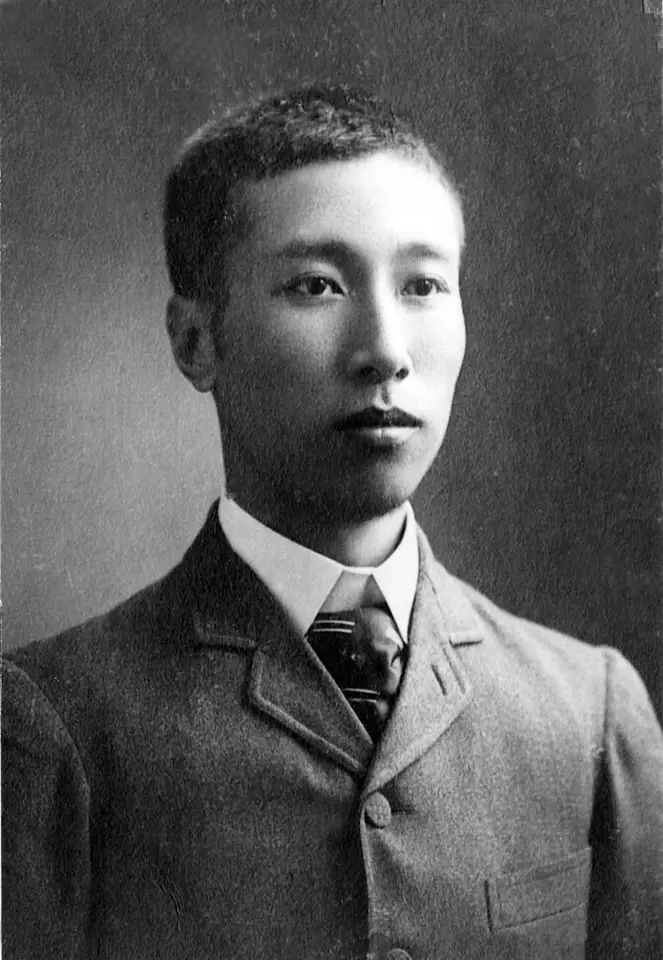
Biography
Mentorship under Wang Kaiyun and Statecraft Philosophy
Yang Du was born on January 15, 1875, in Jiangshe Village, Xiangtan County, Hunan Province. His grandfather Yang Leitang had served in Zeng Guofan's Xiang Army. His father having died young, Yang Du was raised by his uncle Yang Ruisheng. Endowed with brilliant intellect, he mastered the dynastic histories by age ten, demonstrating boundless civic ambition.
In 1892, seventeen-year-old Yang entered the academy of Wang Kaiyun, the foremost exponent of the New Text School of Gongyang Confucianism and kingcraft statecraft. Over three years at Dongzhou and Chuanshan academies, Yang absorbed statecraft principles. His incisive mind captivated Wang Kaiyun, who praised him as an extraordinary talent destined to steer supreme imperial councils.
During this period, Yang complemented classical philosophy with extensive reading of modern gazetteers and geopolitical treatises. In 1893, he achieved the juren degree in Changsha. However, China's catastrophic defeat in the First Sino-Japanese War of 1894 convinced him that traditional scholasticism was inadequate, inspiring his lifelong pursuit of institutional modernization.
Overseas Studies in Tokyo and Constitutional Advocacy
In 1902, Yang sailed to Japan at personal expense, enrolling in Kobun Institute in Tokyo. Witnessing the rapid industrialization and parliamentary order achieved through Meiji constitutionalism, he underwent a profound ideological transformation. He concluded that China could escape foreign subjugation only by dismantling absolute monarchy in favor of constitutionalism.
In Tokyo, Yang established close ties with Liang Qichao, Huang Xing, and Wang Jingwei, emerging as a prominent student leader. He co-founded the influential review Translations by Chinese Students and presided over the Hunan Fellow Provincial Association. In 1903, he penned the famous Song of Hunan Youth, asserting that China would never perish as long as Hunanese lived, electrifying Chinese youth.
In 1905, Sun Yat-sen visited Tokyo to establish the Tongmenghui, engaging in three consecutive nights of vigorous debate with Yang Du. Sun insisted upon violent republican revolution, while Yang argued that widespread illiteracy and vast territorial diversity would cause republicanism to degenerate into warlord fragmentation, contending that constitutional monarchy alone could secure stability. Acknowledging their differences, they sealed a mutual pact to respect each other's patriotic paths.
Drafting Imperial Constitutions and Central Legislation
In 1906, Yang enrolled in the accelerated legal program at Hosei University, studying constitutional law under the celebrated jurist Hozumi Yatsuka. That same year, when the Qing court dispatched five senior commissioners abroad to inspect constitutional governance, Yang was commissioned to ghostwrite their foundational reports, including Exposition on Synthesizing Foreign Constitutional Models.
In 1907, Yang returned to China under joint sponsorship from Grand Secretary Yuan Shikai and Viceroy Zhang Zhidong. He was appointed Executive Director of the Bureau of Constitutional Compilation. Founding the journal New Constitutional Gazette, he became the preeminent intellectual architect of the late Qing constitutional preparation movement.
Within the Bureau, Yang served as primary drafter of the Imperial Constitutional Principles of 1908 and the National Assembly Regulations. He coordinated with provincial gentry to establish provincial assemblies and the national consultative assembly in Beijing, laying the legal foundation for China's first representative representative bodies.
The Chou'an Debates and Inner Storms of the Hongxian Restoration
In 1915, as Yuan Shikai solidified his presidential power, currents within the Beiyang military clique agitated for monarchical restoration. Serving as Yuan's chief civilian strategist, Yang Du firmly believed that monarchical sovereignty alone possessed the imperial prestige required to suppress provincial warlords and prevent the disintegration of China under foreign imperialist encroachment and domestic factional chaos.
During the restoration preparations, Yang drafted Monarchical Constitutionalism to Save China while actively drafting court etiquette, imperial ranks, and constitutional charters for the new empire. Emulating British and Japanese constitutional monarchies, he argued passionately for an accountable cabinet and an independent parliament, seeking equilibrium between a symbolic monarch and modern representative institutions. However, Yuan Shikai and his son Yuan Keding focused solely on autocracy, ignoring Yang's constitutional safeguards.
When Cai E launched the National Protection War from Yunnan, a nationwide anti-monarchical storm erupted, while senior generals Duan Qirui and Feng Guozhang abandoned Yuan. Finding himself at the vortex of national fury, Yang recognized that his constitutional ideals had been co-opted by ambitious militarists. Yet retaining old-school literati loyalty, he remained in the presidential compound even as allies deserted, facing national condemnation with stoic pride.
Buddhist Inquiries under Master Hu and Spiritual Rebirth
Following the collapse of the Hongxian monarchy and Yuan Shikai's sudden death, the Beijing government issued warrants for Yang Du's arrest. Rejecting overseas asylum, Yang withdrew covertly to the German concession in Tianjin. Finding sanctuary in Buddhist temples, he adopted the sobriquets Hugong and Chan Master Hu, dedicating his days to intense scriptural study and meditation.
During these years of spiritual contemplation, Yang mastered the Shurangama Sutra, the Vimalakirti Nirdesa Sutra, and Buddhist Yogacara phenomenology, engaging in profound doctrinal dialogues with eminent monks Master Taixu and Ouyang Jingwu. Synthesizing his turbulent political experiences, he composed philosophical essays including Discussions of the New Study Studio, seeking to harmonize Mahayana Buddhist compassion with secular statecraft.
Though residing in monastic seclusion, Yang never abandoned his devotion to the nation. Engaging in silent meditation, he analyzed the systemic failures of China's early modern reforms, coming to understand that reliance on autocratic strongmen could never regenerate Chinese society. This profound spiritual crucible provided the intellectual foundation that eventually prompted him to embrace Marxist revolution.
Selling Assets to Rescue Li Dazhao and Defying Warlord Terror
In the spring of 1927, Fengtian warlord Zhang Zuolin took control of Beijing, launching brutal persecution against revolutionaries. When Li Dazhao, a principal founder of the Communist Party of China, was arrested inside the Soviet embassy compound, white terror enveloped the capital. Stricken with concern and deeply revering Li's moral stature, Yang Du resolutely initiated high-risk rescue efforts.
To amass bribery and legal mediation funds to penetrate Beiyang judicial authorities, Yang sold his sole luxury private villa in Qingdao, dedicating all proceeds to the mission. Braving lethal retribution from Zhang Zuolin, Yang lobbied Beiyang cabinet ministers, the Minister of Justice, and the metropolitan police superintendent, arguing vigorously against capital punishment.
Although Zhang Zuolin bowed to imperialist legations and executed Li Dazhao, Yang's courageous sacrifice of his personal fortune astounded the intellectual community. This harrowing ordeal shattered any lingering illusions Yang held regarding warlord cliques. Decisively breaking with the old establishment, Yang departed for Shanghai, dedicating the remainder of his life to the revolutionary cause under the Communist Party of China.
The Hongxian Restoration and Chou'an Society
Following the Wuchang Uprising of 1911, Yang persuaded Yuan Shikai to assume leadership and negotiate a peaceful settlement between north and south. Following the founding of the Republic of China, Yang was appointed Senior Advisor to the President. However, early republican factional strife, parliamentary paralysis, and armed revolts reinforced his conviction that republicanism was premature for China.
In the spring of 1915, Yang authored the incendiary political treatise Monarchical Constitutionalism to Save China, arguing that without an institutional monarch above factional competition, the nation would disintegrate into perpetual civil war. He identified Yuan Shikai as the only strongman capable of stabilizing the state, urging him to ascend the imperial throne as a constitutional monarch.
In August 1915, Yang allied with Sun Yujun, Yan Fu, Liu Shipei, and others to form the Chou'an Society, serving as its director to orchestrate the imperial restoration. In December, Yuan proclaimed the Empire of China under the reign title Hongxian. However, the restoration sparked national outrage, culminating in the National Protection War launched by Cai E. In March 1916, Yuan was forced to cancel the monarchy, dying in humiliation shortly thereafter.
Following the collapse of the monarchy, the Beijing government issued warrants for Yang's arrest as the chief instigator. Refusing to flee abroad, Yang published a proud defense accepting full responsibility, retreating into Buddhist seclusion in Tianjin under the moniker Chan Master Hu to study meditation and classical philosophy.
Revolutionary Transformation and Underground Intelligence
Chastened by the collapse of monarchism, Yang engaged in profound introspection. In 1922, he met Sun Yat-sen in Shanghai, publicly renouncing monarchism to embrace the National Revolution. Leveraging his extensive networks among northern militarists, he assisted Sun in mediating with northern commanders and Manchurian warlord Zhang Zuolin.
In April 1927, northern warlord Zhang Zuolin raided the Soviet embassy in Beijing, capturing Communist leader Li Dazhao. Yang mobilized his political influence and sold personal real estate in Qingdao to orchestrate an escape attempt. Though Li was tragically executed, Yang's courageous solidarity won profound reverence among Chinese Communists.
Following the collapse of the United Front, Yang moved to the French Concession in Shanghai, serving as a private advisor to underworld leader Du Yuesheng. In autumn 1929, sponsored by Pan Hannian and approved by Zhou Enlai, fifty-four-year-old Yang secretly joined the Chinese Communist Party. Operating under single-line supervision from Zhou Enlai and Xia Yan, he utilized his high-society connections to gather intelligence and shield underground operatives.
On September 17, 1931, Yang passed away from lung disease in Shanghai at age fifty-six. His secret Communist membership was guarded for decades until 1978, when Premier Zhou Enlai's deathbed instructions prompted its public revelation in the People's Daily, securing historical vindication for his extraordinary life.
Major Achievements
Theoretical Formulation of Monarchist Constitutionalism
Yang Du was modern China's most profound and systematic theorist of constitutional monarchy. Discarding traditional dynastic loyalism, he justified constitutionalism through modern continental jurisprudence, sociology, and geopolitical realism.
In treatises such as Treatise on Gold-and-Iron Nationalism and Monarchical Constitutionalism to Save China, he analyzed global imperialism as a ruthless struggle for survival. He argued that constitutionalism unified domestic public will while monarchical continuity averted parliamentary civil war, providing deep insights into the dilemmas of non-Western modernization.
The Doctrine of Gold and Iron and Modern Nationalism
Authored during his student years in Tokyo, Yang Du's monumental treatise Treatise on Gold-and-Iron Nationalism (Jintie Zhuyi Shuo) was a seminal text of early modern Chinese nationalist statecraft. In this treatise, he identified 'Gold' (industrial economy and financial capital) and 'Iron' (military weaponry and martial discipline) as the twin pillars of national survival.
Analyzing late-nineteenth-century global imperialism, Yang argued that international law was merely an instrument wielded by Western powers, and that weak states could survive only through a powerful, centralized state. He advocated state planning in heavy industry, arms manufacturing, and transcontinental railroads, accompanied by universal military physical training to cultivate a disciplined citizenry. His treatise profoundly influenced contemporaries including Liang Qichao and Cai E, shaping China's early industrial and defense strategies.
Drafting Foundational Late Qing Constitutional Charters
As Executive Director of the Bureau of Constitutional Compilation, Yang was the primary drafter of China's earliest constitutional instruments, harmonizing European public law with China's administrative traditions.
He drafted the Imperial Constitutional Principles of 1908 and the National Assembly Regulations, introducing fundamental civil liberties, legislative oversight, and budgetary audit procedures into Chinese statutory law, establishing the baseline of modern Chinese jurisprudence.
Master of Classical Prose and Antithetical Couplets
Yang was celebrated as an exceptional master of classical prose and poetic couplets. His Song of Hunan Youth combined classical Chu lyricism with modern patriotic passion, becoming an enduring anthem of regional literature.
In antithetical couplets, Yang was regarded as an incomparable genius. Upon Yuan Shikai's death in 1916, he composed a legendary elegiac couplet: 'Did republicanism fail China, or did China fail republicanism? I believed in constitutional salvation, seeking neither fame nor wealth; the world laughs at Yang Du, and Yang Du laughs at the world; whether I am judged right or wrong rests with heavenly justice.'
Heroic Service on the Clandestine Revolutionary Front
In his final years, Yang accomplished an extraordinary evolution from constitutionalist monarchist to Communist intelligence operative. Between 1929 and 1931, during the darkest period of anti-communist terror in Shanghai, he risked his life to navigate between imperialist police, military tribunals, and green gang networks.
Leveraging Du Yuesheng's deference, he secured and transmitted confidential intelligence regarding Nationalist encirclement campaigns, rescuing party organs from disaster. Premier Zhou Enlai's final directive to record his membership permanently in national histories cemented his status as a heroic intelligence operative.