Birth in Boye
Born in Beiyang Village, Boye County, Zhili; adopted into the Zhu family of Lixian, taking the name Zhu Bangliang.
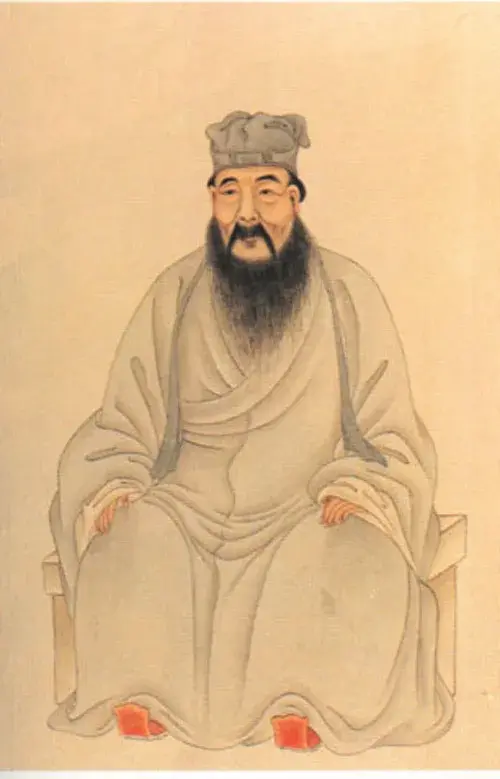
颜元
Yan Yuan (April 27, 1635 – September 30, 1704), originally named Zhu Bangliang, courtesy names Yizhi and Hunran, art name Xizhai, was a native of Beiyang Village, Boye County, Baoding Prefecture, Zhili. He was an epoch-making early Enlightenment philosopher, materialist thinker, and pioneering educator during the Ming-Qing transition, celebrated as the founder of the Yan-Li School. Experiencing intense early privations, Yan…
Yan Yuan (April 27, 1635 – September 30, 1704), originally named Zhu Bangliang, courtesy names Yizhi and Hunran, art name Xizhai, was a native of Beiyang Village, Boye County, Baoding Prefecture, Zhili. He was an epoch-making early Enlightenment philosopher, materialist thinker, and pioneering educator during the Ming-Qing transition, celebrated as the founder of the Yan-Li School. Experiencing intense early privations, Yan was adopted into the Zhu household in childhood, studying medicine, fencing, and military strategy. In his youth, he underwent a profound intellectual evolution, moving from Lu-Wang mind learning to Cheng-Zhu Neo-Confucian orthodoxy. At age thirty-four, while mourning his adoptive grandmother in strict accordance with Zhu Xi's Family Rituals, he suffered severe physical collapse and nearly died. This traumatic ordeal triggered an intellectual epiphany: recognizing that Song Neo-Confucianism strangled vitality through sterile contemplation, he severed ties with the tradition. He subsequently formulated an empirical system centered on "learning through practice" (xihang), concrete substance, and practical utility. Emphasizing that "motion generates life while quietude brings sinking stagnation," he launched fierce attacks against quiet sitting and the eight-legged civil service examination essay. At age fifty, he traveled thousands of miles beyond Shanhai Pass to locate his long-lost father's remains and restored his ancestral surname Yan. In 1696, he presided over the Zhangnan Academy, organizing revolutionary practical departments in military arts, astronomy, hydraulics, mathematics, and agriculture, anticipating modern vocational and scientific curricula. His lifetime philosophy was codified in Si Cun Bian, standing as a towering monument of pragmatic empiricism in Chinese intellectual history.
Born in Beiyang Village, Boye County, Zhili; adopted into the Zhu family of Lixian, taking the name Zhu Bangliang.
Qing troops raid the capital region; his father Yan Chang flees beyond the Great Wall, leaving Yan with his adoptive grandfather.
Studies traditional medicine, military treatises, swordsmanship, and Daoist breathing exercises.
Studies the recorded sayings of Lu Jiuyuan and Wang Yangming, embracing the unity of knowledge and action.
Reads Xingli Daquan and converts to Cheng-Zhu Neo-Confucianism, practicing quiet sitting and mental control.
Collapses from severe hemorrhage while strictly observing Zhu Xi's mourning rituals; rejects Neo-Confucianism to establish practical empiricism.
Travels alone beyond Shanhai Pass to recover his father's remains, restoring his ancestral surname Yan.
Appointed master of Zhangnan Academy in Feixiang, establishing six practical departments before floods destroy the school.
Dies at his home in Beiyang Village at age seventy; his disciples confer the posthumous name Master Wengong.
Yan Yuan was born on April 27, 1635, in Beiyang Village, Boye County, Baoding Prefecture, Zhili. Owing to dire family poverty, his father Yan Chang was adopted into the family of Zhu Jiuzuo, a local military official in neighboring Lixian County, resulting in Yan Yuan being named Zhu Bangliang.
In the winter of 1638, Qing armies breached the northern frontier and ravaged the metropolitan province. Taking advantage of the confusion, Yan Chang fled with the troops beyond the Great Wall, severing all contact with his family. Several years later, Yan Yuan's birth mother remarried, leaving young Yan behind in the Zhu household. His adoptive grandfather Zhu Jiuzuo held regional military commands, demonstrating a fierce temperament and deep dedication to militia readiness. Accompanying his grandfather to Lixian, young Yan witnessed firsthand the looting and panicked retreats of Ming soldiers, forming an enduring hatred of martial incompetence. Consequently, Yan not only applied himself to classical learning, but studied astronomy, geography, medicine, and ancient military treatises, secretly mastering fencing, archery, and horsemanship. At fifteen, he briefly practiced Daoist internal breathing exercises, seeking spiritual immortality, but soon realized such esoteric arts were illusory and returned to the pragmatic Confucian ideal of ordering the state.
In 1658, at age twenty-four, Yan Yuan encountered the recorded sayings of Lu Jiuyuan and Wang Yangming. Intensely moved by their concepts of innate knowledge and dynamic action, he embraced the Lu-Wang school to overcome spiritual restlessness.
In 1660, at age twenty-six, Yan read the vast compendium Xingli Daquan, immersing himself in the writings of Zhou Dunyi, the Cheng brothers, Zhang Zai, and Zhu Xi. Convinced that Cheng-Zhu Neo-Confucianism possessed greater structural rigor, he repudiated his previous devotion to the Lu-Wang school and became a dedicated disciple of Cheng-Zhu orthodoxy. For several years, he conducted himself as a rigorous Neo-Confucian, sitting in daily reverent meditation, emptying his mind of worldly desires, and memorizing Zhu Xi's commentaries. However, this introspective lifestyle failed to provide genuine spiritual tranquility or practical capability. In 1668, upon the death of his adoptive grandmother, the thirty-four-year-old Yan resolved to observe filial piety with absolute fidelity to Zhu Xi's Family Rituals (Zhuzi Jiali). He followed its austere dictates to the letter: fasting continuously, wailing until he coughed blood, and neglecting his own health until he collapsed into a critical illness that left him bedridden for months.
Hovering near death, Yan experienced an intellectual transformation. He reasoned that ancient kings like the Duke of Zhou and Confucius instituted rituals to moderate grief and preserve human life, whereas Zhu Xi's rigid strictures destroyed physical survival. He realized that the Song-Ming traditions were fundamentally spurious schools that masked classical teachings with Buddhist nihilism, crippling China's vitality. Consequently, Yan severed all ties with Neo-Confucianism, resolving to build an empirical philosophy grounded in physical practice.
Having formulated his practical doctrine, Yan constructed a study in his village named Xizhai (Practice Studio), summoning students to cast aside scholastic bookworm habits in favor of agriculture and martial arts.
Nevertheless, an agonizing emotional burden continued to torment Yan Yuan: the unknown fate of his birth father. In classical Confucian ethics, failing to locate a lost father constituted a grave filial dereliction. In 1684, at the age of fifty, following the deaths of his adoptive grandparents, Yan undertook a solitary journey beyond Shanhai Pass into Manchuria to search for his parent. Traveling across the desolate terrain of Shenyang and Liaoyang with a walking staff, sleeping outdoors and enduring bitter blizzards, he painstakingly cross-examined retired garrison soldiers and banner settlements. After months of grueling inquiries, he discovered that his father Yan Chang had operated a confectionery shop in Shenyang, married a local woman, fathered a son, and died decades earlier during the Shunzhi reign.
Weeping tears of blood before his father's forgotten grave, Yan moved his stepmother and half-brother with his devotion, securing permission to exhume the remains and transport them across the passes to Zhili for ancestral burial. This heroic feat astounded the literati of northern China, who hailed his filial piety. Having fulfilled his lifelong duty, Yan formally repudiated the surname Zhu, reclaimed his birth surname Yan, adopted the given name Yuan and courtesy name Yizhi, and dedicated his remaining years to developing his philosophical school.
As his intellectual fame spread, scholars from across northern China traveled to Boye to study under him, among whom Li Gong of Lixian became his foremost disciple. Together, they established the renowned Yan-Li School.
In 1696, Diao Cheng, the magistrate of Feixiang County in Guangping Prefecture, invited the sixty-two-year-old Yan to assume the headmastership of the local Zhangnan Academy. Yan accepted enthusiastically, seizing the opportunity to institutionalize his educational ideals. He redesigned the entire academy compound, eliminating traditional halls dedicated to metaphysical lectures and civil service essay composition. In their place, he established six innovative functional departments. Under his direction, hundreds of students practiced archery, swordsmanship, firearms deployment, river conservancy calculations, and agrarian fieldwork, transforming Zhangnan Academy into the most energetic center of practical learning in northern China.
Tragically, in the autumn of 1696, only months after the academy opened, the torrential Zhang River burst its dikes. Catastrophic floodwaters submerged Feixiang, sweeping away the academy buildings and scattering the students. Contemplating the rushing waters, Yan lamented the obstacles facing practical learning and returned to Boye.
In his declining years, Yan Yuan's physical vitality deteriorated due to the lasting bodily damage inflicted by his youthful mourning ordeal, yet his intellectual resolve remained formidable.
Residing quietly in Beiyang Village, Yan closed his doors to idle visitors, focusing entirely on compiling his philosophical treatises with the assistance of disciples such as Li Gong and Wang Yuan. He synthesized his lifetime thought into the monumental Si Cun Bian, composing incisive refutations of Song-Ming Neo-Confucianism until his final days. On September 30, 1704, this fiercely independent thinker passed away serenely at the age of seventy. On his deathbed, he admonished his followers to cleave to practical action and shun hollow vanity. His disciples buried him in unadorned mourning attire, conferring upon him the private posthumous title Master Wengong.
Yan Yuan's primary historical achievement was launching the most devastating and comprehensive philosophical assault against the Cheng-Zhu and Lu-Wang traditions in Chinese intellectual history.
In ontology, Yan fiercely condemned the Song Neo-Confucian separation of principle (li) and material force (qi). He asserted the materialist proposition that "principle resides entirely within material force" and that "there is no principle outside of material force," arguing that the cosmos consists exclusively of dynamic physical matter, with principle representing merely the inherent order of physical motion. By subordinating material force to principle and denigrating physical human desires as "temperamental evil" to be extinguished, Song scholars had imported Buddhist and Daoist nihilism into Confucianism, perpetrating what Yan called "murder through abstract principle."
In epistemology, Yan overturned the introspective doctrines of quiet sitting and bookish contemplation. He argued that quiet sitting was nothing other than Buddhist meditation, which sapped human strength and fostered passive compliance. He coined the famous maxim: "How can reading books compare to learning through action? How can sitting in quiet meditation compare to managing concrete affairs!" He scathingly noted that Neo-Confucian scholars spent their lives murmuring about human nature with folded hands, only to prove utterly helpless when national crises arrived. Through treatises such as Zhuzi Yulei Ping and Sishu Zhengwu, he systematically dismantled Zhu Xi's textual authority, igniting an intellectual rebellion across early Qing thought.
To replace bankrupt Neo-Confucian metaphysics, Yan Yuan constructed an empirical system anchored in "learning through practice" (xihang), concrete substance, and practical utility.
By "xihang," Yan meant that human beings acquire genuine knowledge only through bodily participation in social practice, physical labor, and technical training. He illustrated this through lucid analogies: "If you wish to understand the zither, you must pluck its strings; if you wish to understand horses, you must hold the reins; if you wish to understand rivers, you must wade into the current." Memorizing manuals on navigation a thousand times will not prevent a person from drowning if they have never paddled a boat. Knowledge, Yan insisted, originates in the material world and can only be authenticated through dynamic bodily action.
Furthermore, Yan advanced the dynamic dialectical concept that "motion generates life, while quietude brings sinking stagnation." He maintained that all physical entities and human faculties flourish through continuous activity: physical labor stimulates vitality and mental clarity, whereas motionless seclusion breeds decay. This philosophical conviction undermined traditional literati contempt for manual work, injecting an enduring ethos of vigorous athleticism and pragmatic realism into Chinese culture.
Yan Yuan was an epochal educational reformer who dismantled the ancient monopoly of classical recitation and civil service preparation in Chinese schooling.
While presiding over the Zhangnan Academy, Yan established an empirical curriculum based on practical affairs, inaugurating the famous Six Departments: First, the Department of Literature and History, teaching the Thirteen Classics, dynastic histories, and administrative memorials to train statesmen; Second, the Department of Military Affairs, providing rigorous instruction in battle formations, astronomy, archery, fencing, and firearms to produce civil-martial leaders; Third, the Department of Technical Arts, focusing on hydraulic engineering, cartography, firearms manufacturing, mathematics, and architectural surveying; Fourth, the Department of Practical Wisdom, dedicated to agronomy, sericulture, pharmacology, and meteorological observation; Fifth and Sixth, temporary departments dedicated to Neo-Confucian theory and examination essays, which Yan explicitly maintained as transitional measures to be abolished once social conventions were reformed.
By incorporating physical labor and technical sciences into academic education, Yan created the institutional forerunner of modern vocational, military, and scientific education in China, anticipating similar European movements by nearly a century.
Beyond his philosophical and educational innovations, Yan Yuan was a seminal school founder who reshaped the landscape of early Qing thought.
In his mature years, Yan distilled his philosophy into four foundational works collectively known as Si Cun Bian: Si Cun Xing (Preserving Human Nature) attacked the dualistic division between celestial nature and physical disposition, vindicating the moral legitimacy of natural human desires and bodily vigor; Si Cun Xue (Preserving Learning) articulated the epistemological doctrine of learning through practice, exposing the historical disasters wrought by two millennia of scholastic pedantry; Si Cun Zhi (Preserving Governance) outlined visionary institutional reforms, advocating ancient well-field egalitarianism, citizen-soldier militias, and equitable taxation; Si Cun Ren (Preserving Humanity) championed vigorous, dynamic, and public-spirited moral character over quietist asceticism.
Yan's teachings resonated powerfully across northern China. His brilliant disciple Li Gong inherited his mantle, composing Yan Xizhai Xiansheng Nianpu and propagating the school across Beijing and Jiangnan. Forming the Yan-Li School, their practical learning movement formed the northern counterpart to southern luminaries like Gu Yanwu, Huang Zongxi, and Wang Fuzhi, marking the pinnacle of seventeenth-century Chinese practical philosophy.
Li Gong recorded in the Yan Xizhai Xiansheng Nianpu: "Our master arose from the northern plains, sweeping away the pedantic errors of thousands of years to align directly with the Duke of Zhou and Confucius. Emphasizing practice, concrete affairs, and real objects, he parted the clouds to reveal the blue sky, washing away three centuries of Neo-Confucian decay."
Eminent historian Qian Mu observed in his Intellectual History of China in the Past Three Hundred Years: "Master Xizhai's scholarship stood singularly vigorous and forceful in the past three centuries. His refutation of empty metaphysics and championing of dynamic action broke like sudden thunder in the dark night, shaking the human spirit."
The editors of Siku Quanshu Zongmu Tiyao commented: "Yan Yuan took empirical practice as his guiding principle, fiercely rejecting Song scholars. His discourses on human nature, history, and statecraft were entirely anchored in concrete facts, establishing an independent school followed by scholars across northern China."
Modern philosophers recognize Yan Yuan as the most militant and materialistic thinker of the early Enlightenment in China. With extraordinary courage, he shattered the spiritual shackles of feudal metaphysics, grounding philosophy in concrete social practice and manual labor. His empirical epistemology and the revolutionary curriculum of Zhangnan Academy radiated early scientific rationalism, establishing him as an enduring exemplar of pragmatic realism in Chinese civilization.
FIGURES ASSOCIATED WITH THIS DYNASTY