Birth in Guanlong
Born into the noble house of Grand Minister of Works Yan Qing, inheriting ducal rank at seven.
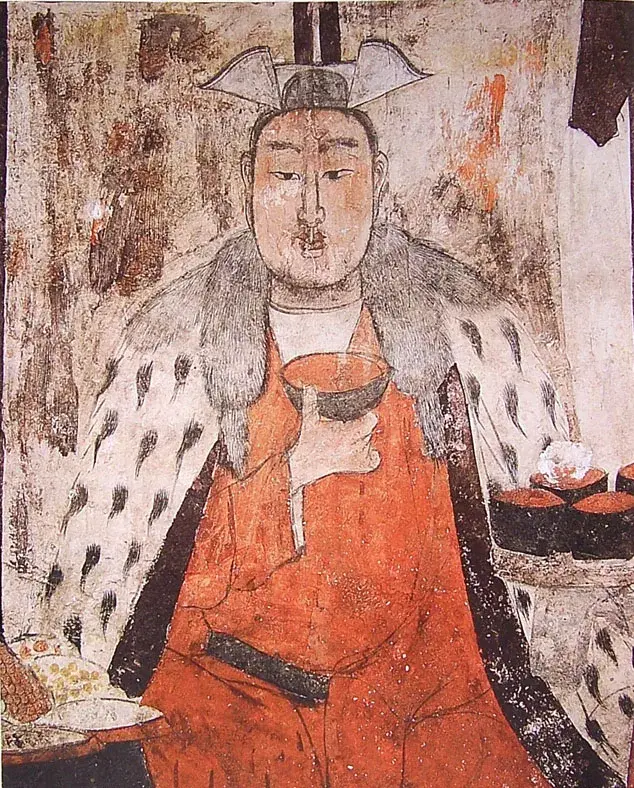
阎毗
Yan Pi (阎毗, 564–613) was a native of Shengle, Yulin (modern Horinger, Inner Mongolia), and an eminent imperial architect, mechanical engineer, and court painter active during the Northern Zhou and Sui dynasties. He is historically celebrated as the patriarch of the premier artistic lineage that produced Tang chancellors and painting giants Yan Lide and Yan Liben. Born into the paramount Xianbei military aristocracy as the son…
Yan Pi (阎毗, 564–613) was a native of Shengle, Yulin (modern Horinger, Inner Mongolia), and an eminent imperial architect, mechanical engineer, and court painter active during the Northern Zhou and Sui dynasties. He is historically celebrated as the patriarch of the premier artistic lineage that produced Tang chancellors and painting giants Yan Lide and Yan Liben. Born into the paramount Xianbei military aristocracy as the son of Northern Zhou Grand Minister of Works Yan Qing, Yan Pi inherited the noble title Duke of Shibao at age seven. Renowned for solemn demeanor, deep immersion in dynastic histories, and prodigious mechanical dexterity, he married Princess Qingdu, daughter of Emperor Wu of Northern Zhou, receiving appointment as Imperial Son-in-law Commandant and Imperial Bodyguard. Under Emperor Wen of Sui, he served as Chief of Staff in Crown Prince Yang Yong's palace guard. When Yang Yong was deposed in 600, Yan was stripped of his offices and reduced to commoner rank. Following Emperor Yang's accession in 604, the monarch recalled Yan Pi to supervise imperial civil engineering, weapon design, and Grand Canal logistics. Yan directed the renovation of imperial armaments, surveyed defensive networks along the Great Wall, dredged the Tongji Canal connecting the Yellow River with Zhuo Commandery, and supervised the construction of imperial palaces in Luoyang and Linshuo. In 609, during Emperor Yang's western expedition to Zhangye to receive twenty-seven Central Asian rulers, Yan designed magnificent mobile palace pavilions and ceremonial canopies. During the Goguryeo campaigns, he engineered military pontoon bridges across the turbulent Liao River. He passed away suddenly in office at Gaoyang in 613 at the age of fifty and was posthumously promoted to Chamberlain for the Palace Buildings with the honorable title Gong ("The Reverent"). His consummate architectural and painterly mastery laid the foundational aesthetic template for early Tang court art.
Born into the noble house of Grand Minister of Works Yan Qing, inheriting ducal rank at seven.
Wed Princess Qingdu, daughter of Emperor Wu, appointed Imperial Son-in-law Commandant and Imperial Bodyguard.
Appointed Chief of Staff of the Crown Prince's Guard under Crown Prince Yang Yong.
Deposed and stripped of noble status following the purge of Crown Prince Yang Yong.
Recommissioned by Emperor Yang as Vice Director of Palace Construction, overseeing weapon manufacturing.
Supervised the excavation of the Tongji Canal and river transport networks, promoted to Vice Director of Palace Buildings.
Engineered mobile palaces and imperial canopies for the diplomatic summit of twenty-seven Western Regions rulers.
Directed the rapid construction of military pontoon bridges spanning the Liao River during the Goguryeo campaign.
Died suddenly while organizing supply lines in Gaoyang at age fifty; honored with the posthumous title Gong.
Yan Pi was born in 564 in Shengle, Yulin, into the eminent Xianbei military aristocracy of the Western Wei and Northern Zhou. His father Yan Qing served as Pillar of the State and Grand Minister of Works, enfeoffed as Commandery Duke of Da'an. Inheriting the title Duke of Shibao at age seven with a revenue of a thousand households, Yan Pi displayed striking dignity and intense academic discipline. He studied the Book of Han under scholar Xiao Gai, mastering dynastic histories. Uniquely among young aristocrats, Yan Pi demonstrated innate genius in structural engineering, metal casting, mechanical design, and fine brushwork painting. In 577, Emperor Wu of Northern Zhou arranged the marriage of his daughter Princess Qingdu to Yan Pi, appointing him Imperial Son-in-law Commandant and Palace Imperial Bodyguard.
With the founding of the Sui dynasty in 581, Emperor Wen recognized Yan Pi's integrity and mechanical expertise, assigning him as Chief of Staff in the guard establishment of Crown Prince Yang Yong. In this post, Yan Pi was responsible for eastern palace security. However, in 600, the fierce succession struggle orchestrated by Prince of Jin Yang Guang and Grand Chancellor Yang Su culminated in Yang Yong's deposition. During the sweeping purge of eastern palace retainers, Yan was stripped of his ancestral titles and reduced to commoner rank. Over the subsequent four years, Yan lived in strict seclusion in Chang'an, immersing himself in pictorial composition, classical architecture, and mechanical drafting.
In 604, Emperor Yang ascended the throne. Ambitious to rebuild the empire's ceremonial apparatus and launch massive infrastructure projects, Emperor Yang recognized that few possessed Yan Pi's comprehensive mastery of architectural engineering and armament design. The emperor recalled Yan as Vice Director of Palace Construction, placing him in charge of state armories. The armor, crossbows, and siege engines manufactured under Yan's supervision set new standards of technical excellence. In 607, Yan supervised construction along the Great Wall. In 608, he was deployed to oversee the dredging of the Tongji Canal, ensuring seamless grain logistics from the fertile south to the northern frontier.
In 609, during Emperor Yang's grand inspection tour to Zhangye, Yan Pi was entrusted with the design and construction of mobile diplomatic pavilions, ceremonial seating, and imperial tents to accommodate the monarchs of twenty-seven Western Regions nations. His portable palatial structures, lavishly gilded and structurally ingenious, dazzled foreign rulers and won high imperial acclaim, earning him promotions to Grand Master for Court Audiences and Vice Director of the Palace Administration. In 612, during the first expedition against Goguryeo, Yan was tasked with throwing military pontoon bridges across the turbulent Liao River. Defying hostile missile fire, Yan calculated current velocities and buoyancy tolerances, completing the bridges on schedule. In 613, while directing military grain transport at Gaoyang, Yan died suddenly from physical exhaustion at age fifty. Emperor Yang expressed profound grief, posthumously promoting him to Chamberlain for the Palace Buildings and bestowing the posthumous name Gong.
Yan Pi was one of the foremost structural engineers and mechanical inventors of medieval China. During the Daye reign, he participated extensively in the planning and construction of the Eastern Capital Luoyang, the Xianren Palace, and the Linshuo Palace in Zhuo Commandery. He invented portable modular pavilions (Guanfeng Xingdian), collapsible siege towers, and counterweighted catapults. His pontoon bridge spanning the Liao River in 612 showcased extraordinary mastery in hydraulic engineering and load-bearing calculation under wartime conditions.
In the history of Chinese painting, Yan Pi holds a foundational position as the progenitor of the greatest artistic lineage of the early Tang. Excelling in figurative portraiture, imperial processions, palatial architecture, and Buddhist frescoes, his painting style synthesized Cao Zhongda's dynamic drapery with Gu Kaizhi's delicate brush control. Yan Pi personally trained his two sons, Yan Lide and Yan Liben. Yan Lide became Grand Master of Works and Minister of Works, while Yan Liben rose to Prime Minister and achieved immortal fame as one of China's paramount painters. The aesthetic lineage founded by Yan Pi directly established the grand, ornate visual language of Tang court art.
FIGURES ASSOCIATED WITH THIS DYNASTY