Life and Career
Aristocratic Lineage and Libertine Disdain
Xue Zhaoyun belonged to the prominent Hedong Xue clan, a distinguished aristocratic lineage centered in Baoding of Hezhong (modern Wanrong, Shanxi). His father, Xue Baoxun, was a noted literatus renowned across the realm for his ornate prose style and unyielding pride. Immersed in familial scholarship from childhood, Xue Zhaoyun mastered the Confucian classics and historical treatises while showing an exceptional talent for musical versification and regulated lyrics. Endowed with striking physical presence and handsome bearing, he consciously adopted the eccentric, unrestrained demeanor of the Seven Sages of the Bamboo Grove, paying little heed to rigid social conventions.
During the late 9th century, civil service recruitment continued to prize poetic composition above all else. Traveling to Chang'an, Xue Zhaoyun passed the Jinshi examination with distinction. Entering bureaucratic service, his elegant drafting style and administrative competence won the favor of leading courtiers, leading to appointments as Vice Director, Bureau Director in the Department of State Affairs, and Secretariat Drafter, positioning him prominently in metropolitan literary circles.
Directing the Examinations and Twirling the Tablet in Court
During the Guanghua era of Emperor Zhaozong, Xue Zhaoyun was elevated to Vice Minister of Rites, placing him in charge of the empire's ritual protocols and the annual imperial civil service examinations. As examiner, Xue Zhaoyun administered the examinations with strict impartiality, disregarding aristocratic pedigree to select genuine literary talent, winning widespread acclaim among scholars.
However, Xue Zhaoyun was intensely proud of his pedigree and genius, displaying an aristocratic disdain for court solemnity. While other ministers approached the throne with grave reverence and solemn decorum, Xue Zhaoyun was notorious for holding his ivory court tablet—an emblem of state authority—and twirling it carelessly in his fingers like a fan as he strode through the imperial corridors. At the same time, he would sing aloud the verses of the popular love lyric Huanxisha, utterly indifferent to the presence of high dignitaries. While conservative courtiers were scandalized, they were intimidated by his literary prestige and noble pedigree.
Following the release of the examination results, a newly graduated disciple whom Xue Zhaoyun had patronized visited his residence to bid farewell before departing for his native province. Standing respectfully before his examiner, the young scholar bowed and presented a sincere plea: "The Vice Minister possesses exalted virtue, and I have been favored with profound patronage. I have only one humble wish: if the Vice Minister would henceforth refrain from twirling his tablet and singing Huanxisha while attending the imperial court, it would be my lifelong fortune!" Xue Zhaoyun laughed heartily, warmly accepting the advice, and the episode became an enduring anecdote illustrating the eccentric freedom of late Tang literati.
Banishment as Prefect and Final Years
During the final years of the Tang Dynasty, regional warlords such as Zhu Quanzhong (Zhu Wen) and Li Maozhen waged ceaseless civil war for control of the central government. As Zhu Wen consolidated power in Chang'an, he launched brutal purges against aristocratic scholar-officials. Xue Zhaoyun, fiercely loyal to his lineage and refusing to flatter the warlord factions, repeatedly alienated dominant ministers with his caustic wit. During the Tianfu era, he was expelled from the capital and demoted to serve as a provincial Prefect.
Observing the imminent disintegration of the dynasty and the collapse of order across the Central Plains, Xue Zhaoyun abandoned political ambitions. In his provincial prefecture, he governed with quiet non-interference and channeled his remaining energies into poetry, using lyric composition to express the sorrow of exile and nostalgia for the fallen empire. He passed away in provincial retirement amidst the chaotic wars that brought the Tang Dynasty to an end.
Major Achievements
Defining the Aesthetic Elegance of the Huajian School
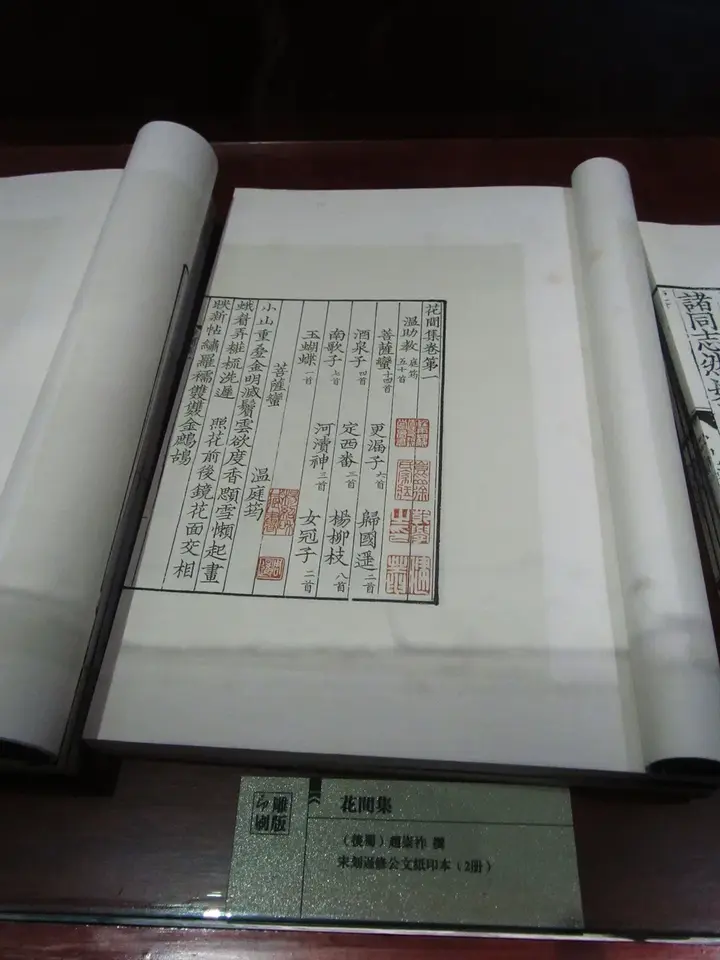
Xue Zhaoyun was a foremost practitioner of late Tang and early Five Dynasties ci poetry. When Zhao Chongzuo compiled the seminal anthology Among the Flowers (Huajian ji) in Later Shu, he selected nineteen of Xue Zhaoyun's lyrics, placing him near the very top in representation among the eighteen anthologized masters. Xue Zhaoyun's poetry captured subtle emotional nuance, particularly the delicate yearnings and quiet loneliness of noblewomen. Works such as Zui Gongzi, Ye Jinmen, and Xiangjianhuan balanced musical fluidity with crystalline imagery, capturing the gentle sorrow of spring and establishing enduring stylistic standards for feminine romance in song lyrics.
Expanding the Genre with the Examination Cycle Xiqianying
Xue Zhaoyun made a seminal contribution to the development of ci poetry by expanding its subject matter beyond secluded boudoir romance. His famous five-poem suite set to the tune Xiqianying was composed from the dual perspectives of an imperial examiner and an aspiring candidate, providing an panoramic portrait of the celebratory world of successful scholars in Chang'an. Depicting the banquets in the Apricot Garden of Qujiang and horseback parades under spring willows, lines such as "Amidst the birch-bark torches, his white robes shine anew, revealing his transformation into a dragon" injected soaring civic pride into the song lyric genre.
Eight Pieces to Huanxisha and Historical Reflections
Among his nineteen extant poems, eight were composed to the tune Huanxisha, showcasing his absolute mastery of the melody. Beyond depicting moonlit river farewells and autumn pavilions, his celebrated piece Qingguo Qingcheng Hen Youyu stands as an immortal meditation on dynastic rise and fall. Reflecting upon King Fuchai of Wu and the legendary beauty Xi Shi, the contrast between the setting sun over Wu territory and the overgrown palace ruins of Yue conveyed the author's melancholy over the collapse of the Tang Empire, investing delicate lyric verse with historical resonance.