Birth in Chang'an
Born into an official scholarly family in Chang'an; her father Xue Yun served as an imperial official.
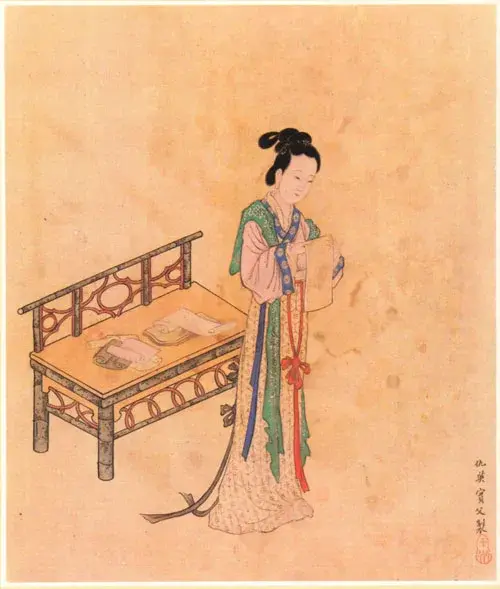
薛涛
Xue Tao (c. 768 – 832), courtesy name Hongdu, was a native of Chang'an in Jingzhao (modern Xi'an, Shaanxi Province) who accompanied her father to Sichuan in childhood and lived in Chengdu. She was an outstanding female poet, essayist, calligrapher, and papermaking innovator of the Tang dynasty, celebrated as the foremost of the "Four Great Female Poets of the Tang" (alongside Li Ye, Yu Xuanji, and Liu Caichun) and one of the…
Xue Tao (c. 768 – 832), courtesy name Hongdu, was a native of Chang'an in Jingzhao (modern Xi'an, Shaanxi Province) who accompanied her father to Sichuan in childhood and lived in Chengdu. She was an outstanding female poet, essayist, calligrapher, and papermaking innovator of the Tang dynasty, celebrated as the foremost of the "Four Great Female Poets of the Tang" (alongside Li Ye, Yu Xuanji, and Liu Caichun) and one of the "Four Talented Women of Shu." Because Wei Gao, Military Commissioner of Jiannan Xichuan, petitioned the throne to appoint her Collator at the Imperial Library (Jiaoshu Lang), she was popularly honored throughout history as the "Female Collator" (Nu Jiaoshu). Born into an official scholarly family, Xue was precocious, able to match verse lines at age eight and possessing an understanding of music and literature. When she was fourteen, her father Xue Yun contracted malarial fever during a diplomatic mission to Nanzhao and passed away, leaving mother and daughter in financial distress. At sixteen, economic hardship compelled Xue Tao to register as an official entertainer (geji) in Chengdu. In the early Zhenyuan era, Military Commissioner Wei Gao established his headquarters in Chengdu; impressed by her literary brilliance, he invited her to his staff as a private secretary and administrative drafter. Observing her prompt execution of official correspondence, Wei Gao submitted a memorial proposing her appointment as Collator at the Imperial Library. Although imperial protocol precluded women from formal bureaucratic office, her reputation as the "Female Collator" spread among the literati. Later dispatched to the frontier fortress of Songzhou over a minor dispute, Xue submitted her celebrated Ten Poems of Parting and Reflections on Being Sent to the Border, which prompted Wei Gao to recall her to Chengdu and secure her release from entertainer status. Following her release, Xue settled beside the scenic Huanhua Stream in western Chengdu. There, utilizing clear spring waters and the bast fiber of the cotton rose (hibiscus), she refined papermaking techniques to produce delicate, deep-red paper stationery cut into sizes suitable for poetry, known as "Xue Tao Paper" (Xue Tao Jian or Huanhua Paper), which became prized among literati. In the Yuanhe era, Xue met Investigating Censor Yuan Zhen in Zizhou, initiating an exchange of poetic verses. In her later years, Xue relocated to Biji Lane in Chengdu, constructing the Poetry Recitation Pavilion, adopting the robes of a Daoist nun, and living in quiet retirement. She maintained poetic exchanges with regional commissioners and literary leaders including Wei Gao, Wu Yuanheng, Li Deyu, Bai Juyi, Liu Yuxi, and Du Mu. In 832 (the sixth year of the Dahe era), Xue Tao passed away in Chengdu at approximately sixty-five years of age; Chancellor Duan Wenchang composed her epitaph, praising her literary talent. Her surviving poems, gathered in the Jinjiang Collection, stand as an enduring monument in Tang poetry.
Born into an official scholarly family in Chang'an; her father Xue Yun served as an imperial official.
Accompanied her father to Chengdu, demonstrating poetic facility at age eight in matching lines on garden paulownia trees.
Father died of illness during a diplomatic mission to Nanzhao, plunging the household into poverty.
To support her widowed mother, registered as an official entertainer with the Chengdu municipal administration at age sixteen.
Military Commissioner Wei Gao invited her into his staff headquarters as an administrative drafter and literary companion.
Dispatched to the Songzhou border garrison; composed the Ten Poems of Parting, secured her recall and release from the entertainer guild.
Wei Gao petitioned the imperial court to appoint her Collator at the Imperial Library; popularly titled "Female Collator."
Developed refined crimson poetry paper using cotton rose bark at Huanhua Stream, popularizing "Xue Tao Paper."
Met Investigating Censor Yuan Zhen in Zizhou, exchanging poetic correspondence that became a literary legend.
Moved to Biji Lane in Chengdu, building the Poetry Recitation Pavilion and adopting the unadorned robes of a Daoist nun.
Passed away in Chengdu; Chancellor Duan Wenchang composed her tomb inscription, commemorating her poetic legacy.
Xue Tao was born around 768 (the third year of the Dali era under Emperor Daizong of Tang) into an official household in the imperial capital of Chang'an. Her father, Xue Yun, was a scholar-official who served the central administration, known for his rectitude. As an only daughter, Xue Tao was educated by her father, mastering the Confucian classics, the Selections of Refined Literature (Wen Xuan), and musical performance, developing a talent for verse and calligraphy.
In the late Dali era, her father incurred the displeasure of powerful courtiers through outspoken remonstrances and was reassigned to Chengdu, the seat of the Jiannan Xichuan Military Commission. Xue Tao moved with her parents to Sichuan. Tradition records that when she was eight years old, her father sat in the courtyard admiring an ancient paulownia tree and composed an opening line to test her wit: "In the courtyard stands an ancient paulownia, its lofty trunk soaring into the clouds." Without hesitation, eight-year-old Xue Tao matched the verse: "Its branches welcome birds from south and north; its leaves bid farewell to arriving winds." Impressed by her poetic facility, her father was simultaneously unsettled, interpreting the image of accommodating traveling winds and birds as an omen of a transient, unsettled life.
In 782 (the third year of the Jianzhong era under Emperor Dezong), as relations between the Tang court and Nanzhao deteriorated, Xue Yun was dispatched on an imperial diplomatic mission to the southern kingdom. During the journey through the southwestern jungles, he contracted malarial fever and passed away soon after returning to Chengdu. Fourteen years of age at her father's death, Xue Tao and her widowed mother faced poverty. In 784 (the first year of the Xingyuan era), driven by economic necessity to support her mother, the sixteen-year-old Xue entered her name into the official entertainers' guild (leji) in Chengdu.
In 785 (the first year of the Zhenyuan era), General Wei Gao was appointed Military Commissioner of Jiannan Xichuan, establishing his headquarters in Chengdu. A patron of literature, Wei governed Sichuan for twenty-one years, supporting cultural activities.
At an official banquet, Wei Gao summoned Xue Tao to compose an extemporaneous poem on the theme A Border Horse. Xue composed the lines: "Upon the stable rail stand proud and spirited steeds, swift runners turning toward wild grasses; speak not of dust and sand having no luster, for Han generals still spur them toward painted halls." Impressed by the poem's vigor, Wei Gao realized that Xue possessed literary gifts beyond ordinary entertainment.
Wei removed her from menial entertainment duties, appointing her as a staff secretary. In this capacity, she assisted in drafting administrative memorials, military dispatches, and ceremonial correspondence. Her facility with prose and administrative competence won the respect of the military staff. Recognizing her literary abilities, Wei Gao submitted an imperial memorial proposing her appointment as Collator at the Imperial Library (Jiaoshu Lang, rank 9b).
Although the central government declined the petition due to traditional prohibitions against women holding imperial office, the honorific title "Female Collator" (Nu Jiaoshu) spread across literate society, becoming an enduring appellation for women of scholarly and literary accomplishment.
As Xue Tao's reputation spread, regional envoys, imperial commissioners, and scholars visiting Chengdu sought her acquaintance, presenting gifts of silk and gold. Xue accepted these offerings and turned them over to the public treasury or distributed them to the poor. However, her prominence aroused resentment among staff colleagues, who accused her of overstepping her position. Influenced by these reports, Wei Gao disciplined her by dispatching her to the remote military outpost of Songzhou (modern Songpan County, Sichuan).
Situated along the border of the Tibetan plateau, Songzhou was an alpine military outpost. Confronted with the hardships endured by garrison soldiers guarding the frontiers, Xue Tao observed border warfare firsthand. Reflecting on her situation, she composed Reflections on Being Sent to the Border and the Ten Poems of Parting (The Dog Parting from its Master, The Horse Leaving the Stable, The Sparrow Leaving the Nest, The Fish Leaving the Pond, The Parrot Leaving the Cage, The Swallow Leaving the Eaves, The Pearl Leaving the Palm, The Falcon Leaving the Gauntlet, The Bamboo Leaving the Pavilion, and The Mirror Leaving the Stand). Using allegorical imagery, these poems expressed gratitude for Wei Gao's patronage while lamenting her estrangement. Moved by their literary quality, Wei recalled her to Chengdu and financed her release from the entertainer registry, granting her legal status as a commoner.
Following her release, Xue moved to the banks of the Huanhua Stream west of Chengdu. At that time, scholars transcribed poetry on large sheets of paper, which was cumbersome for short regulated verses and quatrains. Living beside the stream, Xue observed the quality of the regional spring water and the fibers of cotton rose (hibiscus) trees. She experimented with papermaking techniques, beating hibiscus bark into pulp and infusing it with juice extracted from red hibiscus petals, creating a smooth, durable paper dyed deep red. Cut into compact formats suitable for poetry, this stationery became known as "Xue Tao Paper" (or Huanhua Paper), winning popularity among literati throughout the Tang empire.
In March 809 (the fourth year of the Yuanhe era under Emperor Xianzong), thirty-one-year-old Investigating Censor Yuan Zhen arrived in eastern Sichuan on an imperial judicial assignment, based in Zizhou (modern Santai, Sichuan). Having heard of Xue Tao's reputation, Yuan invited the forty-two-year-old poet to Zizhou. Sharing literary interests, the two spent months traveling, composing verses, and exchanging poems written on Xue Tao Paper. Yuan composed verses in her honor, including the lines: "The waters of Jin River are smooth and the moth-eyebrows fair, bringing forth Zhuo Wenjun and Xue Tao." However, Yuan was recalled to Chang'an, and their romantic relationship concluded as distance and social conventions intervened.
In her later years, Xue withdrew from metropolitan social life. Leaving Huanhua Stream, she moved to Biji Lane inside Chengdu, erecting the Poetry Recitation Pavilion. Adopting the simple habits of a Daoist nun, she lived in quiet retirement.
Despite her seclusion, Xue retained her standing in literary circles. During her final two decades, incoming Military Commissioners of Jiannan Xichuan—including Wu Yuanheng, Li Deyu, and Duan Wenchang—visited her pavilion to consult on regional customs and administration. Concurrently, writers such as Bai Juyi, Liu Yuxi, Du Mu, and Zhang Ji conducted poetic exchanges with her via letters on Xue Tao Paper.
In the summer of 832 (the sixth year of the Dahe era under Emperor Wenzong), Xue Tao passed away at her residence in Chengdu at approximately sixty-five years of age. Regional officials and commoners mourned her passing. Military Commissioner Duan Wenchang, twice Chancellor of the Tang Empire, composed her tomb inscription, writing the epitaph "Tomb of Xue Hongdu, Female Collator of Xichuan," praising her poetic talent and independent character, and interred her beside the Dayun Bridge east of Chengdu.
Xue Tao's primary literary achievement was liberating female classical poetry from conventional domestic laments, directing her verses toward political commentary, statecraft, and frontier military realism. Across the ninety-odd surviving poems in her corpus, her subject matter encompasses garrison warfare, administrative governance, geographical journeys, and philosophical self-expression.
In border poems such as Reflections on Being Sent to the Border, Looking from the Choubian Pavilion, and Border Songs, Xue depicted the suffering of frontier soldiers, expressing critiques of ongoing militarism and urging regional peace. In her Ten Poems of Parting and allegorical quatrains, she demonstrated classical balance, leading the Qing editors of the Siku Quanshu to observe that "her poetic style is solitary and elevated, her diction refined and graceful, and her syntax expansive, in no way inferior to the renowned masters of her era," securing her place as a major female poet of the Tang dynasty.
Beyond her poetry, Xue contributed to material culture through the invention of "Xue Tao Paper" (Xue Tao Jian). Her work represented an innovation in paper craftsmanship and stationery design.
Prior to her work, Tang paper was largely manufactured from hemp and mulberry bark in large sheets that were inconvenient for short regulated verses. Working beside Huanhua Stream, Xue utilized the bast fibers of cotton rose bark, combining them with natural floral pigments extracted from red hibiscus blossoms to produce small, smooth paper dyed a crimson hue. Sized for regulated quatrains, this stationery became popular among Tang and Song scholars, influencing the development of decorative artisanal stationery in China.
Amid the political fragmentation of the mid-to-late Tang dynasty, Xue Tao established her residence in Chengdu as an intellectual gathering place, connecting central statesmen with regional writers.
Over four decades, Xue maintained intellectual friendships with regional Military Commissioners (Wei Gao, Wu Yuanheng, Li Deyu, and Duan Wenchang), contributing insights on regional governance. Concurrently, she engaged in poetic dialogues with literary figures such as Bai Juyi, Yuan Zhen, Liu Yuxi, Du Mu, and Zhang Ji. This sustained intellectual engagement elevated the cultural standing of the Shu region within Tang literature, demonstrating the agency of women scholars in classical China.
FIGURES ASSOCIATED WITH THIS DYNASTY