Birth into a Devout Buddhist Family in Nan'an
Born in Jiancheng Village, Nan'an, Quanzhou, exhibiting exceptional early spiritual inclinations.
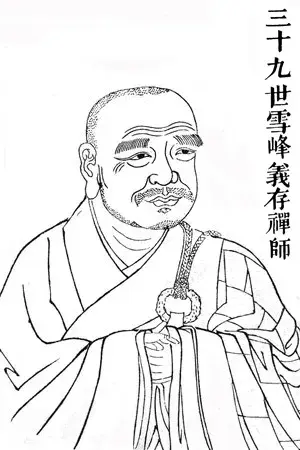
义存禅师
Chan Master Yicun (义存禅师, 822–908), secular surname Zeng, was a native of Jiancheng Village in Nan'an, Quanzhou (modern Nan'an, Fujian Province). Ordained under the monastic name Yicun, he was a preeminent Chan master during the late Tang and Five Dynasties period, the fifth-generation Dharma heir of the Qingyuan Xingsi lineage, founding patriarch of Xuefeng Zhongsheng Chan Monastery in Fuzhou, and recipient of the imperially…
Chan Master Yicun (义存禅师, 822–908), secular surname Zeng, was a native of Jiancheng Village in Nan'an, Quanzhou (modern Nan'an, Fujian Province). Ordained under the monastic name Yicun, he was a preeminent Chan master during the late Tang and Five Dynasties period, the fifth-generation Dharma heir of the Qingyuan Xingsi lineage, founding patriarch of Xuefeng Zhongsheng Chan Monastery in Fuzhou, and recipient of the imperially bestowed honorific title "Great Master Zhenjue" from Emperor Xizong of Tang. Born into a devout Buddhist family, Yicun exhibited religious devotion from an early age, expressing the wish to enter the sangha at age nine. At twelve, he accompanied his father to Yujian Temple in Putian, remaining there to study under Master Qingxuan for five years before receiving full tonsure at seventeen. During the Huichang persecution of Buddhism instituted by Emperor Wuzong of Tang, he was compelled to adopt secular attire but maintained his contemplative vows while sheltering in Mount Furong in Fuzhou. Following the restoration of Buddhism under Emperor Xuanzong, he received full monastic ordination at Baosha Temple in Youzhou in 849. He subsequently traversed extensive circuits across northern and southern China, visiting Touzi three times and Dongshan nine times, serving as head cook in the monastery of Dongshan Liangjie. At forty, he received the Dharma transmission of Deshan Xuanjian in Wuling, Hunan; later, trapped by heavy snow at Mount Ao with fellow monk Yantou Quanhuo, he achieved profound spiritual breakthrough, giving rise to the classical Chan koan of "Awakening at Mount Ao." In 870 (Xiantong Year 11), Yicun and his companion Master Xingshi climbed Mount Xianggu in Minhou, constructing a thatched hermitage that grew into Xuefeng Chan Monastery. Emperor Xizong bestowed the plaque "Yingtian Xuefeng Chan Monastery" and subsequently conferred a purple monastic robe along with the title "Great Master Zhenjue." Yicun presided over Xuefeng for four decades, attracting over 1,500 resident monks and creating the largest and most influential Chan center in southern China. Wang Shenzhi, ruler of the Min kingdom, held him in supreme veneration, frequently inviting him to the princely court and financing the relocation and expansion of the monastery to its grand Chenyang site. Yicun passed away peacefully in 908 at age eighty-seven, entombed in the Nanti Stupa. Yicun nurtured prominent masters, including Yunmen Wenyan, founder of the Yunmen school, and Xuansha Shibei, whose lineage produced Qingliang Wenyi, founder of the Fayan school. Thus, two of the historic "Five Houses of Chan" traced their origins directly to Xuefeng.
Born in Jiancheng Village, Nan'an, Quanzhou, exhibiting exceptional early spiritual inclinations.
After five years of novitiate service under Master Qingxuan at Yujian Temple in Putian, received official tonsure at age seventeen.
Forced into lay clothes during imperial anti-Buddhist campaigns, secretly persevered in ascetic contemplation on Mount Furong.
Received full monastic vows at Baosha Temple in Youzhou before undertaking decades of pilgrimage across the empire.
Received instruction from Deshan Xuanjian in Wuling and achieved complete enlightenment during a snowstorm at Mount Ao.
Ascended Mount Xianggu with Master Xingshi to clear the wilderness and establish Xuefeng Chan Monastery.
Granted the official imperial temple plaque "Yingtian Xuefeng Chan Monastery" on the imperial birthday.
Honored by imperial edict with a purple kasaya and the official honorific title Great Master Zhenjue.
Returned from Mount Siming in Zhejiang upon the invitation of Min Prince Wang Shenzhi, who funded the expansion at Chenyang.
Constructed his own funerary stone chamber on Mount Xuefeng and inscribed the Preface to the Nanti Stupa.
Passed away peacefully at age eighty-seven; Prince Wang Shenzhi dispatched his son Wang Yanbing to conduct state funeral rites.
Chan Master Yicun, secular surname Zeng, was born in the second year of the Changqing era (822) during the reign of Emperor Muzong of Tang in Jiancheng Village, Nan'an County, Quanzhou. Huang Tao's Epitaph for the Late Great Master Zhenjue of Mount Xuefeng in Fuzhou notes that his family for generations maintained spotless piety, befriending Buddhist monastics and strictly keeping precepts.
From early childhood, Yicun possessed a serene disposition, bowing instinctively whenever he encountered sacred images. At nine years of age, he pleaded with his parents for permission to enter the monastic order, though they initially declined due to his tender age. In 833, twelve-year-old Yicun accompanied his father on a pilgrimage to Yujian Temple in Putian. Captivated by the tranquil bells and monastic discipline, he refused to return home. He placed himself under Master Qingxuan, performing menial chores such as sweeping corridors and carrying well water for five years. In 838, seventeen-year-old Yicun was formally tonsured by Master Qingxuan, receiving the Dharma name Yicun.
In 845, Emperor Wuzong launched the severe Huichang suppression of Buddhism, demolishing monasteries and ordering monastics to return to lay status. Twenty-four-year-old Yicun was forced to surrender his monastic robes. Unshaken in his spiritual vows, Yicun trekked into the secluded valleys of Mount Furong north of Fuzhou, seeking shelter under Master Hongzhao (Lingxun). Performing harsh physical labor under an assumed identity, Yicun preserved his monastic resolve through national persecution.
In 847, Emperor Xuanzong rescinded anti-Buddhist edicts, revitalizing monastic institutions across the empire. The twenty-six-year-old Yicun departed Mount Furong to seek ultimate enlightenment among renowned assemblies nationwide, traveling across Wu, Yue, Chu, Liang, Song, Yan, and Qin.
In 849, twenty-eight-year-old Yicun reached Youzhou (modern Beijing), where he climbed the ordination platform at Baosha Temple to receive the full monastic precepts. Subsequently, he wandered through Jiangnan and central China. His perseverance became legendary within the tradition; records note that he visited Master Datong at Mount Touzi three times and climbed Mount Dongshan nine times to study under Dongshan Liangjie. In Dongshan's monastery, Yicun voluntarily took on the rigorous duties of head cook (tenzo), chopping wood, carrying water, and preparing meals for hundreds of monks, consistently carrying a wooden ladle on his belt as an emblem of selfless service.
In his late thirties, Yicun sought out Master Deshan Xuanjian at Mount Deshan in Wuling, Hunan, renowned for his rigorous instructional methods. One day, Yicun asked: "Do I have any share in the supreme ancestral vehicle from ancient times?" Deshan struck him with his staff, shouting: "What are you talking about!" The blow shattered Yicun's dualistic intellect, securing his formal succession in Deshan's lineage.
In the early Xiantong era, Yicun traveled with his monastic peers Yantou Quanhuo and Qinshan Wensui. Arriving at an inn at Mount Ao in Yiyang, Hunan, a ferocious blizzard blocked their mountain path, trapping them for days. While Yantou slept soundly, Yicun sat continuously in rigorous meditation. Yantou woke and yelled: "Go to sleep! Sitting there all day like a clay earth god!" Yicun pointed to his chest and confessed: "My heart is truly not at peace; I dare not deceive myself." Yantou replied: "Speak your understanding, and I will verify it." Yicun recounted his insights from Dongshan's verses and Deshan's staff, but Yantou roared: "Haven't you heard? What enters through the front gate is not the family treasure! If you wish to propagate the great teaching, it must flow directly from your own breast, covering heaven and earth!" Upon hearing this, Yicun experienced sudden, total illumination, weeping with joy and shouting: "Brother! Today, at Mount Ao, I have truly attained the Way!"
Following his awakening, Yicun returned to Fujian to teach. In 866, he dwelt in a stone cavern on Mount Furong in Fuzhou. In 870, his Dharma companion Master Xingshi entered the mountains and urged him: "Mount Xianggu possesses majestic peaks and soaring mist, an enduring sanctuary for the Dharma; why not descend to guide the multitudes of the Min region?"
Yicun, then forty-nine, climbed Mount Xianggu with Xingshi. Observing the mountain's snowy canopy, he renamed it Mount Xuefeng ("Snow Peak"). North of Yingliang Terrace, he cleared brush and felled trees to construct a thatched hall. Attracted by his profound teaching, local gentry and officials contributed generously, transforming the mountain into an immense monastic complex over six years.
In 875, construction was completed. Coinciding with the imperial celebration of Emperor Xizong's birthday (the Yingtian Festival), the court decreed that the monastery be named "Yingtian Xuefeng Chan Monastery." In 882, Emperor Xizong granted Yicun an imperial purple kasaya and the official title "Great Master Zhenjue."
Presiding over Xuefeng for forty years, Yicun synthesized agricultural labor with Chan meditation, establishing strict monastic codes. Monks from across the empire flocked to his mountain. The resident community exceeded 1,500 monks, establishing Xuefeng as the paramount Chan center in southern China.
During the late Tang, the Huang Chao Rebellion and regional warfare engulfed China, spreading into Fujian. In 891, amidst regional disorder, seventy-year-old Yicun led disciples to seek refuge in the Siming Mountains of Ningbo, Zhejiang. Deep in Siming, Yicun constructed another thatched hut (later Xuefeng Hermitage), lecturing on the Mahayana and guiding countless lay followers.
In 894, Wang Chao and Wang Shenzhi pacified Fujian, establishing an orderly regional realm (the Min kingdom). Wang Shenzhi, a devout patron of Buddhism, learned that Master Yicun had retreated to Zhejiang and immediately dispatched envoys with gifts to escort him back to Fuzhou.
Upon Yicun's return, Prince Wang Shenzhi received him with discipleship ceremonies, frequently accommodating him in the princely mansion to seek guidance on statecraft and spiritual liberation. Wang Shenzhi contributed immense treasury funds to relocate and expand the monastery to the spacious Chenyang plateau (the current site of Xuefeng Zhongsheng Temple), erecting grand halls, casting colossal bronze bells, and carving sacred statues, vastly enhancing Xuefeng's monastic splendor.
In 903, sensing his eventual passing, eighty-two-year-old Yicun directed stone masons to erect a funerary chamber behind the monastery, naming it the Nanti Stupa and personally composing the Preface to the Nanti Stupa. He wrote: "Though parting has not yet arrived, what harm is there in preparing beforehand? Stacking stones to form a chamber, cutting wood to join the casket, lying across the mountain facing north. May my fellow practitioners not violate my wish when the time comes."
On June 4, 908 (2nd Day of the 5th Month, Kaiping Year 2 of Later Liang), Chan Master Yicun passed away peacefully on his right side at Xuefeng Monastery at the age of eighty-seven, having completed fifty-nine monastic years. Prince Wang Shenzhi mourned deeply, sending his son Wang Yanbing to preside over state funeral rites. Over 5,000 monks, nuns, and lay followers gathered to witness his entombment in the Nanti Stupa.
Yicun produced an extraordinary assembly of Dharma successors. Among his fifty-six primary heirs, the most prominent were Yunmen Wenyan and Xuansha Shibei. Yunmen Wenyan established the Yunmen school, while Xuansha Shibei transmitted the lineage that led to Qingliang Wenyi, founder of the Fayan school. Thus, two of the traditional Five Houses of Chan traced their lineage back to Xuefeng, cementing Mount Xuefeng's historic status as a fountainhead of Chinese Chan.
Maintained unwavering monastic commitment during the Huichang suppression, sheltering in Mount Furong in lay disguise to preserve the Dharma.
Demonstrated exemplary religious fortitude, providing foundational leadership for the monastic revival during the Dazhong era.
Undertook decades of austere monastic pilgrimage, serving as head cook under Dongshan Liangjie and receiving staff blows from Deshan Xuanjian.
Achieved decisive spiritual liberation during a snowstorm at Mount Ao under the guidance of Yantou Quanhuo, creating a legendary Chan koan.
Founded Xuefeng Chan Monastery on Mount Xianggu in 870, building a major spiritual complex through six years of dedicated construction.
Presided over Xuefeng for four decades, hosting over 1,500 monastics and establishing the premier Chan monastic institution in southern China.
Received an imperial purple kasaya and the title Great Master Zhenjue from Emperor Xizong of Tang in 882.
Venerated by Prince Wang Shenzhi of Min, securing royal sponsorship to expand the monastery at its Chenyang site.
Trained fifty-six prominent Dharma heirs, including Yunmen Wenyan, Xuansha Shibei, Changqing Huileng, and Gushan Shenyan.
Provided the direct ancestral lineage for both the Yunmen and Fayan traditions, establishing Mount Xuefeng as an immortal sanctuary of medieval Chan.
FIGURES ASSOCIATED WITH THIS DYNASTY