Birth in Shaoxing
Born on the 4th day of the 2nd month in Dacheng Hermitage East, Shanyin; his father served as assistant prefect.
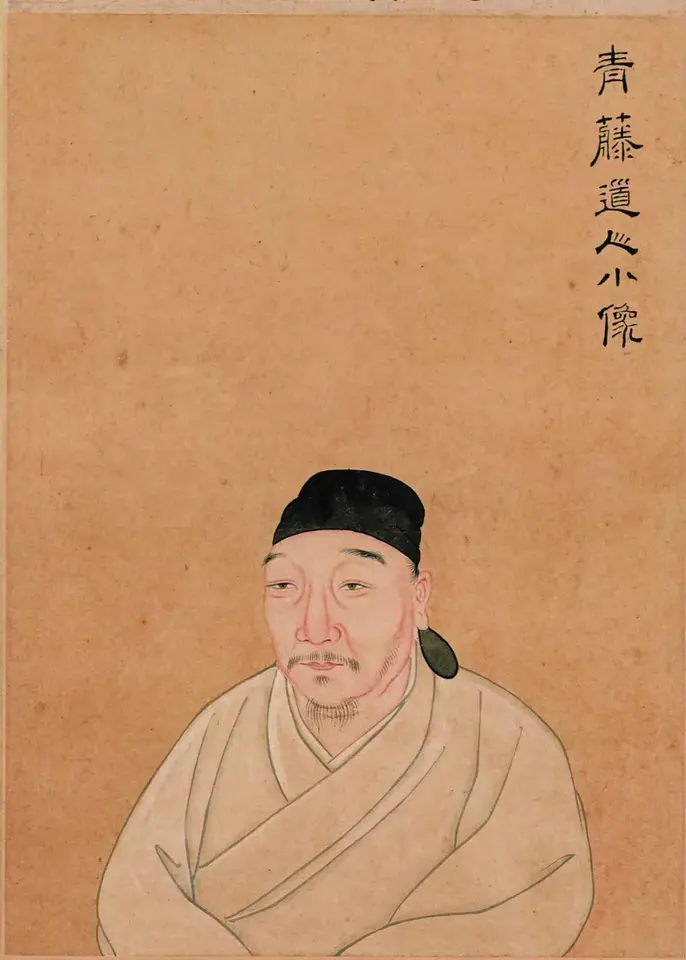
徐渭
Xu Wei (徐渭, March 12, 1521 – 1593, also known as Xu Wenchang and Qingteng Laoren), courtesy name Wenchang, art names Qingteng Daoshi and Tianchi Shanren, was a native of Shanyin County, Shaoxing Prefecture. He was a monumental man of letters, painter, calligrapher, dramatist, and military strategist of the middle-to-late Ming dynasty, celebrated as the founding father of the Chinese great splash-ink freehand flower-and-bird…
Xu Wei (徐渭, March 12, 1521 – 1593, also known as Xu Wenchang and Qingteng Laoren), courtesy name Wenchang, art names Qingteng Daoshi and Tianchi Shanren, was a native of Shanyin County, Shaoxing Prefecture. He was a monumental man of letters, painter, calligrapher, dramatist, and military strategist of the middle-to-late Ming dynasty, celebrated as the founding father of the Chinese great splash-ink freehand flower-and-bird painting style (daxieyi), the founder of the Qingteng Painting School, and honored alongside Xie Jin and Yang Shen as one of the Three Great Geniuses of the Ming Dynasty. Endowed with astonishing genius from childhood, Xu was hailed as an intellectual prodigy, demonstrating photographic memory, deep mastery of classics, and martial strategy. Yet his life was beset with tragic misfortunes: orphaned as an infant, his biological mother was cruelly expelled from the household, and his civil service ambitions were crushed through eight successive failures in the provincial examinations. In 1558, Supreme Commander of Zhejiang and Fujian Hu Zongxian, admiring his genius, recruited him as chief secretariat advisor. Within the military headquarters, Xu served as Hu's premier strategic counselor, formulating the grand strategy of pacifying the wokou pirate incursions, participating in the elimination of pirate chiefs Xu Hai and Wang Zhi, and composing the celebrated Memorial on Presenting the White Deer that dazzled Emperor Shizong. Following the downfall of Grand Secretary Yan Song, Hu Zongxian was imprisoned and committed suicide in 1565. Traumatized by political terror and grief, Xu suffered acute mental derangement, attempting suicide nine times through gruesome acts of self-mutilation, including hammering an iron nail into his ears and battering his skull with an axe. In 1566, during a paranoid psychotic delusion, he struck and killed his second wife, resulting in a death sentence and seven years of harsh imprisonment. Exonerated under an imperial general amnesty in 1573 through the persistent efforts of prominent friends Zhu Dashou and Zhang Yuanbian, Xu traveled to the northern frontier at Xuanhua before retreating permanently to the Qingteng Studio in Shaoxing. In his final years, destitute, crippled, and fiercely defiant, he lived by bartering paintings for daily food, passing away at seventy-three. In artistic and literary creativity, Xu Wei achieved a revolutionary peak in classical Chinese culture. His splash-ink flower-and-bird paintings broke all academic constraints, utilizing turbulent, calligraphic brushstrokes and uninhibited ink washes to express profound tragic indignation, directly inspiring masters Bada Shanren, Shitao, and modern titans Qi Baishi and Pan Tianshou. His dramatic masterpiece Four Cries of an Ape (Si Sheng Yuan) shattered theatrical conventions through biting satire, hailed by Tang Xianzu as the work of a supreme theatrical general. His treatise Account of Southern Drama (Nanci Xulu) was China's first theoretical study of southern opera, while his poetry championed authentic emotion against rigid archaism, directly catalysing Yuan Hongdao's Gong'an School of literary liberation.
Born on the 4th day of the 2nd month in Dacheng Hermitage East, Shanyin; his father served as assistant prefect.
His father having died in infancy, his concubine mother was expelled by his legal mother, inflicting lifelong trauma.
Despite youthful fame as a prodigy, became a county school licentiate at twenty; subsequently failed eight provincial exams.
Entered a matrilocal marriage with the prominent Pan family; his father-in-law Pan Kejing cherished his literary genius.
Lost his elder brother to poisoning and his beloved wife to illness; impoverished, opened a teaching studio at Qingteng.
Recruited by Supreme Commander Hu Zongxian as chief secretariat advisor, drafting famous memorials on the white deer.
Hu Zongxian committed suicide in imperial prison; Xu fell into profound psychosis and attempted suicide nine times.
In a paranoid frenzy, killed his second wife; sentenced to death and imprisoned in Shaoxing jail for seven years.
Pardoned under an imperial accession general amnesty through the strenuous interventions of Zhu Dashou and Zhang Yuanbian.
Traveled to the northern frontier at Xuanhua upon the invitation of Governor-General Wu Dui, inspecting border fortresses.
Passed away in poverty upon his bamboo couch in Shaoxing, guarded only by a faithful dog; buried by loyal friends.
Xu Wei was born on March 12, 1521, in the ancestral mansion of the Xu lineage east of Dacheng Hermitage in Shanyin County, Shaoxing Prefecture. His father, Xu Cong, had served as Vice Prefect of Kuizhou in Sichuan. Xu Cong's first wife bore two elder sons, Xu Huai and Xu Lu, while his second wife had no issue; in his twilight years, he took a concubine who gave birth to Xu Wei. When Xu was merely one hundred days old, his father passed away, leaving the infant to be raised by his legal stepmother, Lady Miao.
In 1530, when Xu was ten, the family fortune experienced severe decline. To curtail household expenditures, Lady Miao ruthlessly expelled Xu's biological mother from the estate. The helpless boy wept bitterly as his mother was cast out, an agonizing trauma that permanently scarred his psyche, fostering an intense, hypersensitive, and defiant emotional nature. In 1535, Lady Miao died, leaving fourteen-year-old Xu dependent upon his eldest brother, Xu Huai. Xu Huai, thirty years his senior and consumed by Daoist alchemy, displayed little fraternal warmth, subjecting young Xu to the bitter indignities of familial dependence.
Despite acute emotional deprivation, Xu displayed staggering intellectual precocity. He began formal reading at six, composed finished classical essays at nine, and authored Refuting Slander (Shi Hui) in his early teens in emulation of Yang Xiong's classical treatises. Regional scholars were astounded, hailing him as a divine prodigy and comparing him to Yang Xiu of the Eastern Han and Liu Yan of the Tang dynasty. As an adult, Xu was tall, robust, and pale-complexioned, his voice ringing out like the cry of a crane, frequently climbing high pavilions at midnight to shout into the wind, venting deep-seated existential angst.
In 1540, at the age of twenty, Xu passed the qualifying examinations to become a licentiate in the Shanyin county school, consistently ranking first in academic evaluations. The following year, impoverished and lacking land, he accepted a matrilocal marriage into the household of local gentry scholar Pan Kejing. His father-in-law recognized his peerless genius and provided him with comfortable lodgings. Xu and his wife Lady Pan enjoyed deep mutual affection and harmony, living through a brief period of intellectual peace.
However, in the civil service examination hall, Xu met with relentless failure. The Jiajing examinations strictly enforced rigid eight-legged conventions and orthodox Neo-Confucian commentaries, whereas Xu's prose was uninhibited, audacious, and fiercely individualistic, regularly dismissed by conservative examiners as dangerously eccentric. Between ages twenty and forty-one, Xu sat for the provincial examinations eight consecutive times, meeting with disappointment on every attempt.
Compounding this failure, domestic tragedies struck in rapid succession. In 1545, his elder brother died from consuming alchemical elixirs, and rapacious creditors seized the family estate. The following year, his beloved wife passed away from illness at twenty-one. Devastated, Xu was forced to vacate the Pan residence and return to his dilapidated ancestral dwelling, where he planted a flowering wisteria vine, naming his retreat the Qingteng Studio. To support himself and his dependents, he opened a private school, selling paintings and drafting letters while enduring grinding poverty.
During the mid-Jiajing era, the southeastern coastline was ravaged by pirate warlords Wang Zhi and Xu Hai, who coordinated Japanese raiders to sack coastal counties. In 1556, military commander Hu Zongxian was appointed Supreme Commander of Zhejiang and Fujian. Seeking extraordinary strategists, Hu learned of Xu's towering intellect and military acumen, personally visiting his retreat in 1558 to recruit him as chief secretariat advisor.
Xu accepted the summons, becoming Hu's premier strategic confidant. Addressing the pirate crisis, Xu formulated the overarching strategy of tactical subversion, sowing internal discord among pirate factions, and employing economic enticements to destroy their alliances. This strategic blueprint enabled Hu to eliminate Xu Hai and capture Wang Zhi, pacifying the maritime coast. Within the command headquarters, though a commoner in plain hemp robes, Xu displayed an unbending pride; Hu treated him with exceptional deference, postponing critical decisions until Xu had deliberated upon them.
In late 1558, Hu captured a rare white deer in Zhejiang and resolved to present it as an auspicious omen to Emperor Shizong, an ardent patron of Daoist immortality rituals. The exquisite and spiritually resonant Memorial on Presenting the White Deer and its subsequent acknowledgment memorial were drafted by Xu Wei. Enchanted by the magnificent rhetoric, the emperor praised the memorial enthusiastically and inquired after its author. Xu's literary renown resounded across the imperial court, and he believed his administrative talents had finally found national scope.
This period of influence proved fleeting. In 1562, Grand Secretary Yan Song fell from imperial grace, and his son Yan Shifan was executed. Because Hu Zongxian had been compelled to coordinate military finances through Yan Song, he was subjected to fierce impeachment by censorate officials. Although temporarily spared due to his military triumphs, Hu was rearrested in 1565 and cast into the imperial prison in Beijing, where he committed suicide by poison.
Hu's tragic demise dealt Xu an annihilating psychological blow. As Hu's most confidential secretary who had penned imperial memorials, Xu lived in mortal dread of immediate arrest and execution by the Embroidered Uniform Guard. Crushed under intense fear, grief, and despair, Xu's psychological equilibrium shattered, plunging him into acute psychotic depression and paranoid delusions.
In this crazed state, Xu experienced violent impulses toward self-destruction, attempting suicide nine times. He drove an iron nail several inches long into his ears, surviving despite profuse cranial bleeding; he pounded his scrotum with an iron mallet, tearing flesh and spilling blood; and he battered his skull with an axe, fracturing the bone. Miraculously surviving these lethal wounds through iron constitution, his mental health remained permanently destabilized by volatile paranoia.
In late 1566, plagued by chronic hallucinations and nervous exhaustion, Xu met with catastrophic disaster. His second wife, Lady Zhang, possessed a proud temperament, and marital arguments were frequent. During an episode of intense psychotic paranoia, Xu suffered a delusion that his wife was committing adultery, and in a frenzy of madness, he seized a wooden vessel and struck her to death.
The uxoricide stunned Shaoxing. Under the Great Ming Code, uxoricide was punishable by decapitation. Xu was arrested and cast into the condemned death cells of Shaoxing prison. From a celebrated prodigy and vice-regal advisor, he was reduced to a chained convict awaiting execution. Over seven years in the damp dungeon, he suffered from biting cold, pestilential stench, and the heavy weight of wooden neck-cangues.
Yet within this abyss of suffering, Xu's lucidity returned. Channeling repentance and anguish into scholarship, he edited his collected poetry and prose, compiled his biographical chronicle Ji Pu, and wrote extensive commentaries on the Daoist internal alchemy classic Cantong Qi. Outside prison, his close friends—including Vice Minister of Rites Zhu Dashou and Hanlin Compiler Zhang Yuanbian—campaigned tirelessly for his life. In early 1573, upon the accession of Emperor Shenzong, a general amnesty was declared, and through the personal guarantees of Zhang Yuanbian, fifty-two-year-old Xu was released from the death cell.
Emerging from prison, white-haired and physically broken, Xu refused to remain in Shaoxing amidst social censure. In the summer of 1576, his former classmate Wu Dui, then Governor-General of Xuanhua and Datong, invited him to the northern border. Xu traveled north beyond Shanhai Pass and the Great Wall to enter Wu Dui's frontier military staff.
At fifty-six, Xu experienced a brief resurgence of youthful martial vigor. Riding warhorses across windswept dunes and inspecting Great Wall watchtowers, he composed stirring frontier ballads. Later, moving with the headquarters to Beijing, high ministers such as Zhang Jiayin and Wang Xijue sought his acquaintance. However, having seen through worldly vanity, Xu despised the condescension of grandees, publicly insulting powerful ministers at banquets before shaking his sleeves and returning south to Shanyin in 1581.
In his final decade at Qingteng Studio, crippled by arthritis and abandoned by society, Xu guarded his artistic integrity with fierce pride. Whenever he possessed modest funds, he shut his doors against visitors; only when supplies ran out did he wield his brush to barter artwork for grain. When wealthy grandees arrived with gold, he cursed them from behind bolted doors; yet when humble commoners brought a jug of wine, he welcomed them warmly and painted freely. In 1593, amidst cold winds and rain, seventy-three-year-old Xu passed away on his rustic wooden couch. In his bare chamber, guarded only by a howling dog, the supreme artistic genius concluded his tragic earthly pilgrimage.
Xu Wei occupies an incomparable pinnacle in Chinese art history as the founding father of the great splash-ink freehand flower-and-bird painting style (daxieyi). Prior to Xu, flower-and-bird painting had evolved through Song fine-brush realism and mid-Ming scholar styles like Shen Zhou and Chen Chun, which remained restrained by objective physical likeness.
Xu broke through all conventional geometric formulas with revolutionary boldness. Executing paintings purely in ink on raw xuan paper, he incorporated the wild cursive script (kuangcao) into brushwork, applying broad, explosive washes of wet ink alongside dry, splintered lines. His depictions of wild grapes, lotus stems, banana leaves, and plum branches were executed with breathtaking speed and volcanic energy, achieving majestic psychological resonance.
Refusing to imitate outward physical form, Xu poured his tragic suffering, isolated pride, and existential fury directly into his brushwork, realizing the supreme aesthetic principle of capturing living spiritual essence beyond literal likeness. His masterpiece Ink Grapes features an autobiographical poem: "Half a lifetime of desolation, I have grown old; standing alone in my studio, whistling in the evening wind. The pearls beneath my brush find nowhere to sell; cast carelessly away among wild wisteria vines." Later, Dong Qichang praised his brush as flying like lightning, while early Qing masters Bada Shanren and Shitao derived their aesthetic breakthroughs from his lineage. Mid-Qing master Zheng Xie carved a seal reading "Runaway Dog at the Gate of Qingteng," and modern titan Qi Baishi famously lamented that he wished he had been born three centuries earlier to serve as a humble servant grinding ink for Master Qingteng.
In dramatic literature, Xu was an epochal innovator. His dramatic collection Four Cries of an Ape (Si Sheng Yuan)—consisting of The Wild Drummer, The Jade Zen Master, The Female Mulan, and The Female Top Scholar—completely overturned the didactic conservatism of mid-Ming theater.
In The Wild Drummer (Kuang Gu Shi), Xu dramatized the Han eccentric Mi Heng performing the Yuyang drum roll in the Netherworld to berate the tyrant Cao Cao, using thunderous drumming and ferocious invective to channel his fury against Grand Secretary Yan Song's corrupt regime. In The Female Mulan and The Female Top Scholar, Xu displayed an astonishingly progressive feminist consciousness, glorifying women who broke through patriarchal constraints to lead armies and excel in statecraft.
Four Cries of an Ape combined caustic satire with musical majesty. Master playwright Tang Xianzu praised the work: "Four Cries of an Ape is truly a flying general of the theatrical field, leaving all other dramatists stunned and speechless!" The drama inaugurated the late Ming movement celebrating genuine emotion and dismantling dogmatic moralism.
Beyond theatrical composition, Xu was a foundational theorist of traditional Chinese drama. His treatise Account of Southern Drama (Nanci Xulu) was the first systematic monograph in Chinese history dedicated to the history, phonological laws, and aesthetic criticism of southern opera (nanxi).
In Account of Southern Drama, Xu overturned traditional literati disdain toward southern theater, tracing its historical roots from Song dynasty Wenzhou through the Yuan and Ming. He meticulously categorized musical modes, lyric meters, and stage role conventions. Most significantly, Xu formulated the foundational aesthetic doctrine of "natural authenticity" (bense), insisting that dramatic language must reflect living colloquial vernacular rather than pedantic classical embellishment. The text preserved invaluable historical documentation, establishing modern Chinese theatrical criticism.
In literary thought, Xu was the premier vanguard who broke the stranglehold of archaistic imitation, pioneering the late Ming revolution of individualistic literature. During the Jiajing and Wanli eras, the Later Seven Masters dominated the literary sphere, enforcing dogmatic imitation of Qin-Han prose and High Tang poetry, filling the empire with lifeless pastiches.
Xu fiercely resisted this orthodoxy, championing the doctrine of "revealing authentic natural selfhood" (benzhen). He compared literary imitation to parrots copying human speech, arguing that literature must flow spontaneously from genuine individual agony and joy. His poetry and prose exhibited fierce originality, biting humor, and monumental emotional depth.
In 1597, literary leader Yuan Hongdao discovered a fragment of Xu's poetry collection, exclaiming in ecstatic awe that Xu was the foremost literary genius of the Ming dynasty and composing the renowned Biography of Xu Wenchang. Inspired by Xu's vision, Yuan and his brothers established the influential Gong'an School, raising the banner of "expressing native sensibility without conforming to rigid conventions." Xu's literary revolt dismantled Ming archaism, inaugurating the great renaissance of expressive individualistic literature.
In calligraphy, Xu made an epochal breakthrough that transformed late Ming aesthetics. Proud of his calligraphic prowess, he declared: "My calligraphy is foremost, my poetry second, my prose third, and my painting fourth." He shattered the rigid constraints of bureaucratic script (taigeti) and the gentle elegance of the Wu School, unleashing a monumental, turbulent style of wild cursive script (kuangcao).
Drawing upon Mi Fu, Huang Tingjian, and Huaisu, Xu maintained that copying ancient masters was merely an exercise in spiritual communion rather than literal replication. His running and cursive scripts feature dramatic spatial tensions, sweeping brush strokes, and sudden variations between concentrated ink and flying-white dryness. Tao Wangling praised his calligraphy as peerless in the Ming dynasty, while Yuan Hongdao hailed him as "the untrammeled saint of the eight methods, the wandering knight of the forest of characters." By fusing cursive brushwork with freehand ink painting, Xu laid the foundational groundwork for late Ming expressive calligraphy.
FIGURES ASSOCIATED WITH THIS DYNASTY