Birth in Luotian
Born into an impoverished commoner family in Luotian County; peddled cotton cloth across regional markets in youth.
徐寿辉
Xu Shouhui (徐寿辉, 1320–1360), also known as Xu Zhenyi, was a native of Duoyun Township in Luotian County, Qizhou (present-day Jiuzihe Town, Luotian County, Hubei Province). He was the supreme paramount leader of the southern Red Turban Army during the chaotic collapse of the Mongol-led Yuan Dynasty and the founding emperor of the insurgent Tianwan regime. In his early years, Xu earned a modest living as an itinerant cloth…
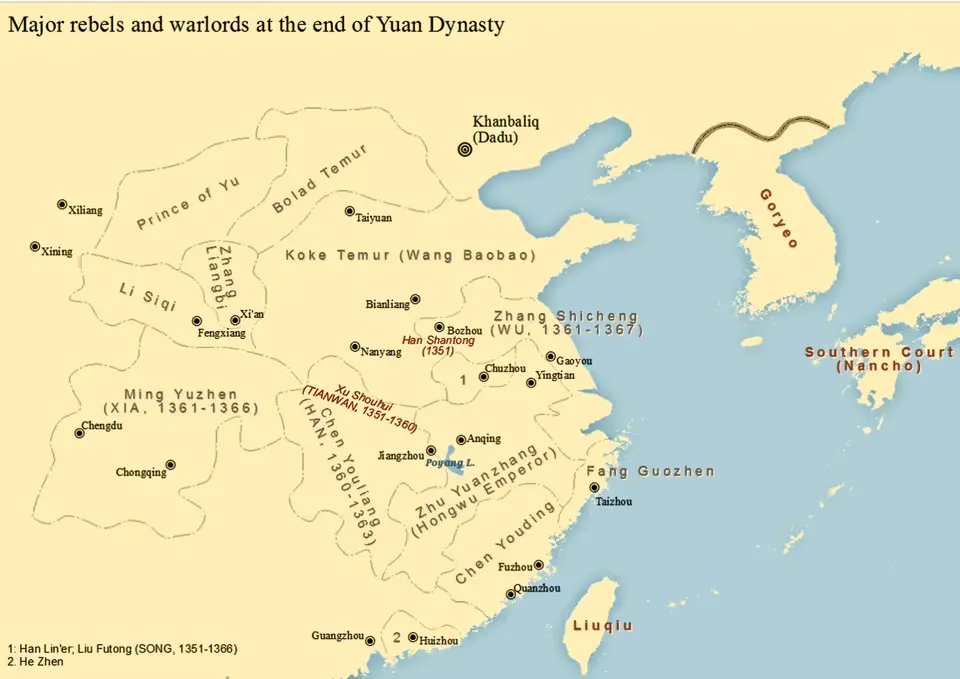
Xu Shouhui (徐寿辉, 1320–1360), also known as Xu Zhenyi, was a native of Duoyun Township in Luotian County, Qizhou (present-day Jiuzihe Town, Luotian County, Hubei Province). He was the supreme paramount leader of the southern Red Turban Army during the chaotic collapse of the Mongol-led Yuan Dynasty and the founding emperor of the insurgent Tianwan regime. In his early years, Xu earned a modest living as an itinerant cloth peddler. Renowned for his imposing physical stature, dignified countenance, and open-handed benevolence, he developed wide connections among rural folk and disaffected outlaws across the Dabie Mountains. In the autumn of 1351, amidst widespread agrarian distress, Xu forged an alliance with Macheng ironsmith Zou Pusheng and White Lotus preceptor Peng Yingyu, raising the standard of rebellion at Tiantangzhai under red banners. Tens of thousands of impoverished peasants rallied to their cause within days. In October 1351, the insurgents captured Qishui, where Xu was formally proclaimed emperor of the Tianwan regime, inaugurating the Zhiping reign era and establishing the first major rebel state apparatus in southern China. Following Tianwan's establishment, Xu promulgated the egalitarian program of "suppressing the wealthy to benefit the impoverished." Dispatching accomplished generals including Ding Pulang, Xiang Pulüe, Ou Puxiang, and Zhao Pusheng on divergent strategic axes, Tianwan forces rapidly took Hanyang and Wuchang, overrunning strategic territories across Hubei, Jiangxi, Anhui, Zhejiang, Jiangsu, and Hunan, amassing an army approaching one million and shattering the foundations of Yuan authority in the south. When a multi-pronged Yuan counter-offensive sacked Qishui in late 1353, Xu led survivors into guerrilla sanctuaries within the marshes of Mianyang and rugged peaks of Huangmei. In 1356, the revived Tianwan forces recovered Hanyang, making it their new capital under the Taiping era. However, internal factionalism crippled the leadership; Xu was progressively marginalized and held as a figurehead sovereign by his grand chancellors Ni Wenjun and subsequently Chen Youliang. In 1360, while accompanying Chen Youliang's naval offensive against Zhu Yuanzhang, Xu was bludgeoned to death at Caishiji by iron-hammer-wielding assassins dispatched by Chen. Following his murder, southwestern rebel leader Ming Yuzhen mourned his passing, founding a memorial shrine and posthumously honoring him as Emperor Shizong.
Born into an impoverished commoner family in Luotian County; peddled cotton cloth across regional markets in youth.
Rose in rebellion at Tiantangzhai with Zou Pusheng and Peng Yingyu in August; proclaimed emperor of Tianwan at Qishui in October.
Dispatched Ding Pulang to seize Hanyang and Wuchang; captured dozens of regional prefectures across central and lower Yangtze circuits.
Besieged by a five-column imperial army; escaped into the marshes of Mianyang and Dabie peaks as four hundred officials perished.
Subordinate general Ni Wenjun recaptured Mianyang, Zhongxing, and Wuchang, revitalizing Tianwan's military infrastructure.
Established Hanyang as imperial capital, changing the reign title to Taiping; gradually held hostage by Chancellor Ni Wenjun.
Ni Wenjun attempted to assassinate Xu but fled to Huangzhou where Chen Youliang killed him; Chen seized control over Xu.
Commissioned Ming Yuzhen to lead western campaigns into Sichuan, annexing Chongqing and Chengdu; inaugurated Tianqi era and minted copper cash.
Changed reign era to Tianding; attempted to move his court to Longxing but was ambushed at Jiangzhou by Chen Youliang, becoming an outright prisoner.
Bludgeoned to death with iron hammers aboard a warship at Caishiji by assassins acting on Chen Youliang's orders; posthumously honored as Emperor Shizong.
Xu Shouhui was born in 1320 in Duoyun Township, Luotian County, Qizhou (present-day Jiuzihe Town, Luotian County, Hubei Province). Originating from a humble rural background, he lacked classical schooling and earned a modest living as an itinerant peddler carrying loads of cotton cloth between Qizhou, Huangzhou, and Macheng across the southern slopes of the Dabie Mountains. Endowed with tall stature, an imposing appearance, and an upright, congenial demeanor, Xu gained widespread respect among peasants, boatmen, and itinerant traders.
During the Zhizheng reign of Toghon Temur (Emperor Huizong of Yuan), bureaucratic corruption, ethnic discrimination, and unbridled inflation caused by the over-issue of paper currency (Zhizheng Jiaochao) devastated agrarian communities. Recurrent breaches of the Yellow River coupled with catastrophic droughts drove millions to desperation. In May 1351, Han Shantong and Liu Futong sparked the northern Red Turban Rebellion in Yingzhou. Around the same time, Zou Pusheng, an ironsmith in Macheng, secretly organized regional peasants under the eschatological White Lotus banner of the imminent advent of Maitreya Buddha, seeking a charismatic figurehead whose commanding presence matched prophetic expectations.
When Xu Shouhui brought ten pounds of iron to Zou's smithy to forge agricultural tools and casually rested upon the anvil, Zou recalled a vivid dream from the preceding night featuring a golden dragon coiled around his anvil stone. Convinced of Xu's imperial destiny, Zou cast aside his hammer and persuaded Xu to abandon farming implements for battle swords. Moved by the suffering of the common people, Xu consented. Joined by southern White Lotus master Peng Yingyu, they gathered at Tiantangzhai in August 1351, binding red cloths around their heads and initiating the southern Red Turban uprising.
Promoting the millenarian doctrine that "Maitreya Buddha descends to become sovereign of this world," the insurgent army swelled to tens of thousands within weeks. In September 1351, Xu personally led his peasant vanguard in an assault on Qishui and Huangzhou, routing the Mongolian garrison troops commanded by Prince of Weishun Kuanche Buha.
In October 1351, seeking to establish a sovereign state rivaling the Mongol empire, the insurgent commanders proclaimed Xu Shouhui emperor at Qishui. The new dynastic title was named "Tianwan," composed by adding sovereign roofs above the characters for "Da Yuan," signifying the cosmic triumph of Heaven over Mongol rule. Xu inaugurated the Zhiping era, adopted the Wanshou Calendar, and established an imperial court comprising a Lotus Terrace Secretariat (modeled after the Central Secretariat) and six administrative ministries. Zou Pusheng was appointed Grand Preceptor and Peng Yingyu Imperial Counselor, formally establishing the first sovereign rebel state in southern China during the late Yuan.
Xu instituted an egalitarian policy centered on "suppressing the wealthy to benefit the impoverished," dispatching armies across the south. In November 1351, Tianwan forces pushed into northern Jiangxi, where commander Deng Nan'er died storming Ruizhou, igniting anti-Yuan fires across Poyang Lake; concurrently, detachments took Susong, Taihu, and Qianshan in Anhui. In early 1352, general Ding Pulang took Hanyang and Wuchang. Commander Xiang Pulüe advanced eastward, taking Huizhou, Yanzhou, and briefly occupying Hangzhou. Preceptor Peng Yingyu and general Ou Puxiang swept through central Jiangxi, seizing Linjiang, Ji'an, Yuanzhou, and Fuzhou before Peng fell in combat at Ruizhou. Naval commander Zhao Pusheng swept Chaohu Lake and Chizhou along the Yangtze. Within a single year, hundreds of thousands joined Tianwan, disrupting fiscal grain shipments to Dadu.
Despite breathtaking initial conquests, the rapid expansion of Tianwan exposed critical vulnerabilities. Forces operated largely as mobile raiders, failing to consolidate local administrative machinery in newly conquered prefectures, leaving armies dangerously overextended. In response, the Yuan court mobilized five provincial armies, integrating Mongolian cavalry with local gentry militias to envelop the rebel capital.
In late 1353, prior to the enemy encirclement, Xu welcomed Suizhou insurgent Ming Yuzhen into the Tianwan fold, appointing him Grand Marshal of Expeditionary Forces, a farsighted appointment that would later preserve Tianwan's lineage in the southwest. Soon afterward, imperial armies under commanders Huo Ni'chi and Dashbadur assaulted Qishui. Xu and his garrison mounted desperate resistance, but the walls fell. Yuan troops executed widespread slaughter, martyring more than four hundred civil officials of the Lotus Terrace Secretariat. Xu and Zou Pusheng broke through enemy cordons with a modest escort, finding refuge amidst the rugged crags of Huangmei and the dense reed marshes of Mianyang.
Throughout 1354, Tianwan endured its darkest hour. Hidden in mountain hideouts and marshland creeks, Xu maintained steadfast determination. He dispatched couriers across central China to coordinate with scattered garrisons, such as Ou Puxiang in Yuanzhou, Shi Puqing in Fengxin, and Li Pucheng in Ruizhou, encouraging commanders to fortify rural stockades. Xu's enduring imperial legitimacy maintained cohesion across the southern Red Turban movement.
In 1355, circumstances turned favorable when Yuan main armies marched north to besiege Zhang Shicheng at Gaoyou. Operating from Mianyang marshes, commander Ni Wenjun launched a sudden offensive, retaking Mianyang, Zhongxing, Wuchang, and Hanyang in rapid succession, engineering a dramatic resurgence for Tianwan.
In January 1356, Xu relocated his court to Hanyang, initiating the Taiping reign era. However, internal factionalism quickly undermined the throne. Ni Wenjun claimed the office of Grand Chancellor, centralizing military command and reducing the lenient Xu to a figurehead sovereign within his own palace.
In February 1357, Xu directed Grand Marshal Ming Yuzhen to march upriver into Sichuan. Ming scored decisive triumphs, capturing Chongqing and Chengdu and establishing Tianwan's Longshu Branch Secretariat. In September 1357, Ni Wenjun attempted to assassinate Xu to seize the throne; when the plot collapsed, Ni fled to Huangzhou to seek shelter with his subordinate Chen Youliang. The ruthless Chen executed Ni on the spot, absorbed his forces, and assumed the titles of Pacification Commissioner and Manager of Governmental Affairs. Chen escorted Xu to Hanyang, but enforced even tighter armed surveillance over the emperor.
In 1358, Chen Youliang captured Longxing (present-day Nanchang). When Xu expressed an intention to move his court there to escape Chen's oversight, Chen sternly forbade it. In 1358, Xu inaugurated the Tianqi era, casting Tianqi Tongbao copper coins in Hanyang to foster trade.
In June 1359, Ming Yuzhen defeated Yuan general Li Zhongxian at Puzhou, securing Sichuan. Delighted, Xu elevated Ming to Assistant Administrator of Longshu. In October, Ming dispatched envoys laden with grain, silver, and Sichuan silks to Hanyang. Xu feasted the envoys, personally presenting Ming with a golden cup and two silver ingots while appointing him Left Chancellor of Longshu. Recognizing Chen's treachery, Ming returned Chen's imperial edicts unopened and petitioned Xu to appoint the Crown Prince as regent. In April 1359, Xu proclaimed the Tianding era, minting Tianding Tongbao currency.
In December 1359, Xu attempted to break free, setting out eastward toward Longxing. When his retinue reached Jiangzhou (present-day Jiujiang), Chen's hidden soldiers ambushed the imperial convoy, executing Xu's loyal bodyguards. Chen established his own capital at Jiangzhou, proclaimed himself King of Han, and confined Xu under house arrest.
In May 1360, Chen mobilized massive naval squadrons down the Yangtze to invade Zhu Yuanzhang's stronghold at Yingtian (Nanjing), forcing the captive Xu along on his flagship. After capturing Taiping, the fleet anchored at Caishiji. Intending to proclaim himself emperor after defeating Zhu, Chen viewed Xu's continued existence as an intolerable obstacle. On May 16, 1360, Chen sent courtiers aboard Xu's vessel under the guise of submitting official memorials. As Xu was distracted reading the scrolls, assassin brutes armed with heavy iron hammers rushed from behind and smashed Xu's skull, killing him instantly at the age of forty-one.
Chen unceremoniously cast Xu's body into the surging Yangtze currents, hastily declaring himself Emperor of Great Han before the Wutong Temple at Caishi. Upon receiving news of the murder, Ming Yuzhen and his officers wept inconsolably in Chongqing, executing Chen's messengers, burning alliances, and ordering three days of military mourning. In 1361, Ming established the Daxia state in Sichuan, building a dedicated ancestral temple for Xu and posthumously conferring the title Emperor Yingtian Qiyun Xianwu, with the temple name Shizong.
Xu Shouhui's primary historical achievement was establishing the Tianwan regime, an unprecedented institutional innovation in Chinese peasant warfare.
In the face of rigid Mongol ethnic stratification and oppressive provincial governance, Xu rose in 1351, creating the title "Tianwan" to signify Heaven's moral supremacy over the Yuan dynasty. Rejecting mere guerrilla plunder, Xu replicated traditional dynastic institutions, creating the Lotus Terrace Secretariat and six central ministries alongside regional branch secretariats across Huguang, Jiangxi, and Longshu. By organizing popular rebellion into a sovereign dynastic structure, Xu transformed localized religious uprisings into an organized revolution, providing a structural precedent for regional contenders including Zhang Shicheng, Ming Yuzhen, and Zhu Yuanzhang.
Tianwan instituted a highly structured military apparatus whose precision surpassed earlier medieval peasant rebellions.
Archaeological discoveries of Tianwan bronze seals—such as the "Seal of the Directorate of Military Myriads," "Seal of the Military Chiliarchy," "Seal of the Military Century," and "Seal of the Marshal's Headquarters"—confirm that Xu operated a standardized command pyramid. Carved with administrative inscriptions such as "Manufactured by the Ministry of Rites," these seals reflect that myriarchies directed civil and military governance over prefectural seats without secondary deputies to preserve authority; chiliarchies operated with three officers per prefecture; and centurions directed squads backed by military marshals. This integrated command system greatly elevated rebel mobilization efficiency.
Leading the southern Red Turbans, Xu championed the socio-economic principle of "suppressing the wealthy to benefit the impoverished," generating immense enthusiasm among the dispossessed.
Amidst rampant land monopolization in the Yangtze basin, Xu ordered the burning of land deeds, debt contracts, and indentured servitude registries in every captured district. Granaries and treasuries seized from Mongol authorities and wealthy estates were opened to distribute food and land among impoverished tenants. This radical redistribution dismantled centuries-old feudal manorial dependency across central China, transforming rural refugees into committed insurgent fighters while laying egalitarian agrarian foundations later inherited by early Ming land reforms.
To shield regional economies from the hyperinflation caused by Yuan paper currency, Xu instituted comprehensive monetary and calendar reforms.
Adopting the independent Wanshou Calendar, Xu sequentially inaugurated four reign eras: Zhiping, Taiping, Tianqi, and Tianding. Capitalizing on abundant copper and iron resources in the Dabie Mountains, Tianwan operated official mints that produced Tianqi Tongbao and Tianding Tongbao coins in standard, double, and triple-denomination issues. Distinguished by elegant regular script calligraphy and reliable metallurgical purity, these copper coins circulated widely across Hubei, Jiangxi, Hunan, Anhui, and Sichuan, stabilizing wartime commerce while providing invaluable artifacts for modern numismatic scholarship.
The Tianwan Red Turbans commanded by Xu represented the geographically broadest and militarily most devastating insurgent force operating against the late Yuan.
Anchored in the middle Yangtze, Xu's forces swept eastward into Zhejiang, southward into Fujian, and westward into Sichuan, conquering over one hundred major administrative centers and eliminating tens of thousands of elite Mongol garrison troops. By pinning down the primary military capabilities of the Yuan court in the southern theater, Tianwan provided vital breathing room for Han Song forces in the north and Zhu Yuanzhang's burgeoning state in the Huai basin. Though betrayed by ambitious subordinates in his final years, Xu's campaigns dealt a fatal blow to Mongol imperial governance in southern China.
FIGURES ASSOCIATED WITH THIS DYNASTY