Born in Zhaoling
Born into a distinguished family in Zhaoling, Runan, displaying early dedication to classical Confucian literature.
许慎
Xu Shen (许慎, c. 58–147 CE), courtesy name Shuzhong, was a native of Zhaoling in Runan (modern Luohe, Henan), an illustrious Old Text classicist, lexicographer, and philologist of the Eastern Han Dynasty, revered throughout Chinese history as the founding master of Chinese lexicography and the "Sage of Characters." Endowed with an austere and upright temperament, he mastered the Five Classics, winning such acclaim among…
Xu Shen (许慎, c. 58–147 CE), courtesy name Shuzhong, was a native of Zhaoling in Runan (modern Luohe, Henan), an illustrious Old Text classicist, lexicographer, and philologist of the Eastern Han Dynasty, revered throughout Chinese history as the founding master of Chinese lexicography and the "Sage of Characters." Endowed with an austere and upright temperament, he mastered the Five Classics, winning such acclaim among contemporaries that classicist Ma Rong celebrated him with the proverb: "Peerless in the Five Classics is Xu Shuzhong." Serving sequentially as Officer of Merit in Runan, Libationer of the Southern Pavilion, and Magistrate of Xiao County, he studied Old Text philology under the renowned master Jia Kui beginning in 96 CE. Grieved by contemporary New Text commentators who arbitrarily distorted character forms to fabricate mystical omens, Xu Shen resolved to recover the authentic origins of Chinese script, completing the initial draft of Shuowen Jiezi (Explaining Graphs and Analyzing Characters) in 100 CE. Appointed by Empress Dowager Deng to collate imperial archives in the Eastern Pavilion (Dongguan) in 110 CE, he expanded his research over two decades. In 121 CE, he finalized his masterpiece and dispatched his son Xu Chong to present it to Emperor An. Organizing 9,353 characters and 1,163 variant forms under 540 radical categories (bushou), Shuowen Jiezi pioneered radical lexicography and established the theoretical analysis of the Six Principles of character formation (liushu). Alongside his classical treatise Wujing Yiyi (Differing Meanings of the Five Classics), Xu Shen's scholarship laid the unshakeable foundation of Chinese philology across two millennia.
Born into a distinguished family in Zhaoling, Runan, displaying early dedication to classical Confucian literature.
Selected as Officer of Merit in Runan Commandery, administering local governance with integrity before being recommended as Filial and Incorrupt.
Summoned to the capital as Libationer of the Southern Pavilion under the Grand Commandant, earning widespread renown among imperial scholars.
Studied Old Text philology under master Jia Kui, consulting scholars across the empire to initiate the compilation of Shuowen Jiezi.
Finished the first draft of Shuowen Jiezi and authored Wujing Yiyi, establishing standards for classical textual criticism.
Summoned by Empress Dowager Deng to the Eastern Pavilion with Ma Rong to collate imperial palace archives, continually enriching Shuowen.
Finalized the complete text of Shuowen Jiezi and dispatched his son Xu Chong to submit the fifteen-volume manuscript to Emperor An.
Passed away in his hometown of Zhaoling at approximately ninety years of age, leaving an immortal philological monument to Chinese civilization.
Xu Shen was born during the early Eastern Han Dynasty in Zhaoling County, Runan Commandery (modern Xuzhuang Village, Zhaoling District, Luohe, Henan Province). During the Han period, Runan was celebrated as an intellectual cradle producing prominent scholar-officials. By nature serious, upright, and contemplative, Xu Shen disdained superficial worldly vanity, dedicating his youth entirely to exhaustive classical study. He immersed himself in the Confucian Five Classics—the I Ching, Book of Documents, Classic of Poetry, Book of Rites, and Spring and Autumn Annals—probing deep grammatical and philosophical meanings.
Rather than confining himself to a single scholastic faction, Xu Shen compared diverse commentaries across rival traditions. His intellectual breadth astonished his contemporaries. Ma Rong, the foremost classical master of the era, expressed boundless admiration for his scholarship, openly praising his profound learning before court ministers. Within the Imperial Academy at Luoyang and across the Central Plains, scholar-gentry celebrated his brilliance with the famous public adage: "Peerless in the Five Classics is Xu Shuzhong," establishing his standing as a leading intellectual of the Eastern Han.
In 78 CE, the Commandery Administrator of Runan recognized Xu Shen's moral virtue and recruited him as Commandery Officer of Merit (Gongcao), assisting in overseeing civil examinations, official evaluations, and administrative edicts. He performed his duties with incorruptible fairness and strict legality, winning universal praise throughout the commandery. Consequently, he was recommended as Filial and Incorrupt (Xiaolian), advancing into central administrative appointments.
In 83 CE, Xu Shen was summoned to the imperial capital to serve as Libationer of the Southern Pavilion under the Grand Commandant, managing legal and ceremonial protocols, later serving as Magistrate of Xiao County (modern Guzhen, Anhui). During his official tenures, Xu Shen observed that contemporary classical commentaries were plagued by severe discord: rival scholars, catering to court politics and apocryphal omens (chenwei), distorted ancient texts and indulged in arbitrary speculations. To resolve these contradictions, Xu Shen authored the ten-volume treatise Wujing Yiyi (Differing Meanings of the Five Classics), systematically collating conflicting interpretations between New Text and Old Text traditions, evaluating institutional discrepancies, and establishing a rigorous standard of historical evidence.
During the Yongyuan era under Emperor He, an imperial edict instructed the Old Text master Jia Kui to systematically restore and collate ancient classics. In 96 CE, Xu Shen formally apprenticed himself to Jia Kui, receiving comprehensive training in Old Text philology. He consulted Jia Kui regarding ancient bronze inscriptions and seal scripts, while interviewing prominent scholars throughout the empire. By 100 CE, Xu Shen completed the initial fourteen-volume draft of Shuowen Jiezi.
In 110 CE, Empress Dowager Deng issued an imperial decree appointing Xu Shen alongside scholars Ma Rong and Liu Zhen to collate palace archives in the Eastern Pavilion (Dongguan), the imperial palace library. In Dongguan, Xu Shen had unrestricted access to rare pre-Qin bronze vessels, ancient bamboo slips, and confidential imperial archives. Refusing to publish an imperfect work, he spent the next decade revising and augmenting Shuowen Jiezi with newly discovered textual evidence. Concurrently, Empress Dowager Deng ordered palace attendants to study Confucian classics in Dongguan, and Xu Shen was tasked with instructing imperial eunuchs, further enhancing his scholastic prestige.
In 121 CE, after twenty-two years of meticulous revisions, Xu Shen completed the final manuscript of Shuowen Jiezi. The work stood as an exhaustive, definitive dictionary of the Chinese language. At that time, Xu Shen was over sixty years old and confined to his bed with grave illness, making it impossible to travel to the capital. On October 19, 121 CE, he dispatched his son Xu Chong, then serving as Officer of Merit in Zhaoling, to submit the fifteen-volume manuscript to Emperor An. Xu Chong presented a formal memorial detailing his father's decades of exhaustive labor to restore authentic ancient script.
Emperor An reviewed the work with great admiration, ordering Shuowen Jiezi to be housed permanently in the Eastern Pavilion library and rewarding Xu Chong with imperial silk gifts. Having fulfilled his life's sacred mission, Xu Shen declined further honors, living out his remaining years in retirement in Zhaoling. In 147 CE, the founding master of Chinese lexicography passed away peacefully at his ancestral estate at roughly ninety years of age. His tomb in Zhaoling remains an enduring cultural shrine for scholars across centuries.
Xu Shen's paramount contribution to global linguistic history was his independent authorship of Shuowen Jiezi, the world's first comprehensive, etymologically structured dictionary. Before Xu Shen, lexical handbooks such as Cangjie Pian and Jijiu Pian were mere mnemonic primers lacking taxonomic classification or phonetic and semantic analysis. Comprising fifteen volumes, Shuowen Jiezi recorded 9,353 primary head characters, 1,163 duplicate forms (variants), and over 130,000 characters of explanatory commentary.
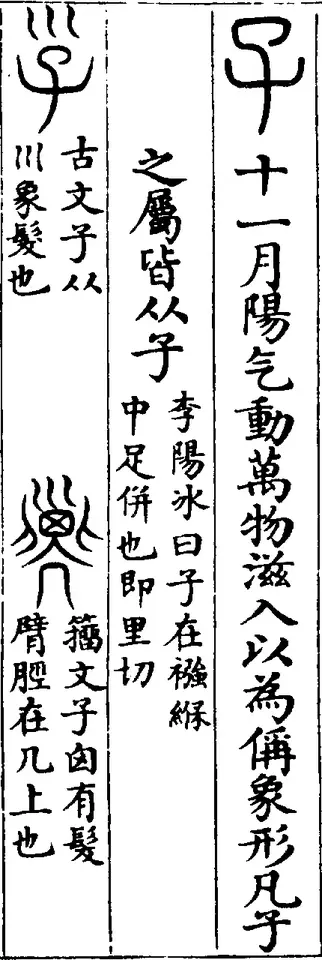
Xu Shen's most brilliant structural breakthrough was inventing the radical classification system (bushou). Organizing over ten thousand disparate glyphs, he derived 540 fundamental structural radicals based on graphic form and semantic origin. Ordering these radicals cosmologically from "One" (yi) to "Culmination" (hai), he pioneered the organizational rule that "the radical is established, and all affiliated characters follow its structural category." This pioneering indexical architecture served as the ancestral template for all subsequent Chinese dictionaries—from Yupian and the Kangxi Dictionary to modern computerized lexicons—maintaining structural coherence across Chinese written civilization for two millennia.
In the postscript to Shuowen Jiezi, Xu Shen established the definitive analytical formulation of the Six Principles of Chinese character construction (liushu). He formulated rigorous, timeless definitions accompanied by standard exemplary characters: pictograms (xiangxing, drawing the physical object following its curves), ideograms (zhishi, seeing the form and discerning its implied concept), compound ideographs (huiyi, combining semantic elements to express an abstract direction), phono-semantic compounds (xingsheng, naming an object by a semantic radical combined with a phonetic marker), mutual explanation (zhuanzhu, establishing a common category with shared meaning), and phonetic loans (jiajie, adopting an existing graph phonetically when no character exists).
Applying these six principles to small seal script, Xu Shen made the critical analytical distinction between primary single-element graphs (wen, pictograms and simple ideograms) and composite multi-element characters (zi, compound ideographs and phono-semantic compounds), from which the title Shuo Wen Jie Zi ("Explaining Graphs and Analyzing Characters") was derived. His systematic dissection revealed that Chinese script evolved primarily as a semantic-phonetic system, providing a pioneering theoretical framework for world grammatology.
Beyond lexicography, Xu Shen occupied a pivotal role in Han dynasty classical philosophy. During the Eastern Han, scholastic warfare between New Text and Old Text schools degenerated into theological pedantry and apocryphal fabrications. Although the White Tiger Hall Conference attempted to establish state orthodoxies, factional bitterness persisted.
Xu Shen authored the ten-volume Wujing Yiyi, adopting an objective empirical methodology. He systematically juxtaposed conflicting interpretations of ancient rites, ancestral sacrifices, enfeoffment protocols, and penal laws across New Text traditions (Qi, Lu, and Han Odes; New Text Documents) and Old Text canons (Mao Odes; Old Text Documents). Grounding his evaluations in concrete philological evidence, he rectified countless far-fetched allegorical claims. During the late Han, master Zheng Xuan composed Bo Wujing Yiyi, absorbing Xu Shen's Old Text critiques to achieve the grand synthesis of Han classical learning, demonstrating how Xu Shen's scholarship unified imperial Confucianism.
During the middle and late Eastern Han, New Text commentators routinely manipulated distorted clerical script (lishu) to manufacture mystical political omens, claiming that contemporary clerical graphs represented original ancient inscriptions. Xu Shen astutely warned: "Characters are the root of classical learning and the foundation of royal governance; they are the medium by which predecessors transmit wisdom to posterity, and descendants comprehend antiquity." If character forms were corrupted, classical truths would disintegrate into superstition.
In Shuowen Jiezi, Xu Shen selected Qin small seal script as the standard orthographic baseline, while preserving ancient pre-Qin scripts (guwen) and large seal script (dazhuan). He dismantled the erroneous notion that clerical script represented the origin of Chinese writing, establishing the fundamental philological law of "discerning original meaning through graphic structure and verifying phonetic values through semantic origins." By dissecting thousands of ancient graphs, he preserved the meanings of pre-Qin classics and the phonological contours of archaic Chinese, building the irreplaceable historical bridge that enabled modern scholars to decipher Shang dynasty oracle bones and Zhou bronze inscriptions. For this monumental achievement, Chinese civilization honors him as the "Sage of Characters."
FIGURES ASSOCIATED WITH THIS DYNASTY