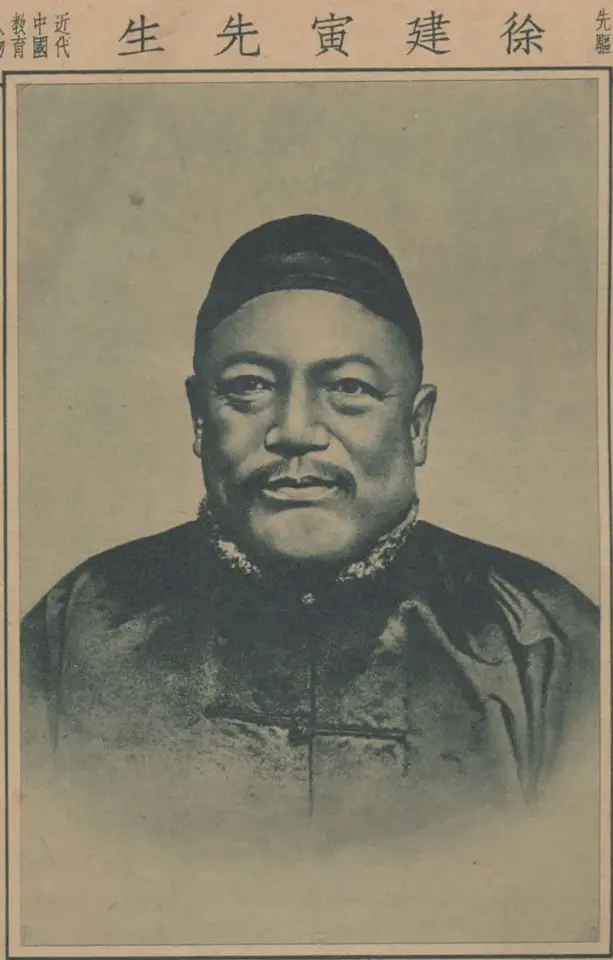
Biography
Early Learning and Shipbuilding at Anqing
Xu Jianyin was born in 1845 in Shegangli, Wuxi County, Changzhou Prefecture, Jiangsu Province (present-day Liangxi District, Wuxi City). His family had maintained a scholarly tradition for generations, and his father, Xu Shou, became a pioneer of modern scientific inquiry and chemistry in China. In contrast to the prevailing societal obsession with civil examination stereotyping, Xu Shou educated his sons, Xu Jianyin, Xu Xuefu, and Xu Huafeng, in practical mathematical sciences and natural philosophy, emphasizing hands-on experimental inquiry and mechanical dissection.
In 1861, at the young age of seventeen, Xu Jianyin accompanied his father to Anqing to join the military workshop established by Viceroy Zeng Guofan. Amid the turbulence of the Taiping conflict, Zeng Guofan recognized the pressing need for autonomous modernization of warships and weapons. Tasked alongside mathematician Hua Hengfang to construct a steam-powered vessel, Xu Shou and his son faced an absence of foreign blueprints, models, or Western technical assistance. Relying on acute geometric perception and analytical skill, young Xu Jianyin contributed innovative mechanical designs, calculating boiler pressures and drafting technical profiles for pistons and connecting rods.
Through sustained trial and experimentation between 1864 and 1865, China's first indigenous wooden steamship, the Huanghu, was successfully completed and launched at Anqing. Measuring fifty-five feet in length with a displacement of twenty-five tons, the vessel attained a speed of over twenty li per hour. Western observers in Shanghai expressed amazement that all core mechanisms, including steam pressure gauges and cylinders, had been devised solely by Chinese engineers without foreign aid. Zeng Guofan lauded Xu Jianyin's extraordinary talent, submitting a glowing memorial to the imperial court recommending him for official advancement.
Jiangnan Bureau and Translation Endeavors
In 1867, Xu Shou and Xu Jianyin moved to Shanghai at the behest of Li Hongzhang to assist in expanding the Jiangnan Machine Manufacturing General Bureau. As the bureau relocated from Hongkou to Gaocangmiao, industrial facilities required comprehensive modernization. The Xu father and son submitted four fundamental strategic recommendations to Viceroy Zeng Guofan: translating Western technical texts to understand scientific theory, mining coal and smelting iron to secure raw resources, manufacturing artillery to strengthen frontiers, and training naval crews to protect territorial waters. This visionary proposal led directly to the establishment of the Jiangnan Translation Department, China's first institutional agency dedicated to translating modern scientific literature.
During his seven years at the Jiangnan Bureau, Xu Jianyin conducted naval engineering research while collaborating with British sinologist John Fryer to translate seminal Western treatises into Chinese. In 1868, under the leadership of the Xu family, the bureau successfully launched China's first large steam-powered wooden gunboat, the Huiping. Displacing six hundred tons with an overall length of one hundred and eighty feet and armed with eight modern guns, the Huiping demonstrated that China had achieved the capacity to construct major naval vessels independently. In subsequent years, Xu Jianyin helped oversee the construction of additional warships, including the Chaojiang, Cehai, the thousand-ton Weiqing, and the 2,800-ton iron-ribbed cruiser Yuyuan, training the first generation of indigenous marine engineers and master craftsmen.
In the realm of scientific translation, Xu Jianyin proved remarkably prolific. In 1872, he co-translated Huaxue Fanyuan (Principles of Analytical Chemistry) with John Fryer, producing China's earliest printed manual on qualitative and quantitative chemical analysis, laboratory glassware fabrication, and reagent preparation. He also translated foundational works on mechanics, engineering drawing, and geometry, such as Qiji Biyi and Qixiang Xianzhen. To democratize scientific education, Xu Shou, Xu Jianyin, and Fryer raised funds to establish the Shanghai Gezhi Academy in 1874, creating an open educational institution that offered lectures, public exhibitions, and competitive essay prizes in natural science.
Chemical Breakthroughs and Shandong Plant Construction
In 1874, Zhili Viceroy Li Hongzhang summoned Xu Jianyin north to the Tianjin Machinery Bureau to solve a critical bottleneck: the manufacture of sulfuric acid. High-concentration sulfuric and nitric acids were indispensable for modern explosives, propellants, and mercury fulminate primers. Chinese arsenals had previously depended entirely on costly maritime imports from Europe and America, which cost tens of thousands of silver taels annually and left military manufacturing vulnerable to foreign blockades. Arriving in Tianjin, Xu Jianyin designed an industrial lead-chamber facility, successfully producing concentrated sulfuric acid matching Western import purity at substantially reduced expenditure. This milestone severed foreign commercial monopolies over Chinese military chemicals.
In 1875, when the imperial court solicited recommendations for practical talent, Jiangsu Governor Ding Richang praised Xu Jianyin's abilities, prompting Xu to submit a ten-thousand-character memorial on maritime defense and scientific industrialization that earned high praise from the Zongli Yamen. In September of that year, newly appointed Shandong Governor Ding Baozhen resolved to construct the Shandong Machinery Bureau in Jinan to bolster northern defenses. Despising the arrogance and exorbitant charges of foreign contractors, Ding appointed Xu Jianyin as Director-General to manage site selection, facility design, and machine installation independently.
Surveying regional terrain, Xu Jianyin chose a site along the Xiaoqing River north of Jinan, boasting convenient waterway access and proximity to regional coal and iron fields. He resolved not to hire foreign engineers, personally drawing architectural blueprints, laying metallurgical foundations, and assembling steam engines with indigenous artisans. Serving as both chief project engineer and administrator, Xu slept in temporary workshops on-site. In barely a year, the Shandong Machinery Bureau was fully completed and operational, casting explosive shells, firearms, and gunpowder. Ding Baozhen memorialized the throne, noting that Xu possessed immense energy and that his solitary work surpassed that of several foreign engineers combined, establishing a celebrated model of autonomous industrial construction.
European Technical Mission and Naval Procurement
In 1879, the Qing court appointed Chonghou as envoy to Russia, and Xu Jianyin was assigned to the legation as Second Secretary in Germany, becoming the first specialized Chinese engineering scientist sent to conduct a comprehensive survey of Western European industrial and military centers. His dual mandate encompassed surveying advanced technologies across European powers and managing the technical evaluation and procurement of capital ironclad warships for the Beiyang Fleet.
Between 1879 and 1881, Xu Jianyin carried out extensive on-site inspections of over eighty major shipyards, steel mills, ordnance factories, chemical works, and research laboratories in Britain, France, and Germany. Dressed in Qing administrative attire, he carried technical notebooks everywhere, cross-examining engineers on Bessemer and open-hearth steelmaking, seamless tube rolling, electrical naval mine detonation, and composite armor plate hardening. He compiled his extensive observations into the multi-volume work Ouyou Zalu, recording detailed technical data on over two hundred industrial processes and creating an invaluable primary record of Second Industrial Revolution technology.
In contracting for the Beiyang Fleet's capital warships, Xu Jianyin defended China's strategic interests against the deceit and commission-seeking of foreign arms conglomerates. After comparing designs and price quotations from Britain's Armstrong firm and Germany's Vulcan AG, Xu advocated selecting Vulcan for its superior protective armor layout and balanced gun turret distribution. He participated directly in examining and modifying naval architectural schematics, verifying keel metallurgy and steam boiler specifications before finalizing the purchase of two 7,000-ton first-class ironclad battleships: the Dingyuan and Zhenyuan. These two capital ships served as the core bulwark of the Beiyang Navy for over a decade.
Service in Jinling, Hubei, and the Shipping Bureau
Returning to China in late 1881, Xu Jianyin resumed translation work at the Jiangnan Bureau until 1886, when Liangjiang Viceroy Zeng Guoquan appointed him Superintendent of the Jinling Machinery Manufacturing Bureau in Nanjing. Over three years, Xu overhauled lagging production methods, modifying disused machinery into a functional steel converter that produced quality indigenous military steel and reduced dependency on costly foreign metals. He also supervised the production of advanced breech-loading wall guns and defensive naval mines to strengthen fortifications along the lower Yangtze River.
In 1890, Huguang Viceroy Zhang Zhidong launched his expansive industrial modernization drive in Wuhan, building the Hanyang Ironworks, the Hanyang Arsenal, and the Hubei Railway. Zhang summoned Xu Jianyin to serve as Associate Director of the Hubei Railway Bureau. Because the ironworks and armaments factories required vast supplies of high-grade metallurgical coking coal that foreign merchants sold at predatory prices, Xu undertook mineralogical surveys across Daye and Jiangxia. Drawing upon his geological knowledge, he discovered a thick, high-quality coal seam near Qingshan in Jiangxia. Testing proved the coal yielded coke comparable to premium British supplies, ensuring reliable domestic fuel for the Hanyang industrial complex.
Following China's defeat in the First Sino-Japanese War in 1895, Emperor Guangxu granted Xu Jianyin an individual imperial audience in the Forbidden City, consulting him on ordnance weaknesses and mechanical failures. The court dispatched him as a special commissioner to Tianjin, Dagu, and Weihaiwei to inspect damaged naval vessels and battlefield weaponry, charging him to formulate an engineering analysis of the military debacle.
The Hundred Days' Reform and Military Scholarship
In 1896, Xu Jianyin was transferred to Fuzhou to serve as Proctor of the Fujian Shipping Bureau (Mawei Shipyard), managing China's largest naval manufacturing complex. Following severe wartime devastation during the Sino-French and Sino-Japanese conflicts, the shipyard suffered from neglected machinery and an exodus of skilled labor. Xu eliminated bureaucratic redundancy, enforced standardized shop-floor safety regulations, and restored operational maintenance for regional coastal defense craft.
Deeply troubled by the imperialist scramble for concessions and existential threats to China, Xu recognized that true military salvation required tactical modernization alongside weapon improvements. Drawing upon foreign manuals and his three decades of ordnance experience, he composed the military treatise Bingxue Xinshu (New Book on Military Science). The text systematically analyzed infantry, cavalry, and artillery coordination, ballistic ranges, and modern chemical propellant properties, emphasizing that armed power depended less on hardware than on rigorous tactical discipline and structural professionalization.
During the Hundred Days' Reform of 1898, Emperor Guangxu actively recruited technical modernizers. Recommended by provincial viceroys and reformist scholars, Xu Jianyin was elevated to Supervisor of the Bureau of Agriculture, Industry, and Commerce, granted Third-Rank official dress, and accorded the privilege of direct memorialization. Xu devised forward-thinking regulations to encourage mining ventures, foster modern commercial chambers, and launch technical schools. However, Empress Dowager Cixi launched a conservative coup in September 1898, crushing the reform movement. Because his appointment had occurred late in the reforms, Xu avoided execution but was stripped of his third-rank title and dismissed from office, living in quiet retirement in Wuxi and Shanghai for over a year.
Smokeless Powder Development and Fatal Explosion
In 1900, the Boxer uprising erupted, and Eight-Nation Alliance forces seized Beijing, Dagu, and North China's military arsenals, prompting Western powers to impose a total embargo on arms and munitions shipments to China. Under the Southeast Mutual Protection pact, Huguang Viceroy Zhang Zhidong urgently expanded provincial forces, but local arsenals were depleted of gunpowder. Recognizing Xu Jianyin's peerless expertise, Zhang sent a fast vessel to Shanghai to enlist him as Provincial Armaments Superintendent and head of the newly planned Baoan Gunpowder Bureau. Responding selflessly to the national emergency, Xu worked day and night with local artisans, completing the factory at Zhuodaoquan in Wuchang within three months and delivering black powder to local forces.
Nevertheless, contemporary world powers had already adopted nitrocellulose-based smokeless powder, which rendered traditional black powder obsolete due to its heavy smoke, short range, and fouling residue. Zhang Zhidong had previously erected the Hanyang Steel and Gunpowder Factory to manufacture smokeless powder, but foreign technicians had fled during the 1900 crisis while withholding essential chemical formulas. Zhang implored Xu Jianyin to take direct charge of the Hanyang plant and unlock the technology independently.
Smokeless nitrocellulose manufacturing involved volatile chemical handling; slight deviations in acid ratios or temperature could cause violent spontaneous ignition. Unmindful of the extreme hazards at age fifty-seven, Xu Jianyin personally directed chemical mixing, washing, dehydration, and solvent plasticization in the laboratory. On the afternoon of March 31, 1901 (12th day of the 2nd month), Xu was in the Hanyang experimental workshop demonstrating chemical compounding to senior technical artisans. While stirring and grinding a new batch of experimental compound, an unexpected runaway chemical reaction triggered a catastrophic explosion. Fierce fire and shockwaves ripped through the building, leveling the laboratory in seconds.
Xu Jianyin was killed instantly in the explosion alongside sixteen Chinese munitions artisans. The tragedy brought profound grief to Zhang Zhidong and the people of Hubei. Zhang memorialized the imperial throne: "Xu Jianyin was devoted and loyal to the dynasty, deeply learned in new science, and fearless in facing peril. His death in the line of duty during powder experimentation is truly a sacrifice for the country." The Qing court issued an imperial rescript expressing profound sorrow, granting posthumous compensation under the most generous battlefield casualty terms, conferring the title of Third-Rank Academician of the Grand Secretariat, directing the State Historiography Bureau to record his biography, and enshrining his tablet in the Manifest Loyalty Shrines at Hanyang and Wuxi.
Major Achievements
Pioneering Modern Chinese Autonomous Shipbuilding
Xu Jianyin stands as one of the foremost architects of modern Chinese naval and commercial shipbuilding. During the 1860s, as Western gunboats dominated China's coastlines and inland rivers, Xu devoted himself to naval engineering. Beginning in 1861 at the Anqing Arsenal, he assisted his father Xu Shou in building indigenous steam propulsion units, contributing to the successful maiden voyage of the Huanghu in 1865. This achievement shattered the colonial myth that Chinese minds could not master mechanical navigation and established a viable model for self-reliant shipbuilding and artisan training.
At the Jiangnan Machine Manufacturing General Bureau after 1867, Xu Jianyin achieved another major milestone by overseeing the layout of the first large drydock and directing the construction of China's first large steam-powered warship, the Huiping. Over the next decade, he supervised the construction of six major naval vessels with displacements ranging from hundreds of tons to nearly three thousand tons, including the Chaojiang, Cehai, Weiqing, and Yuyuan. He drafted marine boiler schematics, refined composite wood-iron hull frameworks, and translated standard technical works like Qiji Biyi and Zaochuan Quanfa, building the technical bedrock of China's modern marine engineering corps.
Breaking Monopolies in Chemical and Munitions Industries
Xu Jianyin was a seminal pioneer of industrial chemistry and military explosives in China. In early Self-Strengthening ordnance production, essential industrial acids—concentrated sulfuric and fuming nitric acids—were monopolized by Western import cartels that extracted exorbitant prices. Understanding that true military autonomy required domestic control over acid production, Xu introduced the lead-chamber method at the Tianjin Machinery Bureau in 1874, fabricating large acid-resistant chambers that yielded high-purity industrial acid and slashed production costs across northern armaments plants.
In munitions manufacturing, Xu conquered sequential technical obstacles, including black powder refining, mercury fulminate percussion cap fabrication, and smokeless powder formulation. He authored standardized chemical manuals such as Jingti Maoxiao Fa and Aolian Qiangshui Fa, which served as operational standards in provincial arsenals nationwide. During the 1900 foreign arms embargo, he built the Baoan Gunpowder Bureau in one hundred days, subsequently accepting the perilous task of synthesizing nitrocellulose smokeless powder at Hanyang. His ultimate sacrifice in that endeavor established him as a premier martyr of modern Chinese scientific industrialization.
European Industrial Survey and Armored Battleship Procurement
Between 1879 and 1881, serving as Second Secretary in Germany, Xu Jianyin conducted a rigorous two-year survey of European industry, becoming the first Chinese technical specialist to inspect Western heavy industrial heartlands. Crossing Britain, France, and Germany, he toured more than eighty advanced shipyards, steel plants, arsenals, and military installations, systematically documenting cutting-edge technologies of the Second Industrial Revolution in his classic travel memoir, Ouyou Zalu.
Entrusted with the vital responsibility of acquiring first-class ironclad battleships for the nascent Beiyang Fleet, Xu resisted the commissions, kickbacks, and technical distortions of Western arms brokers. Through rigorous technical appraisal, he selected Germany's Vulcan AG, signing the contracts for the 7,000-ton armored battleships Dingyuan and Zhenyuan. Xu took a direct role in modifying hull compartmentalization drawings and adjusting primary and secondary turret armor ratios, ensuring that these two ironclads remained the most formidable naval bulwarks in East Asia for over a decade.
Scientific Translation and the Founding of Gezhi Academy
Xu Jianyin was a tireless champion of scientific translation and secular science education in late Qing China. Following the establishment of the Jiangnan Translation Department in 1868, he collaborated closely with Xu Shou, Hua Hengfang, and John Fryer for over a decade, translating more than forty multi-volume works spanning chemistry, mechanical drawing, physics, astronomy, and military theory, comprising millions of translated characters.
His translations, including Huaxue Fanyuan, Qiji Biyi, Qixiang Xianzhen, and Bingxue Xinshu, represented pioneering Chinese publications in their respective fields, helping standardize modern chemical nomenclature, mechanical drafting terminology, and ballistic concepts. Furthermore, by co-founding the Shanghai Gezhi Academy in 1874 with public reading rooms, science laboratories, and periodic prize examination essays on natural philosophy, he inspired a generation of young Chinese intellectuals to embrace empirical science, accelerating the transition from traditional academy curricula toward modern scientific schooling.