Born in Wutai
Born into a scholarly family in Dongye, Wutai County, Shanxi; received classical training and studied under Gao E in Beijing.
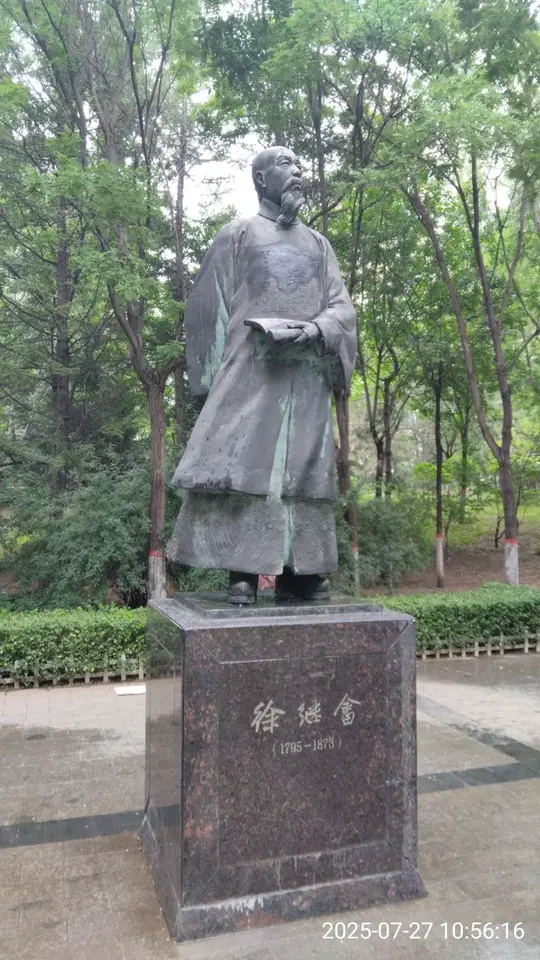
徐继畬
Xu Jiyu (徐继畬; 1795–1873), courtesy names Jiannan and Songkan and art names Mutian and Juansou, was a native of Wutai County, Shanxi Province. He was a pioneering intellectual, geographer, and patriotic statesman of the late Qing Dynasty, celebrated as one of the foremost Chinese leaders to open his eyes to the wider modern world. Passing the metropolitan examinations in 1826 with first rank in the palace evaluation, he…
Xu Jiyu (徐继畬; 1795–1873), courtesy names Jiannan and Songkan and art names Mutian and Juansou, was a native of Wutai County, Shanxi Province. He was a pioneering intellectual, geographer, and patriotic statesman of the late Qing Dynasty, celebrated as one of the foremost Chinese leaders to open his eyes to the wider modern world. Passing the metropolitan examinations in 1826 with first rank in the palace evaluation, he was inducted into the Hanlin Academy as a compiler. He subsequently served as Investigating Censor of the Shaanxi Circuit and Prefect of Xunzhou before spending long years governing coastal jurisdictions across Fujian and Guangdong. During the First Opium War, Xu staunchly advocated active defense against foreign aggression, fortifying coastal estuaries in Zhangzhou and composing his influential Treatise on Banning Opium to propose root-cause remedies against the illicit drug trade. Appointed Governor of Fujian and Acting Governor-General of Minzhe following the war, he engaged extensively with Western consuls and missionaries in Fuzhou and Xiamen. After five years of rigorous collation of Chinese and Western cartography, in 1848 he published the groundbreaking ten-volume world geography A Short Account of the Maritime Circuit (Yinghuan Zhilüe). The work systematically introduced the five continents, their institutions, and technologies, while famously praising George Washington for rejecting monarchical titles and establishing democratic republican institutions. In 1851, Xu was cashiered due to conservative court intrigues over the British lease of the Shengguang Temple in Fuzhou, returning to Shanxi to direct the Chaoshan Academy in Pingyao. In 1865, he was recalled to national service by the Qing government, serving as Minister Attached to the Zongli Yamen and Director of the Tongwen Guan foreign language academy. In 1867, American Minister Anson Burlingame presented Xu with a portrait of George Washington on behalf of the United States government in recognition of his visionary scholarship. He died in 1873 at age seventy-eight. His seminal treatise exerted a profound influence on both Chinese reformist thought and the Meiji Restoration in Japan.
Born into a scholarly family in Dongye, Wutai County, Shanxi; received classical training and studied under Gao E in Beijing.
Passed the metropolitan examinations with first rank in the court review; appointed Compiler in the Hanlin Academy.
Appointed Investigating Censor of the Shaanxi Circuit; memorialized to streamline administration and impeached corrupt regional magistrates.
Appointed Prefect of Xunzhou in Guangxi and later transferred to Circuit Intendant of Tingzhanglong in Fujian to oversee coastal defenses.
Following the outbreak of the Opium War, organized local militias and blocked harbor channels in Zhangzhou to deter British naval raids.
Promoted to Administration Commissioner of Fujian; interrogated Westerners and collected foreign maps to compile his world geography.
Elevated to Governor of Fujian and Acting Governor-General of Minzhe, overhauling naval fortifications and balancing commercial affairs.
Published A Short Account of the Maritime Circuit (Yinghuan Zhilüe), introducing world geography and praise of George Washington.
Slandered by conservative court factions during the Shengguang Temple controversy; dismissed and retired to teach in Shanxi.
Recalled to the capital by the imperial court; appointed Minister Attached to the Zongli Yamen and Superintendent of the Tongwen Guan.
Presented with an official copy of Gilbert Stuart's portrait of George Washington by US Minister Anson Burlingame.
Passed away in his native Wutai County at the age of seventy-eight; honored as an intellectual forefather of modernization.
Xu Jiyu was born in the Dongye township of Wutai County, Shanxi. Born into a cultivated but modest scholarly lineage, he accompanied his father Xu Rundi to Beijing, studying under distinguished literati including Gao E. In 1826, he passed the metropolitan examinations with highest honors in the palace evaluation, entering the Hanlin Academy as a compiler. Following his father's demise, he collated his late father’s posthumous philosophical writings, integrating Neo-Confucian, Qi-based, and Yijing philosophies into a rigorous intellectual framework that questioned rigid orthodox dogmas, laying the intellectual foundation for his later engagement with foreign cultures.
Reentering civil service in 1830, Xu was appointed Investigating Censor of the Shaanxi Circuit in 1833. He fearlessly impeached corrupt local magistrates in Xinzhou and Baode, while submitting detailed proposals to simplify burdensome bureaucratic reporting. His penetrating administrative proposals impressed the Daoguang Emperor, who summoned Xu for direct consultations and commended his practical grasp of statecraft, launching his rapid career through regional executive posts.
Throughout his official career, Xu adhered to the fundamental Confucian principle that the core of statecraft lies in nurturing rather than coercing the population. In his celebrated political essay Treatise on Nurturing the People (Zheng Zai Yangmin Lun), he argued that ancient sage rulers spoke of nourishing the populace rather than ruling over them, declaring that enriching the imperial treasury while impoverishing common households was the negation of true governance.
Acting upon these convictions, Xu maintained unbending personal incorruptibility across decades of coastal administrative service. Despite holding lucrative posts across Guangdong and Fujian for more than fifteen years, he never accumulated personal estates, living on modest stipends and maintaining a lifestyle of austere simplicity that earned him the profound respect of regional populations.
Stationed along the southern maritime circuits during the escalating opium crisis, Xu composed his penetrating treatise Treatise on Banning Opium (Jin Yapian Lun). He identified the illicit trade as a calculated predatory scheme through which foreign merchants drained China's wealth and physical vigor to enrich their own homelands.
In contrast to dogmatic court bureaucrats who advocated either total inaction or impetuous naval aggression, Xu proposed a structured prohibition campaign: punishing high-ranking domestic consumers before humble addicts, wealthy distributors before impoverished peddlers, and domestic racketeers before foreign smugglers. During the First Opium War in 1840, when British warships entered regional waters, Xu personally mobilized coastal militias in Zhangzhou, deploying heavy timber barriers and boom obstacles across strategic estuaries. His resolute preparedness dissuaded British naval commanders from assaulting his defensive perimeter.
Following the Treaty of Nanjing and the opening of treaty ports in 1842, Xu served successively as Administration Commissioner and Governor of Fujian. Recognizing that China could no longer afford ignorant complacency, he initiated systematic investigations into global geography and foreign governance. In Xiamen and Fuzhou, he held extensive interviews with American missionary David Abeel and Western consular officials, transcribing geographical lore and comparing over forty Western maps with Chinese imperial records.
After five years of exhaustive synthesis, Xu published his monumental ten-volume world geography A Short Account of the Maritime Circuit (Yinghuan Zhilüe) in 1848. The work divided the globe into oceanic circuits, detailing the topography, customs, historical developments, and administrative frameworks of sovereign states across Asia, Europe, Africa, and the Americas. Most remarkably, Xu offered glowing praise for the political system of the United States and its founding president, George Washington: "Washington was an extraordinary man. In raising an insurrection, his bravery exceeded Chen Sheng and Wu Guang; in establishing a state, his courage surpassed Cao Cao and Liu Bei. He refused to hold power by force, did not transmit authority to his heirs, but established an elective republican system, creating a statecraft unseen in ancient or modern times!" Xu's iconic eulogy was later engraved on a granite stone slab by American admirers and installed inside the Washington Monument in Washington, D.C.
In addition to his pioneering geographical scholarship, Xu was an accomplished classicist, poet, and epigrapher. He authored numerous scholarly monographs, including historical commentaries on ancient dynastic borders, epigraphic studies on bronze inscriptions, and poetic collections gathered in the Poetic and Prose Works of Songkan.
His scholarly works were characterized by a commitment to empirical evidence and factual verification, prefiguring the intellectual transition from traditional evidential scholarship to modern geography and international relations.
Throughout his official career, Xu was celebrated for his dry wit, unpretentious demeanor, and absolute refusal to engage in administrative hypocrisy. When colleagues urged him to flatter imperial princes to secure higher promotions, he laughingly replied that an official should rely on his pen and deeds rather than court sycophancy.
His legendary dedication to duty was accompanied by personal eccentricity; he was known to walk the streets of provincial capitals on foot with a single servant, conversing freely with foreign merchants, boatmen, and dockworkers to gather unvarnished intelligence regarding maritime commerce.
Xu was distinguished by his willingness to speak hard truths to power. In 1850, the controversial Shengguang Temple incident erupted in Fuzhou when British interpreters rented lodgings in a municipal Buddhist temple, sparking intense anti-foreign agitation organized by local gentry and supported by retired commissioner Lin Zexu. Recognizing the military vulnerability of the port and seeking to avoid providing Britain with a pretext for renewed naval war, Xu intervened through pragmatic diplomatic channels, convincing the British to vacate the temple and relocate to alternate quarters.
Despite peacefully defusing the crisis, conservative court cliques slandered Xu as being overly compliant toward foreigners. The Xianfeng Emperor capitulated to anti-foreign rhetoric, summarily dismissing Xu from his governorship in 1851. Xu accepted his unjust dismissal with dignified composure, returning to his native Shanxi to dedicate fourteen years to teaching at the Chaoshan Academy in Pingyao.
In 1865, following the rise of the Self-Strengthening Movement under Prince Gong and Wenxiang, the Qing court recognized the urgent necessity of Xu's diplomatic expertise and recalled him to Beijing. He was appointed Minister Attached to the Zongli Yamen and Superintendent of the Tongwen Guan foreign language academy, participating in the modern translation of international treaties and statecraft texts.
In 1867, American Minister Anson Burlingame, acting on behalf of the President of the United States, presented Xu with an official replica of Gilbert Stuart’s portrait of George Washington, publicly honoring his pioneering recognition of American republican ideals. After retiring in 1869 due to advancing age and failing eyesight, Xu spent his remaining years in quiet scholarly contemplation in Wutai, dying peacefully in 1873 at age seventy-eight.
Xu Jiyu combined the courage of an incorruptible frontier statesman with the vision of an intellectual forefather. In an era dominated by xenophobic insularity, he penetrated the veil of imperial ignorance to present the first comprehensive, accurate picture of the modern world, inspiring the earliest generations of Chinese and East Asian modernizers.
"Xu Jiyu possessed immense erudition and piercing strategic foresight. His Short Account of the Maritime Circuit surveyed global geography, political institutions, and material cultures with unprecedented thoroughness, standing as a peerless masterwork for the ages." — Guo Songtao, late Qing pioneer diplomat and Westernizer statesman
"America does not establish kingly titles or hereditary succession, but entrusts state affairs to public debate, creating a political system unprecedented in ancient or modern history. Truly, how marvelous! Among all Western historical figures, who can deny that Washington stands foremost!" — Xu Jiyu, A Short Account of the Maritime Circuit (Yinghuan Zhilüe), inscribed on the Washington Monument
"Xu Jiyu grasped the changing global situation early, pioneering an enlightened intellectual atmosphere. His writings on foreign lands demonstrated meticulous evidential precision, establishing him as a great intellectual titan of the dynasty." — Zhao Erxun, Chief Editor, Draft History of Qing (Qing Shi Gao), Volume 422, Biographies 209
FIGURES ASSOCIATED WITH THIS DYNASTY