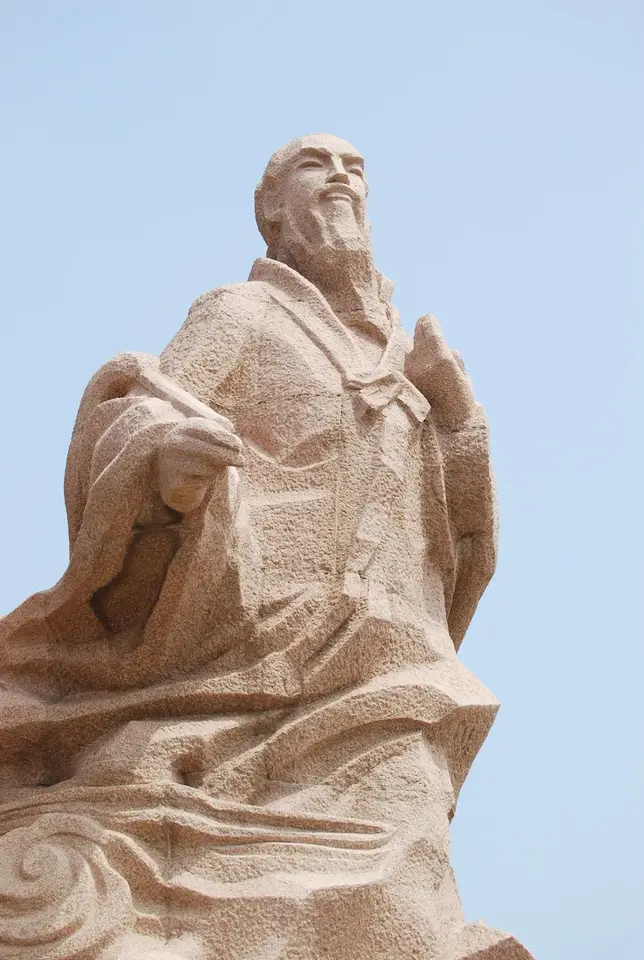
Biography
Qi Heritage and Fangshi Traditions
Xu Fu was born during the late Warring States period in the coastal region of Langya within the state of Qi. From the Spring and Autumn period onward, the states of Qi and Yan commanded extensive coastlines where shifting oceanic mirages fostered a distinct maritime esoteric culture. Folklore held that three sacred islands—Penglai, Fangzhang, and Yingzhou—existed across the eastern ocean, constructed of gold and silver, inhabited by transcendent beings, and preserving herbs that conferred immortality.
Rulers such as King Wei of Qi, King Xuan of Qi, and King Zhao of Yan had commissioned maritime expeditions to locate these divine realms. Although they failed to discover magical isles, their voyages fostered ship design, astronomical navigation, and familiarity with regional winds and tidal currents.
Immersed in this coastal environment, Xu Fu combined classical learning with practical sciences. He mastered the principles of yin-yang and the five elements, herbal medicine, astronomy, and oceanography. Interacting widely with coastal artisans, shipbuilders, and navigators, he became expert in multi-decked vessel construction and maritime logistics, emerging as the foremost scholar-navigator of eastern China.
The Imperial Tour and First Sea Voyage
In 221 BCE, the First Emperor of Qin unified the realm under a centralized empire. Yet as he surveyed his vast domains, the emperor was increasingly tormented by his mortality and sought formulas for eternal life.
In 219 BCE, the First Emperor conducted an inspection tour of the east, ascending Mount Tai to perform the feng and shan sacrifices before arriving at Langya Terrace, where he constructed a coastal palace. Gazing out upon the sea, the emperor granted audience to local scholars, and Xu Fu seized the opportunity to present his memorial.
Xu Fu wrote: "Far across the eastern seas lie three sacred mountains named Penglai, Fangzhang, and Yingzhou, wherein dwell immortal beings possessing herbs of immortality. Your servant begs to undergo ritual purifications and lead pure virgin youths out to sea to seek these holy beings, that we may bring back the divine elixir for Your Majesty."
Delighted, the First Emperor approved the grand expedition. Royal treasuries funded the construction of large ocean-going vessels, drafted thousands of intelligent youths, and provisioned the fleet with three years of grain, dried meats, wine, clothing, medicine, and farming implements.
Bidding farewell to the emperor, Xu Fu led his armada into the deep waters. However, limited by navigational knowledge and seasonal monsoons, the fleet navigated the Bohai, Yellow Sea, and surrounding peninsula waters for several years without discovering mythical islands. Knowing that returning empty-handed invited execution under draconian Qin laws, Xu Fu anchored his fleet along the Shandong coast to study regional currents and plan a more ambitious transoceanic route.
The Giant Fish Obstacle and the Emperor's Archery
In 210 BCE, approaching the end of his life and suffering declining health, the First Emperor revisited Langya Terrace. When fellow esotericists Lu Sheng and Han Zhong fled after criticizing imperial tyranny, sparking the persecution of scholars, Xu Fu faced mortal peril.
Aware that confessing failure meant execution, Xu Fu appeared before the emperor and reported: "The divine elixir of Penglai was within our grasp, and the immortals promised to grant it. Yet monstrous sea creatures consistently churn the waves and block the narrow maritime passes to the sacred peaks. We request that Your Majesty assign skilled archers armed with repeating crossbows to slay these creatures, clearing the path to the immortals."
That night, the emperor dreamed of battling a sea deity shaped like a human-headed fish. Diviners interpreted: "Water spirits are invisible, manifesting as dragons and giant fish. Slaying this malevolent creature will permit the true spirits to appear."
Convinced, the emperor ordered an armed maritime sweep. Boarding an imperial galley, the emperor sailed along the northern Shandong coast. Off the waters of Zhifu Island (present-day Yantai), a giant marine creature surfaced amidst the waves. The emperor discharged repeating crossbows, slaying the creature and turning the waters red. Believing the primary obstacle had been eliminated, the emperor ordered full support for Xu Fu's final voyage.
Broad Plains and Fertile Marshes: Settling Overseas
Following the sea creature's death, the First Emperor's confidence was restored. He granted Xu Fu three thousand virgin youths, alongside over one hundred skilled artisans, including blacksmiths, bronze founders, potters, carpenters, textile weavers, physicians, and farmers. The armada was supplied with seeds of the five grains, iron agricultural tools, weaponry, and hundreds of multi-decked vessels.
In the summer of 210 BCE, Xu Fu set sail with this expansive fleet, embarking upon the earliest recorded large-scale transoceanic colonization voyage in Chinese history.
Riding the warm Kuroshio Current eastward, the armada traversed open waters before reaching a verdant land with mild maritime weather. Sima Qian recorded in the Records of the Grand Historian: "Xu Fu reached broad plains and fertile marshes, where he stopped, ruled as king, and never returned."
Surveying the expansive lowlands, Xu Fu observed fertile soil, crisscrossing waterways, a mild climate, and friendly native tribes. Recognizing that Qin laws were unforgiving, that elixirs were fictitious, and that returning meant ruin, Xu Fu resolved to settle permanently.
Xu Fu ordered his fleet to establish permanent settlements, terminating all ties with the Qin Empire. He arranged marriages between his retinue and local populations, establishing workshops for metallurgy, pottery, and sericulture. He introduced irrigated wet-rice farming, iron implements, spinning techniques, and herbal medicine, dramatically transforming local tribal culture and initiating a technological leap across the islands.
Chronicles of Danzhou and Ancient Epigraphic Records
Although Xu Fu never returned, historical memories of his voyage endured in Chinese records across successive dynasties.
During the Eastern Han period, Ban Gu documented the expedition in the Book of Han. In 230 CE, Sun Quan, Emperor of Eastern Wu, dispatched Generals Wei Wen and Zhuge Zhi with 10,000 troops to explore Danzhou and Yizhou in the eastern ocean.
The Records of the Three Kingdoms recorded: "Danzhou lies in the ocean. Elders transmit by tradition that the First Emperor of Qin dispatched esotericist Xu Fu with thousands of youths to sea to seek Penglai and elixirs, but he stopped at this island and never returned. His descendants have multiplied to tens of thousands of households. Sometimes their people visit Kuaiji to trade, and coastal fishermen blown off course by storms occasionally reach Danzhou." This record confirmed that trade and maritime contacts persisted between southeastern China and Xu Fu's overseas colony during the late Han and Three Kingdoms eras.
With increasing Sino-Japanese diplomatic exchanges during the Tang and Song dynasties, identifications of Xu Fu's destination became explicit. In the tenth century, Later Zhou Buddhist master Yichu authored the Six Categories of Buddhist Monks, recording: "The country of Japan, also known as Wa, lies in the eastern sea. During the Qin Dynasty, Xu Fu brought five hundred youths and five hundred maidens to settle in this realm, where their descendants are now surnamed Qin."
During the Song Dynasty, statesman Ouyang Xiu observed in his Song of the Japanese Sword: "It is said that their country occupies a great island, where the soil is rich and customs are fine. Anciently Xu Fu deceived the Qin people, taking youths to pick herbs and growing old abroad. Taking along artisans and the five grains, their artifacts remain exquisite to this day." In Japan itself, historic sites, ancestral shrines, and annual festivals dedicated to Xu Fu from Mount Kumano to Mount Fuji and Mount Kinryu celebrate him as a culture hero, venerating him as the patron deity of agriculture, medicine, and sericulture.
The Yayoi Transition and Civilizational Transformation
Modern archaeology corroborates that Xu Fu's voyage coincided with the dramatic transition from the prehistoric hunter-gatherer Jomon period to the agricultural, metal-using Yayoi period in Japan (c. 300 BCE – 300 CE).
Archaeological excavations reveal the sudden appearance of irrigated paddy fields, bronze weapons, iron tools, and continental weaving looms across northern Kyushu and western Honshu during this exact window, displaying striking technological continuity with late Warring States and Qin material culture. Historians widely view Xu Fu's large migration fleet as a primary catalyst accelerating this civilizational transformation.
Historiographical evaluations of Xu Fu encompass multiple dimensions. Traditional Confucian historians like Sima Qian and Ban Gu cited the expedition to demonstrate how imperial superstition exhausted state resources under Qin tyranny; Eastern Han philosopher Wang Chong in Balanced Discourses similarly dismissed claims of oceanic immortality as charlatanry. Conversely, later thinkers and poets admired Xu Fu's audacity and strategic intellect in executing a transoceanic migration under extreme political terror, escaping imperial violence while planting the seeds of continental civilization across the eastern seas. His journey remains a foundational epic in the maritime history of East Asia.
Major Achievements
Imperial Memorial and the First Official Maritime Expedition
In 219 BCE, Xu Fu submitted his famous memorial to the First Emperor describing the sacred peaks of Penglai, Fangzhang, and Yingzhou, securing imperial backing to explore the eastern ocean.
He mobilized imperial resources to build an ocean-going fleet, provision thousands of personnel, and conduct the first state-sponsored maritime exploration in recorded Chinese history.
Overcoming Sea Obstacles and Preparing the Migration Fleet
Confronting potential execution after his initial voyage yielded no elixirs, Xu Fu displayed exceptional political tact in 210 BCE by attributing delays to a giant sea creature.
He convinced the emperor to personally shoot the sea creature with a repeating crossbow, turning an administrative crisis into an opportunity to secure three thousand youths, hundred-craft artisans, seeds, tools, and a reinforced colonization fleet.
Transoceanic Voyage and Overseas Settlement
Commanding his fleet across open waters, Xu Fu capitalized on oceanic currents to reach fertile island lowlands, resolving to settle permanently and break ties with the authoritarian Qin state.
His bold leadership preserved thousands of lives from domestic political terror and resulted in the earliest recorded transoceanic overseas settlement in East Asian history.
Cultural Dissemination and Catalyzing the Yayoi Civilization
Upon settling abroad, Xu Fu introduced wet-rice agriculture, sericulture, bronze and iron metallurgy, pottery, and traditional medicine to the native populations.
This technological transfer coincided with the archaeological emergence of the Yayoi period, accelerating the transition of regional island communities from hunting-gathering into a settled agricultural civilization.