Dragging the Ox
Assembled clan militia in Qiao Commandery, hauling a runaway bull backward to terrify bandit armies.
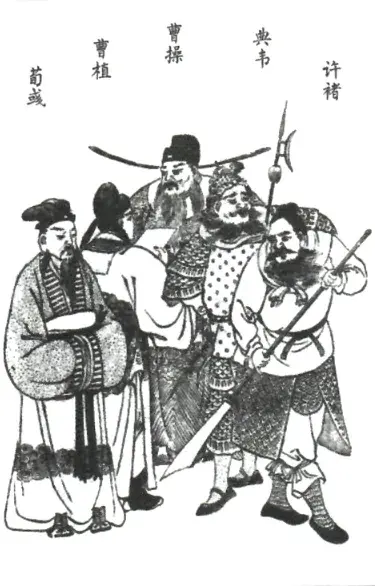
许褚
Xu Chu (许褚, ?–227), styled Zhongkang, was a native of Qiao County, Qiao Commandery (modern Bozhou, Anhui Province). He was one of the foremost military commanders and elite imperial bodyguard leaders of Cao Wei during the Three Kingdoms period. Standing over eight chi tall with a waist of ten spans, Xu Chu possessed a martial countenance and stupendous physical prowess. Amid the chaos of the late Han Dynasty, he mobilized…
Xu Chu (许褚, ?–227), styled Zhongkang, was a native of Qiao County, Qiao Commandery (modern Bozhou, Anhui Province). He was one of the foremost military commanders and elite imperial bodyguard leaders of Cao Wei during the Three Kingdoms period. Standing over eight chi tall with a waist of ten spans, Xu Chu possessed a martial countenance and stupendous physical prowess. Amid the chaos of the late Han Dynasty, he mobilized thousands of clan kinsmen into a fortified manor, once dragging an ox backwards by its tail for over a hundred paces to terrify bandit hordes across the Huai-Ru river basin. Submitting to Cao Cao in 197, he was commissioned Commandant and assigned to protect the warlord's person, his elite followers christened the "Tiger Warriors." In 200 at the Battle of Guandu, he intercepted and slew assassins in Cao Cao's bedchamber. During the Battle of Tong Pass in 211, Xu Chu shielded Cao Cao across the Wei River under intense archery barrages and subsequently cowed Western Liang general Ma Chao with a ferocious glare, earning the moniker "Tiger Idiot" while Cao Cao celebrated him as "my Fan Kuai." Upon Cao Cao's death, Xu wept until he coughed blood. Under Cao Pi, he was created Marquis of Muxiang and promoted to General of Martial Might. He died in 227 and was posthumously honored as Marquis Zhuang.
Assembled clan militia in Qiao Commandery, hauling a runaway bull backward to terrify bandit armies.
Surrendered with his militia to Cao Cao; named Commandant and leader of the elite Tiger Warriors.
Foiled Xu Ta's assassination plot at Guandu, slaying the conspirators beside Cao Cao's bed.
Spearheaded assaults during the capture of Ye, receiving the title Marquis of Within the Passes.
Defended Cao Cao during the hazardous Wei River crossing and repelled Ma Chao with a fierce glare.
Elevated to Marquis of Muxiang and General of Martial Might following Cao Pi's enthronement.
Fief expanded to one thousand households by Emperor Ming; died shortly after and canonized as Marquis Zhuang.
Xu Chu was born in Qiao County, Qiao Commandery, the same ancestral home as Cao Cao. Historical records describe Xu Chu as standing over eight chi in height, endowed with massive girth, an austere countenance, and titanic strength. In the waning decades of the Eastern Han, the collapse of imperial authority spawned pervasive banditry across the central plains. Xu Chu mobilized thousands of households among his kinsmen and neighbors, constructing fortified redoubts to defend against roving raiders.
When the bandit chieftain Ge Pei attacked his settlement with over ten thousand men, Xu Chu directed a desperate defense. When their supply of arrows was exhausted, Xu Chu instructed everyone inside the redoubt to stockpile heavy river stones. Standing upon the parapets, Xu personally hurled boulders with lethal velocity, smashing enemy skulls and breaking the assault.
As the siege dragged on, food supplies dwindled. Xu Chu feigned a truce, offering to trade the settlement's cattle for grain. Once the grain arrived, the bandits attempted to lead the oxen away, but the frightened animals bolted back toward the fortress. Before thousands of stunned onlookers, Xu Chu sprinted forward, seized a charging bull by its tail with one hand, and dragged the massive beast backward over a hundred paces against its struggling weight. Paralyzed with terror at his superhuman strength, the bandits abandoned the livestock and fled in panic. News of the feat spread rapidly across the Huai and Ru river basins, deterring future incursions.
In 197, Cao Cao campaigned through Runan and Yingchuan. Recognizing Cao Cao's visionary leadership, Xu Chu led his entire community to submit to him. Gazing upon Xu Chu's towering frame and formidable aura, Cao Cao exclaimed: "Here is my Fan Kuai!" Xu Chu was promptly appointed Commandant, with his household warriors incorporated into an elite bodyguard corps known as the "Tiger Warriors." Xu Chu served as personal guard commander, watching over Cao Cao day and night with unwavering fidelity.
During the Battle of Guandu in 200, Cao Cao faced Yuan Shao in a grueling confrontation. Xu Ta, an attendant within the headquarters, plotted with several conspirators to assassinate Cao Cao. Aware that Xu Chu remained by Cao Cao's side at all hours, the plotters waited until Xu Chu took a scheduled rest break before entering the bedchamber with concealed daggers.
While resting in his barracks, Xu Chu experienced an unexplainable premonition of danger. He immediately turned back toward Cao Cao's tent. Stepping into the chamber just as Xu Ta and his accomplices arrived, Xu Chu immediately noted their blanched complexions and erratic movements. Before the assassins could draw their blades, Xu Chu charged and battered them to death. Awakening to the bloody scene, Cao Cao was filled with gratitude and relief, resolving never to leave his quarters without Xu Chu's protective presence.
In 211, western warlords Ma Chao and Han Sui raised an army of one hundred thousand troops in rebellion, initiating the Battle of Tong Pass. Cao Cao marched west to confront them along the Wei River. Intending to cut off enemy supply lines, Cao Cao ordered his main force to cross to the northern bank, remaining behind on the southern shore with Xu Chu and a rearguard of several hundred bodyguards.
Suddenly, Ma Chao swept down upon the rearguard with ten thousand elite Western Liang cavalry. A torrential volley of arrows rained down on the shoreline. As soldiers panicked and swarmed the few remaining boats, Xu Chu helped Cao Cao aboard a cargo vessel and shoved off into the current. With arrows thudding against the hull and all the boatmen slain, Xu Chu held a heavy wooden horse saddle in his left hand to shield Cao Cao while using his right hand to row the barge. Although struck by multiple arrows, Xu Chu maneuvered the boat across the river, delivering Cao Cao safely to the northern bank.
Several days later, Cao Cao met Ma Chao and Han Sui between the lines for a parley, escorted solely by Xu Chu. Renowned as an invincible champion in the western frontier, Ma Chao intended to lunge forward and seize Cao Cao during the parley. Observing the formidable warrior standing vigilantly behind Cao Cao, Ma Chao grew suspicious and inquired, "Where is the Tiger Marquis in Your Excellency's army?" Cao Cao pointed behind him. Xu Chu locked eyes with Ma Chao, resting his hand on his sword hilt and glaring with terrifying fury. Intimidated by Xu Chu's lethal aura, Ma Chao abandoned his plan and retreated. Days later, Cao Cao crushed the allied forces in pitched battle, with Xu Chu cutting down hundreds of enemy combatants.
Despite his unmatched combat reputation, Xu Chu maintained an austere, modest demeanor within the palace, speaking little and rigorously avoiding political entanglements with outside ministers. Once, Senior General Cao Ren arrived from Jingzhou to attend an imperial audience. While waiting in the antechamber, Cao Ren warmly invited Xu Chu to sit and converse. Xu Chu declined courteously, stating: "The King will emerge momentarily; what matters can we not discuss openly before the court?" He then retreated inside to avoid improper fraternization. When others warned Xu Chu that offending an imperial kinsman like Cao Ren was dangerous, Xu responded: "Cao Ren is an imperial relative, but he commands territorial armies; I am a humble officer responsible for inner palace security. Secret consultations between palace guards and field commanders violate imperial discipline." Cao Cao commended his integrity and appointed him Central Guard General.
In 220, Cao Cao died in Luoyang. Shattered by grief, Xu Chu wept so violently that he coughed blood. Following his accession, Cao Pi rewarded his decades of devotion by appointing him General of Martial Might and granting him the title Marquis of Wansuiting, placing the imperial guards under his command. When Cao Pi proclaimed himself emperor, Xu Chu was created Marquis of Muxiang with a fief of nine hundred households.
In 227, Emperor Ming of Wei (Cao Rui) succeeded to the throne and expanded Xu Chu's fief to one thousand households. Xu Chu passed away from illness later that year. The imperial court mourned his death deeply, honoring him with the posthumous title Marquis Zhuang (The Resolute Marquis).
The Wei River crossing during the 211 Tong Pass campaign stands as the defining moment of Xu Chu's military career. Under an overwhelming surprise attack by Western Liang cavalry, Cao Cao's rearguard was thrown into confusion. Xu Chu single-handedly changed the course of the battle by keeping his composure under dense archery fire. With his left arm balancing a wooden saddle to deflect arrows and his right arm driving the barge pole through turbulent currents, he preserved Cao Cao's life and ensured the eventual triumph of Cao Wei in the northwestern campaign.
Xu Chu's confrontation with Ma Chao demonstrated the sheer deterrent power of his martial presence. Ma Chao, universally feared as a peerless fighter, was completely immobilized by Xu Chu's menacing gaze. Following this standoff, both armies acclaimed Xu Chu as the "Tiger Marquis," while his comrades affectionately called him "Tiger Idiot" due to his quiet simplicity off the battlefield contrasted with his ferocious valor in combat.
FIGURES ASSOCIATED WITH THIS DYNASTY