Birth at Shining
Born at the ancestral Shining estate in Kuaiji, grandson of the famed general Xie Xuan.
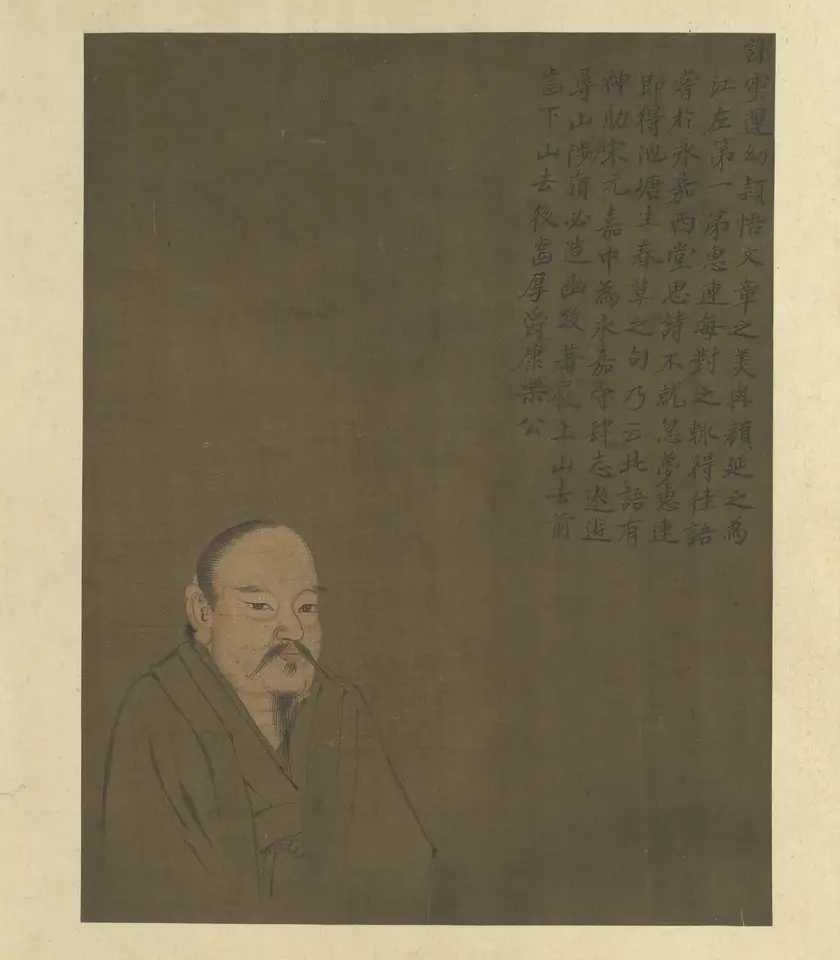
谢灵运
Xie Lingyun, 385–433 (谢灵运), birth name Xie Gongyi, courtesy name Lingyun, also known as Xie Kangle and Master Xie, was an aristocratic statesman, Buddhist philosopher, explorer, and the foundational founder of Chinese landscape poetry (Shanshui Shi) during the Southern and Northern dynasties. Originating from the preeminent Xie clan of Chen Commandery and born in Shining, Kuaiji, he was the grandson of General Xie Xuan, the…
Xie Lingyun, 385–433 (谢灵运), birth name Xie Gongyi, courtesy name Lingyun, also known as Xie Kangle and Master Xie, was an aristocratic statesman, Buddhist philosopher, explorer, and the foundational founder of Chinese landscape poetry (Shanshui Shi) during the Southern and Northern dynasties. Originating from the preeminent Xie clan of Chen Commandery and born in Shining, Kuaiji, he was the grandson of General Xie Xuan, the victor of the Battle of Fei River. Inheriting the hereditary title Duke of Kangle during the Eastern Jin dynasty, Xie Lingyun entered official service holding posts such as Army Staff Member, Assistant in the Palace Library, and Imperial Diarist. Following the dynastic transition to Liu Song in 420, his title was demoted to Marquess of Kangle; resentful of being treated purely as a literary figure without real executive power, he voiced relentless political complaints. Exiled as Grand Administrator of Yongjia by regent Xu Xianzhi in 422, he neglected bureaucratic administration, spending entire weeks exploring rugged coastal valleys and inaugurating a revolutionary aesthetic style of landscape poetry. Recalled in 426 by Emperor Wen of Song, he was appointed Director of the Palace Library, compiling the monumental Catalogue of the Four Sections of the Imperial Library (Mige Sibu Mulu) and beginning work on the Book of Jin. Elevated to Cavalier Attendant-in-Ordinary, his literary prose and elegant calligraphy were celebrated by the emperor as the "Two Treasures." However, alienated by his exclusion from core state decisions, he retired to Shining and engaged in land reclamation disputes with Kuaiji Administrator Meng Yi. Framed for rebellion, he was reassigned to Linchuan, where he detained imperial marshals and fled into the mountains. Sentenced to death, his sentence was commuted to exile in Guangzhou due to his grandfather's historic merits. In 433, implicated in an armed escape plot organized by former retainers, he was executed in Guangzhou at the age of forty-nine. His innovative verse broke the century-long dominance of arcane metaphysical poetry (xuan yan shi), directly inspiring the Yongming style and High Tang landscape masters.
Born at the ancestral Shining estate in Kuaiji, grandson of the famed general Xie Xuan.
Raised in a Daoist abbey in Qiantang during childhood; returned to the ancestral mansion in Jiankang at age fifteen.
Inherited the hereditary title Duke of Kangle with an estate of two thousand households following his mourning period.
Commenced official career as staff officer to Grand Marshall Sima Dewen; his sumptuous dress and carriages set fashion trends across Jiankang.
Appointed Consulting Officer under General Liu Yu after the fall of Liu Yi; later promoted to Assistant in the Palace Library.
Demoted to Marquess of Kangle upon the Liu Song dynastic founding, appointed Cavalier Attendant-in-Ordinary and Crown Prince Guard Commander.
Resigned from office to reside at his Shining villa, altering his legal registry to Kuaiji and writing the celebrated Rhapsody on Mountain Dwelling.
Summoned by Emperor Wen; directed the Palace Library, compiled the Catalogue of the Four Sections, and was promoted to Palace Attendant.
Feigned illness due to marginalization from political authority; retired home and was formally dismissed by the Censorate for absenteeism.
Slandered by Kuaiji Administrator Meng Yi; transferred to Chancellor of Linchuan, captured imperial arrest officers, and had his death sentence commuted to Guangzhou exile.
Implicated in an armed rescue conspiracy; executed in Guangzhou by imperial decree at the age of forty-nine, composing a defiant deathbed poem.
Xie Lingyun was born in 385 at the ancestral estate in Shining, Kuaiji Commandery. The Xie clan of Chen Commandery stood alongside the Wang clan as the supreme aristocratic lineage in Southern dynasties politics. His grandfather was Xie Xuan, the illustrious battlefield commander who routed the Former Qin invasion at the Battle of Fei River, while his father was Sanqi Shilang Xie Huan. Displaying remarkable intellectual brilliance from early childhood, Xie Lingyun was cherished by his grandfather, who frequently observed that Xie Huan was dull yet had sired an extraordinary genius. Owing to high infant mortality in the family, Lingyun was sent to a Daoist temple in Qiantang to be raised by Abbot Du Jiong, not returning to the capital until the age of fifteen, earning the affectionate childhood name Ke'er (the Guest Child).
In 403, upon reaching adulthood, he inherited his grandfather's enfeoffment as Duke of Kangle with two thousand households. He commenced official service under Sima Dewen, Grand Marshall and Prince of Langye. Endowed with striking personal beauty and haughty aristocratic elegance, he altered standard court garments and carriages into dazzling patterns, sparking widespread emulation among young patricians who referred to him as Xie Kangle. In 407, he joined the staff of general Liu Yi as Consulting Recorder. Following Liu Yi's defeat in 413, warlord Liu Yu recognized his preeminent literary stature, enlisting him as Staff Officer and subsequently promoting him to Assistant in the Palace Library, Imperial Diarist, and Yellow Gate Attendant. Entrusted with inspecting military divisions at Pengcheng, he composed Rhapsody on the Southern Expedition, winning acclaim throughout the armed forces.
When Liu Yu deposed the Eastern Jin to establish the Liu Song dynasty in 420, traditional door-status privileges suffered severe imperial curtailment. Xie Lingyun's hereditary peerage was reduced from Duke to Marquess of Kangle, his revenue fief slashed to five hundred households, and he was appointed Cavalier Attendant-in-Ordinary and Left Guard Commander to the Crown Prince. A man of overweening political ambition who envisioned himself as a paramount chancellor, Xie Lingyun was infuriated that the new dynasty treated him merely as a skilled literary decorator while excluding him from executive councils. His outspoken insolence and disdain for court protocol alienated royal ministers.
In 422, upon the accession of young Emperor Liu Yifu, court regents Xu Xianzhi and Fu Liang found his biting criticisms intolerable and dispatched him as Grand Administrator of Yongjia. Situated along the rugged southeast coast, Yongjia featured soaring peaks and rushing mountain rivers. Consumed by political alienation, Xie Lingyun abandoned all official administrative tasks, leaving lawsuits unresolved and tax rolls untouched. Instead, accompanied by hundreds of private retainers and literati companions, he explored the Nanxi River and Yandang ranges, frequently disappearing into the mountains for weeks at a time. Channeling his profound existential melancholy into descriptive verse, he composed dozens of revolutionary poems, laying the foundational aesthetic paradigm of Chinese landscape poetry.
After a single year in Yongjia, Xie Lingyun pleaded illness and retired to his ancestral estate at Shining. He officially transferred his household registration to Kuaiji, designing expansive terraced gardens between Mount Nanshan and Mount Lishan that maximized natural water views. Surrounding himself with reclusive scholars like Wang Hongzhi and Kong Chunzhi, he engaged in endless poetic symposia and scenic expeditions, documenting his ecological philosophy in the famous Rhapsody on Mountain Dwelling. Each time a new poem arrived in Jiankang, both aristocrats and commoners eagerly transcribed the manuscript, generating overnight fame throughout the capital.
In 426, Emperor Wen purged regents Xu Xianzhi and Fu Liang, dispatching imperial emissaries to summon Xie Lingyun to court as Director of the Palace Library. In this capacity, he restored damaged national collections, authored the comprehensive Catalogue of the Four Sections of the Imperial Library, and commenced drafting the official Book of Jin. Soon elevated to Cavalier Attendant-in-Ordinary, the emperor summoned him for daily consultations. Xie Lingyun was an exquisite calligrapher, penning every composition personally; Emperor Wen treasured his verses and brushwork as the "Two Treasures" of the realm.
Nevertheless, Xie Lingyun's hopes for real statecraft power were swiftly dashed. Emperor Wen, mirroring his father's policies, relied on humble administrators like Wang Huashou and Yin Jingren for state affairs, reserving Xie Lingyun solely for literary diversion. Disillusioned, Xie Lingyun feigned illness to skip court assemblies, diverting government laborers to landscape palace gardens and departing on spontaneous expeditions across hundreds of miles. Sensing imperial displeasure, he submitted an official request for sick leave, submitting an unheeded strategic memorial urging Emperor Wen to attack the northern frontiers while Northern Wei fought the Xia kingdom, before retiring once more to Kuaiji.
Returning to Shining in 428, Xie Lingyun formed an intimate literary brotherhood known as the "Four Friends" with Xie Huilian, He Changyu, Xun Yong, and Yang Xuanzhi. In 428, Censor-in-Chief Fu Long impeached him for prolonged truancy and wild revelry, stripping him of all official titles. Wealthy and commanding hundreds of hereditary retainers, Xie Lingyun launched extensive excavation projects, clearing roads through virgin forests and utilizing his invented "Xie's Clogs" with detachable cleats to traverse hazardous precipices.
During this period, he developed a bitter feud with Kuaiji Administrator Meng Yi, a pious Buddhist whom Xie Lingyun openly ridiculed, asserting that only men of poetic genius could achieve enlightenment, predicting Meng Yi would reach heaven first but achieve Buddhahood last. When Xie Lingyun petitioned to drain Lake Huizhong and Lake Pixu for rice cultivation, Meng Yi firmly blocked the decrees to preserve local fisheries and ecological stability. Enraged by the stalemate, Meng Yi memorialized the throne, falsely alleging that Xie Lingyun was amassing private weaponry for rebellion. Xie Lingyun rode posthaste to Jiankang to plead his innocence. Recognizing the slander, Emperor Wen dismissed the charges but appointed him Chancellor of Linchuan to prevent further provincial conflict.
In Linchuan, Xie Lingyun's defiant lifestyle persisted. When the Censorate issued a second arrest warrant and Marshal Zheng Wangsheng arrived with troops, Xie Lingyun staged an armed insurrection, taking Zheng Wangsheng hostage and fleeing into the wilderness while penning verses comparing himself to ancient martyrs Zhang Liang and Lu Zhonglian. Captured by provincial pursuing forces, he was sentenced to public decapitation by the judiciary. Out of reverence for Xie Xuan's monumental dynastic services, Emperor Wen commuted his punishment to forfeiture of rank and lifelong exile to remote Guangzhou.
In 433, regional military guards at Qin Commandery apprehended suspect vagabonds led by Zhao Qin near the Taoxu village crossing. Interrogations revealed that Xie Lingyun's former lieutenant Xue Daoshuang had distributed gold to purchase weapons, plotting an armed ambush at Sanjiangkou to liberate Xie Lingyun during his transit to exile. Because the rendezvous failed, the scattered conspirators resorted to roadside robbery.
Court authorities presented this testimony as definitive proof that Xie Lingyun remained committed to armed rebellion even in exile. Pressured by Prince of Pengcheng Liu Yikang and judicial hardliners, Emperor Wen issued a secret decree commanding imperial commissioners to execute Xie Lingyun immediately in Guangzhou. Standing before the execution ground at the age of forty-nine, Xie Lingyun displayed serene defiance. Famed for his magnificent beard, he formally bequeathed his whiskers to the Jihuan Monastery in Guangzhou to decorate the statue of Vimalakirti, which the monks preserved for over two centuries until mutilated during the Tang dynasty. Composing his poignant deathbed poem declaring that his noble aspirations had not dissolved amidst tranquil mountain crags, he met his end with dignified composure.
Xie Lingyun stands as an epochal figure in the history of world literature, revered as the foundational father of Chinese landscape poetry. Throughout the Eastern Jin period, the southern poetic scene had been dominated by arcane metaphysical poetry (xuan yan shi), which favored abstract philosophical discourse over emotional expression, degenerating into pedantic versification that Sima Qian would have dismissed as dry paraphrases of the Daodejing.
With incomparable natural genius, Xie Lingyun redirected the poetic gaze toward the magnificent mountains, cascading waterfalls, and misty forests of the natural world. Among his surviving corpus, nearly forty works constitute mature, comprehensive landscape poems. He harmonized intricate parallel couplets with breathtaking natural observations, creating celebrated lines such as "Spring grasses flourish along the garden pool, / While weeping willows echo with transforming songs of birds," realizing an aesthetic perfection likened to fresh lotus blossoms rising through pristine waters. His work breathed heroic vitality back into verse, directly shaping the emergence of the Yongming metric style and establishing the artistic horizon for Tang landscape masters like Wang Wei and Meng Haoran.
Xie Lingyun's relentless experiments in poetic phonetics and syntactical parallelism directly accelerated the formal codification of Chinese regulated verse. In his critical postscript in the Book of Song, Shen Yue observed that Xie Lingyun consciously pursued tonal modulation and melodic variation in five-character poetry, striving to ensure that within a single bamboo slip all tones differed, and within two couplets light and heavy accents balanced harmoniously.
Breaking free from the monotonous phrasing of ancient verse, he deliberately balanced the four tones and coordinated alliteration and rhyming compounds. His sophisticated syntactic parallelism and melodic cadences provided the direct technical catalyst for Shen Yue and Xie Tiao to formulate the Yongming metric rules during the Southern Qi, establishing the musical and prosodic foundation that culminated in High Tang regulated verse.
The monumental Rhapsody on Mountain Dwelling and its detailed autocommentary represent far more than a literary masterpiece; they constitute an invaluable socio-economic and geographical treatise on early medieval aristocratic estate life. In this text, Xie Lingyun minutely recorded the territorial planning, ecological zoning, and hydraulic management of his extensive estate in Shining.
He constructed dams and canals to irrigate terraced rice paddies, cleared hemp and mulberry orchards across hillsides, established medicinal herb groves, and constructed private storehouses and artisan workshops. Simultaneously, he erected Buddhist sanctuaries, shrines, and meditation grottoes among secluded ravines. His vivid account provides irreplaceable primary documentation regarding land reclamation, rural ecology, and the self-sufficient manor culture of Six Dynasties southern aristocrats.
Beyond literature, Xie Lingyun was an eminent Buddhist philosopher and translator of the Six Dynasties. He maintained lifelong communion with Master Huiyuan at Mount Lu, engaging deeply in Pure Land meditation and Prajnaparamita dialectics. In Jiankang, he assisted Gunabhadra in polishing and annotating Chinese recensions of the Avatamsaka Sutra (Huayan Jing) and Mahaparinirvana Sutra, and compiled the Fourteen Phonetic Annotations, the earliest extant Sanskrit-Chinese lexical manual.
His seminal theoretical work was the philosophical treatise Discourse on the Ultimate Truth (Bian Zong Lun). In this essay, Xie Lingyun systematically defended and expanded Zhu Daosheng's revolutionary doctrine of sudden enlightenment (dunwu). Integrating Confucian innate moral comprehension with Buddhist emptiness, he constructed a distinctively Sinicized ontology of mind that profoundly impacted the historical development of Chan Buddhism in the Tang and Song dynasties and Song-Ming Neo-Confucian metaphysics.
In 426, appointed Director of the Palace Library, Xie Lingyun took charge of organizing imperial collections damaged during decades of civil war and dynastic displacement. Leading renowned bibliographers such as Yin Chun, he conducted an exhaustive empire-wide search for lost manuscripts, meticulously collating variants and cataloging rare volumes.
His efforts culminated in the compilation of the Catalogue of the Four Sections of the Imperial Library (Mige Sibu Mulu). According to Ruan Xiaoxu's Gu Jin Shu Zui, this catalog recorded 14,582 scrolls of classical, historical, philosophical, and literary works, alongside 438 scrolls of Buddhist scriptures categorized across 645 wraps. Exhibiting rigorous structural taxonomy, it dramatically superseded Li Chong's earlier Jin bibliographies, preserving invaluable records of ancient Chinese intellectual patrimony through centuries of turmoil.
Xie Lingyun was an authentic pioneer of geographical exploration and mountaineering in ancient China. Viewing wilderness exploration as an avenue to liberate the soul from bureaucratic servitude, he surveyed the formidable terrain of Kuaiji, Yongjia, Tiantai, and Yandang, clearing pathways across unexplored ranges and setting the standard for patrician mountaineering expeditions.
To overcome the hazardous, slippery gradients of southern mountains, he engineered specialized wooden sandals equipped with detachable cleats known as "Xie's Clogs" (Xie Gong Ji). The wearer removed the front cleat when climbing uphill to lean forward comfortably, and detached the rear cleat when descending to ensure steady footing. This ingenious invention became the standard footwear for mountaineering scholars across centuries. Tang dynasty poet Li Bai immortalized this spirit in Dreaming of a Tour to Mount Tianmu, writing: "Strapping on the clogs of Master Xie, / I ascend the azure ladder to the clouds," enshrining Xie Lingyun's pioneering spirit in the global history of mountaineering culture.
FIGURES ASSOCIATED WITH THIS DYNASTY