谢薖
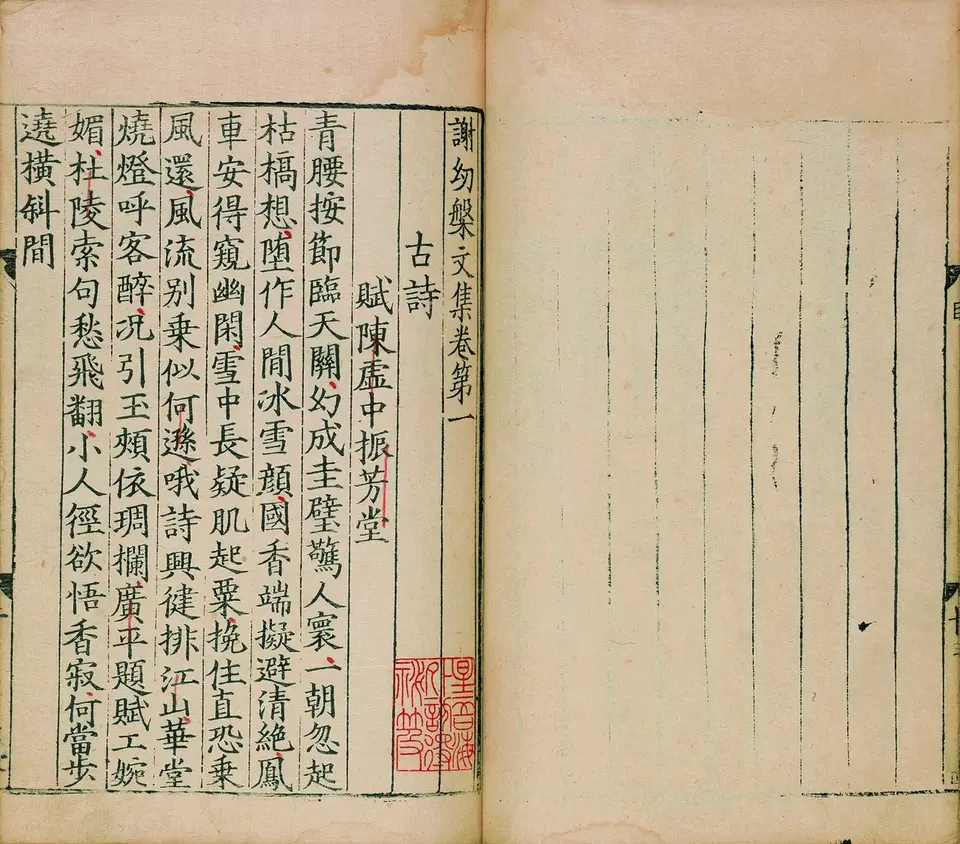
Classical woodblock edition / text (Xie Ke)
Image credits謝薖 · Public domainImage source

Historical figure

Xie Ke (谢薖)

谢薖

Xie Ke (谢薖), courtesy name Youdu (幼度; alternatively Youpan 幼盘), art name Lay Buddhist of Zhuyou (竹友居士), was a native of Linchuan, Fuzhou (modern Wudun Village, Dongguan Town, Linchuan District, Fuzhou, Jiangxi). Active during the reigns of Emperors Zhezong and Huizong, he was a distinguished poet, lyricist, and prominent figure of the renowned "Jiangxi poetry movement" (Jiangxi shipai). Tracing his ancestry to the…

Era not stated

PROFILE

Xie Ke (谢薖), courtesy name Youdu (幼度; alternatively Youpan 幼盘), art name Lay Buddhist of Zhuyou (竹友居士), was a native of Linchuan, Fuzhou (modern Wudun Village, Dongguan Town, Linchuan District, Fuzhou, Jiangxi). Active during the reigns of Emperors Zhezong and Huizong, he was a distinguished poet, lyricist, and prominent figure of the renowned "Jiangxi poetry movement" (Jiangxi shipai). Tracing his ancestry to the celebrated Six Dynasties landscape poets Xie Lingyun and Xie Tiao, Xie Ke grew up in a scholarly household alongside his elder cousin Xie Yi. Both brothers studied under the prominent Neo-Confucian educator Lü Xizhe (Master Xingyang), immersing themselves in classical philosophy and elegant composition. Xie Ke achieved early literary renown across southern China, matching his cousin Xie Yi in poetic prestige; contemporaries celebrated the pair as the "Two Xie Brothers of Linchuan". Furthermore, in association with Xie Yi, Wang Ge, and the poet-monk Rao Jie, they were hailed as the "Four Talents of Linchuan." Disillusioned by the fierce factional purges and corrupt civil service examinations under Grand Councilor Cai Jing, Xie Ke chose to live as an unranked commoner scholar (buyi), resolutely refusing to compete for official rank. In his poetry, he synthesized the structural discipline of Huang Tingjian with the natural, luminous lyricism of Xie Tiao, avoiding the obscure, awkward diction common among late Jiangxi school versifiers. His surviving works are recorded in Ma Duanlin's Wenxian Tongkao, encompassing Zhuyou ji (Collected Works of Zhuyou) in ten volumes and Zhuyou ci (Lyrics of Zhuyou) in one volume.

Courtesy Name
Youdu (幼度; alternatively Youpan 幼盘)
Art Name
Lay Buddhist of Zhuyou (竹友居士)
Native Place
Linchuan, Fuzhou (抚州临川; now Wudun, Dongguan Town, Linchuan District, Fuzhou, Jiangxi)
Major Identity
Prominent Northern Song poet, lyricist, master of the Jiangxi poetry movement
Accurate Identity Positioning
Renowned Northern Song poet of the Jiangxi poetry movement, one of the Two Xie Brothers of Linchuan, one of the Four Talents of Linchuan, reclusive commoner poet
LIFE TIMELINE

Relationship graph

BIOGRAPHY

Chronology

  • Yuanyou Era (c. 1086–1093) | Classical Studies under Lü Xizhe | Studied Confucian classics and literature alongside his cousin Xie Yi under Master Xingyang Lü Xizhe.
  • Early Shaosheng Era (c. 1094) | Poetic Emergence in Jiangnan | Traveled across Jiangnan, winning wide literary acclaim for his pristine and elegant verse.
  • Jianzhong Jingguo Era (1101) | Fame of the Two Xies | Resided south of Linchuan city; surrounded his cottage with bamboo, adopting the art name Lay Buddhist of Zhuyou.
  • Chongning Era (1102–1106) | Renouncing Bureaucracy | In protest against Cai Jing's factional blacklists and corrupt examinations, permanently renounced official exams.
  • Daguan Era (1107–1110) | Four Talents of Linchuan | Formed an iconic literary fellowship with Xie Yi, Wang Ge, and Rao Jie, exchanging verses along Linchuan rivers.
  • Zhenghe to Xuanhe Eras | Compiling Works and Death | Completed Zhuyou ji in ten volumes and Zhuyou ci; passed away peacefully at his Linchuan cottage.

Life and Career

Linchuan Heritage and Mentorship under Master Xingyang

Xie Ke was born into a respected scholarly family in Wudun Village south of Linchuan. Fuzhou was a fertile cradle of Song literary talent, and the Xie clan traced its lineage to the famed Six Dynasties poets Xie Lingyun and Xie Tiao. Endowed with quiet intellect and deep aesthetic sensitivity, Xie Ke formed an inseparable bond with his elder cousin Xie Yi from childhood, studying side by side in their family library.

During the Yuanyou era of Emperor Zhezong, the renowned Confucian scholar Lü Xizhe (Master Xingyang, eldest son of Grand Councilor Lü Gongzhu) retired from central office to lecture in the Huai and Jianghan regions. Drawn by his fame, Xie Ke and Xie Yi traveled together to enroll as his disciples. Master Xingyang taught that genuine scholarship must be anchored in personal moral cultivation and principled independence rather than the pursuit of worldly wealth. This ethical training deeply impressed Xie Ke, instilling in him a lifelong resolve to maintain uncompromised personal dignity.

Hermitage among Bamboo and Commoner Integrity

Returning to Linchuan, Xie Ke constructed a modest cottage surrounded by thousands of emerald bamboo stalks. Reverencing the bamboo's evergreen endurance and unbending integrity, he named his dwelling "Zhuyou" (Friend of Bamboo) and styled himself the "Lay Buddhist of Zhuyou."

During the Shaosheng, Chongning, and Daguan eras, the central court was torn by vicious factional purges as Cai Jing and his allies blacklisted upright scholar-officials. Imperial civil service examinations devolved into exercises in political conformity and venal flattery. Observing this moral degradation, Xie Ke chose absolute detachment. He refused to sit for the metropolitan examinations or seek bureaucratic patronage, choosing to subsist on coarse grain in rustic seclusion.

Master of the Jiangxi School and the Four Talents

In his rural retreat, Xie Ke concentrated entirely on refining his poetic craft. At the time, the "Jiangxi poetry movement" founded by Huang Tingjian dominated Chinese literary circles. While Xie Ke absorbed Huang Tingjian's emphasis on poetic structure and allusion, he avoided the pedantic obscurity that plagued many Jiangxi followers.

Xie Ke and his cousin Xie Yi published countless collaborative verses, earning universal acclaim across the empire as the "Two Xie Brothers of Linchuan" (Linchuan Er Xie), explicitly compared by scholars to the famous Six Dynasties pair Xie Lingyun and Xie Huilian. Furthermore, they joined with reclusive scholar Wang Ge and the gifted poet-monk Rao Jie to form the "Four Talents of Linchuan." The four friends spent their days boating along local streams, brewing tea, and chanting poetry. Xie Ke compiled his lifetime output into Zhuyou ji in ten volumes and Zhuyou ci in one volume before passing away peacefully in Linchuan.

Major Achievements

Lyrical Vanguard within the Jiangxi Poetry Movement

Xie Ke holds a distinct place in Song dynasty literature as one of the few Jiangxi school poets who successfully reconciled structural rigor with effortless lyricism.

Where many contemporaries fell into the trap of forced rhyming and pedantic obscurity, Xie drew directly from his ancestor Xie Tiao. His verses are marked by crystal-clear diction, natural rhythmic cadence, and ethereal atmospheric beauty. Southern Song scholar-statesman Lü Benzhong wrote in Ziwei's Poetry Talks (Ziwei Shihua): "Xie Youdu's poetry is extraordinarily pristine and free from vulgarity, frequently approaching the very spirit of Xie Xuanhui (Xie Tiao)." The Two Xie Brothers of Linchuan stood out as a beacon of natural elegance, correcting the rigid stiffness of the late Jiangxi school.

Classical Corpus of Zhuyou ji and Lyric Achievements

Xie Ke's literary legacy was formally canonized in Ma Duanlin's Yuan dynasty historical encyclopedia Wenxian Tongkao, which recorded Zhuyou ji in ten volumes and Zhuyou ci in one volume.

His song lyrics (ci) are equally celebrated for their refined melancholy, emotional restraint, and exquisite natural imagery. Compositions to tunes such as Jianzi Mulan Hua and Dielianhua reflect the pure aesthetic sensibility of Yan Shu and Qin Guan, securing him an enduring place in Song lyric history.

Personal Relationships

  • Ancestral Models: Xie Lingyun and Xie Tiao, Six Dynasties landscape poetry titans.
  • Cousin and Literary Comrade: Xie Yi, art name Xitang, renowned Jiangxi school poet and elder partner in the Two Xie Brothers of Linchuan.
  • Mentor: Lü Xizhe, celebrated Northern Song Neo-Confucian educator (Master Xingyang).
  • Literary Associate: Wang Ge, reclusive poet and one of the Four Talents of Linchuan.
  • Literary Associate: Rao Jie, renowned poet-monk and one of the Four Talents of Linchuan.
  • Poetry Critic: Lü Benzhong, compiler of the Chart of the Jiangxi Poetry School, who praised Xie's affinity with Xie Tiao.

Historical Evaluations

  • *Lü Benzhong, Ziwei's Poetry Talks***: "Xie Youdu's poetry is exceedingly clear, moist, and free from worldly dust, frequently approaching the grace of Xuanhui. The Two Xies of Linchuan truly lived up to their renown."
  • *Ma Duanlin, Wenxian Tongkao**: "Xie Ke, courtesy name Youdu, art name Zhuyou, was a native of Linchuan. Sharing equal fame with his brother Xie Yi, he authored Zhuyou ji in ten volumes and Zhuyou ci* in one volume."
  • **Siku Quanshu Zongmu Tiyao (Annotated Catalogue of the Complete Library of the Four Treasuries)**: "Although Xie Ke received his poetic method from Huang Shangu, his spiritual marrow remained pure and elegant, untainted by the awkward, stiff mannerisms of the Jiangxi school. Like a solitary pine upon an azure peak, his verse possesses an authentic, independent grace."

Related Entries

  • Xie Yi
  • Jiangxi poetry movement
  • Lü Xizhe
  • Lü Benzhong
  • Rao Jie
  • Two Xie Brothers of Linchuan
  • Four Talents of Linchuan

FIGURES ASSOCIATED WITH THIS DYNASTY

Bibliography

  • Wenxian Tongkao, Volume 238, Monograph on Classical Literature
  • Songshi Jishi (Recorded Events of Song Poetry), Volume 36, Xie Ke