Birth in Jiangxi
Born into a scholar-official household in Yiyang, Xinzhou; raised by his noble-minded mother Madame Gui following his father's early demise.
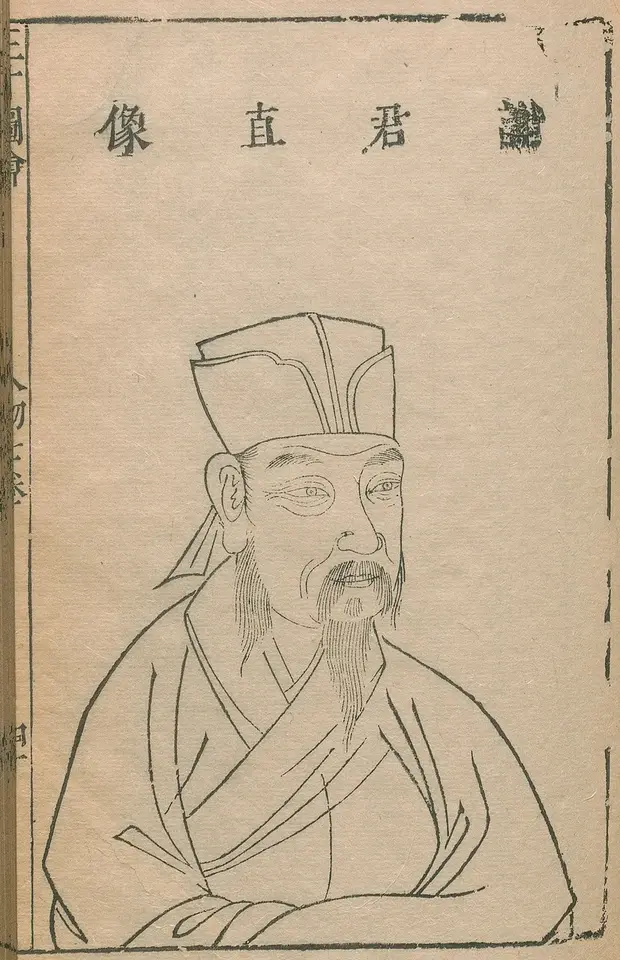
谢枋得
Xie Fangde (谢枋得, 1226–1289), courtesy name Junzhi, art name Dieshan, was a native of Yiyang, Xinzhou. He was a towering patriotic statesman, anti-Yuan military commander, acclaimed writer, and literary anthologist during the final years of the Southern Song dynasty. Born into an esteemed scholar-official family, Xie earned his jinshi degree in 1256 alongside Wen Tianxiang. In his palace examination essay, he fearlessly…
Xie Fangde (谢枋得, 1226–1289), courtesy name Junzhi, art name Dieshan, was a native of Yiyang, Xinzhou. He was a towering patriotic statesman, anti-Yuan military commander, acclaimed writer, and literary anthologist during the final years of the Southern Song dynasty. Born into an esteemed scholar-official family, Xie earned his jinshi degree in 1256 alongside Wen Tianxiang. In his palace examination essay, he fearlessly assailed corrupt favorites such as eunuch Dong Songchen and Grand Councilor Jia Sidao, causing his rank to be suppressed. When Mongol forces invaded in 1275, Xie liquidated his entire estate to raise a ten-thousand-man righteous army, serving as Judicial Commissioner of Jiangdong and Prefect of Xinzhou, battling enemy forces tenaciously at Tuanhuping. Following the fall of Xinzhou, he lived in reclusion across northern Fujian under assumed names, earning a frugal living as a street diviner while adhering to an oath never to wear shoes under foreign rule. Following the complete conquest of Song, the Yuan court repeatedly issued imperial decrees to recruit him, but Xie steadfastly refused. Forcibly escorted in an enclosed cart to Dadu, Xie was confined at Minzhong Temple, where he prostrated before the portrait of Emperor Lizong and fasted unto death for over twenty days at the age of sixty-four. Conferred the posthumous name Wenjie during the Ming dynasty, his compilation Standard Models of Literature (Wenzhang Guifan) represents the pinnacle of Song prose criticism. Revered alongside Wen Tianxiang as the Two Mountains of Song loyalism, his steadfast moral courage remains an eternal beacon in Chinese history.
Born into a scholar-official household in Yiyang, Xinzhou; raised by his noble-minded mother Madame Gui following his father's early demise.
Passed the metropolitan examination alongside Wen Tianxiang; fiercely attacked court favorites in his palace essay, relegated to first rank of the second tier.
Formulated examination questions challenging Jia Sidao's secret appeasement at Ezhou; impeached by court partisans and banished to Xingguo Military Prefecture.
Declined imperial summons to compile official state histories, resolutely refusing to associate with Jia Sidao's corrupt regime.
Appointed Judicial Commissioner of Jiangdong and Prefect of Xinzhou as Mongol armies pushed eastward; spent all private wealth to field an army of ten thousand men.
Led righteous volunteers into fierce combat at Tuanhuping against defector general Lv Shikui; overwhelmed by numbers, went underground in the Wuyi Mountains.
Guided his mother and family into refuge across Jianning, Jianyang, and Chong'an; disguised his identity and earned a living selling divinations in public markets.
Repeatedly rejected recruitment missions dispatched by Yuan Hanlin Academician Cheng Jufu, swearing by heaven to choose death over collaboration.
Surrounded and abducted by Fujian military forces led by Wei Tianyou; escorted under armed guard in a prisoner cage to Dadu.
Detained at Minzhong Temple in Dadu; wept bitterly before the portrait of Emperor Lizong and died following a hunger strike of over twenty days at age sixty-four.
Xie Fangde was born in 1226 in Yuting, Yiyang County, Xinzhou, into a distinguished lineage of Confucian officials. His grandfather, Xie Guangcan, had served as Prefect of Changzhou and military controller of five prefectures. His father, Xie Yingxiu, had been an esteemed scholar at the Imperial Academy whose unyielding uprightness provoked the enmity of powerful court favorites, leading to his tragic imprisonment and death. Xie Fangde was raised solely by his mother, Madame Gui. A woman of extraordinary moral vision from Guixi, Madame Gui instilled in her children strict Confucian standards of public integrity and uncompromising righteousness.
From early childhood, Xie displayed prodigious intellectual gifts. Beyond mastering classical canonical texts and historical treatises, he immersed himself in statecraft, military strategy, institutional jurisprudence, and calendar astronomy. Endowed with an expansive, chivalric spirit, he forged friendships with like-minded scholars across Jiangxi, dedicating himself to national salvation.
In 1256, at the age of thirty-one, Xie traveled to Lin'an to take the metropolitan and palace examinations, emerging victorious on the same jinshi roll as Wen Tianxiang. At that time, Emperor Lizong indulged in palace pleasures, leaving supreme authority to eunuch Dong Songchen, while Jia Sidao consolidated ministerial dominance. In his palace policy essay, Xie delivered an unsparing indictment of eunuch usurpation and executive decay. Though examiners were awed by his rhetorical power, dread of royal displeasure caused them to reduce his standing to the top of the second class.
In 1259, Mongol armies under Kublai Khan crossed the Yangtze River and laid siege to Ezhou, plunging the Song realm into panic. Jia Sidao, commanding reinforcements at Hanyang, secretly dispatched envoys promising territorial concessions and vassalage to obtain a Mongol withdrawal. Returning to Lin'an, Jia concealed his treacherous dealings, claiming credit for a heroic victory and seizing dictatorial authority. In the autumn of that year, the Jiangdong Transportation Commission appointed Xie as regional examination supervisor. Seizing the opportunity, Xie devised ten examination questions explicitly probing the betrayal of national defense, publicly exposing Jia's duplicity.
He questioned why the court abandoned the natural defenses of the Huai River and asserted that purchasing false peace with gold and tribute was suicidal. Infuriated by this public exposure, Jia ordered the Censorate to impeach Xie for slandering the court. Xie was stripped of two official ranks and banished to Xingguo Military Prefecture under administrative custody. At Xingguo, observing the layered peaks embracing the prefecture, Xie adopted the literary pseudonym Dieshan (Folded Mountains). He closed his doors to study the Book of Changes, while regional prefects and scholars visited his residence in discipleship to receive instruction in classical statecraft.
In 1267, the court summoned Xie to Lin'an to serve in the Historiography Institute. Recognizing that Jia Sidao's entrenchment had rendered the dynasty irremediably corrupt, Xie declined to lend his reputation to the regime, pleading illness to remain at home. When Jia dispatched envoys offering lucrative promotions, Xie rejected them unequivocally, choosing to remain in Jiangxi to instruct local students and maintain his untarnished integrity.
In early 1275, Mongol grand commander Bayan led combined naval and cavalry armies down the Yangtze, prompting dozens of Song garrison commanders to capitulate. Jia Sidao suffered total annihilation at Dingjiazhou. With the dynasty on the brink of extinction, the desperate court appointed Xie as Judicial Commissioner of Jiangdong, Pacification Commissioner of Jiangxi, and Prefect of Xinzhou, charging him with defending Raozhou, Xinzhou, and Fuzhou.
Confronting overwhelming enemy forces, Xie liquidated his ancestral lands and household valuables, distributing thousands of strings of cash as military pay. He issued passionate proclamations across Jiangxi, raising an army of ten thousand patriotic volunteers. Establishing fortified positions around Yiyang and drilling his troops rigorously, he resolved to defend Xinzhou with his life.
In the first month of 1276, Song defector general Lv Shikui led elite Mongol units against Xinzhou. Lv had previously enjoyed Xie's patronage and sent letters urging surrender. Xie severed the envoy's harness, burned the letters, and publicly denounced Lv's treachery. Marching to Tuanhuping in Anren County, Xie positioned his volunteer forces in ambush against the invaders.
When the enemy cavalry advanced into the valley, Xie's volunteers sprang their ambush, inflicting severe initial casualties. However, as the main Mongol cavalry swept in, the lightly equipped volunteers were gradually overpowered. As the defense collapsed, Xie attempted suicide, but his followers restrained him, urging him to preserve his life for future restoration. Xie disguised himself in commoner attire and carried his aged mother Madame Gui into the rugged mountains.
Following the capture of Xinzhou, Mongol forces conducted ruthless manhunts for Xie and his kin. His elder brother Xie Junyu was captured defending Jiujiang and executed; his wife Lady Li swallowed gold to commit suicide rather than surrender; his mother was briefly detained but released when her serene dignity disarmed her captors. Xie escorted his mother through the Wuyi Mountains, taking refuge in Jianning, Chong'an, and Jianyang.
In Jianyang, Xie adopted the pseudonym Yizhai the Diviner, setting up a divination stall beside the South Water Bridge. He swore never to wear leather shoes under alien dominion, walking barefoot or in simple straw sandals. He accepted only two measures of coarse rice to feed his mother, or a pair of straw shoes for travel, firmly rejecting all offerings of silver or bronze coinage.
Despite living in market alleys, his renown attracted a steady stream of scholars. Local officials and gentry entrusted their sons to his tutelage, and Xie transformed his humble cottage into an academy dedicated to classical virtue. During these arduous years, he penned extensive prose collections and completed his compilation of Standard Models of Literature, embodying the unyielding cultural memory of the fallen realm.
At the southern end of the South Water Bridge in Jianyang, Xie hung a wooden sign reading "Yizhai the Diviner," sitting peacefully each day to offer divinations. When townsfolk inquired why he rejected coin and accepted only grain and footwear, Xie proclaimed: "Accepting rice sustains daily life; requesting straw sandals hardens my resolve to walk these rugged mountains. Since our dynastic defeat, I have sworn before heaven never to wear formal shoes until the South Court is restored!" Wandering through the Wuyi peaks, he penned numerous letters to friends such as Chen Jupu and Yang Shixi, decrying the decadence of late Song literary culture and advocating the revival of righteous prose.
In 1279, following the disaster at Yashan, the Southern Song ceased to exist. Seeking to pacify southern public opinion, Kublai Khan dispatched envoys across Jiangnan to recruit surviving Confucian luminaries. In 1286, Hanlin Academician Cheng Jufu traveled south on an imperial mission. Revering Xie's reputation, Cheng visited him five times, offering premier ministerial appointments. Xie rejected every overture, declaring by heaven that he would die before serving another dynasty.
In 1288, Wei Tianyou, an ambitious Yuan official in Fujian seeking imperial favor, dispatched troops to surround Xie's home in Jianyang. As Xie attempted suicide, guards seized him and placed him into an enclosed prison cart, transporting him by force across the country to Dadu.
Arriving in Dadu in the spring of 1289, Xie encountered high ministers sent by Kublai Khan to persuade him to accept office. Xie sat facing the wall with eyes closed, refusing to utter a single word. He was subsequently placed under house arrest at Minzhong Temple.
While walking through the temple grounds, Xie beheld an imperial portrait of Emperor Lizong hanging inside a shrine hall. Overcome with grief, he prostrated himself, weeping blood upon the stones. He lamented that having lived over sixty years without saving his country from ruin, he could never consume the food of barbarians to sustain a shameful life. From that hour, he ceased eating and drinking, refusing every grain of food offered by the Yuan court.
During more than twenty days of extreme fasting, attendants attempted to force liquid broths down his throat, but he spat them out in defiance. His physical body wasted away, yet his spirit remained magnificent. In the fourth month of 1289, Xie sat upright and passed away at Minzhong Temple at the age of sixty-four. Months later, his son Xie Dingzhi transported his casket back to Jiangxi for burial in Yiyang. In 1456, the Ming court conferred the posthumous name Wenjie, erecting the Shrine of Xie Dieshan in Beijing and immortalizing him alongside Wen Tianxiang for all posterity.
In 1275, as Mongol armies advanced in invincible strength, most regional Song commanders surrendered without resistance. Appointed in the hour of supreme peril, Xie demonstrated exceptional mobilization talent as Judicial Commissioner governing three critical prefectures. He liquidated his ancestral fortune to finance food and weaponry, rallying thousands of peasants, miners, and local literati into disciplined resistance regiments.
At the Battle of Tuanhuping, Xie's lightly armed militia fought veteran Mongol cavalry for an entire day. Though ultimately overcome by superior firepower, their fierce resistance delayed the Mongol subjugation of northern Fujian, creating critical strategic space for Wen Tianxiang to organize new defense lines across Jiangxi and Guangdong. His heroic stand exemplified the ultimate Confucian dedication to national survival.
In his youth, Xie Fangde came into possession of an ancient inkstone once utilized by the Southern Song national hero Yue Fei, treasuring it as a sacred heirloom. In 1275, as the Mongol onslaught threatened the Song capital, his examination contemporary Wen Tianxiang depleted his family fortune to raise a loyalist army in Jiangxi. Recognizing their shared mission, Xie dispatched an envoy to present this historic relic to Wen Tianxiang, engraving an inscription upon its reverse invoking Yue Fei's boundless loyalty to inspire unwavering resistance.
Deeply moved by the gift, Wen Tianxiang wept and carved his own poetic response onto the stone: "Though this inkstone is not iron, it can scarcely be worn through; though the human heart is not stone, it is as steadfastly enduring. If one guards integrity without wavering, the Way remains complete." The two men formed a solemn spiritual pact to sacrifice their lives for the dynasty, becoming immortalized in subsequent historiography as "Wen and Xie." Wen Tianxiang carried the inkstone through campaigns across Jiangxi and Guangdong until his execution in Yingtian, while Xie Fangde matched his sacrifice through a fatal hunger strike in Dadu, fulfilling their shared oath.
Xie Fangde's martyrdom in Dadu stands as a timeless monument of moral integrity in Chinese history. After the Southern Song was irrevocably extinguished, he rejected all worldly honors, preferring death through self-starvation rather than compromising his allegiance.
In his memorable letter to Cheng Jufu, he proclaimed: "A true gentleman, in his actions, weighs righteousness rather than advantage, legitimacy rather than mere outcome, and eternity rather than a single ephemeral lifetime." Fasting for over twenty days at Minzhong Temple in serene defiance of his captors, his glorious demise ranks alongside Wen Tianxiang's martyrdom at Caishikou and Lu Xiufu's leap into the sea at Yashan, personifying the pinnacle of spiritual defiance.
Xie achieved tremendous distinction as a poet and essayist, but his compilation and critical commentary in Standard Models of Literature (Wenzhang Guifan) represents a monumental milestone in classical Chinese prose criticism. Selecting preeminent prose masterpieces from the Han dynasty through Han Yu, Liu Zongyuan, Ouyang Xiu, and Su Shi, he created a rigorous framework connecting literary rhetoric with practical statecraft.
Xie pioneered an insightful commentary method that analyzed thematic gravity, architectural progression, rhythmic momentum, and syntax. This work became the premier textbook for generations of Ming and Qing scholars, raising Southern Song prose commentary to mature perfection. His elegiac poetry, including In the Wuyi Mountains, captured the tragic beauty of national mourning and remains celebrated across the centuries.
Xie's philosophical convictions were firmly grounded in Song Neo-Confucianism, influenced deeply by the Cheng brothers and Zhu Xi. He insisted on the absolute unity of moral knowledge and heroic practice, regarding heavenly principle as the ultimate guide for life. Concurrently, during his years of wandering through the Wuyi Mountains, he studied Daoist cosmological texts, utilizing Daoist detachment to endure poverty and physical peril.
This philosophical harmony enabled Xie to transcend personal loss, finding inner serenity amidst cosmic cataclysm. His life provided a living testament to the highest ethical aspirations of the Confucian gentleman.
In 1271, during the critical siege of Xiangyang and Fancheng, Xie gathered seventeen patriotic scholars at Jinxiang Temple in Qianshan to offer sacrifices to heroic poet Xin Qiji, authoring Record of Visiting the Shrine of Master Xin Jiaxuan to celebrate Xin's heroic genius and unyielding moral resolve. Later, in his famous letter to Cheng Jufu during his northern captivity, Xie bared his soul: "I took office at thirty-one and retired at fifty-one, serving in actual posts for less than eight months. I returned no salary home to nourish my mother, which means I cannot claim filial piety; when the realm fell into ruin, I failed to sacrifice my life in battle, which means I cannot claim supreme loyalty. Having fallen short in both loyalty and filial piety, how could I bear to accept honors under a new dynasty to defile my ancestral name!" Every word burned with tragic devotion.
Xie Fangde's heroic conduct was deeply rooted in his family's extraordinary moral tradition. When his ninety-year-old mother Madame Gui was detained by Mongol troops, she declared calmly that she only wished to die early and that teaching her sons righteousness was no crime, shaming the Mongol officers into releasing her.
His elder brother Xie Junyu fell defending Jiujiang; his wife Lady Li committed suicide in prison to preserve her honor; his younger brothers Junlie and Junze died in the loyalist resistance. The entire Xie family offered their lives for the realm, leaving an immortal legacy of moral grandeur in Chinese historical annals.
FIGURES ASSOCIATED WITH THIS DYNASTY