Philosophical Awakening
Gained regional literary renown; his profound lectures on the Zhuangzi earned him Shan Tao's lifelong friendship.
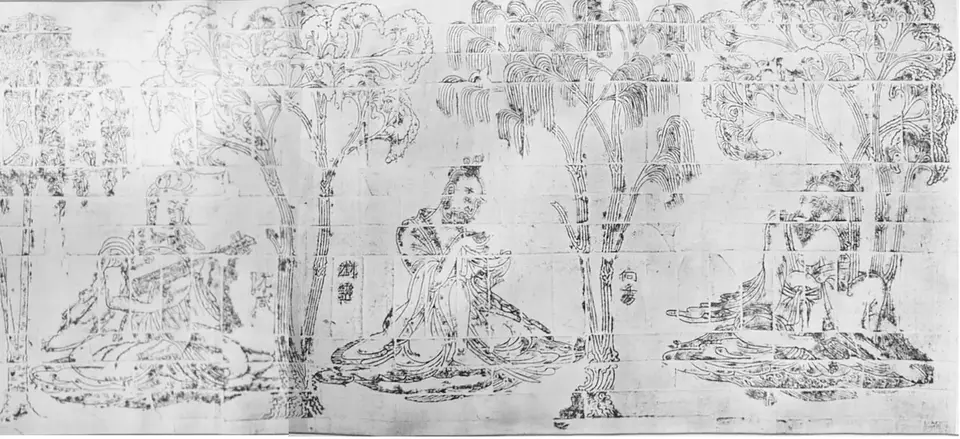
向秀
Xiang Xiu (向秀, ?–272 CE), courtesy name Ziqi, was an eminent philosopher, writer, and intellectual of the Wei-Jin period from Huai County in Henei (modern Wuzhi, Henan). He was a central luminary among the celebrated "Seven Sages of the Bamboo Grove." Devoted from his youth to classical learning and Daoist metaphysics (Xuanxue), he was introduced by Shan Tao to Ji Kang and Ruan Ji, forming an idyllic retreat in the bamboo…
Xiang Xiu (向秀, ?–272 CE), courtesy name Ziqi, was an eminent philosopher, writer, and intellectual of the Wei-Jin period from Huai County in Henei (modern Wuzhi, Henan). He was a central luminary among the celebrated "Seven Sages of the Bamboo Grove." Devoted from his youth to classical learning and Daoist metaphysics (Xuanxue), he was introduced by Shan Tao to Ji Kang and Ruan Ji, forming an idyllic retreat in the bamboo groves of Shanyang. He formed an exceptionally intimate bond with Ji Kang, assisting him at his blacksmith forge beneath the willow tree and pursuing a life of rustic independence. Xiang Xiu's crowning intellectual achievement was his groundbreaking commentary on the Zhuangzi, which dismantled dogmatic Han scholasticism and illuminated the philosophical concepts of self-generation and natural spontaneous order. His drafts formed the core analytical foundation for Guo Xiang's celebrated standard commentary on the thirty-three chapters of the Zhuangzi. Following the tragic execution of Ji Kang and Lv An in 263 CE, Xiang Xiu passed by their abandoned cottage at Shanyang and, moved by a neighbor's melancholic flute song, composed the elegiac literary masterpiece Rhapsody on Thinking of the Past (Sijiu Fu). Compelled by Sima Zhao's political pressure, he entered government service at Luoyang, serving as Cavalier Regular Attendant until his death in 272 CE.
Gained regional literary renown; his profound lectures on the Zhuangzi earned him Shan Tao's lifelong friendship.
Introduced to Ji Kang and Ruan Ji; joined the Bamboo Grove hermitage and assisted Ji Kang in smithing at Shanyang.
Composed Refutation of Ji Shuye's Essay on Nourishing Life, engaging Ji Kang on metaphysics and human desire.
Composed his seminal commentary on the Zhuangzi, establishing the synthesis between natural spontaneity and moral teaching.
Ji Kang and Lv An were executed; passing their former dwelling at dusk, Xiang Xiu composed Sijiu Fu.
Compelled to report to Luoyang; adroitly answered Sima Zhao's interrogation and accepted imperial appointment.
Served as Palace Attendant and Cavalier Regular Attendant under the Western Jin; died of illness at Luoyang.
Xiang Xiu was born into the prestigious Xiang lineage of Huai County in Henei. Exhibiting exceptional intellectual acuity and literary elegance from his youth, he dedicated himself to the profound texts of pre-Qin Daoism. While lecturing on the deeper tenets of the Zhuangzi in his native commandery, his transcendent insights and philosophical eloquence attracted the admiration of eminent scholar Shan Tao. Observing that Xiang Xiu's intellect had "escaped worldly dust to peer into absolute mystery," Shan Tao formed a cherished friendship across generational differences.
Through Shan Tao's sponsorship, Xiang Xiu joined Ji Kang and Ruan Ji in their renowned retreat known as the Seven Sages of the Bamboo Grove. Among these free-spirited intellectuals, Xiang Xiu was quiet, modest, and abstained from heavy drinking, finding his deepest affinity with Ji Kang and Lv An. Possessing extraordinary mechanical ingenuity, Ji Kang took delight in forging iron. The two companions established a smithy beneath a towering willow tree before Ji Kang's residence at Shanyang, with Ji Kang wielding the hammer while Xiang Xiu pumped the bellows. Working in unblemished harmony amidst flying sparks, they derived joyful amusement while earning modest income to sustain their households. During harvest seasons, Xiang Xiu assisted Lv An in cultivating his vegetable gardens, savoring an unconstrained rural idyll far removed from bureaucratic ambition.
During his seclusion, Xiang Xiu directed his principal intellectual energies toward reinterpreting the pre-Qin classic Zhuangzi. Earlier commentators from the Later Han dynasty, such as Ma Rong and Cui Zhuan, had approached the text through pedantic philology and rigid Confucian moralizing, frequently dismissing Zhuangzi's allegorical narratives as absurd fabulations.
Xiang Xiu broke decisively with this outmoded scholasticism. He illuminated the core concepts of "self-transformation" (zihua) and "spontaneous generation" (zisheng), philosophically demonstrating that myriad phenomena evolve intrinsically without external transcendental creation. Crucially, he sought to reconcile the innate freedom of Daoist nature (ziran) with the functional order of social rites (mingjiao). Contemporary scholars acclaimed his commentary, noting that it "subtly analyzed rare insights and broadly unrolled the metaphysical style." Although Xiang Xiu passed away before revising the final chapters on "Autumn Floods" and "Ultimate Joy," his groundbreaking drafts were systematically expanded by Western Jin thinker Guo Xiang, resulting in the canonical thirty-three-chapter edition that survives today.
During the twilight years of the Cao Wei dynasty, political hegemony was usurped by the Sima clan, who weaponized orthodox Confucian filial piety to execute political purges against independent thinkers. While forging iron beneath the willow tree, Xiang Xiu had witnessed Ji Kang's contemptuous rebuff of Sima partisan Zhong Hui, sensing that catastrophic disaster was inevitable. In 263 CE, Sima Zhao arrested and executed Ji Kang and Lv An on fabricated charges of subverting public morals, dealing a devastating psychological shock to Xiang Xiu.
Shortly following their executions, Xiang Xiu was compelled to travel westward toward Luoyang. Along the journey, he detoured to visit their former residence at Shanyang. Arriving at twilight amid winter desolation, he found the garden overgrown and the dwelling silent. As he stood frozen in grief, a neighboring herdsman suddenly played a high-pitched, mournful tune on a flute. The plaintive notes piercing the evening air evoked overwhelming memories of Ji Kang's sublime character, the lost strain of the Guangling San, and their uninhibited leisure beneath the willow. Overcome with sorrow and constrained by political terror, Xiang Xiu penned the immortal elegy Rhapsody on Thinking of the Past (Sijiu Fu), embedding silent defiance and eternal lamentation within oblique, elegiac prose.
The execution of Ji Kang effectively shattered the hermitage of the Bamboo Grove. Intent on pacifying the literary elite and coercing submission, the Sima regime deployed aggressive administrative conscription. Faced with the immediate peril of execution and the preservation of his clan, Xiang Xiu submitted to the regional summons and traveled to Luoyang as an administrative delegate.
Within the chancellor's hall, Sima Zhao tested Xiang Xiu with mockery and menace, asking: "I have heard that you harbored the lofty hermetic resolve of Mount Ji; what brings you here today?" Recognizing the fatal trap within the query, Xiang Xiu calmly responded: "Ancient hermits like Chao Fu and Xu You possessed narrow and unyielding dispositions, failing to comprehend the sagely monarch's grand design of governing all under heaven. Such obstinate reclusion is unworthy of emulation." Pleased by his deferential answer, Sima Zhao dismantled his suspicion and integrated Xiang Xiu into the dynastic administration.
Under the Western Jin dynasty, Xiang Xiu served successively as Cavalier Attendant, Palace Attendant, and Cavalier Regular Attendant. Aware of the lethal volatility of the court, he abstained from political factions, conducting his official duties with detachment while reserving his intellect for pure philosophical discourse. In 272 CE, Xiang Xiu passed away quietly in his residence at Luoyang, bringing an end to his complex and introspective life.
Xiang Xiu's foremost philosophical contribution was his transformative commentary on the Zhuangzi. He liberated Daoist philosophy from pedantic Han philology, elevating textual analysis to systematic ontological exposition. By arguing that all entities arise spontaneously from within their own natures, Xiang Xiu laid the theoretical foundation that integrated natural spontaneity with institutional governance. His discourse functioned as the indispensable bridge between early Xuanxue and the radical individualism of Guo Xiang, marking a major milestone in medieval Chinese philosophy.
Xiang Xiu's Rhapsody on Thinking of the Past (Sijiu Fu) stands as an undisputed masterpiece of classical Chinese elegiac literature. Under oppressive political surveillance, he utilized evocative imagery—the desolate twilight homestead, the haunting pastoral flute—to transmute grief for fallen comrades into an enduring aesthetic monument. The work departed from the grandiose descriptive conventions of Han rhapsodies, establishing a concise, profoundly melancholic lyrical tradition that directly inspired subsequent masterpieces, including Jiang Yan's Rhapsody on Resentment and Pan Yue's Poems of Mourning.
Demonstrating intellectual independence, Xiang Xiu actively participated in the intellectual debates surrounding physiological self-cultivation. In response to Ji Kang's Essay on Nourishing Life, which posited that immortal longevity could be attained through ascetic suppression of emotion, Xiang Xiu authored Refutation of Ji Shuye's Essay on Nourishing Life. He argued that bodily desires for food and companionship represent innate biological instincts that must be reasonably channeled rather than violently extirpated. His critique reflected a rare empirical and rational perspective within medieval intellectual discourse.
FIGURES ASSOCIATED WITH THIS DYNASTY