Birth in Songjiang
Born on the ninth day of the ninth month at Huating, Songjiang; father Xia Yunyi welcomed his first son at age thirty-five.
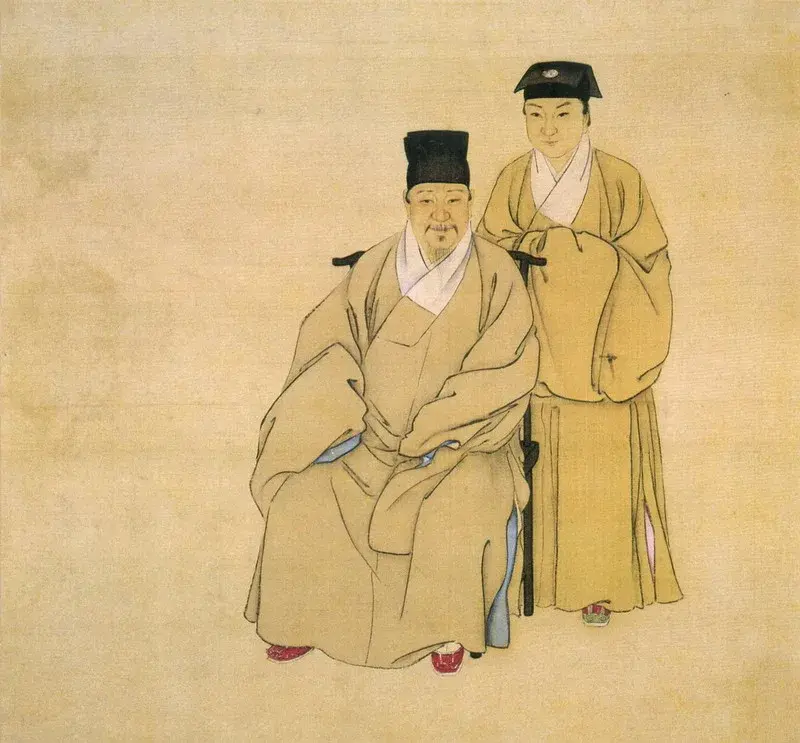
夏完淳
Xia Wanchun (夏完淳, 1631–1647), originally named Xia Fu, courtesy name Cungu, art name Master of Xiaokunshan, was a native of Huating in Songjiang Prefecture (modern-day Songjiang District, Shanghai). He was a celebrated patriotic hero, teenage martyr, poet, and prose essayist of the late Ming and early Qing transition. Hailing from an illustrious scholarly household, his father Xia Yunyi was an eminent late Ming loyalist and…
Xia Wanchun (夏完淳, 1631–1647), originally named Xia Fu, courtesy name Cungu, art name Master of Xiaokunshan, was a native of Huating in Songjiang Prefecture (modern-day Songjiang District, Shanghai). He was a celebrated patriotic hero, teenage martyr, poet, and prose essayist of the late Ming and early Qing transition. Hailing from an illustrious scholarly household, his father Xia Yunyi was an eminent late Ming loyalist and co-founder of the celebrated literati society Ji She. Endowed with precocious genius, Xia was recognized as a child prodigy who read the Confucian classics at five, composed verse at seven, and published his poetry collection Dairy Collection (Dai Ru Ji) at age nine. Nurtured by his father and esteemed mentor Chen Zilong, he cultivated uncompromising moral rectitude and founded the Qiu She society to promote statecraft. Following the fall of Beijing in 1644, Xia styled himself "Youth of Jiangzuo" and addressed a stirring memorial to forty Jiangnan notables urging loyalist resistance. When Qing armies swept south across the Yangtze in 1645, fourteen-year-old Xia joined his father and Chen Zilong in launching armed resistance at Songjiang. Following the fall of the city, Xia Yunyi drowned himself to preserve his loyalty. Grieving yet resolute, Xia joined the Lake Taihu guerrillas as military adviser to naval commander Wu Yang. In 1647, the Prince of Lu conferred upon him the title of Drafting Secretary to coordinate inland resistance. After an operational roster of loyalists was captured, Xia was arrested and escorted to Nanjing for trial. Confronting Governor-General Hong Chengchou, Xia stood proud, scathingly exposing Hong's treasonous defection and reducing the turncoat minister to humiliated silence. Before his execution, Xia composed the immortal prose masterpieces Letter to Mother from Prison and Letter to Wife from Prison, alongside the poetry collection Southbound Prisoner's Grasses (Nan Guan Cao), meeting his death with serene composure at age seventeen. His heroic martyrdom and brilliant literary legacy remain an enduring inspiration of Chinese patriotic integrity.
Born on the ninth day of the ninth month at Huating, Songjiang; father Xia Yunyi welcomed his first son at age thirty-five.
Mastered the Six Classics at age five, composed poems at seven, and compiled Dairy Collection at age nine, astonishing contemporaries.
Formally became the disciple of Ji She leader Chen Zilong at age twelve, absorbing classical style and heroic ideals.
Established the Qiu She literary society with friends such as Du Dengchun, gathering patriotic youth to study statecraft.
Following the suicide of the Chongzhen Emperor, styled himself "Youth of Jiangzuo" and petitioned forty Jiangnan gentry to take up arms.
Joined father Xia Yunyi and teacher Chen Zilong in launching an anti-Qing uprising in Songjiang to resist the hair-cutting edict.
Songjiang fell and Xia Yunyi committed suicide by drowning; Xia composed the Great Lament (Da Ai Fu) vowing to carry on the fight.
Infiltrated Lake Taihu to serve as military adviser to loyalist commander Wu Yang, narrowly escaping by swimming after naval defeat.
Commissioned as Drafting Secretary by the Prince of Lu, drafting secret mobilization rosters to coordinate defections.
Arrested in Jiashan in the sixth month; denounced Hong Chengchou at court and went serenely to his death on the nineteenth day of the ninth month at age seventeen.
Xia Wanchun was born at Huayunbang, west of the prefectural seat of Huating County, Songjiang Prefecture. The Xia lineage was an ancient and distinguished gentry family celebrated for classical scholarship and civic rectitude. His father, Xia Yunyi, was an imperial jinshi laureate, a renowned loyalist statesman of the Chongzhen era, and an intellectual arbiter in Jiangnan. Alongside his close friend Chen Zilong, Xia Yunyi founded the celebrated Ji She literati society, championing classical prose revivalism and ethical integrity in opposition to court eunuch corruption. Xia Yunyi was thirty-five when Xia Wanchun was born, and the family celebrated the birth of a promising heir.
Endowed with transcendent intellect, Xia exhibited astonishing brilliance from infancy. He recognized complex classical ideograms at age three, read through the Four Books and Five Classics at five, and composed refined ancient yuefu poetry and parallel prose at seven. At nine, his father compiled his childhood essays and poems into an anthology titled Dairy Collection (Dai Ru Ji). The collection demonstrated soaring poetic imagination and sophisticated classical resonance, stunning Jiangnan literary circles.
Whenever Xia Yunyi traveled across eastern China to visit historical landmarks or confer with leading Confucian scholars, he brought his young son with him. Experiencing high mountains, expansive waterways, and strategic passes firsthand, Xia observed the social decay, rampant land concentration, and displacement of commoners that afflicted late Ming China. This rigorous upbringing and broad geographic horizon elevated him beyond mere scholastic rote learning, instilling within him a resolute commitment to public welfare and moral martyrdom.
Xia Wanchun's character was profoundly nurtured by the moral devotion of his motherly guardians and kinsmen. He was born to Xia Yunyi's concubine, Lady Lu, but according to late Ming ritual law, his father's primary wife, Lady Sheng, was his formal legal mother. Lady Sheng was a virtuous and generous matriarch who nurtured Wanchun with boundless maternal affection. His birth mother, Lady Lu, was an unyielding woman who educated him with severe moral discipline, frequently recounting the heroic sacrifices of ancient martyrs to cultivate his uncompromising courage. The loving care of Lady Sheng and the moral discipline of Lady Lu provided him with an unshakable ethical foundation.
His paternal uncle, Xia Zhixu, was likewise an accomplished Jiangnan scholar who generously guided his classical studies. His elder sister, Xia Shuji, was a brilliant poet and painter who engaged in regular literary dialogues with Chen Zilong; following the Qing invasion, she preserved her loyalty in seclusion, earning reverence alongside her female relatives as the "Three Hermits of the Empty Valley".
Surrounded by a family dedicated to moral rectitude, Xia developed deep reverence for loyalist archetypes. Whenever he read historical chronicles detailing Qu Yuan drowning in the Miluo River or Wen Tianxiang preserving his integrity in northern captivity, he wept openly, embracing the conviction that a man's ultimate calling was to deliver the empire or perish in noble sacrifice.
During his formative youth, Xia was nurtured by the most eminent scholars and patriotic luminaries of seventeenth-century Jiangnan. Among these mentors, Chen Zilong exerted the most profound influence upon his intellectual and moral development. Chen was a towering figure in late Ming letters and a master of statecraft who initiated the vigorous Yunjian poetic school. Chen loved young Wanchun like a son, and at twelve Xia formally enrolled as Chen's disciple, studying ancient prose, classical verse, and military strategy under his daily guidance.
In addition, Zhang Pu, the celebrated founder of the Fu She society, was an intimate companion of the Xia household. Zhang took delight in Wanchun's agile intellect, personally tutoring him in the Zuo Zhuan and the Records of the Grand Historian. Eminent ministers such as Shi Kefa and Huang Daozhou, when traveling through Songjiang on inspection tours, summoned young Wanchun, praising him as a rare national genius and encouraging him to maintain his heroic resolve.
In 1643, thirteen-year-old Xia collaborated with local companions Du Dengchun and Shen Yuxiao to found the "Southwest Fellowship", which soon expanded into the "Qiu She" (Society of Seeking). Serving as a youthful branch of the Ji She, the Qiu She attracted promising young intellectuals from Songjiang and Jiaxing. Although the youngest member, Xia demonstrated incomparable eloquence and fiery literary power, serving as the acknowledged leader of his peers and forging an organizational network that would later sustain anti-Qing resistance.
In the third month of 1644, Li Zicheng's peasant insurgent hosts breached the walls of Beijing, and the Chongzhen Emperor hanged himself on Coal Hill, marking the collapse of the Ming central administration. Shortly thereafter, the Manchu Eight Banners pierced the Great Wall at Shanhai Pass, seizing the capital and launching southward conquests.
When news of the national catastrophe reached Jiangnan, society was paralyzed by despair and confusion. Fourteen-year-old Xia wept inconsolably before taking decisive action. Styling himself "Youth of Jiangzuo", he worked through the night to compose an urgent ten-thousand-word manifesto titled Memorial Pleading for Loyal Uprising, circulating copies among forty-one prominent gentry lineages and regional leaders across Jiangnan.
In this manifesto, Xia laid bare the profound humiliation of imperial ruin, pleading with southern landholders to abandon selfish complacency. Displaying acute military insight, he urged Jiangnan to mobilize its vast agrarian wealth and intricate river networks, demanding the immediate recruitment of militia, construction of war galleys, fabrication of firearms, and fortifying of the Yangtze defense perimeter. Composed by a fourteen-year-old youth, this impassioned plea electrified regional elites and laid the ideological groundwork for armed resistance.
In the fifth month of 1645, Qing Prince Dodo crossed the Yangtze River, overrunning Yangzhou and capturing Nanjing, bringing an ignominious end to the southern Hongguang regime. Soon afterward, Qing Prince Regent Dorgon promulgated the draconian hair-cutting edict, mandating that all Chinese men shave their foreheads and adopt the Manchu queue upon penalty of death, igniting ferocious armed resistance across Jiangnan.
Confronting the choice between submission and death, Xia Yunyi and Chen Zilong raised the banner of armed uprising in Songjiang. Fourteen-year-old Xia took up arms alongside his father and teacher. Xia Yunyi directed supreme command, Chen Zilong managed military operations, and Xia Wanchun organized urban youths, transmitted secret orders, and drilled civic militias along the parapets.
The loyalist forces scored an initial victory, eliminating Qing collaborationist magistrates, liberating Songjiang, and dispatching couriers to rally Jiaxing and Suzhou. However, veteran Qing banner armies rapidly encircled the city with heavy artillery. Although the defenders resisted desperately with pikes and matchlocks, Songjiang fell after days of savage fighting.
Following the fall of Songjiang, Xia Yunyi covered the retreat of Chen Zilong and his son, retreating to the surrounding countryside. As Qing detachments arrested loyalist families and conducted brutal tortures to uncover his hiding place, Xia Yunyi recognized that ultimate defeat was inevitable. Refusing to submit to foreign conquerors, he resolved to commit suicide.
In the intercalary sixth month, Xia Yunyi composed his farewell poem, adjusted his official robes, faced south toward the lost Ming court, and drowned himself in a deep pool at Xitang, dying at age fifty. His final testament commanded Xia Wanchun to sustain the family honor and fight to the end.
Learning of his father's martyrdom, fourteen-year-old Xia was devastated by grief. Confronting the ruin of his empire and the death of his father, he fell prostrate before composing the monumental four-thousand-word rhapsody Great Lament (Da Ai Fu). Emulating the tragic cadence of Qu Yuan's Encountering Sorrow, he gave voice to the agony of a collapsing civilization, swearing that he would live and die as an unyielding subject of the Ming dynasty.
After burying his father, fifteen-year-old Xia wiped away his tears and plunged into the sprawling reed marshes of Lake Taihu to join armed guerrilla forces. Southern Ming official Wu Yang had rallied tens of thousands of fishermen into a formidable amphibious insurgent force known as the "White-Turban Army", waging hit-and-run warfare against Qing transport convoys.
Wu Yang held immense respect for the late Xia Yunyi and was astonished by Wanchun's strategic maturity, naming him chief military adviser to oversee strategic drafting and tactical planning. In the harsh encampments of Lake Taihu, Xia wore coarse straw sandals and a bamboo cape, braving gales and waves alongside rough boatmen while planning surprise raids against Qing supply lines.
In the autumn of 1646, Qing Commander Wu Shengzhao mobilized over a hundred war galleys supported by cavalry to encircle the lake guerrillas. During the decisive naval engagement at Caoxiedu in Wu Jiang, a sudden thunderstorm soaked the insurgents' gunpowder, rendering their firearms useless. The fleet was ambushed and scattered, and commander Wu Yang was captured and executed. Amid hail of arrows, Xia leaped into the surging waters of Lake Taihu, diving underwater for several li before finding refuge in dense reed thickets, narrowly escaping capture. Undeterred, he went into hiding along the borders of Wu Jiang and Jiashan, secretly searching for surviving loyalist cells.
Following the collapse of the inland guerrilla strongholds, the locus of Southern Ming resistance shifted to the Zhoushan Archipelago, where Prince of Lu Zhu Yihai maintained an maritime government that coordinated with resistance in Fujian and Guangdong. Xia recognized that isolated inland insurrections were insufficient, and that victory required linking mainland underground cells with the offshore fleet.
In the spring of 1647, the Prince of Lu learned of Xia Yunyi's martyrdom and Xia Wanchun's daring aquatic campaigns. Moved by their heroism, the prince posthumously created Xia Yunyi Duke of Wenzhong, and dispatched an envoy across the sea to grant sixteen-year-old Xia Wanchun the official post of Drafting Secretary.
Xia welcomed the imperial commission with solemn gratitude, drafting his celebrated memorial Thanksgiving Memorial for the Appointment as Drafting Secretary. In this text, he lamented the desolation of the Central Plains and pledged his youthful life to the restoration of the empire, expressing indomitable courage and resolve.
Armed with his imperial appointment, Xia shouldered the leadership of the underground resistance network across Jiangnan. Collaborating closely with Chen Zilong, he targeted Qing Regional Commander Wu Shengzhao, who garrisoned Songjiang. Wu had originally been a Ming commander, and his growing alienation from the Qing authorities made him susceptible to patriotic appeal.
Xia and Chen established a secret alliance encompassing dozens of former officials, gentry scholars, and underground chieftains throughout Songjiang, Jiaxing, and Suzhou. Xia personally drafted the confidential Roster of Jiangnan Loyalists, preparing to coordinate with an offshore amphibious landing by the Prince of Lu's navy to retake Songjiang.
Xia concealed the thanksgiving memorial, the alliance manifesto, and the secret rosters inside the lining of his courier's clothing, entrusting them to scholar Xie Yaowen, who routinely sailed between Zhoushan and the mainland. However, while waiting for a vessel at the port of Chongque, Xie aroused suspicion and was searched by Qing coastal patrols. The concealed documents were discovered, and Xie was arrested. Shortly afterward, Wu Shengzhao's planned mutiny was exposed, and Governor-General Hong Chengchou launched a sweeping regional manhunt using the captured roster to eradicate Xia Wanchun and his comrades.
When the arrests commenced, Xia was hiding in Jiashan at the estate of his father-in-law, Qian Mo. Qian belonged to an ancient gentry lineage and, admiring Xia's genius and virtue, had recently wed his eldest daughter Qian Qinzhuang to the young hero. Recognizing that staying would doom his wife's entire family, Xia rejected appeals to hide in the mountains, bade farewell to his bride, and slipped back toward Songjiang to find an offshore passage. However, all waterways were heavily guarded, and in late June of 1647, Xia was apprehended outside Songjiang.
Placed aboard a prison barge to be conveyed upriver to Nanjing, Xia sailed past Mount Xilin (Chen Shan). Along the riverbank lay the freshly turned earth of his venerated master Chen Zilong, who had recently drowned himself to evade capture. Weeping uncontrollably at the ship's gunwale, Xia composed the magnificent seven-character lament Weeping by Night at Xilin. Sailing through Wu Jiang, he composed Weeping by Night at Wu Jiang to commemorate fallen comrades. His tragic verses moved the prison guards to tears.
Upon arrival in Nanjing, Governor-General Hong Chengchou personally presided over the interrogation. Once the Ming Minister of War and Commander-in-chief of Liaodong, Hong had surrendered to the Manchus after the Battle of Songshan. Aware of Xia's illustrious lineage and towering fame, Hong sought to induce the youth to surrender, hoping to use him as a propaganda trophy to pacify Jiangnan.
Seated majestically upon the dais, Hong adopted an air of benevolent paternalism, saying: "How could a tender youth understand high politics or take up arms in rebellion? You must have been misled by villainous conspirators! If you repent and submit to the Great Qing, this governor-general will ensure you are pardoned and granted high official honors."
Shackled in heavy irons, seventeen-year-old Xia stood proudly erect, refusing to bow. Feigning ignorance of the judge's identity, he declared in ringing tones: "I have heard that Lord Hong Chengchou, our late Ming Commander-in-chief, was the foremost heroic gentleman of the realm! At the Battle of Songshan, Lord Hong fought to the death, drenching his robes in blood. The late Emperor wept upon hearing the news, constructed seven ceremonial altars, and personally mourned his martyrdom amid universal grief! We youths of Jiangnan revere Lord Hong's unblemished loyalty. Young though I am, how could I yield the virtue of dying for my country to Lord Hong alone!"
Guards stepped forward to shout: "Silence! The great dignitary seated above you is Governor-General Lord Hong Chengchou himself!" Hearing this, Xia glared with fiery indignation, pointing his finger at Hong and thundering: "Absurd! Lord Hong died for his sovereign long ago, as all under heaven know! What sort of shameless traitor are you, daring to usurp the sacred name of our immortal martyr to cover your vile defection and pollute the noble spirit of an imperial hero!"
These righteous words struck Hong like a thunderbolt, stripping bare his hidden shame. Court scribes and guards were struck dumb with terror. Hong turned pale as death, broke into a cold sweat, and sat slumped in his chair without a single word of reply, finally waving his sleeve in humiliation to order Xia remanded to the condemned cells.
Xia was imprisoned in the death cells of Nanjing for over eighty days. In the damp subterranean dungeon, subjected to harsh interrogation and weighed down by heavy chains, he remained serene. Acknowledging that death was near, he used scraps of paper and ink smuggled by sympathetic guards to write his final works.
He penned the immortal epistolary masterpieces Letter to Mother from Prison and Letter to Wife from Prison, and compiled dozens of his prison poems into the collection Southbound Prisoner's Grasses (Nan Guan Cao). In the farewell letter to his mothers, he wrote: "Your unfilial Wanchun dies today! Sacrificing my body for the realm, loyalty and filial piety cannot both be fulfilled. Born as the son of an unyielding loyalist, I die as a martyr of the state, swearing never to disgrace the name of the Xia lineage!"
On October 16, 1647 (the nineteenth day of the ninth month in the fourth year of the Shunzhi era), execution orders arrived. Seventeen-year-old Xia Wanchun and more than forty loyalists were escorted to the western execution grounds of Nanjing. Dressed in classical robes, Xia walked proudly with serene composure. When ordered to kneel, he roared: "A true gentleman dies for righteousness; my neck may be severed, but my knees shall never bend!"
Standing tall upon the execution platform, Xia adjusted his robes, smiled, and extended his neck to receive the blade, dying a martyr at the age of seventeen. His friend Du Dengchun and companion Shen Yuxiao risked their lives to recover his remains, conveying his coffin back to Songjiang to be buried alongside his father at Mount Xiaokunshan.
Xia Wanchun was a rare literary prodigy whose seventeen brief years produced an enduring legacy in Chinese classical literature.
Nurtured in classical scholarship, Xia mastered the Six Classics at five, composed verse at seven, and authored Dairy Collection at nine. His creative style was forged in the classical revivalist movement led by his father and Chen Zilong, rejecting late Ming triviality and sentimentalism to recover the monumental vigor of Han, Wei, and High Tang poetry.
During his brief creative life, Xia produced more than ten volumes of collected works, including Dairy Collection, Rhapsody Outlines, Jingting Collection, Southbound Prisoner's Grasses, and Continuation of Records of Survival. His poems, such as Farewell to Yunjian, Autumn Reflections, and Weeping by Night at Xilin, combined rigorous architectural syntax with profound tragic resonance. Modern scholars universally recognize that Xia was not merely a romantic teenage hero, but an accomplished master who stood in the foremost rank of seventeenth-century Chinese literature.
Beyond his literary brilliance, Xia was a courageous military coordinator and underground strategist.
At fourteen, he established the Qiu She society to unite youth and drafted a manifesto rallying forty Jiangnan gentry lineages to defend the Yangtze. During the Songjiang uprising, he coordinated logistical supply lines under enemy bombardment. Following his father's death, he joined the aquatic White-Turban Army under Wu Yang, braving naval battles on Lake Taihu.
As Southern Ming resistance went underground, Xia served as the chief coordinating link between mainland loyalist cells and the Prince of Lu's offshore fleet on Zhoushan. His ability to build intelligence channels, draft mobilization rosters, and coordinate the defection of regional commanders illustrated extraordinary political maturity and executive courage, establishing him as an exceptional figure in Chinese military history.
Xia Wanchun's dramatic confrontation with Governor-General Hong Chengchou in the Nanjing tribunal of 1647 remains one of the most powerful dialogues of moral defiance in Chinese history.
Confronting the supreme military commander of southern China, seventeen-year-old Xia employed devastating rhetorical irony. By praising the martyred "Hong Chengchou of Songshan" as an untouchable paragon of Ming fidelity, he exposed the living, capitulationist Hong as an imposter who had disgraced his ancestors.
His thundering rebuke, "What sort of shameless traitor are you, daring to usurp the sacred name of our immortal martyr," stripped away all pretense of imperial dignity, reducing Hong to humiliated silence. Transcribed and circulated throughout Jiangnan, this courtroom confrontation completely shattered the Qing administration's attempt to entice southern intellectuals through official honors, providing an unshakeable moral compass for the Chinese people.
Composed in the death cells of Nanjing shortly before his execution, Xia's Letter to Mother from Prison, Letter to Wife from Prison, and the poetry collection Southbound Prisoner's Grasses represent towering monuments of classical Chinese prose and lyric verse.
Letter to Mother from Prison is celebrated as one of the finest epistolary masterworks in Chinese literature. Written in weeping characters, it balanced profound grief over his inability to provide lifelong care for his mothers with unyielding commitment to patriotic martyrdom. His declarations that "my father died for the state, and his son now follows him" demonstrated the seamless synthesis of filial piety and civic sacrifice.
In Southbound Prisoner's Grasses, his celebrated verse Farewell to Yunjian features the immortal lines: "Boundless tears shed over our mountains and rivers, yet who can say that heaven and earth are broad! Knowing that the underworld draws near, how hard it is to bid farewell to my native home." This tragic synthesis of filial tenderness and heroic defiance has inspired generations of Chinese readers.
Xia Wanchun's heroic life and literary work became a sacred banner of patriotic resistance during modern China's struggle against imperialism and feudal autocracy.
During the late Qing period, revolutionaries Liu Yazi, Chen Qubing, and Gao Xu established the influential patriotic literary society "Southern Society" (Nan She), revering Xia Wanchun as their spiritual patron. The society made pilgrimages to Xia's tomb at Mount Xiaokunshan, publishing commemorative editions of his collected works and writing stirring elegies honoring his sacrifice.
Revolutionary martyrs of the 1911 Revolution, including Qiu Jin and Xu Xilin, drew profound inspiration from Xia's martyrdom at seventeen. In modern Chinese consciousness, Xia Wanchun represents not merely the tragic loyalty of a fallen dynasty, but the unbending spiritual resilience of the Chinese nation in times of supreme peril.
FIGURES ASSOCIATED WITH THIS DYNASTY