Hermitage at Nanyang
Mastered classical canons; after failing the examinations, retreated to Mount Yidi at age fifteen to pursue Daoist cultivation.
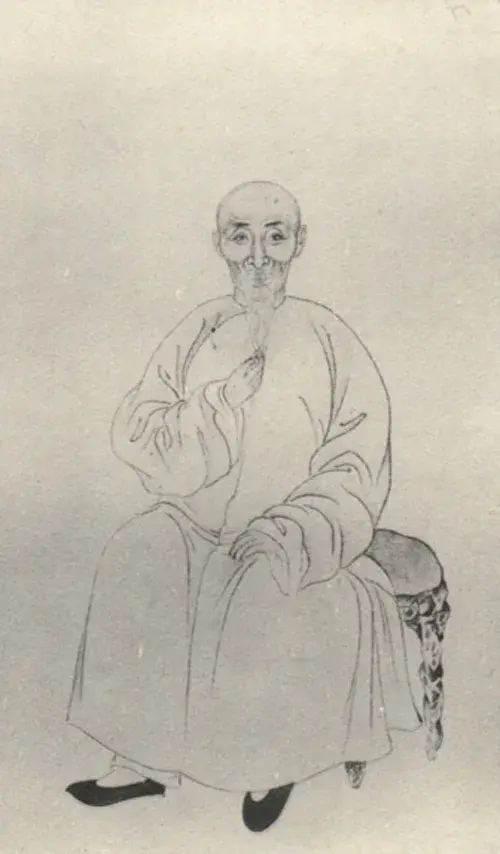
吴筠
Wu Yun (吴筠, ?–778), courtesy name Zhenjie, was a native of Huayin in Huazhou (modern Huayin, Shaanxi; alternatively recorded as a scholar from Lu), an illustrious Daoist patriarch, theoretical pioneer of Internal Alchemy (Neidan), and renowned poet of the Tang dynasty, posthumously honored by disciples as "Master Zongxuan." Versed in Confucian classics and historical treatises in his youth, he sat for the imperial jinshi…
Wu Yun (吴筠, ?–778), courtesy name Zhenjie, was a native of Huayin in Huazhou (modern Huayin, Shaanxi; alternatively recorded as a scholar from Lu), an illustrious Daoist patriarch, theoretical pioneer of Internal Alchemy (Neidan), and renowned poet of the Tang dynasty, posthumously honored by disciples as "Master Zongxuan." Versed in Confucian classics and historical treatises in his youth, he sat for the imperial jinshi examination without success. Possessing an aloof, unyielding temperament intolerant of worldly vanity, he renounced civil office at age fifteen to live in mountain hermitage at Mount Yidi in Nanyang. During the Kaiyuan reign, he journeyed south to Nanjing, entering Mount Mao to receive the Shangqing Three Caverns ordination and sacred talismans, subsequently wandering through Mount Tiantai and Shanxi, where his visionary Daoist verse became celebrated in Chang'an. Emperor Xuanzong summoned Wu to the capital, granting him personal audiences in the Datong Hall and appointing him Hanlin Academician Waiting-upon-Decree. When Emperor Xuanzong inquired about magical longevity and external alchemy, Wu submitted candid admonitions: "The supreme essence of the Dao resides entirely in Laozi's five thousand words; extraneous magical formulas merely waste paper. As for cultivating immortality, that is a lifetime pursuit for mountain ascetics, not a proper diversion for the sovereign of the empire." He earnestly urged the emperor to concentrate on frugality, benevolence, and administrative vigilance, earning Xuanzong's profound esteem. Astutely foreseeing that ministerial despotism under Li Linfu and Yang Guozhong would plunge the realm into insurrection, Wu repeatedly petitioned to return to Mount Mao. When the An Lushan Rebellion erupted, he took refuge in Kuaiji and Tiantai, exchanging poetry with Li Bai and Kong Chaofu. Authoring foundational philosophical treatises including On the Principles of the Mysterious (Xuangang Lun), Treatise on Tracing the Mysterious (Zongxuan Pian), and Immortality Can Be Learned, Wu synthesized Daoist, Confucian, and Buddhist thought, championing the dual cultivation of inner spiritual nature and physical vitality (xingming shuangxiu), occupying a pivotal monument in Chinese religious and philosophical history.
Mastered classical canons; after failing the examinations, retreated to Mount Yidi at age fifteen to pursue Daoist cultivation.
Traveled south to Mount Mao, studying under Shangqing lineage masters and receiving Three Caverns and Zhengyi ordinations.
Wandered through Mount Tiantai and the Shan River; his Daoist poetry was copied and circulated across Chang'an.
Summoned to Chang'an by Emperor Xuanzong; received in the Datong Hall and appointed Hanlin Academician Waiting-upon-Decree.
Officially registered as a Daoist priest; studied golden elixir secrets at Mount Song under master Feng Qizheng.
Presented his philosophical masterpiece On the Principles of the Mysterious (Xuangang Lun) in three scrolls to Emperor Xuanzong.
Anticipated An Lushan's rebellion; repeatedly petitioned to step down from court service and successfully retired to Mount Mao.
Following the fall of Chang'an, retreated to Mount Tiantai, traveling along rivers with poet Li Bai and Kong Chaofu.
Resided along the Shan River, revising Treatise on Tracing the Mysterious and Immortality Can Be Learned.
Passed away peacefully in meditative posture at his Shan River hermitage; disciples conferred the title Master Zongxuan.
Wu Yun spent his formative years during the transition from the early Tang to the flourishing Kaiyuan epoch. According to the Preface to the Collected Works of Master Zongxuan by Vice Minister of Rites Quan Deyu, Wu was born into a prominent scholar-official family in Huayin, Huazhou (while the Old Book of Tang recorded him as a Confucian scholar of Lu). Endowed with exceptional intellect, he immersed himself in Confucian canons, histories, and poetic composition. However, possessing a fiercely proud, independent temperament, Wu sat for the imperial jinshi examination in Chang'an and was rejected.
This failure caused Wu to reflect upon the vanity of bureaucratic status and metropolitan rivalry. At age fifteen, he renounced civil ambitions and entered the secluded forests of Mount Yidi in Nanyang with a small group of ascetic companions. In this mountain sanctuary, Wu studied the foundational Daoist canons of Laozi and Zhuangzi alongside classical commentaries, cultivating an austere, contemplative spirit that underpinned his philosophical and poetic achievements.
In the middle Kaiyuan reign, Wu left Nanyang to embark on a pilgrimage to sacred Daoist peaks across southern China. Traveling south to Nanjing, he ascended Mount Mao, the sacred epicenter of the Shangqing (Supreme Purity) Daoist tradition. There, he studied under revered Shangqing masters, mastering meditative visualization, the preservation of internal spirit, and ritual talismans. He subsequently traveled to Mount Tiantai, the Siming Mountains, and the scenic Shan River in eastern Zhejiang.
Residing in eastern Zhejiang, Wu joined local literati in wine banquets and literary retreats. His poems depicted soaring journeys through celestial realms with majestic imagination, and transcripts of his verse spread rapidly to Chang'an. Emperor Xuanzong, who maintained an abiding interest in Daoist theology, dispatched imperial messengers to Zhejiang to summon Wu to court.
Upon his arrival in the capital, Emperor Xuanzong granted Wu a ceremonial audience in the Datong Hall. Delighted by his profound command of statecraft and spiritual philosophy, the emperor appointed him Hanlin Academician Waiting-upon-Decree. In the early Tianbao era, Wu formally requested registration as an ordained Daoist priest, traveling to Mount Song to receive the transmission of Zhengyi and Shangqing internal scriptures from Feng Qizheng, a disciple of the great master Pan Shizheng.
While serving in the Hanlin Academy, Wu attended imperial audiences alongside civil and military ministers. In contrast to sycophantic courtiers who flattered the monarch, Wu preserved strict ascetic modesty and moral rectitude. On numerous occasions in the inner palace, Emperor Xuanzong questioned him regarding esoteric longevity spells and the compounding of external mineral elixirs. Wu replied firmly: "The supreme essence of the Dao is contained entirely in the five thousand words of the Daodejing; extraneous magical formulas merely waste paper and ink. As for cultivating immortality, that is a lifetime discipline for hermits in the wild, not a pursuit suited for the sovereign of the world." Urging the emperor to prioritize agrarian relief, judicial equity, and moral vigilance, Wu earned Xuanzong's esteem, receiving the honorary title "Master Zongxuan."
In 754, Wu submitted his philosophical masterpiece On the Principles of the Mysterious (Xuangang Lun) in three scrolls to the throne. Grounded in Laozi's metaphysics, the work organized cosmology, institutional governance, social ethics, and physiological meditation into a cohesive philosophical system, arguing that moral governance of the state and spiritual preservation of the body were manifestations of the same underlying principle. However, Buddhist factions aligned with chief eunuch Gao Lishi resented Wu's imperial access and conspired to malign him before the throne.
During the late Tianbao era, Chief Minister Yang Guozhong monopolized executive authority while Emperor Xuanzong indulged in luxury at the Huaqing Palace. An Lushan was assembling veteran cavalry in Fanyang, preparing to revolt. Recognizing that catastrophe was inevitable, Wu submitted memorials seeking permission to retire to Mount Mao. Reluctant to lose his counselor, the emperor refused and constructed an imperial Daoist lodge within the capital for his residence.
In early 755, following repeated ascetic appeals, Xuanzong granted Wu permission to leave Chang'an. Wu departed for Mount Mao. Only months later, An Lushan launched his rebellion, overrunning both Luoyang and Chang'an and forcing Emperor Xuanzong to flee to Sichuan. As brigandage engulfed the Yangtze basin, Wu relocated to Mount Tiantai and Kuaiji.
In Zhejiang, Wu was reunited with his longtime friend, the poet Li Bai, alongside scholar Kong Chaofu. Having known each other in earlier decades, Wu and Li Bai shared boat journeys across Mirror Lake and the Shan River, climbing the peaks of Tiantai to compose verse celebrating natural transcendence and mourning the devastation of the empire.
In his final years, Wu settled permanently in an austere hermitage along the Shan River. Detached from court politics, he focused on teaching disciples and finalizing his philosophical writings, completing Treatise on Tracing the Mysterious (Zongxuan Pian), Immortality Can Be Learned (Shenxian Kexue Lun), and The Form and Spirit Can Be Solidified (Xingshen Kegu Lun). In these works, he attacked the practice of ingesting poisonous mineral elixirs (mercury and lead), articulating a physiological theory of Internal Alchemy (Neidan) centered on harmonizing internal breath, vital essence, and ethical awareness.
In 778, during the Dali reign of Emperor Daizong, Wu bathed, dressed in fresh robes, and passed away peacefully in meditative posture at his hermitage along the Shan River at approximately seventy years of age. His disciples conferred the posthumous title Master Zongxuan. Vice Minister of Rites Quan Deyu later compiled his collected writings, praising him as a master whose learning spanned all Daoist caverns and whose literary brilliance rivaled the foremost Confucian scholars.
Wu Yun's foremost contribution to Chinese intellectual history was On the Principles of the Mysterious (Xuangang Lun). Consisting of thirty-three thematic chapters, the work established a comprehensive philosophical synthesis of Laozi's cosmology and Tang administrative statecraft.
He demonstrated that the Dao was the formless origin of cosmic order and formulated the concept of inner sagehood and outer kingship (neisheng waiwang), arguing that a monarch must cultivate tranquility and simplicity to govern effectively. Overcoming the speculative abstractness of Wei-Jin Xuanxue, Wu elevated Tang Daoist thought into a mature philosophical discipline, profoundly influencing the emergence of Song Neo-Confucian moral psychology and Quanzhen internal alchemy.
In religious and medical history, Wu played a pivotal role in dismantling the deadly practice of external alchemy (Waidan). Troubled by the fatalities caused by ingesting metallic elixirs, Wu authored Immortality Can Be Learned and related treatises to demonstrate that true longevity depended upon internal physiological cultivation.
He formulated the doctrine of the human body as a microcosm, demonstrating that health and spiritual realization required conserving vital essence (jing), breath (qi), and spirit (shen). He championed the principle of "Dual Cultivation of Nature and Life" (Xingming Shuangxiu), proving that moral cultivation (nature) and internal meditative discipline (life) were inseparable. This doctrine provided the foundational framework for the Zhong-Lu internal alchemy school, ensuring that Daoism evolved into a tradition of spiritual and ethical self-realization.
Beyond his philosophical stature, Wu was one of the preeminent Daoist poets in Chinese literature. Masterpieces such as Ten Chants of Stepping across the Void (Buxuci) and Twenty-Four Poems on Roaming as an Immortal (Youxian Shi) replaced the cryptic ritual incantations of early Daoist verse with dynamic cosmic imagery and soaring lyricism.
His expansive, unconstrained poetic style won the admiration of Emperor Xuanzong and directly influenced Li Bai's imaginative landscape verse, such as A Dream Visit to Mount Tianmu. In Biographies of Tang Talents, Xin Wenfang praised his verse as possessing an ethereal majesty that transcended the mortal realm.
FIGURES ASSOCIATED WITH THIS DYNASTY