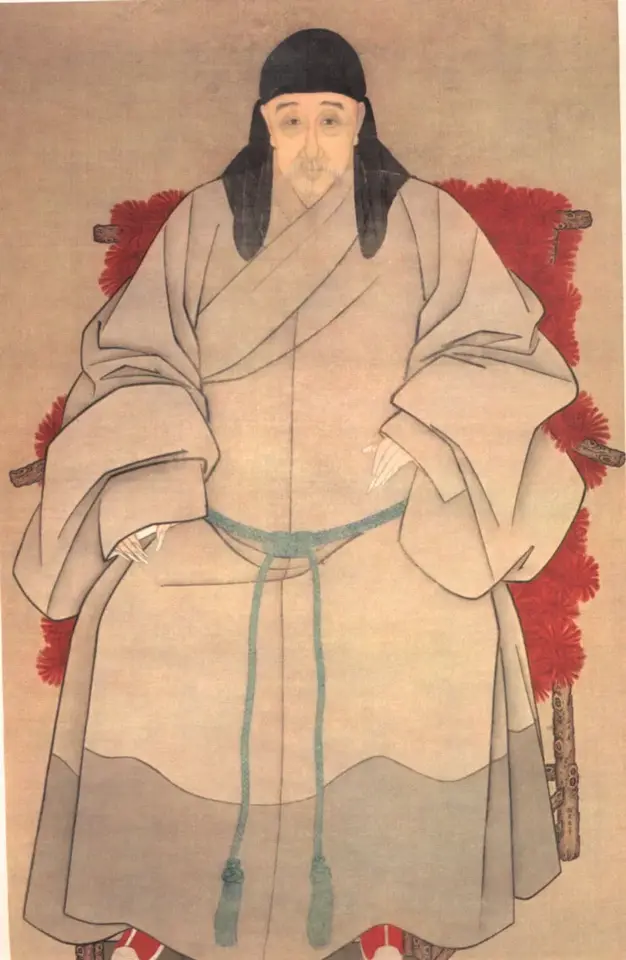
Life and Career
Early Precociousness and Examination Triumph
Wu Weiye was born in 1609 into a prominent lineage in Taicang, Jiangsu. According to local lore, his mother dreamed of a red-robed envoy bearing examination honors before his birth, prompting his parents to oversee his schooling strictly. Highly gifted, Wu entered school at seven and composed complex essays by fourteen. Recognizing his talent, Restoration Society leader Zhang Pu accepted him as an intimate disciple, instructing him in classical statecraft and broad literary learning. Under Zhang's mentorship, Wu emerged as an essential figure in the Restoration Society.
In 1630, Wu passed the Yingtian provincial examination. In 1631, at twenty-three, he competed in Beijing, winning first place (Huiyuan) in the metropolitan examination and second place (Bangyan) in the palace examination, entering the Hanlin Academy as a Compiler. Because he secured double honors, rivals alleged examination fraud, prompting examiners to submit his papers directly to the Chongzhen Emperor. Deeply impressed, the emperor personally wrote on the manuscript: "Upright, grand, erudite, and refined; a model to counter superficiality," silencing criticism. Wu remained grateful for the emperor's patronage throughout his life.
In 1632, Wu returned home on marriage leave, enjoying high literary renown in Jiangnan. Returning to official service, he directed the Huguang provincial examinations, served as Daily Lecturer to the Heir Apparent in 1637, and was appointed Director of Studies of the Nanjing Imperial Academy in 1640. Amid intense factional disputes among the Donglin, Restoration Society, and remnants of the eunuch faction, Wu preserved his integrity and advanced steadily.
Dynastic Fall and Resignation from Southern Ming
During the late Chongzhen era, peasant uprisings and northern military threats destabilized the realm. Recognizing administrative collapse, Wu declined successive promotions and retired to his hometown. In April 1644, Li Zicheng's forces captured Beijing, and the Chongzhen Emperor hanged himself on Coal Hill. Shortly thereafter, Wu Sangui surrendered to the Qing armies, who occupied Beijing. Grieving the dynastic fall, Wu mourned the loss of the Ming court.
In May 1644, the Southern Ming established the Hongguang court in Nanjing, appointing Wu as Junior Supervisor of the Household. Wu assumed his post hoping to assist loyalist restoration, but witnessed Grand Secretary Ma Shiying and eunuch associate Ruan Dacheng monopolizing power and persecuting Restoration Society scholars. Recognizing the hopelessness of the situation, Wu resigned after two months, returning to Taicang.
In 1645, Qing armies crossed the Yangtze and captured Nanjing. Wu sought refuge in rural villages around Taicang and Suzhou, maintaining his status as a former Ming loyalist and declining collaboration with the new regime. During this period of displacement, he began channeling his grief into grand narrative songs.
Coerced Service and Chancellor of the Imperial Academy
In 1653, the Qing court sought to legitimize its rule by summoning prominent southern scholars. Wu's relative by marriage, Chen Zhilin, held high office in Beijing amid intense court factionalism; seeking to bolster his standing with Wu's prestige, Chen repeatedly recommended him to the Shunzhi Emperor. Meanwhile, the Qing issued peremptory decrees commanding local officials to escort renowned scholars north under threat of family punishment. Faced with imperial coercion and the tears of his elderly mother, Wu found himself in an agonizing dilemma.
Southern loyalists, including Hou Fangyu, wrote letters urging him to resist service to preserve literati morale. Traveling north, Wu submitted memorials and poems pleading for permission to return home in retirement, but court ministers rejected his requests. In 1654, Wu entered Qing service, receiving appointments as Expositor in the Secretariat and Chancellor of the Imperial Academy, overseeing higher education.
However, Wu did not participate in major policy decisions. Chen Zhilin was soon banished to Liaodong following court intrigues. Holding ceremonial educational office, Wu was consumed by remorse, feeling that submission had stained his lifelong moral reputation. In late 1656, upon his mother's death, Wu obtained permission to retire for mourning. Returning south, he refused all subsequent imperial summonses, resolving never to serve again.
Late Life Repentance and Poet Epitaph
Following his return, Wu lived in seclusion in Suzhou and Taicang for fifteen years. During this period, the Qing court conducted severe literary inquisitions and tax delinquency purges across Jiangnan, creating an atmosphere of fear. Living in rural retreat, burdened by remorse over his political submission and failing health, Wu built the Meicun Villa in western Taicang, organizing his lifetime's poetry and historical records.
In the summer of 1671, his chronic respiratory illness worsened severely. In a final letter to his friend Mao Pijiang, he wrote: "Throughout my life, every circumstance was fraught with sorrow and peril; not a single moment was free of danger, nor any setting devoid of hardship—I am truly the most afflicted man under heaven!" Regretting that he had lacked the courage of loyalist martyrdom and had suffered the shame of collaboration, he sought solace solely as a poet.
Wu dictated his final instructions: "After my death, shroud me in Buddhist monastic robes and bury me near Mount Dengwei and Mount Lingyan; place a plain round stone before my grave inscribed: 'Tomb of the Poet Wu Weiye'." On January 23, 1672, Wu passed away in Taicang at the age of sixty-three, interred north of Mount Xuanmu in Suzhou.
Major Achievements
Creating the Meicun Style and Innovating Narrative Verse
Wu Weiye's preeminent literary achievement was developing the "Meicun Style" (Meicun ti) of seven-character narrative song (gehang), which influenced poetry throughout the Qing dynasty. Traditional Chinese long narrative verse had often suffered from colloquial plainness, lacking the emotional concentration of regulated verse. Wu synthesized the rhythmic vitality of Early Tang masters such as Lu Zhaolin, the dense imagery of Li Shangyin, and the expansive storytelling of Bai Juyi.
He applied the balanced tonal patterns and structural discipline of regulated verse to ancient-style narrative songs, utilizing shifting points of view, flashbacks, and dynamic transitions. Harmonizing musical modes with poignant imagery, his long narrative songs became standard models for later Qing poets, earning his collected works the distinction in the Siku Quanshu Zongmu Tiyao of being "the foremost collection of our dynasty."
Preserving History Through Verse and Dynastic Transition
Living through the collapse of the Ming and the rise of the Qing, Wu incorporated the narrative techniques of Sima Qian's Shiji into verse, interweaving individual fates with the rise and fall of empires, elevating his poetry to the status of "poetry as history" (shishi). Centering narrative songs on key historical figures, he captured the turbulence of his era.
His celebrated masterpiece Yuanyuan Qu traced Wu Sangui's betrayal and the fall of the empire through the personal vicissitudes of courtesan Chen Yuanyuan; Yonghe Gongci depicted the Chongzhen Emperor's court and the decline of the state; Songshan Ai recorded the carnage of the Battle of Songshan; Linjiang Canjun eulogized loyalist martyr Yang Tinglin; Linhuai Laoji Xing utilized an aging entertainer to reflect on dynastic collapse; and Ting Nü Daoshi Bian Yuqing Danqin Ge expressed mournful nostalgia for the vanished elegance of the Southern Ming. These narrative songs remain essential literary masterworks and vivid primary documents of the dynastic transition.
Leading the Restoration Society and Southeastern Literati
During the Chongzhen era, the Restoration Society (Fushe) stood as China's largest literati organization, directing cultural and political discourse across southeastern China. Wu Weiye and his mentor Zhang Pu were its primary leaders. Leveraging his prestige as double examination champion, Wu directed major literati gatherings at Nanjing and Tiger Hill, assembling thousands of scholars to critique eunuch corruption and promote statecraft.
Following the dynastic transition, Wu maintained his role as an intellectual leader of Jiangnan society. He presided over southeastern poetic societies, promoting rigorous classical forms while mentoring younger writers such as Huang Yujian and Wang Kui of the Loudong School, preserving traditional literary culture during a period of acute political crisis.
Lyric Drama and Historiographical Scholarship
Beyond poetry, Wu achieved distinction in ci lyrics, drama, and historical scholarship. His ci lyrics expressed deep grief for the fallen dynasty, praised by late Qing critic Chen Tingzhuo as sharing the spiritual depth of Su Shi. In drama, he authored the southern play Moling Chun and the northern-style zaju Tongtiantai and Linchunge, admired for structural cohesion and musical elegance.
In historiography, adhering to empirical facts, he compiled the twelve-fascicle chronicle Suikou Jilüe, providing an objective record of peasant rebellions under Li Zicheng and Zhang Xianzhong and the Ming court's military responses, serving as an indispensable historical source. His Chunqiu Dili Zhi demonstrated deep geographical exegesis, while his Meicun Shihua recorded firsthand anecdotes of late Ming and early Qing writers without superficial posturing, creating an enduring cultural legacy.