Birth in Tongcheng
Born on October 28 into an ancestral scholarly family in Gaodian, Tongcheng, Anhui.
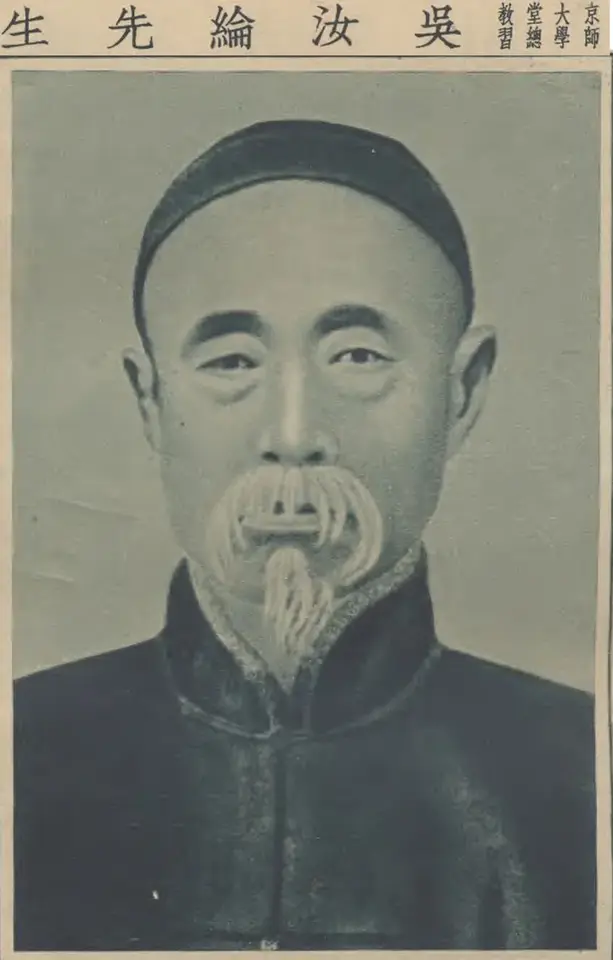
吴汝纶
Wu Rulun (吴汝纶, October 28, 1840 – February 5, 1903), courtesy name Zhifu (挚甫), was a preeminent literary master, educational reformer, leading late-stage representative of the Tongcheng School, and Dean of Academic Affairs of the Imperial University of Peking (predecessor of Peking University). Born into an esteemed scholarly family in Tongcheng, Anhui, he obtained the jinshi degree in 1865 and was recruited into the…
Wu Rulun (吴汝纶, October 28, 1840 – February 5, 1903), courtesy name Zhifu (挚甫), was a preeminent literary master, educational reformer, leading late-stage representative of the Tongcheng School, and Dean of Academic Affairs of the Imperial University of Peking (predecessor of Peking University). Born into an esteemed scholarly family in Tongcheng, Anhui, he obtained the jinshi degree in 1865 and was recruited into the secretariat of Viceroy Zeng Guofan, acclaimed alongside Zhang Yuzhao, Li Shuchang, and Xue Fucheng as one of the "Four Disciples of Zeng Guofan." Serving successively as magistrate of Shenzhou and Jizhou in Zhili, he governed with exceptional administrative integrity, promoting agriculture and local academies. Resigning from officialdom, he presided as rector over Baoding's prestigious Lianchi Academy for thirteen years, pioneering the integration of modern Western sciences, foreign languages, and mathematics into traditional Chinese curricula. In 1902, appointed Dean of Academic Affairs of the Imperial University of Peking by Minister of Education Zhang Baixi, Wu led the first official Chinese educational mission to Japan, inspecting over forty modern schools and authoring Dongyou Conglu, which championed universal compulsory education, modern teacher training, and standard phonetic transcription. His recommendations directly laid the foundation for China's first national statutory school system, the Guimao Educational System. Returning to his hometown in late 1902, he founded Tongcheng School (modern Tongcheng Middle School) before his premature death. Championing the integration of classical prose with modern Western thought, his famous preface to Yan Fu's translation of Huxley's Evolution and Ethics (Tian Yan Lun) stands as a monumental landmark in modern Chinese intellectual history.
Born on October 28 into an ancestral scholarly family in Gaodian, Tongcheng, Anhui.
Passes the Jiangnan provincial examination at age twenty-five, acclaimed across the Huai River region.
Obtains his jinshi degree, appointed Grand Secretariat Drafter; joins Viceroy Zeng Guofan's secretariat in Nanjing.
Drafts vital imperial memorials for Zeng Guofan, grouped among the celebrated "Four Disciples of Zeng."
Appointed Magistrate of Shenzhou on the recommendation of Viceroy Li Hongzhang, reforming local police and founding academies.
Promoted to Magistrate of Jizhou, acclaimed across Zhili Province as a model magistrate for flood control and education.
Retires from administrative office to serve as rector of Baoding Lianchi Academy, directing it for thirteen years.
Composes the historic classical Chinese preface to Yan Fu's translation of Thomas Huxley's Evolution and Ethics.
Recommended by Zhang Baixi as Dean of Academic Affairs of the Imperial University of Peking; departs for Japan in May to survey educational systems.
Inspects over forty Japanese educational institutions, authoring Dongyou Conglu and advocating universal compulsory education.
Returns to his Anhui hometown to establish Tongcheng School, establishing the motto "Strive to Become Instruments of the State."
Passes away from illness in Tongcheng on February 5, posthumously awarded the rank of Chief Minister of the Court of Imperial Entertainments at age sixty-four.
Wu Rulun was born on October 28, 1840 (the fourth day of the tenth month of the twentieth year of Daoguang) in Gaodian, Tongcheng County, Anqing Prefecture, Anhui (modern Huigong Town, Zongyang County). His lineage belonged to the renowned cultural aristocracy of Tongcheng, celebrated across China as the cradle of the Tongcheng Literary School. His father Wu Yuanlu was an accomplished classical teacher. From childhood, Wu Rulun was studious and pious, thoroughly internalizing the literary principles of Tongcheng masters Fang Bao, Liu Dakui, and Yao Nai. In 1864, at age twenty-five, he passed the Jiangnan provincial examinations as a juren; in 1865, he obtained the jinshi degree in the yichou palace examination and was appointed Grand Secretariat Drafter.
At that time, Viceroy Zeng Guofan established his viceregal headquarters in Nanjing following the suppression of the Taiping Rebellion, assembling the empire's finest minds. Aware of Wu's literary reputation, Zeng invited him into his personal secretariat to manage military and administrative correspondence. Within Zeng's camp, Wu collaborated with Zhang Yuzhao, Li Shuchang, and Xue Fucheng; the four scholars dominated the empire's literary stage and were universally revered as the "Four Disciples of Zeng Guofan." Entrusted with drafting sensitive memorials on diplomatic policy, military reorganization, and modern industrialization, Wu earned Zeng's highest praise as a "peerless scholar of the realm."
In 1874, favored by Viceroy Li Hongzhang, Wu Rulun was appointed Magistrate of Shenzhou in Zhili. In Shenzhou, he reformed local administration, encouraged agricultural reclamation, repaired dikes, established community charity schools, and adjudicated lawsuits with compassionate equity, winning deep affection among northern commoners. In 1881, he was promoted to Magistrate of Jizhou, where his establishment of modern academies and pacification of regional banditry made him a model official in Zhili Province. In 1889, weary of bureaucratic routines, Wu resigned his magistracy and retired to Baoding.
Upon his retirement, Viceroy Li Hongzhang appointed Wu as head rector of the prestigious Lianchi Academy in Baoding. Wu directed the academy for thirteen years, dismantling the rote examination curricula. He pioneered institutional educational reform across northern China, establishing a dedicated Western Studies Hall alongside classical histories, hiring foreign teachers to instruct students in English, French, modern mathematics, physics, and world geography. Lianchi Academy became the paramount northern training ground for reform-minded scholars, diplomats, and modern administrators.
In the spring of 1902, the Qing court reorganized the Imperial University of Peking (predecessor of Peking University). Minister of Education Zhang Baixi, recognizing Wu's encyclopedic command of Chinese and Western learning, submitted an urgent memorial requesting the Guangxu Emperor to appoint Wu as Dean of Academic Affairs to construct the institutional framework of China's national university. Believing that educational modernization was vital to national survival, Wu insisted that before reforming China's supreme university, he must personally inspect modern educational systems abroad.
In May 1902, the sixty-three-year-old scholar led an official delegation to Japan, conducting the first systematic overseas educational inspection by a Chinese university leader. Over several months, Wu inspected more than forty Japanese educational institutions, including Tokyo Imperial University, higher normal schools, primary academies, and female academies. Consulting with Japanese Education Minister Kikuchi Dairoku, judo founder Kano Jigoro, and leading Sinologists, he meticulously recorded Japan's national school laws, textbook compilation, teacher accreditation, and public educational finance, publishing his findings in the landmark Dongyou Conglu. He urgently petitioned the Qing throne to implement universal compulsory education, establish a unified three-tier school system, and adopt a standard national spoken language (guoyu) and phonetic script, proposals that formed the direct structural blueprint for China's Guimao Educational System.
In the autumn of 1902, Wu returned from Japan. Confronted by bureaucratic factionalism in Beijing and suffering from worsening health, he resigned his post at the Imperial University, resolving to build a modern grassroots educational model in his hometown. In the winter of that year, he returned to Tongcheng, liquidating his savings and rallying regional gentry to transform the traditional Zilai Academy into Tongcheng School (modern Tongcheng Middle School), the first modern secondary school in Anhui Province.
For Tongcheng School, Wu formulated the enduring eight-character motto: "Strive to Become Instruments of the State, Overcoming Common Mediocrity." He also inscribed upon the main gate the famous classical couplet: "The youth are to be held in awe; the future can be overtaken." However, exhausted by ocean travel and severe winter weather, his chronic illness flared up violently. On February 5, 1903, Wu passed away at his Tongcheng residence at age sixty-four. Mourned across the empire, he was posthumously granted the title of Chief Minister of the Court of Imperial Entertainments.
Wu Rulun was a seminal pioneer of modern civic education and national educational institutionalization in China. He identified the root cause of China's humiliating defeats in the First Sino-Japanese War and the Boxer Rebellion as systemic intellectual stagnation: "Scholars know nothing of past and present, soldiers know nothing of strategy, and the populace knows nothing of global affairs." He articulated the visionary doctrine that "to save China, one must prioritize schooling; to establish schooling, one must awaken the people's intellect," elevating education to an existential national security strategy.
In Dongyou Conglu, he systematically argued for universal compulsory education, vocational schooling, female education, and a standardized national spoken language to eradicate illiteracy. His institutional framework was adopted wholesale by imperial ministers Zhang Baixi, Rongqing, and Zhang Zhidong, directly crystallizing into the Guimao Educational System (Zouting Xuetang Zhangcheng) of 1904—the first statutory national education system implemented in Chinese history—laying the institutional foundations of twentieth-century Chinese modern education.
In literary history, Wu Rulun stands as the culminating titan of the Tongcheng Literary School, acknowledged as Zeng Guofan's rightful successor as patriarch of classical Chinese prose. Confronting modern national crises, Wu boldly shattered the conservative dogma that restricted Tongcheng prose to archaic Neo-Confucian moralizing, formulating the revolutionary doctrine of "harmonizing ancient prose with Western learning."
He argued that classical prose must engage with pressing contemporary realities, combining the grand architectural prose methods of Sima Qian, Han Yu, and Ouyang Xiu with modern physical sciences, international law, and social philosophy. His celebrated classical prefaces to Yan Fu's translations of Thomas Huxley's Evolution and Ethics and Adam Smith's The Wealth of Nations achieved an extraordinary synthesis of refined classical Chinese and modern Western scientific concepts, creating an immortal model of cross-cultural translation in modern Chinese intellectual history.
Wu's scholarship spanned classics, history, ancient philosophy, poetry, and modern scientific education. His disciples compiled his lifetime writings into Tongcheng Wu Xiansheng Quanshu, encompassing dozens of monographs across hundreds of volumes, including Yi Shuo, Shangshu Gu, Guanzi Jiaoli, Hanshu Diankan, Shenzhou Fengtuji, Dongyou Conglu, and his celebrated collection of personal letters (Chidu).
His epistolary essays are acclaimed as the absolute pinnacle of late Qing letter-writing, characterized by crisp, incisive argumentation and panoramic geopolitical vision. His critical collation of pre-Qin and Han texts assimilated the finest traditions of Qianlong-Jiaqing evidential scholarship while pursuing practical historical truth. Modern cultural reformers including Hu Shi and Lu Xun, despite their championship of vernacular Chinese, uniformly lauded Wu's prose for its lean vigor, hailing him as the "final authentic grandmaster of classical Chinese literature."
FIGURES ASSOCIATED WITH THIS DYNASTY