Birth in Suzhou
Born into an esteemed commoner scholar household in Changzhou, immersing himself in classical literature.
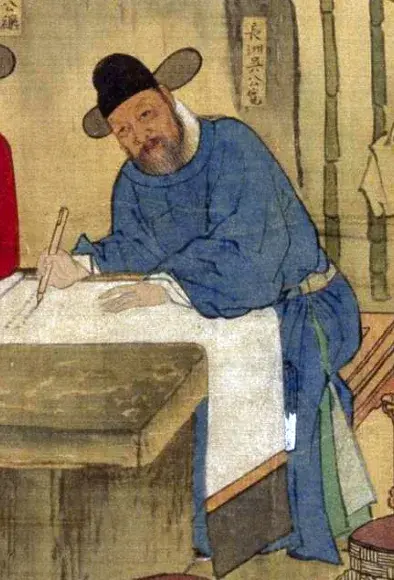
吴宽
Wu Kuan (吴宽, 1435–1504), courtesy name Yuanbo (原博), pseudonym Pao'an (匏庵) and Yutingzhu (玉亭主), posthumously titled Wending (文定), was a celebrated scholar-statesman, master prose writer, calligrapher, and bibliophile of the mid-Ming Dynasty, originating from Changzhou, Suzhou Prefecture. In 1472, Wu achieved the rare distinction of Double First, placing first in both the metropolitan examination (huiyuan) and the palace…
Wu Kuan (吴宽, 1435–1504), courtesy name Yuanbo (原博), pseudonym Pao'an (匏庵) and Yutingzhu (玉亭主), posthumously titled Wending (文定), was a celebrated scholar-statesman, master prose writer, calligrapher, and bibliophile of the mid-Ming Dynasty, originating from Changzhou, Suzhou Prefecture. In 1472, Wu achieved the rare distinction of Double First, placing first in both the metropolitan examination (huiyuan) and the palace examination (zhuangyuan). Entering the Hanlin Academy as Senior Compiler, he served for nine years as preceptor to Crown Prince Zhu Youcheng (the future Hongzhi Emperor), establishing a profound master-disciple relationship characterized by mutual reverence and academic rigor. Following the accession of the Hongzhi Emperor in 1487, Wu advanced rapidly through ministerial ranks, serving as Left Mentor, Junior Supervisor of the Household, and Compiler of the Veritable Records of Emperor Xianzong, before being promoted to Right Vice Minister of Personnel. Following maternal mourning, the emperor kept his ministerial seat vacant and summoned him back to supervise imperial edict drafts in the Grand Secretariat and tutor Crown Prince Zhu Houzhao (the future Zhengde Emperor). He concurrently served as Associate Grand Compiler for the Collected Statutes of the Ming Dynasty (Da Ming Huidian). In 1503, he was appointed Minister of Rites. Throughout thirty years at court, Wu was celebrated for his incorruptibility, genial character, and moral authority, standing as the moral lodestar of civil officials. Passing away in 1504 at age seventy, he was posthumously honored as Grand Guardian of the Heir Apparent with the posthumous name Wending. As a prose stylist, he championed classical simplicity modeled upon Su Shi, pioneering the Wu School of calligraphy and leaving an enduring legacy in Jiangnan literati culture.
Born into an esteemed commoner scholar household in Changzhou, immersing himself in classical literature.
Placed first in the metropolitan examination and first in the palace examination; appointed Senior Compiler in the Hanlin Academy.
Appointed Right Mentor to tutor Crown Prince Zhu Youcheng for nine continuous years.
Emperor Hongzhi ascended the throne; Wu appointed Left Mentor and directed compilation of Veritable Records of Emperor Xianzong.
Elevated to Right Vice Minister of Personnel, conducting official evaluations with celebrated impartiality.
Recalled following mourning to draft imperial edicts and tutor Crown Prince Zhu Houzhao.
Promoted to Minister of Rites upon the completion of the Collected Statutes of the Ming Dynasty.
Died in office in Beijing at age seventy; posthumously awarded the title Grand Guardian of the Heir Apparent and titled Wending.
Wu Kuan was born in 1435 in Changzhou County, Suzhou Prefecture. In his youth, while contemporary examination candidates focused narrowly on rigid civil service styles, Wu absorbed himself in pre-Qin and Western Han classical writings, particularly the Zuo Zhuan, Hanshu, and the collected works of the Northern Song master Su Shi. His compositions were noted early on for mature balance, resonant depth, and unpretentious clarity.
Despite his literary brilliance, Wu suffered repeated setbacks in the provincial examinations of South Zhili. Entering the National University in Beijing as a tribute scholar, he achieved immediate renown among his peers for his exemplary moral character and profound scholarship, earning praise from senior luminaries such as Xu Youzhen, Zhang Rubing, and Bian Huabo. Demoralized by successive examination failures, Wu contemplated permanent retirement in Suzhou. However, South Zhili Education Intendant Chen Xuan visited him with ceremonial courtesy and persuaded him to re-enter the examinations, where Wu secured third place in the 1471 provincial trials. In the spring of 1472, Wu achieved first place in the metropolitan examination (huiyuan) and subsequently captured first place in the palace examination (zhuangyuan). Emperor Xianzong personally conferred his top rank, praising his memorial on benevolent governance as having the profound resonance of the ancient Golden Age. He was appointed Senior Compiler in the Hanlin Academy.
In August 1475, Wu was granted leave to visit his parents in Suzhou. Following the death of his father Wu Rong, he observed traditional three-year mourning, returning to the capital in 1479 to resume his Hanlin post.
Throughout these years, Wu was designated imperial tutor to the young Crown Prince Zhu Youcheng (Emperor Hongzhi), lecturing on Confucian classics for nine years. Wu combined gentle pedagogical encouragement with unwavering personal decorum, winning the lifelong affection of the crown prince. Upon the conclusion of his nine-year term in 1484, he was promoted to Right Mentor in the Right Spring Brigade. In early 1487, he served as co-examiner for the metropolitan examinations alongside Minister of War Yin Zhi.
In September 1487, Emperor Xianzong died and Emperor Hongzhi ascended the throne. Remembering his old tutor with gratitude, the new emperor promoted Wu to Left Mentor in the Left Spring Brigade and Reader-in-Waiting, assigning him as a principal compiler of the Veritable Records of Emperor Xianzong. In 1491, upon the successful completion of the records, Wu was advanced to Junior Supervisor of the Household of the Heir Apparent and Expositor-in-Waiting. In 1493, he served as Palace Examination Reader alongside Grand Secretary Xu Pu.
In August 1495, Emperor Hongzhi promoted Wu to Right Vice Minister of Personnel. Aware of the intense political lobbying surrounding bureaucratic appointments, Wu maintained unbending rectitude, rebuffing personal petitions and basing assessments entirely on merit. When his stepmother passed away in 1496, Wu resigned to observe mourning. Refusing to fill the vacancy, Emperor Hongzhi kept the vice-ministerial post open for three years until Wu completed his mourning rituals.
Returning to the capital in 1499, Wu was assigned to the Grand Secretariat to oversee imperial patent drafts and supervise the household of Crown Prince Zhu Houzhao (the future Zhengde Emperor). During this period, palace eunuchs frequently disrupted the crown prince's studies by scheduling frivolous entertainments. Alarmed by the neglect of royal education, Wu led his colleagues in submitting a forceful memorial: "Royal tutoring is already suspended during winter freezes, summer heat, rainy days, the first and fifteenth of every month, and all festival occasions. The actual days of study in a year amount to only a few months, and only a few hours per day. To allow palace diversions to encroach upon this scarce time is disastrous! Ancient kings sent princes outside at age eight precisely so they would remain distant from flattering menials and close to upright scholars. If ordinary subjects observe this, how much more must the Crown Prince, the foundation of the realm!" Emperor Hongzhi was moved by his candor and accepted his memorial in full.
In February 1503, upon the completion of the Collected Statutes of the Ming Dynasty, in which Wu served as Associate Grand Compiler, he was elevated to Minister of Rites and concurrently directed the Household of the Heir Apparent, standing as the senior scholar-official of the realm. Grand Secretary Xie Qian repeatedly petitioned Senior Grand Secretary Liu Jian to induct Wu into the Grand Secretariat. Liu Jian hesitated, remarking that Wu should enter only after his own retirement. Frustrated, Xie Qian declared in full court: "Lord Wu surpasses me in examination seniority, age, and moral standing; I feel profound shame sitting above him, yet you refuse to bring him into the cabinet—for what reason?" Liu Jian smiled without replying. While contemporary officials lamented Wu's exclusion from supreme executive office, Wu remained entirely indifferent, remarking calmly that he had never harbored personal ambition for the grand secretariat.
In 1504, upon the death of Empress Dowager Zhou, court scholars debated whether her spirit tablet should be placed directly beside Empress Qian in the Imperial Ancestral Temple. Citing the Classic of Poetry and the Spring and Autumn Annals, Wu demonstrated that past dynasties had constructed separate memorial shrines for secondary consorts. The throne endorsed his proposal, establishing stable ritual precedents.
In late spring of 1504, suffering from failing health, Wu submitted three consecutive retirement petitions, but Emperor Hongzhi earnestly declined each. On August 19, 1504, Wu passed away in his ministerial residence at the age of seventy. The emperor suspended court audiences for a day, dispatched sacrificial envoys, granted two extra sacrificial altars, and bestowed upon him the posthumous title of Grand Guardian of the Heir Apparent and the posthumous name "Wending."
In 1472, Wu Kuan achieved the rare distinction of placing first in both the metropolitan examination (huiyuan) and the imperial palace examination (zhuangyuan). Emulating the robust prose styles of Ouyang Xiu and Su Shi, he led a major literary revival that decisively dismantled the frivolous, ornamental tendencies of early Ming courtly writing, advocating natural vigor, moral seriousness, and unaffected simplicity. Alongside Li Dongyang, he was revered as one of the twin literary luminaries of the Chenghua and Hongzhi eras.
Wu Kuan served as imperial tutor to Crown Prince Zhu Youcheng (later the Hongzhi Emperor) for nine years, and subsequently instructed Crown Prince Zhu Houzhao (later the Zhengde Emperor). When palace eunuchs attempted to curtail scholarly lectures to isolate the heir apparent, Wu drafted the famous Memorial on Eastern Palace Lectures, courageously confronting court favoritism and protecting classical Confucian education for imperial heirs.
As Minister of Rites, Wu Kuan adjudicated complex ritual debates by invoking classical precedents from the Spring and Autumn Annals, particularly resolving controversies regarding imperial ancestral temple sacrifices. Concurrently serving as Associate Grand Compiler, he directed the editing of monumental dynastic works including the Collected Statutes of the Great Ming (Da Ming Huidian), Zongjian Zuanyao, and the Veritable Records of Emperor Xianzong, contributing enduring achievements to Ming jurisprudence and historical archival preservation.
In an era dominated by the slender, fluid calligraphic style of Zhao Mengfu, Wu Kuan charted an independent path by modeling his brushwork exclusively on Su Shi. Characterized by dignified structural mass, thick and resonant strokes, and unexpected angular vigor, his calligraphy swept away prevailing decorative tendencies and established him as a founding pioneer and patriarch of the celebrated Wu School (Wumen) of calligraphy.
Wu Kuan was among the most distinguished bibliophiles of southern China during the mid-Ming. Throughout his life, he collected rare editions and personally transcribed precious volumes by hand. Bearing his studio mark Congshu Tang and executed in his distinctive Su Shi-style calligraphy, his meticulously collated manuscripts were treasured by subsequent generations of Chinese bibliophiles as priceless masterpieces of textual scholarship.
Exhibiting personal frugality, Wu Kuan channeled his imperial stipends and agrarian rents into charitable relief for impoverished kin and rural scholars. When his destitute friend He En fell terminally ill, Wu hosted him in his residence for months and observed formal mourning for him upon his demise. His celebrated literary gathering, depicted in the famous painting Zhuyuan Shouji, epitomized the refined cultural fellowship and noble moral ethos of mid-Ming scholar-officials.
Wu Kuan embodied the classical ideal of the Confucian gentleman, characterized by moral purity, intellectual breadth, and unyielding administrative rectitude.
"Wu Kuan was pristine in conduct and gentle toward others, yet immovably firm in his moral principles. In prose, he took Su Shi as his master; in calligraphy, he modeled himself upon Su's monumental style while developing his own full-bodied presence. Serving Emperor Hongzhi for many years, he was treated with immense generosity upon the emperor's ascension. Posthumously awarded Grand Guardian of the Heir Apparent, he was granted the title Wending." — History of Ming (Ming Shi), Scroll 184, "Biographies"
"Master Yuanbo was warm and unadorned like unrefined gold and uncut jade; his scholarship was pure without blemish, and his prose was expansive and tranquil, rivaling Su Dongpo himself. Serving at court for thirty years without a speck of selfish intrigue, he was a true righteous gentleman of our generation." — Li Dongyang, Funerary Stele for the Late Minister of Rites Wu Wending
FIGURES ASSOCIATED WITH THIS DYNASTY