Birth in Yangzhai
Born into an impoverished household in Yangzhai, Henan; orphaned in early childhood.
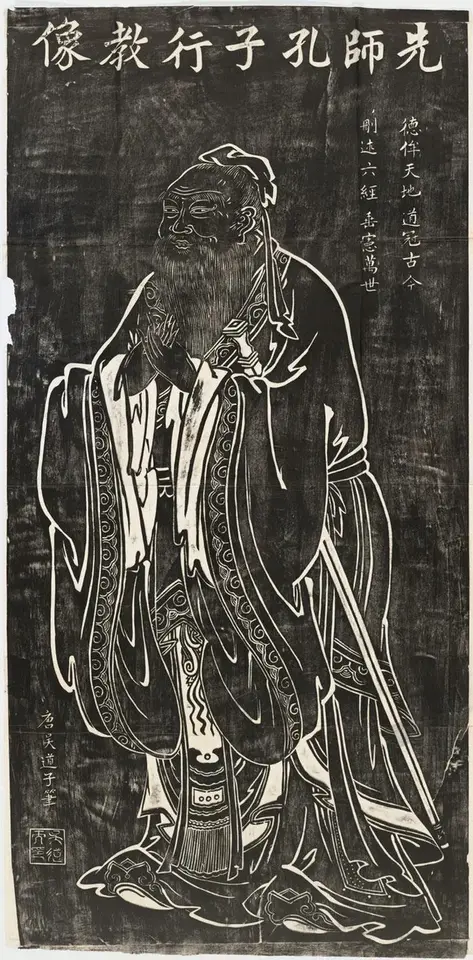
吴道子
Wu Daozi (c. 680–c. 759), also known by his imperial honorific name Wu Daoxuan, was a native of Yangzhai in Henan Circuit. A titanic figure of High Tang culture, he is universally acclaimed in traditional Chinese art history as the "Sage of Painting" (Huasheng). Born into grinding poverty and orphaned in early childhood, Wu Daozi apprenticed under legendary cursive calligrapher Zhang Xu and master He Zhizhang. Deeply…
Wu Daozi (c. 680–c. 759), also known by his imperial honorific name Wu Daoxuan, was a native of Yangzhai in Henan Circuit. A titanic figure of High Tang culture, he is universally acclaimed in traditional Chinese art history as the "Sage of Painting" (Huasheng). Born into grinding poverty and orphaned in early childhood, Wu Daozi apprenticed under legendary cursive calligrapher Zhang Xu and master He Zhizhang. Deeply absorbing the kinetic tension, dynamic brush pressure, and volumetric momentum of cursive calligraphy, he transitioned to painting, mastering the medium with unmatched velocity and inventive power before reaching his twentieth year. During the early Kaiyuan reign of Emperor Xuanzong, his soaring reputation caught the attention of the throne; summoned to the imperial palace, he was appointed Doctor of the Imperial Academy and Companion to the Prince of Ning, receiving the exceptional imperial command that he could only paint upon direct imperial decree. Wu Daozi was an extraordinarily prolific artist, executing over three hundred monumental religious frescoes across Buddhist and Daoist temples in the twin capitals of Chang'an and Luoyang. He instituted revolutionary breakthroughs across all traditional genres: in linear technique, he pioneered the "orchid-leaf line" (lanye miao), wielding the brush with lightning velocity to render swirling garments that billowed as if buffeted by alpine winds—a signature style immortalized as "Wu's drapery floating in the wind" (Wu dai dang feng); in coloring, he established the "Wu manner" (Wu zhuang), employing light, ethereal washes of ink and vegetable tints over powerful structural brushlines; and in iconographic modeling, he established the classic "Wu model" (Wu jia yang), thoroughly sinicizing foreign Buddhist deities into monumental figures radiating imperial dignity. His celebrated masterworks include The Birth of the Buddha (Songzi Tianwang Tu), the Transformations of the Hells (Diyu Bianxiang), the monumental Golden Bridge Procession, and the legendary three-hundred-li Jialing River Landscape executed in a single day across the walls of Dadong Palace. Tang art critic Zhang Yanyuan hailed him as "peerless across past and present, transcending Gu Kaizhi and Lu Tanwei," while Song polymath Su Shi declared him "the solitary titan of all under Heaven."
Born into an impoverished household in Yangzhai, Henan; orphaned in early childhood.
Apprenticed under calligraphers Zhang Xu and He Zhizhang, mastering kinetic brush energy before dedicating himself to painting.
Served as Defender of Xiaqiu in Yanzhou; resigned out of frustration with administrative routine to paint freely in Luoyang.
Summoned by Emperor Xuanzong to Chang'an; appointed Doctor of the Imperial Academy and bestowed the name Daoxuan.
Collaborated on the imperial Golden Bridge Procession following the Fengshan sacrifices at Mount Tai alongside general Pei Min.
Painted over 300 extensive temple murals across Chang'an and Luoyang, including the legendary Transformations of the Hells.
Dispatched to sketch Sichuan's waterways; completed a 300-li landscape on the Dadong Palace wall in a single day from memory.
Fled the capital during the An Lushan Rebellion, continuing to paint Buddhist murals among rural monasteries.
Passed away during the Qianyuan era of Emperor Suzong at approximately eighty years of age.
Wu Daozi was born during the reign of Emperor Gaozong in Yangzhai County, Henan Circuit (modern Yuzhou, Henan). Destitute from birth and orphaned as an infant, he faced extreme deprivation in his early youth. Seeking a practical craft to sustain himself, he journeyed to Chang'an, where he had the fortune to apprentice under He Zhizhang and the "Cursive Sage" Zhang Xu, two of the era's supreme masters of calligraphic energy. Watching Zhang Xu shout aloud and plunge his brush onto silk in wild cursive bursts, young Wu Daozi internalized the structural principles of brush momentum, rhythmic pauses, and volumetric weight.
Recognizing that he could not eclipse his mentors within calligraphy alone, Wu Daozi audaciously transplanted the kinetic velocity of cursive script into the visual language of figurative painting. He applied himself day and night to observing nature, capturing the muscular tension of animals and the volumetric weight of mountain crags. By the time he reached manhood, his technical command had reached such sublime perfection that contemporaries marveled that he had exhaustively unlocked the innermost mysteries of pigment and ink.
In 709, Chancellor Wei Sili recognized the young artist's gifts, employing him as an administrative clerk and subsequently securing his appointment as Defender of Xiaqiu in Yanzhou (modern Jining, Shandong). However, Wu Daozi was uninhibited, generous, and fond of wine. He chafed under the mundane clerical duties of judicial inquests and tax collection. Whenever inspired by wine, he stripped off his outer robes and demanded large brushes, finding the courtroom magistrate's desk an intolerable prison. After several years, he formally resigned his commission, drifting to the auxiliary capital of Luoyang, where he supported himself by painting religious frescoes in local temples. His transcendent murals quickly stunned the empire.
Shortly after ascending the throne in the Kaiyuan era, Emperor Xuanzong initiated a systematic search for the empire's greatest artistic talents. Hearing of the painter whose murals drew thousands to Luoyang's temples, Xuanzong issued an imperial summons commanding Wu Daozi to Chang'an. The emperor appointed him Doctor of the Imperial Academy (Neijiao Boshi), later elevating him to Companion to Prince of Ning Li Xian, and bestowed upon him the imperial name Daoxuan. Xuanzong prized Wu's talents so jealously that he issued a rare imperial decree forbidding the artist from painting for private patrons without an explicit imperial command, transforming Wu Daozi into the supreme artistic icon of the High Tang court.
In the tenth month of 725, Emperor Xuanzong led an immense procession of hundreds of thousands of courtiers, cavalry regiments, and foreign ambassadors to perform the sacred Fengshan sacrifices at Mount Tai. On their triumphant return, the imperial retinue halted at the Golden Bridge post near the hot springs, where banners and cavalry covered the valleys for leagues. Deeply moved by this imperial spectacle, Xuanzong ordered court artists Chen Hong, Wei Wuci, and Wu Daozi to record the event on a grand scroll titled The Golden Bridge Procession. While Chen Hong painted the emperor's portrait and his steed, and Wei Wuci depicted military gear and horses, Wu Daozi executed the sweeping landscape of bridges, cascading rivers, distant peaks, and billowing clouds with breathtaking structural power, producing a masterpiece that left the court spellbound.
During this golden age in Luoyang, an extraordinary meeting occurred that became legend in Chinese art history—the Meeting of the Three Perfections. Senior General Pei Min, mourning his deceased mother, approached Wu Daozi at the Tiangong Temple in Luoyang, offering generous gifts to request a mural of the Buddhist realms to ensure her salvation. Wu Daozi replied: "I have long admired the general's peerless martial art. If you would perform your sword dance for me, its kinetic spirit will ignite my brush to touch the divine." Pei Min stripped off his mourning garments, mounted his steed, and cast his broadsword straight into the sky; the weapon ascended like lightning into the clouds, then plummeted downward, where Pei Min thrust his scabbard forward, catching the blade cleanly inside the sheath without a fraction of error. The thousands of onlookers gasped in terror and delight. Electrified by this burst of physical genius, Wu Daozi tore off his robes, seized a massive mop-like brush, and dashed onto the whitewashed temple wall; in a whirlwind of ink strokes, he completed the Transformations of the Hells, its thundering lines seeming to shake the very pillars of the hall. Calligrapher Zhang Xu then stepped forward, covering an adjoining wall in tempestuous cursive script, prompting the citizens of Luoyang to rejoice that they had witnessed the Three Perfections of human creation in a single afternoon.
In the Tianbao era, Emperor Xuanzong grew enamored with the legendary beauty of Sichuan's rivers and mountains, dispatching Wu Daozi on an official mission along the postal roads to sketch the waterways of the Jialing River. After several months of wandering among the gorges, Wu Daozi returned to the imperial palace. When Xuanzong eagerly asked to see his preliminary sketches and silk drafts, Wu Daozi bowed calmly and replied: "Your servant brought no drafts; every mountain, gorge, and rapid is etched inside my heart."
Xuanzong immediately commanded him to paint the river directly onto the pristine walls of the Dadong Palace. Discarding preliminary outlines, Wu Daozi stood before the vast wall with heavy jars of rich ink. Dipping a massive brush, he lunged across the plaster in sweeps of controlled frenzy. Drawing entirely upon visual memory and his profound grasp of tectonic structure, he mapped the surging river from its origins in Guangyuan through wild reefs, dizzying suspension bridges, and mist-veiled forests, completing the three-hundred-li expanse of the Jialing River from dawn to dusk.
Concurrently, the elder master of monumental green-and-blue landscape painting, General Li Sixun, was commissioned to paint the identical river valley upon an adjacent palace wall. Li Sixun employed meticulous lapis lazuli pigments and gold leaf, working for several months with architectural precision. Inspecting both completed murals, Emperor Xuanzong marveled: "Li Sixun's labor of many months and Wu Daoxuan's execution of a single day—both reach the utmost perfection of art!" This celebrated imperial verdict recognized two complementary peaks of Chinese landscape aesthetics, establishing Wu Daozi as the founding master of rapid, expressive, calligraphic landscape painting.
The golden age came to a violent end in the winter of 755 with the outbreak of the An Lushan Rebellion. Rebel cavalry captured Luoyang and breached the Tong Pass, forcing Emperor Xuanzong into flight to Sichuan and plunging the imperial heartland into slaughter and destruction. In the wreckage of the twin capitals, the elderly painter took refuge among the rural temples of Henan and Shaanxi.
Despite the desolation, Wu Daozi never laid down his brush. Visiting ruined monasteries such as Jinggong Temple and Ci'en Temple in Chang'an, he donated his failing strength to restore scarred murals, infusing his divine figures with a deepened sense of mortal tragedy and universal compassion. During the early Qianyuan reign of Emperor Suzong, the Sage of Painting passed away quietly in retirement at approximately eighty years of age, leaving behind an immortal artistic lineage that transformed the cultural landscape of East Asia.
Before Wu Daozi, traditional Chinese figure painting followed the delicate, uniform "spring silkworm silk" and "tight iron-wire" line styles pioneered by Gu Kaizhi and Lu Tanwei. Infusing his brushwork with wild cursive calligraphy techniques, Wu invented the revolutionary "orchid-leaf line" (lanye miao), characterized by fluctuating pressure, dynamic swells, and sudden tapering. His depictions of deities, celestial maidens, and guardian kings featured garments billowing as if caught in dynamic gusts, establishing the enduring aesthetic canon celebrated across dynasties as "Wu's drapery floating in the wind" (Wu dai dang feng).
Over his career, Wu Daozi painted more than three hundred temple murals, spearheading the Sinicization and secularization of Buddhist and Daoist iconography. He replaced foreign Gandharan austerity with full-bodied, dignified Tang human forms, infusing sacred divinities with mortal vitality. Furthermore, he pioneered the "Wu-style tinting" (Wuzhuang), replacing dense mineral pigments with light washes of ochre and indigo over expressive ink outlines, inaugurating line-driven ink painting.
Wu Daozi's murals wielded immense emotional and psychological resonance. His monumental Transformations of Hell painted at Jingyun Monastery in Luoyang and Zhao Jinggong Monastery in Chang'an depicted the terrors of moral retribution with such graphic intensity that butcher and fishmonger guilds across the imperial capital closed their shops in fear of karmic punishment and took vows of repentance.
Wu's acknowledged masterpiece, The Heavenly King Sending a Son (Songzi Tianwang Tu), captures the historic fusion of Buddhist theology with native Chinese courtly aesthetics. Across three sweeping compositions depicting the birth and presentation of Prince Siddhartha, Wu executed hundreds of armored celestial generals, fearsome guardian beasts, and serene attendants, setting the definitive benchmark for Chinese narrative painting.
Wu Daozi established the definitive visual archetype of Zhong Kui, the iconic demon-dispelling deity of Chinese folklore. According to the Dream Pool Essays, when Emperor Xuanzong recovered from malaria after dreaming of a bearded ghost-catcher, he commissioned Wu Daozi to depict the apparition. Wu grasped the vision with uncanny precision, creating the ferocious, righteous archetype venerated in Chinese households for millennia.
When painting monumental walls, Wu Daozi displayed superhuman speed and precision, executing dynamic circles and straight axes with a single unbroken stroke without compasses or rulers. Literati critics such as Su Shi marveled that Wu's figures seemed illuminated by dynamic light, exhibiting foreshortening, anatomical curvature, and lifelike depth that rivaled sculptural relief.
Wu Daozi generously trained legions of disciples and studio assistants, founding the most influential artistic guild of the High Tang. Foremost among his pupils was Lu Lengjia, whose brushwork closely mirrored Wu's power. Wu's stylistic principles were institutionalized into workshop traditions that guided monumental painters through the Five Dynasties and Northern Song.
Wu Daozi's virtuosity became the subject of widespread folklore in Tang and Song collections such as Records of the Court and Commonalty and Miscellaneous Morsels from Youyang. Tales of unpainted dragon eyes that would cause temple walls to shatter upon completion, or drawn asses that brayed at night, elevated Wu Daozi into the immortal "Sage of Painting" (Huasheng) in the popular Chinese imagination.
FIGURES ASSOCIATED WITH THIS DYNASTY