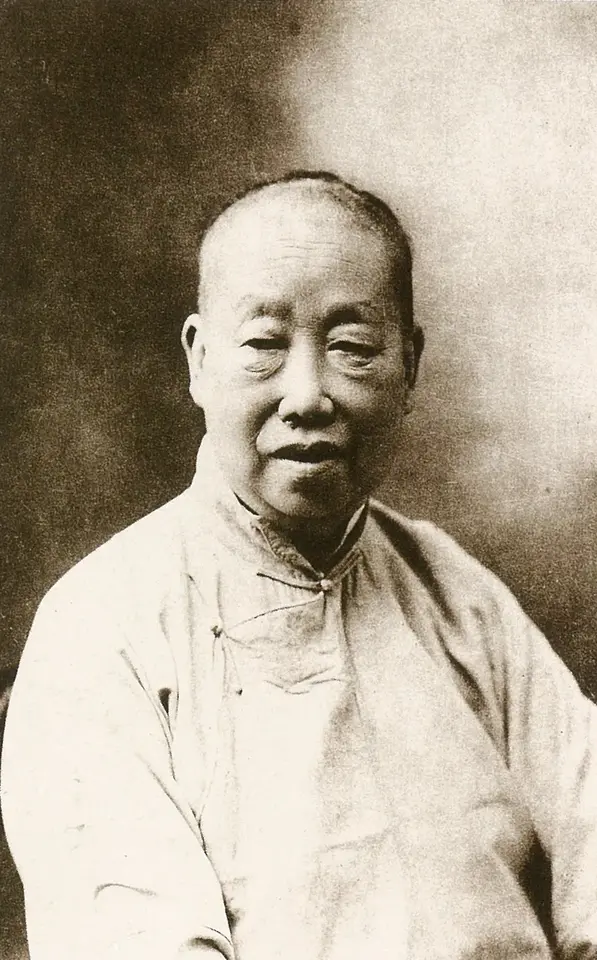
Life and Career
Farming and Scholarly Heritage Amidst War
Wu Changshuo was born in 1844 in Zhangwu Village, Xiaofeng County (modern Anji County), Zhejiang. His father, Wu Xinji, was a Juren graduate who excelled in poetry and epigraphy. From age six, Wu studied the Classics under his father's instruction; by ten, he was proficient in composition; and by fourteen, he was carving stone seals, inaugurating a lifelong engagement with the arts.
In 1860, fighting between Taiping forces and the Qing military devastated western Zhejiang. Anji suffered severe destruction, and Wu's mother, fiancée Lady Zhang, and several siblings perished from disease and famine. Wu fled with his elderly father, living as an itinerant laborer across Jiangsu, Hubei, and Anhui, sustaining himself on wild plants. These years of displacement instilled in him resilience and deep empathy for the common people.
In 1864, as fighting subsided, Wu returned with his father to Anji, finding their ancestral home in ruins. They built a modest dwelling in the county seat, naming it Wuyuan. In 1865, at twenty-two, Wu passed the county examinations to become a licentiate. To support his blind, ailing father, Wu taught local children, wrote letters, and carved seals. Following his father's death in 1868, Wu resolved to travel to advance his education.
Seeking Mentors and Expanding Intellectual Horizons
In 1869, Wu left Anji to attend Gujing Jingshe in Hangzhou, studying under the prominent classicist Yu Yue. Under Yu's mentorship, he investigated Xu Shen's Shuowen Jiezi, phonology, and ancient philology, compiling his first seal impression volume, Puchao Yincun. Over the next decade, Wu traveled across Hangzhou, Suzhou, Jiaxing, Huzhou, and Shanghai.
In Jiaxing, he befriended painter Pu Hua, exploring composition and wash techniques. In Huzhou, he taught in the library of collector Lu Xinyuan, studying poetry with Shi Buhua. In Suzhou, he resided at the Liangruixuan studio of collector Wu Yun, examining ancient Zhou and Qin bronzes and rare Song editions, and publishing Xiaogulu Yincun. During this period, he studied Han and Northern Dynasties steles under calligrapher Yang Xian, and acquired a rubbings edition of the pre-Qin Stone Drum Script, beginning a lifelong practice of transcribing the text.
In 1882, Wu moved his family to Suzhou, taking minor administrative posts to supplement his income. He befriended inkstone collector Shen Shiyou, who supported his artistic work. In 1883, Wu met painter Ren Bonian in Shanghai. Recognizing Wu's epigraphic brushwork, Ren instructed him in ink washes and dynamic floral composition, painting several celebrated portraits of Wu, including Master of Wujing Pavilion and The Chill Official. In 1887, Wu relocated to Shanghai, collaborating with epigrapher Wu Dacheng and scholar Luo Zhenyu to study ancient scripts.
Military Expedition and Resignation from Andong
In 1894, the First Sino-Japanese War erupted. Hunan Governor Wu Dacheng was appointed to lead troops beyond Shanhaiguan; knowing Wu Changshuo's strategic judgment and artistic skill, he invited Wu to join his military staff. Approaching fifty, Wu accepted the appointment and traveled north to assist the campaign.
However, the Qing armed forces collapsed, culminating in the destruction of the Beiyang Fleet. Experiencing front-line carnage and bureaucratic incompetence, Wu wrote Composing a Poem on the Shanhaiguan Expedition to mourn the fallen. Following the defeat, Wu returned inside the pass. In winter 1895, Ren Bonian died in Shanghai, leaving Wu grief-stricken; he resolved to carry forward Ren's artistic legacy while developing an independent aesthetic.
In 1898, Wu compiled his clan genealogy in ten fascicles. In 1899, recommended by friends, he was appointed Magistrate of Andong County (modern Lianshui County) in Jiangsu. Wu intended to govern as a fair administrator, but found the regional bureaucracy corrupt, extortionate, and consumed by stifling protocol. Unwilling to demean himself before superiors, Wu resigned after one month in office, returning south. Upon his departure, he carved the white-character seal "Magistrate of Andong for One Month" to commemorate his renunciation of public office.
Directing the Xiling Seal Society and Renown in Japan
Following his resignation, Wu settled permanently in Shanghai, earning a livelihood through calligraphy, painting, and seal carving. Supported by businessman and painter Wang Yiting, Wu's artistic reputation grew rapidly across Shanghai's art circles. In 1904, he moved to Pisi Hall, where young artists including Chen Shizeng and Zhao Ziyun sought his instruction; opera master Mei Lanfang also visited his studio.
In 1904, Zhejiang seal carvers Ding Ren, Wang Ti, Ye Ming, and Wu Yin established an association on Gushan in Hangzhou. In 1913, the organization was formally named the Xiling Seal Society, and members unanimously elected the sixty-nine-year-old Wu as its inaugural president. Wu authored the Record of the Xiling Seal Society, defining its mission as "preserving epigraphy, studying seal art," establishing the society as China's premier institution for seal studies.
Beginning in 1914, Wang Yiting organized solo exhibitions for Wu at the Rokusansen Garden in Shanghai, captivating Japanese connoisseurs and collectors. Japanese publishers printed Wu Changshuo Painting Manual, and sculptor Asakura Fumio traveled to Shanghai to cast a bronze bust of the artist. Wu's works circulated across Tokyo and Kyoto, where Japanese scholars venerated him as the "Sage of Seals."
Protecting the Han Three Elders Stele and Passing in Shanghai
In 1916, Wu supervised the publication of Ming poet Wu Jiacheng's rare collection Yuangai Fucao, preserving a forgotten local literary work. In 1917, when severe floods struck northern China, leaving millions destitute, Wu composed the painting Refugees, auctioning his artworks to contribute all proceeds to famine relief.
In 1921, the Stele of the Three Elders (Han Sanlao Huizi Jiri Bei), carved during the Eastern Han reign of Emperor Shun and unearthed in Yuyao, was slated for secret purchase and foreign export by a Japanese merchant. Learning that this national antiquity was in jeopardy, the seventy-seven-year-old Wu organized an auction with Xiling Seal Society colleagues. Wu contributed dozens of paintings, successfully raising eight thousand silver dollars to purchase the stele back, constructing a stone pavilion at Gushan to house it permanently.
In his eighties, Wu continued to write, paint, and mentor younger artists including Pan Tianshou, Sha Menghai, Zhu Wenyun, and Zhu Lesan. On November 29, 1927, Wu passed away from a stroke at his Shanghai residence at the age of eighty-four. In 1933, his remains were interred near Baoci Temple on Mount Chaoshan in Yuhang, Zhejiang, amid the plum blossoms he had celebrated throughout his life.
Major Achievements
Integrating Epigraphy into Painting and Founding the Epigraphic Grand Freehand Style
Wu Changshuo's central historical contribution to Chinese painting was infusing the archaic weight of bronze vessels and stone drums into freehand floral painting, founding the "epigraphic grand freehand" (jinshi daxieyi) style. Toward the late Qing, traditional bird-and-flower painting had grown delicate and derivative. Wu observed: "My lifelong strength lies in my ability to paint using the methods of calligraphy."
Rejecting superficial verisimilitude, he executed plum branches, orchids, and bamboo using the weighted strokes of ancient seal script, while depicting wisteria vines with the sweeping momentum of wild cursive. He excelled in painting red and ink plum blossoms, balancing moisture and mineral pigments to produce vibrant crimsons; in orchids, he employed seal script brushwork to convey resilience; in bamboos, he used light ink for stems and saturated ink for leaves, pairing them with weathered rocks; in chrysanthemums, he paired scorched ink outlines with earthenware vases; and in his late years, he rendered peonies with vivid rouge and carmine, balancing vibrancy with classical gravity.
Masterpieces such as Wisteria utilized cursive brushwork with dynamic energy; Lotus employed splashed ink for leaves paired with delicate rouge petals; Magnolia juxtaposed white blossoms against scorched ink rocks; and Heavenly Bamboo and Narcissus utilized diagonal balance to demonstrate the expressive peak of freehand ink painting.
Decades of Stone Drum Script Mastery and Calligraphic Revolution
Wu mastered all major calligraphic scripts, standing preeminent in seal script. In his youth, he studied Yan Zhenqing and Zhong Yao for standard script, Han steles for clerical script, and Huang Tingjian, Wang Duo, and Huang Daozhou for running-cursive. His foremost calligraphic achievement was his lifelong dedication to the pre-Qin Stone Drum Script (Shiguwen).
From the time he first viewed rubbings in his thirties, Wu transcribed the Stone Drum Script daily for decades. Rather than copying the weathered, static appearance of the stones, he transformed circular configurations into square structures, tilting strokes dynamically upward toward the right with deliberate friction. His lines evoked aged vines, robust and powerful, moving beyond the formulaic rigidity of contemporary seal script. Theorists such as Kang Youwei and Sha Menghai acclaimed his seal script as an unprecedented peak in three centuries of Qing calligraphy.
Combining Punch and Cut Techniques and the Aesthetic of Weathered Seals
As inaugural president of the Xiling Seal Society, Wu elevated seal carving to an artistic zenith. Beginning with the Zhejiang School, he studied Qin and Han seals, synthesizing Deng Shiru, Wu Rangzhi, and Zhao Zhiqian while examining ancient pottery stamps, clay sealings, and Han-Wei roof tiles. In carving technique, he integrated the rapid incision of the punch knife (chongdao) with the controlled resistance of the cut knife (qiedao).
He pioneered the aesthetic technique of deliberately distressing seal edges. Recognizing that ancient seals acquired beauty through centuries of subterranean erosion, Wu tapped, rubbed, and polished his finished seals with stones and metal tools, imparting a weathered bronze texture that elevated seal carving to the realm of antique aesthetic perfection.
His surviving seals number in the thousands, collected in volumes such as Foulu Yincun and Tiehanshanguan Yincun, including celebrated seals such as Magistrate of Andong for One Month, Undertook the World's Tasks, and Taishan Residual Stone Tower, standing with Zhao Zhiqian as a pillar of modern seal carving.
Classical Poetic Mastery and the Ancient Grandeur of the Foulu Collection
Wu was an accomplished poet who achieved recognition among late Qing classical literati. Educated under Yu Yue, his verse was rooted in the High Tang traditions of Du Fu and Han Yu, alongside Northern Song masters Su Shi and Huang Tingjian, characterized by an archaic, mournful resonance.
He composed thousands of poems documenting wartime displacement, military expeditions, travel, and epigraphical commentaries. In 1893, he published the first three volumes of Foulu Shi in Shanghai, prefaced by Shi Xuchen and Tan Xian; in 1903, he issued Volume Four and a supplementary volume. His verse combined sorrow over the declining dynasty with compassion for common people, leading contemporaries to observe that "his poems contain epigraphy, and his paintings contain poetry."
Founding the Xiling Seal Society and Preserving Epigraphical Heritage
In the early Republic, amid social turbulence and the rapid erosion of traditional scholarship, Wu assumed the presidency of the Xiling Seal Society, utilizing his prestige to assemble epigraphers and painters on Gushan in Hangzhou.
Drafting the Record of the Xiling Seal Society, he articulated a clear preservationist mission. When the Eastern Han Stele of the Three Elders was threatened with foreign purchase, Wu organized public auctions, contributing his own paintings to raise eight thousand silver dollars to secure the monument for the nation, building a stone chamber on Gushan to house it. Through these efforts, Wu served as an essential custodian of Chinese epigraphical heritage.
Mentoring Younger Artists and the Shanghai School Lineage
Wu was a generous educator who nurtured generations of twentieth-century artists. Residing in Shanghai, he instructed students regardless of social background. Leading artists including Chen Shizeng, Wang Geyi, Pan Tianshou, Zhu Lesan, and Sha Menghai studied directly under his tutelage.
Master Qi Baishi, though never an official student, admired Wu's work deeply, writing: "Master Foulu's talent in his old age is extraordinary; I would gladly serve as a disciple at his gate." Absorbing Wu's grand freehand style, Qi developed his celebrated "red flowers and black leaves" method. Wu's aesthetic legacy shaped the Shanghai School while decisively influencing the Beijing School and modern Chinese flower-and-bird painting.