Birth of Wu Bin
Born in Huangshi, Putian, Fujian, demonstrating brilliant precocity in classical prose, calligraphy, and painterly composition.
吴彬
Wu Bin (1550–1643), courtesy names Wenzhong and Wenzhong, art name Zhiyin Toutuo (Ascetic of the Branch Retreat), native of Huangshi, Putian, Fujian, who long resided in Jinling (modern Nanjing), was one of the most innovative and celebrated master painters of the late Ming dynasty. Summoned during the Wanli era to serve as court painter in Beijing, he was appointed Secretary in the Ministry of Works and subsequently…
Wu Bin (1550–1643), courtesy names Wenzhong and Wenzhong, art name Zhiyin Toutuo (Ascetic of the Branch Retreat), native of Huangshi, Putian, Fujian, who long resided in Jinling (modern Nanjing), was one of the most innovative and celebrated master painters of the late Ming dynasty. Summoned during the Wanli era to serve as court painter in Beijing, he was appointed Secretary in the Ministry of Works and subsequently Secretariat Drafter (Zhongshu Sheren). Highly esteemed by premier cultural luminaries including Dong Qichang, Chen Jiru, Mi Wanzhong, Ye Xianggao, and Gu Qiyuan, Wu occupied a central position in the late Ming artistic vanguard. During the Tianqi reign, his unyielding moral courage led him to publicly condemn the usurpation of the eunuch dictator Wei Zhongxian, resulting in his arrest, imprisonment, and dismissal from court. Retiring to his retreat, the Zhiyin Hermitage in Nanjing, Wu dedicated his final decades to Buddhist contemplation and landscape painting. Breaking decisively with decorative conventions, Wu created idiosyncratic Buddhist and arhat figures that inaugurated the Mannerist distortion school, while reviving monumental Northern Song panoramic landscapes filled with labyrinthine peaks and towering cascades. Renowned alongside portraitist Zeng Jing as one of the "Four Incomparables of Putian," his masterworks include Ten Views of a Lingbi Rock, Sixteen Arhats, and A Thousand Peaks and Myriad Ravines.
Born in Huangshi, Putian, Fujian, demonstrating brilliant precocity in classical prose, calligraphy, and painterly composition.
Relocated permanently to Nanjing, constructing the Zhiyin Hermitage (Zhiyin'an) at Mount Qixia to paint and study Chan Buddhism.
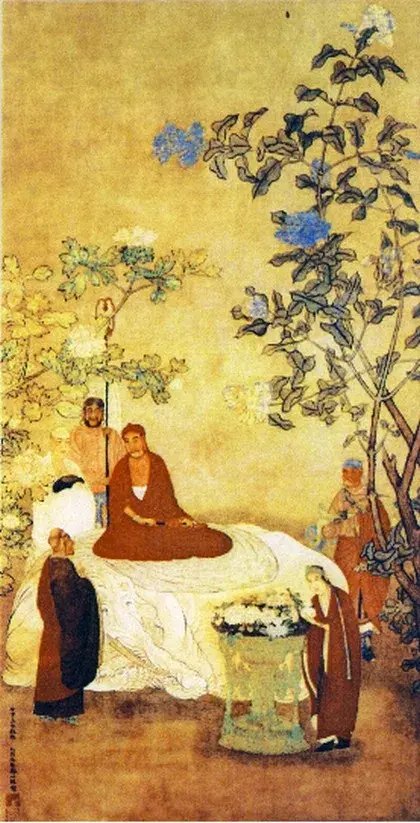
Completed his landmark Buddhist scroll Sixteen Arhats (Shiliu Yingzhen Tu), acclaimed for its archaic, expressive brushwork.
Created Layers of Peaks and Encircling Precipices, reviving the austere majesty and dense monumentalism of Northern Song masters.
Summoned by the Wanli Emperor to serve as imperial court painter, granted office as Secretary in the Ministry of Works and Secretariat Drafter.
Commissioned by his close friend Mi Wanzhong to execute Ten Views of a Lingbi Rock, a pioneering multi-perspective visual masterpiece.
Completed The Twenty-Five Perfect Transferences of the Surangama Sutra, winning laudatory inscriptions from Dong Qichang and Chen Jiru.
Openly condemned the tyrannical dominance of the eunuch Wei Zhongxian; thrown into prison by imperial guards and stripped of all official rank.
Following release from prison, severed worldly ties to reside as an ascetic lay monk in Nanjing, painting arhats and guiding disciples.
Passed away peacefully at Zhiyin Hermitage in Nanjing at ninety-four years of age, leaving behind an incomparable aesthetic legacy.
Wu Bin was born into an educated family in Huangshi, Putian, Fujian, a coastal prefecture celebrated for classical learning and Buddhist devotion. From youth, Wu demonstrated an extraordinary facility for classical prose and esoteric philosophy, yet found his true vocation in the brush arts. Rather than dedicating his life to civil examination routines, he journeyed across southeastern China to study ancient stone carvings, Buddhist murals, and private art collections. By the early 1580s, seeking a more cosmopolitan artistic environment, Wu relocated permanently to Jinling (modern Nanjing), the southern cultural capital of the Ming Empire.
At the foothills of Mount Qixia outside the Nanjing ramparts, Wu constructed a serene hermitage, christening it the "Zhiyin Hermitage" (Zhiyin'an, the Branch Retreat) to evoke a solitary bird contented with a single twig. In this secluded retreat, Wu lived as an ascetic, rising at dawn to chant Buddhist sutras, burn incense, and meditate before working with ink and brush. His refined demeanor and breathtaking painterly skill quickly attracted Nanjing's premier literati elite. Senior Grand Secretary Ye Xianggao composed the Preface to the Collected Poems of the Branch Hermitage, marveling at Wu's spiritual independence amidst worldly modesties, while scholar Gu Qiyuan hailed him as "the foremost gentleman of the Eight Min regions, a poet from a previous life and an immortal artist incarnate."
During the mid-Wanli reign, as news of Wu's extraordinary technical versatility reached the imperial capital, provincial governors and Grand Academicians recommended him to the imperial throne. In 1608, the Wanli Emperor summoned Wu to Beijing, inducting him into the inner court as an imperial painter. In recognition of his broad classical literacy, the emperor appointed him Secretary in the Ministry of Works (Gongbu Zhushi) and subsequently Secretariat Drafter (Zhongshu Sheren), charging him with executing imperial landscapes, hanging scrolls for seasonal court ceremonies, and connoisseurship of palace collections.
During his tenure in the capital, Wu formed a deep artistic friendship with the celebrated bureaucrat and connoisseur Mi Wanzhong. Having acquired a magnificent, perforated Lingbi scholar's rock, Mi invited Wu to paint it. Rather than rendering a conventional portrait of the stone, Wu spent months observing the rock under shifting natural lighting, painting it sequentially from ten distinct planar angles—front, back, left, right, obliquely, and inverted. The resulting masterwork, Ten Views of a Lingbi Rock (Shimian Lingbi Tu), astonished Beijing's literati. Dong Qichang lauded the work as possessing miraculous spiritual power, establishing Wu as the supreme master of botanical and mineral depiction.
In the 1620s, the accession of the youthful Tianqi Emperor inaugurated the catastrophic ascendancy of the eunuch dictator Wei Zhongxian and the wet-nurse Madam Ke. While opportunistic courtiers built living shrines and clamored to proclaim the eunuch "Lord of Nine Thousand Years," Wu Bin refused to flatter the cabal. Offended by the corruption of court governance and the persecution of righteous ministers, Wu openly castigated Wei's faction during conversations within official departments. Infuriated by this insubordination, Wei ordered the imperial secret police to arrest Wu, throwing him into the capital penitentiary. Resisting torture with stoic composure, Wu was eventually released following the discreet intervention of senior patrons, but was stripped of all rank and banished.
Returning to Nanjing, Wu severed all aspirations for worldly office. Adopting the tonsure and monastic robes of a lay Buddhist, he referred to himself as "Zhiyin Toutuo" (The Ascetic of the Branch Retreat). During his final two decades, Wu attained absolute mastery over his idiosyncratic brushwork. Living on vegetarian fare, he painted solemn representations of arhats, Guanyin bodhisattvas, and panoramic mountain retreats characterized by soaring peaks and swirling mists. In 1643, on the eve of the collapse of the Ming dynasty, Wu passed away peacefully in his hermitage at the grand age of ninety-four.
Wu Bin stands as the undisputed pioneer of Mannerist and Expressionist figure painting in pre-modern Chinese art. Rejecting the delicate, standardized Buddhist imagery prevalent in late Ming commercial workshops, Wu embraced bold anatomical distortion to communicate transcendent spiritual energy.
His depictions of the sixteen and eighteen arhats feature exaggerated cranial vaults, piercing elongated eyes, contorted musculature, and flowing draperies executed in immaculate iron-wire (tiexian) lines. Influenced by medieval Chan aesthetics and esoteric Buddhist iconography, these figures project an aura of uncanny antiquity and raw psychological presence. Modern art historians recognize Wu's stylistic innovations—shared in part with his younger contemporaries Ding Yunpeng and Chen Hongshou—as the earliest manifestations of subjective expressionism in Asian art.
In landscape painting, Wu Bin staged a revolutionary revival of the monumental "Great Mountain" style of the Northern Song masters Li Cheng, Fan Kuan, and Guo Xi. While his contemporaries in the Wu School pursued the sparse, relaxed brushwork of the Yuan literati, Wu constructed vast, densely populated panoramic compositions that conveyed the awesome, alien power of nature.
In masterpieces such as A Thousand Peaks and Myriad Ravines (Qianyan Wanhe Tu) and Layers of Peaks and Encircling Precipices (Ceng Luan Chong Zhang Tu), jagged mountains twist upward like petrified flames, sheer cliffs cascade down to narrow chasms, and vaporous clouds wind through vertiginous defiles. Utilizing meticulous textural strokes (cunfa) and layered washes of ink, Wu synthesized archaic grandeur with visionary, surreal imagination, expanding the conceptual boundaries of the Chinese landscape tradition.
Wu Bin's creation of Ten Views of a Lingbi Rock (1610) remains a crowning achievement of world material art. Measuring nearly thirty meters in length, the scroll visualizes a single geological specimen from ten systematic vantage points, combining empirical proto-scientific observation with lyrical calligraphic brushwork.
This monumental painting anticipated Western cubist and multi-perspectival aesthetics by three centuries, analyzing form, mass, shadow, and negative space with unprecedented geometric precision. In 2020, the scroll was sold at auction for 512.9 million RMB, breaking the world auction record for classical Chinese art and confirming Wu Bin's enduring status as an immortal titan of global artistic history.
FIGURES ASSOCIATED WITH THIS DYNASTY