Royal Birth
Born in the Onon River valley on the Mongolian plateau as the eldest son of Jochi and eldest grandson of Genghis Khan.
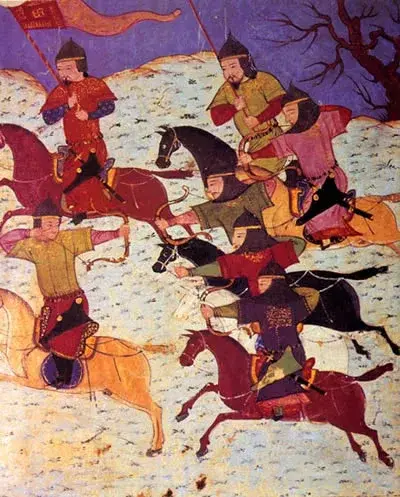
斡儿答
Orda Khan (斡儿答, c. early 13th century–c. 1280), also rendered as Orda, was an imperial prince of the Mongol Empire, a founding father of the Golden Horde (Ulus of Jochi), and the first Khan of the White Horde. He was the eldest son of Jochi, the eldest grandson of Genghis Khan, and the senior elder brother of Batu Khan. As the eldest grandson of the supreme imperial clan, Orda was celebrated among the Mongol princes for his…
Orda Khan (斡儿答, c. early 13th century–c. 1280), also rendered as Orda, was an imperial prince of the Mongol Empire, a founding father of the Golden Horde (Ulus of Jochi), and the first Khan of the White Horde. He was the eldest son of Jochi, the eldest grandson of Genghis Khan, and the senior elder brother of Batu Khan. As the eldest grandson of the supreme imperial clan, Orda was celebrated among the Mongol princes for his magnanimity, wisdom, and steadfast dedication to tribal unity. Following the death of Jochi in 1227, nomadic custom favored Orda's accession as paramount ruler of his father's domain. Recognizing that his younger brother Batu possessed superior military energy and commanding talent, Orda voluntarily yielded the supreme khanship to Batu, contenting himself with directing the eastern left wing. This noble act of dynastic deference eliminated internal factionalism and secured more than a century of fraternal unity for the house of Jochi. During the Mongol invasion of Europe (1235–1242), Orda served as a senior commander alongside Batu. Leading the northern wing through the Volga river basin, his forces reduced the principalities of Ryazan, Vladimir, and Kiev. In the spring of 1241, Orda and Prince Baidar spearheaded the northern invasion of Poland, annihilating the combined armies of Polish feudal lords and the Teutonic Knights at the landmark Battle of Legnica, where Duke Henry II the Pious of Silesia was slain. Following the western campaign, Batu assigned Orda hereditary rule over the eastern steppes of the Ulus of Jochi—stretching from the Irtysh River to Lake Balkhash and north of the Aral Sea—establishing the White Horde (also known as the Ulus of Orda). Orda governed this vast pastoral realm with enlightened equity, establishing the lineage from which the rulers of the later Kazakh Khanate and various Central Asian dynasties traced their descent.
Born in the Onon River valley on the Mongolian plateau as the eldest son of Jochi and eldest grandson of Genghis Khan.
Following Jochi's death, declined the paramount khanship, elevating his younger brother Batu to preserve harmony.
Dispatched as senior commander of the Jochid left wing during the great expedition against the Kipchaks and Eastern Europe.
Captured the fortified strongholds of Ryazan, Moscow, and Vladimir, taking part in the sack of ancient Kiev.
Spearheaded the northern advance into Silesia, destroying the knightly coalition at Legnica and slaying Duke Henry II.
Returned from Europe and received the eastern appanage from the Irtysh to the Aral Sea, founding the White Horde.
Backed Batu's elevation of Mongke Khan as Great Khan, sending royal detachments to attend the imperial kurultai.
Passed away peacefully in his encampment along the Irtysh River; his lineage eventually unified the Kipchak steppes.
Orda was born in the opening years of the thirteenth century as the firstborn son of Jochi, the eldest son of Genghis Khan. In the imperial division of nomadic pastures following the conquest of the Khwarazmian Empire, Jochi was assigned vast territories extending from the Altai Mountains westward to the Urals and the northern shores of the Caspian Sea. Because he was the senior grandson of Genghis Khan, Orda was held in high esteem across the nomadic aristocracy.
In 1227, Jochi died while encamped in the Kipchak steppes. Under steppe inheritance traditions, many tribal chieftains and tumen commanders expected Orda to assume the royal throne of the Jochid ulus. Demonstrating surpassing political maturity, Orda recognized that his younger brother Batu possessed exceptional leadership and military charisma.
Addressing his mother, Oki Khatun, and the gathered commanders, Orda declared that the preservation and expansion of their father's realm required Batu's decisive leadership. He personally escorted Batu to the royal golden throne and swore the oath of allegiance. This profound act of humility prevented succession warfare and established enduring political cohesion within the golden clan of Jochi.
In 1235, Ogodei Khan convened a kurultai on the Onon River to organize the invasion of Europe, known historically as the Campaign of the Imperial Princes. Batu was appointed supreme commander, with veteran general Subutai serving as chief strategist. Orda led the veteran cavalry divisions of the Jochid left wing.
In the winter of 1237, the Mongol hosts crossed the frozen Volga. Orda's divisions crushed the Volga Bulgars, Bashkirs, and Kipchaks before pivoting into the fragmented principalities of Kievan Rus. Fighting in sub-zero winter temperatures, Orda's cavalry utilized frozen rivers as highways, storming Ryazan, Kolomna, Moscow, and Vladimir.
In late 1240, Orda took part in the siege and capture of Kiev, extinguishing effective resistance across southern Rus and opening the road into central Europe.
In the spring of 1241, the Mongol high command devised a strategic pincer offensive to invade the Kingdom of Hungary. While Batu and Subutai pushed south through the Carpathian Mountains, Orda and Chagatai's son Baidar were assigned twenty thousand elite cavalry to form the northern task force, designed to ravage Poland and Bohemia to protect Batu's northern flank.
Orda advanced across Poland, sacking Sandomierz and burning Krakow. On April 9, 1241, at Legnica in Lower Silesia, Orda encountered the combined host of Polish knights, Moravian barons, the Knights Templar, the Hospitallers, and the Teutonic Order, led by Duke Henry II of Silesia.
Employing traditional feigned retreats, Orda drew the heavily armored European knights into an overextended charge, separating them from their infantry support. Mongol light horsemen encircled the knights, unleashing volleys of armor-piercing arrows before heavy cavalry charged the flanks. The allied army was annihilated. Duke Henry II was captured and decapitated, and his severed head was paraded on a lance outside the walls of Legnica. The battle stunned the Papacy and the Holy Roman Empire, spreading panic across Western Europe. Having accomplished his strategic objective, Orda turned south through the Moravian Gate to unite with Batu's main army in Hungary.
Following the western campaign, Batu established his capital at Sarai on the lower Volga, consolidating the Golden Horde. In recognition of Orda's unyielding loyalty and martial brilliance, Batu formally partitioned the realm, delegating semi-autonomous rule over the eastern territories to his elder brother.
While Batu governed the western Volga territories (historically termed the Blue Horde), Orda was granted the eastern steppes stretching from the Irtysh River to the Syr Darya, Lake Balkhash, and the northern Aral Sea, founding the White Horde (also known as the Ulus of Orda).
Orda established his primary camp along the upper Irtysh River and the slopes of Mount Ulugh Tagh. He implemented tolerant administrative policies, welcoming caravan merchants from Bukhara and Samarkand and ensuring the safety of transcontinental Silk Road routes. In all-Mongol imperial politics, Orda remained a dependable ally of Batu, dispatching his sons and tumens to Karakorum in 1251 to ensure the elevation of Mongke Khan as Great Khan.
Orda passed away in his royal camp in the late thirteenth century. His descendants continued to rule the White Horde for generations. In the late fourteenth century, his descendant Tokhtamysh unified the Blue and White Hordes, restoring the supremacy of the Golden Horde. Furthermore, the founders of the Kazakh Khanate, Kerei Khan and Janibek Khan, were direct patrilineal descendants of Orda Khan, cementing his foundational role in Central Asian nomadic history.
Voluntarily yielded the supreme khanship to his younger brother Batu in 1227, preserving unity and preventing dynastic civil war.
Commanded the left-wing cavalry host during the conquest of the Volga Bulgars, the Kipchak steppes, and the principalities of Kievan Rus between 1235 and 1242.
Spearheaded the northern strike into Poland in 1241, destroying the Polish and Teutonic knightly army and securing the northern flank of the Mongol advance into Europe.
Established the White Horde over the eastern steppes between the Irtysh River and the Aral Sea, establishing an enduring dynasty that gave rise to the Kazakh Khanate.
FIGURES ASSOCIATED WITH THIS DYNASTY