Birth in Daxing
Born into an elite scholar-gentry lineage in Daxing, Shuntian Prefecture, mastering classics in early youth.
翁方纲
Weng Fanggang was a celebrated classicist, epigrapher, calligrapher, and literary theorist during the Qianlong and Jiaqing reigns of the Qing dynasty. He was the founder of the influential "Texture" (Jili) theory of poetics and is remembered alongside Liu Yong, Liang Tongshu, and Wang Wenzhi as one of the Four Great Calligraphers of the Qing Dynasty (Weng-Liu-Liang-Wang). Born into a distinguished scholar-official family in…
Weng Fanggang was a celebrated classicist, epigrapher, calligrapher, and literary theorist during the Qianlong and Jiaqing reigns of the Qing dynasty. He was the founder of the influential "Texture" (Jili) theory of poetics and is remembered alongside Liu Yong, Liang Tongshu, and Wang Wenzhi as one of the Four Great Calligraphers of the Qing Dynasty (Weng-Liu-Liang-Wang). Born into a distinguished scholar-official family in the metropolitan capital region, he passed the imperial examinations as a jinshi in 1752, was selected as a Hanlin bachelor, and subsequently appointed a compiler. Throughout his official career, Weng served as Director of Studies at the Imperial Academy, Junior Supervisor of the Household Administration, and Grand Academician of the Grand Secretariat, additionally serving three tenures as provincial educational commissioner in Guangdong, Jiangxi, and Shandong. In 1773, when the Siku Quanshu (Complete Library in Four Sections) editorial bureau was established, Weng was appointed an official compiler. Alongside Qian Daxin, Zhu Yun, and Gui Fu, he collated imperial texts and authored critical annotated bibliographical synopses. An ardent collector of ancient stone rubbings, he surveyed hundreds of ancient inscriptions across Guangdong, publishing Yuedong Jinshi Lue, and later authored the landmark epigraphic treatise Liang Han Jinshi Ji (Epigraphic Records of the Two Han Dynasties). In poetics, Weng advocated for the integration of evidential scholarship into verse, proposing the Texture school based on moral philosophy (yili) and compositional structure (wenli) to counter Yuan Mei's individualist Expressive (Xingling) school. In calligraphy and connoisseurship, he adhered to the models of Ouyang Xun and Yu Shinan while cultivating an intense veneration for Song master Su Shi. At his Beijing studio "Bao Su Zhai" (Studio Treasuring Su Shi), he preserved rare Song printings and ancient rubbings of Wang Xizhi's Lanting Xu, leaving monumental critical colophons that enriched early modern scholarship.
Born into an elite scholar-gentry lineage in Daxing, Shuntian Prefecture, mastering classics in early youth.
Passed the palace examination to obtain the jinshi degree at age twenty; selected as a Hanlin bachelor.
Appointed Educational Commissioner of Guangdong, inspecting scholarly education and systematically gathering stone inscriptions.
Gathered 562 ancient epigraphic rubbings across Lingnan, publishing the pioneering nine-volume survey Yuedong Jinshi Lue.
Appointed compiler for the Siku Quanshu, working daily with Qian Daxin and Zhu Yun to collate ancient manuscripts.
Promoted to Director of Studies in the Imperial Academy and subsequently Reader in the Hanlin Academy.
Examined the Song rubbing of Lanting Xu at Cao Wenzhi's residence, executing a precise facsimile and beginning decades of research.
Completed the twenty-two-volume epigraphic masterpiece Liang Han Jinshi Ji, establishing new evidential standards.
Elevated to Grand Academician of the Grand Secretariat with the rank of Vice Minister of Rites.
Appointed Educational Commissioner of Shandong, erecting the Little Stone Sail Pavilion and promoting evidential philology.
Dispatched with vice-ministerial rank to guard the Qianlong Emperor's Yuling Mausoleum, retiring after three years.
Died peacefully in his Bao Su Zhai residence on Bao'ansi Street in Beijing at the age of eighty-six.
Weng Fanggang was born on September 24, 1733 (the sixteenth day of the eighth lunar month) in Daxing County, Shuntian Prefecture (modern Beijing). The Weng family had long been prominent gentry in the capital, immersed in classical scholarship. Gifted with an extraordinary memory and sharp intellect, Weng mastered the Confucian classics, historical records, and ancient prose styles before reaching adulthood. Contemporary scholars celebrated his early poetic and calligraphic maturity, referring to him as a child prodigy.
In 1752, at the age of twenty, Weng passed the provincial, metropolitan, and palace examinations to obtain the jinshi degree during the special imperial grace examination (enke). Pleased with his balanced literary style and elegant script, the Qianlong Emperor personally selected him as a bachelor in the Hanlin Academy. Following three years of intensive archival study, he was appointed a compiler, entering the elite ranks of court scholars.
During his early service in the Hanlin Academy, Weng immersed himself in classical commentaries and ancient epigraphic stones. Known for his erudition and integrity, he was appointed associate examiner for the Jiangxi provincial examination in 1759 and the Hubei examination in 1762, winning wide praise for his impartial evaluation of literary candidates.
In 1764, at age thirty-two, Weng received an appointment as Educational Commissioner of Guangdong, a role that marked a major turning point in his scholarship. Located along the southern coast, Guangdong was rich in Tang and Song cliff inscriptions, yet earlier local gazetteers had largely overlooked these historical treasures.
During his inspectoral tenure, Weng elevated local academic discipline while devoting his leisure time to epigraphic fieldwork. He traveled across Chaozhou, Huizhou, Zhaoqing, and Guangzhou, scaling mountains, exploring ravines, and visiting Buddhist temples to copy inscribed monuments. After years of exhaustive labor, Weng gathered 562 distinct inscriptions spanning from the Han through early Ming dynasties, publishing the nine-volume Yuedong Jinshi Lue in 1771. The work analyzed the history, orthography, and historical discrepancies of each inscription, establishing an influential model for regional epigraphic studies.
In 1773, the Qianlong Emperor established the Siku Quanshu compilation bureau to collect and edit the literary heritage of the empire. Recognizing Weng's expertise in classical philology and bibliography, the court appointed him an official compiler.
Over more than a decade at the bureau, Weng exemplified the rigorous methodology of the Qianlong-Jiaqing evidential school (Kaozheng). Each morning, he reviewed texts alongside scholars including Qian Daxin, Zhu Yun, Gui Fu, Huang Yi, Dai Zhen, and Chief Editor Ji Xiaolan. During rest days, Weng and his colleagues combed the bookstalls of Liulichang for Song block prints and Han-Wei rubbings. In the bureau, Weng evaluated the Classics and Epigraphy sections, authoring detailed bibliographical evaluations later compiled into Weng Fanggang Zuan Siku Tiyao Gao, which provided critical foundations for the final Siku Quanshu Zongmu Tiyao.
In 1781, Weng was promoted to Director of Studies in the Imperial Academy, and subsequently Junior Supervisor of the Household Administration. In 1790, at age fifty-eight, he was promoted to Grand Academician of the Grand Secretariat with the rank of Vice Minister of Rites, joining the central second-rank dignitaries of the empire.
In the autumn of 1791, Weng was dispatched as Educational Commissioner of Shandong. As the birthplace of Confucianism, Shandong was a treasure house of Han-Wei stelae, boasting monuments in Qufu, Mount Tai, and Qingzhou. Weng thrived in this environment, establishing a private study behind the Sizhao Hall in Jinan which he named the "Little Stone Sail Pavilion" (Xiao Shifan Ting), collecting his poems of this period in Xiao Shifan Ting Gao.
In Shandong, Weng steered students away from frivolous rhetoric toward evidential classical philology, lecturing on ancient commentaries of the Zhouli and Yili. Simultaneously, he conducted field surveys of celebrated Eastern Han monuments including the Shichen, Yiying, and Liqi stelae, using epigraphic variants to verify textual readings in ancient canons, training a generation of prominent local scholars.
Following the accession of the Jiaqing Emperor, the court recognized Weng's decades of loyal service to Qianlong by dispatching him in 1801 with vice-ministerial rank to guard the Qianlong Emperor's Yuling Mausoleum in Zunhua. After fulfilling this assignment for three years, he retired to his home on Bao'ansi Street outside Qianmen in Beijing.
In his retirement, Weng lived surrounded by thousands of books in his studios Bao Su Zhai, Xiao Penglai Ge, and Shimo Lou. Having acquired an authentic Song rubbing of Su Shi's Songyang Tie (Tianji Wuyun Tie) and a 1213 Song edition of Su's poetry, Weng revered Su Shi as his intellectual mentor. Annually on January 29 (the nineteenth day of the twelfth lunar month), Su Shi's birthday, Weng gathered prominent scholars at his studio for the "Su Commemoration Ritual," burning incense, displaying scrolls, and composing verses, an occasion that became a legendary tradition in capital literary life.
On March 4, 1818, the eighty-six-year-old scholar passed away peacefully in his Bao Su Zhai residence, receiving imperial funeral honors according to his rank.
Weng Fanggang's most significant contribution to Qing literary criticism was the systematic formulation of the "Texture" (Jili) theory of poetics. By the mid-eighteenth century, Wang Shizhen's "Spiritual Resonance" (Shenyun) theory had become excessively abstract, Shen Deqian's "Metrical Tone" (Gediao) theory suffered from formulaic archaism, and Yuan Mei's "Expressive" (Xingling) school disregarded classical erudition in favor of spontaneous sentiment.
Weng critiqued these approaches in works such as Shizhou Shihua, Shenyun Lun, and Gediao Lun. He argued that "contemporary poets misunderstand spiritual resonance as empty words; my theory of texture seeks to substantiate it with reality." Texture comprised two complementary elements: moral philosophy (yili) grounded in classical Confucian commentaries and evidential scholarship, and literary texture (wenli) consisting of precise tonal balance, syntax, and compositional logic. Championing the maxim "transforming classics into poetry," he celebrated Huang Tingjian's Jiangxi Poetic School, arguing that true poetry required verifiable erudition.
Weng played an indispensable role in the compilation of the Siku Quanshu, overseeing the collation of the Classics and Epigraphy divisions for over a decade.
Drawing upon his knowledge of Tang and Song textual lineages, he scrutinized palace manuscripts, provincial submissions, and extracts from the Yongle Dadian. His bibliographical synopses were celebrated for methodological rigor, frequently resolving discrepancies using ancient epigraphic evidence and rare Song editions. His works, including Siku Tiyao Gao and Jingyi Kao Buzheng, resolved centuries of textual corruption, earning praise from Chief Editor Ji Xiaolan as the standard measure of classical scholarship.
As a foundational master of the evidential epigraphic movement, Weng elevated ancient bronzes and stone tablets from casual connoisseurship into a rigorous auxiliary discipline for verifying canonical history.
Synthesizing thousands of rubbings gathered across Guangdong, Shandong, and Zhili, Weng published the twenty-two-volume Liang Han Jinshi Ji in 1789. The work compiled all extant Han dynasty roof-tiles, bronze vessels, cliff carvings, and inscribed stelae. Breaking from Song catalogues that merely recorded informal colophons, Weng introduced a systematic layout: printing the transcription first, followed by phonetic and lexical glosses, transmission histories, and historical cross-references. He relied on Xu Shen's Shuowen Jiezi to analyze archaic characters, illuminating Han administrative structures and geographic changes. The treatise is revered alongside Qian Daxin's epigraphic writings as a twin summit of Qing evidential epigraphy.
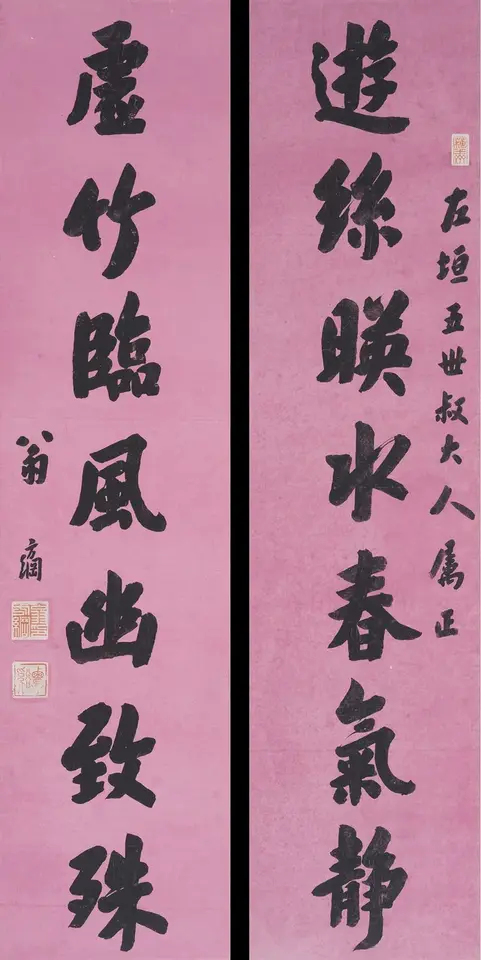
In the history of calligraphy, Weng stands at the head of the Four Great Calligraphers of the Qing Dynasty (Weng-Liu-Liang-Wang). His calligraphic philosophy insisted that "every single brushstroke must have an authentic historical source." Beginning with Yan Zhenqing, he specialized in Ouyang Xun's Huadu Temple Stele, while his clerical script traced directly to Eastern Han monuments.
His regular script was dense, restrained, and upright; his running script synthesized Su Shi and Mi Fu with dignified gravitas. Bao Shichen recorded in Yizhou Shuangji that Beijing connoisseurs held Liu Yong and Weng Fanggang in highest esteem. As a connoisseur of ancient rubbings, Weng spent thirty-two years studying the Song Luoshui Lanting rubbing of Wang Xizhi's preface, adding thirty colophons totaling over 6,500 characters. His assembly of Su Shi's calligraphy at Bao Su Zhai created a legendary chapter in Chinese art history.
FIGURES ASSOCIATED WITH THIS DYNASTY