Birth in Caoxiang
Born into an official scholarly family in Changzhou, Suzhou, quiet and reserved throughout childhood.
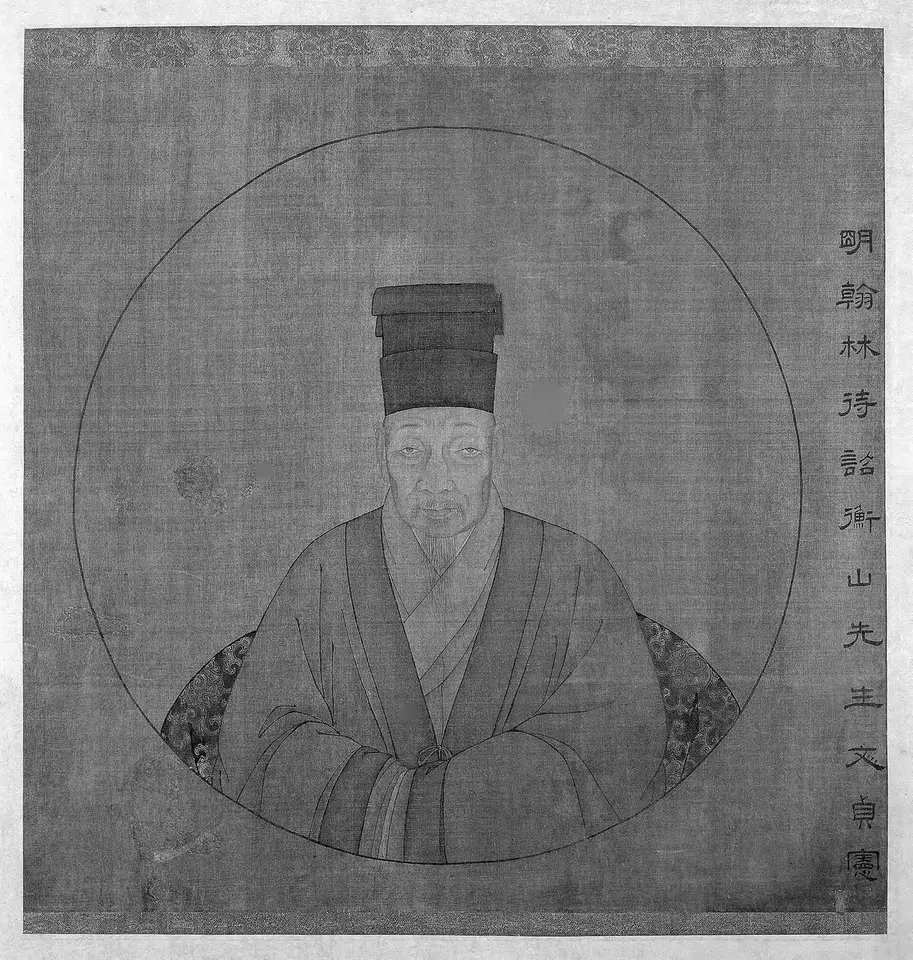
文徵明
Wen Zhengming (1470–1559), originally named Bi, courtesy name Zhengming (later Zhengzhong), art names Hengshan Jushi and Tingyun Sheng, was a native of Changzhou, Suzhou Prefecture, South Zhili (modern Suzhou, Jiangsu). He was an undisputed grand master of Chinese art, the towering leader of the Wu School of painting, and one of the immortal "Four Talents of Wuzhong." Wen Zhengming developed slowly in early childhood, not…
Wen Zhengming (1470–1559), originally named Bi, courtesy name Zhengming (later Zhengzhong), art names Hengshan Jushi and Tingyun Sheng, was a native of Changzhou, Suzhou Prefecture, South Zhili (modern Suzhou, Jiangsu). He was an undisputed grand master of Chinese art, the towering leader of the Wu School of painting, and one of the immortal "Four Talents of Wuzhong." Wen Zhengming developed slowly in early childhood, not speaking clearly until the age of eight. His father, Wen Lin, recognized his composed and earnest nature, firmly believing he would achieve greatness later in life. During the Hongzhi era, Wen Zhengming studied under multiple masters, learning painting from Shen Zhou, calligraphy from Li Yingzhen, and classical prose from Wu Kuan, achieving consummate synthesis in poetry, calligraphy, painting, and literature. His examination career was marked by severe frustration; he failed the provincial examinations nine consecutive times over three decades. In 1523, at the age of fifty-four, he was recommended to court and appointed Painter-in-Attendance in the Hanlin Academy to compile the Veritable Records of Ming Wuzong. Disillusioned by bitter factional struggles surrounding the Great Ritual Controversy, he persistently requested retirement, obtaining permission in 1526 to return south to Suzhou. There he built the Jade Chime Mountain Studio (Yuqing Shanfang), dedicating his final thirty-three years entirely to artistic creation. His painting developed into complementary "broad" (cu) and "delicate" (xi) modes, epitomizing Jiangnan literati aesthetics; his small standard script was celebrated as the finest of the Ming dynasty. In 1559, while sitting at his desk drafting an epitaph for a disciple, he passed away peacefully with brush in hand at the age of ninety, commemorated by disciples with the posthumous private title "Master Zhenxian."
Born into an official scholarly family in Changzhou, Suzhou, quiet and reserved throughout childhood.
Entered the studio of Wu School founder Shen Zhou, studying Song and Yuan landscape compositions and brush techniques.
Studied brush methods under Li Yingzhen, Vice Minister of the Court of the Imperial Stud, absorbing independent stylistic principles.
Studied classical prose under Wu Kuan; sat for the provincial civil examination in Nanjing for the first time without passing.
Exchanged poems and paintings with Zhu Yunming, Tang Yin, and Xu Zhenqing, acclaimed together as the Four Talents of Wuzhong.
Recommended by Minister of Works Li Chongsi to the capital and appointed Painter-in-Attendance in the Hanlin Academy to compile imperial records.
Weary of court intrigues in the Great Ritual Controversy, submitted three memorials requesting retirement and was granted official leave.
Constructed the Jade Chime Mountain Studio in Suzhou, succeeding Shen Zhou as the supreme patriarch of the Wu School of Painting.
Passed away peacefully at his studio desk while brushing an epitaph inscription at age ninety.
Wen Zhengming was born in 1470 in Caoxiang near Deqing Bridge, Changzhou, Suzhou. His father, Wen Lin, served as Magistrate of Wenzhou, renowned for upright integrity. Wen Zhengming's physical development was noticeably slow; even at age eight, he could barely utter coherent sentences, leading neighbors to suspect intellectual impairment. His father Wen Lin, however, recognized his solemn deportment and profound focus, reassuring relatives that he was destined to be a late-blooming prodigy. In 1480, at age eleven, Wen Zhengming's speech matured, and he entered school, demonstrating astonishing diligence and recall.
During his youth, guided by his father's vast network, Wen Zhengming sought instruction from the greatest masters of the age. In 1489, at twenty, he entered the studio of Shen Zhou, the founding master of the Wu School of Painting. Shen Zhou deeply cherished his modesty and painstaking discipline, imparting his entire stylistic knowledge. In 1491, he studied calligraphy under Li Yingzhen, Vice Minister of the Court of the Imperial Stud in Nanjing, who urged him never to mimic ancient masters blindly but to forge an authentic individual voice. In 1495, he studied classical Confucian prose under the eminent scholar-statesman Wu Kuan. Benefiting from the guidance of these three intellectual luminaries, Wen Zhengming's literary, calligraphic, and pictorial talents reached exquisite refinement.
During this period, Wen Zhengming formed intimate artistic bonds with Tang Yin, Zhu Yunming, and Xu Zhenqing, composing verses and harmonizing scrolls in what contemporary literati hailed as the "Four Talents of Wuzhong." Yet unlike Tang Yin, who achieved first place (jieyuan) in the provincial examination at age twenty-nine, Wen Zhengming detested the rigid stereotyping of eight-legged examination prose. From his first attempt at age twenty-six, he sat for the provincial civil service examination in Yingtian Prefecture nine consecutive times over three decades, failing on every occasion.
In the early Jiajing reign, Li Chongsi, Grand Coordinator of Jiangnan and Minister of Works, inspected Suzhou and lamented that a cultural giant of Wen Zhengming's caliber remained stranded in common obscurity. He submitted a memorial to Emperor Shizong urging his direct recruitment into imperial service. In 1523, at the mature age of fifty-four, Wen Zhengming arrived in Beijing. Following Ministry of Personnel evaluations, Emperor Shizong issued an imperial rescript appointing him Painter-in-Attendance in the Hanlin Academy, assigning him to compile the Veritable Records of Ming Wuzong.
While in the capital, Wen Zhengming found himself engulfed by the fierce political tempests of the Great Ritual Controversy, witnessing bitter purges and factional rivalry between Grand Secretaries Yang Tinghe, Zhang Cong, and their rivals. Within the Hanlin Academy, many career bureaucrats who had earned their degrees through regular civil service examinations sneered at Wen Zhengming's appointment through recommendation, subjecting him to petty ostracism. Gentle, modest, and upright by nature, Wen Zhengming abhorred sycophancy and palace factionalism. He submitted three successive memorials pleading for retirement due to age, which Emperor Shizong finally granted in the winter of 1526.
In the spring of 1527, Wen Zhengming set sail southward, returning permanently to his ancestral Suzhou. He constructed the Jade Chime Mountain Studio (Yuqing Shanfang), establishing it as a private sanctuary for moral cultivation, poetic composition, and painting. Renouncing all worldly ambitions, he immersed himself in Jiangnan gardens and streams for over three decades. Following the passing of Shen Zhou, Wen Zhengming naturally ascended to the leadership of the Wu School of Painting, becoming the cultural arbiter of the Ming realm.
In his final decades, Wen Zhengming enjoyed monumental fame. Jiangnan literati and visiting grandees queued outside his gate daily for scrolls. He strictly observed three moral prohibitions: he steadfastly refused to paint for imperial princes, palace eunuchs, or foreign emissaries, while graciously fulfilling requests from poor scholars and humble townsfolk without charging hefty fees.
On the twentieth day of the second lunar month in 1559, ninety-year-old Wen Zhengming sat at his desk in Jade Chime Mountain Studio brushing an epitaph commemorating the mother of Censor Yan Jie. Halfway through the text, with serene countenance, he laid down his brush and passed away effortlessly into immortality. In reverence for his lifelong integrity and artistic mastery, disciples and Jiangnan scholars bestowed upon him the posthumous private title "Master Zhenxian."
Following Shen Zhou, Wen Zhengming propelled the Wu School of Painting to its golden half-century zenith. In landscape painting, he established two complementary aesthetic models: the "delicate Wen" (xi Wen) and "broad Wen" (cu Wen).
His delicate style drew upon Zhao Mengfu, Wang Meng, and Ni Zan, featuring dense, layered mountain ridges, intricate compositional webbing, and shimmering, translucent mineral washes. Masterpieces in this mode include True Appreciation Studio, Piled Ravines Competing in Verdure, Tea Gathering at Mount Hui, and The Humble Administrator's Garden. His broad style drew on Shen Zhou and Wu Zhen, blending Zhao Mengfu's calligraphic branch strokes with robust, textured brushwork, dry rubbing, and flying white, manifesting monumental archaic power within apparent simplicity. Alternating seamlessly between ink monochrome and blue-and-green mineral color, he firmly established the refined, poetic elegance of Jiangnan literati painting as China's aesthetic benchmark.
Wen Zhengming's calligraphic accomplishments stood unrivaled throughout the Ming dynasty. Highly proficient across regular, cursive, clerical, and seal scripts, he reached his absolute pinnacle in small standard script (xiaokai), unanimously lauded by subsequent generations as the finest standard script of the dynasty.
His small standard script traced back to the classical discipline of Zhong Yao and Wang Xizhi, featuring impeccably balanced bone and flesh, serene structural architecture, and graceful elegance. Even into his late eighties and nineties, he could brush minute fly-head characters without the slightest hand tremor or diminishing stroke vigor. His running script merged the crisp grace of Wang Xizhi's Preface to the Sacred Teachings with the sweeping dynamic thrust of Huang Tingjian. Ming literary titan Wang Shizhen praised his small regular script as "paramount in the Ming dynasty," remarking that "his technique was so exquisitely perfected that not a single speck of mundane dust remained."
Beyond his visual masterpieces, Wen Zhengming was an accomplished classical essayist and poet. His collected writings were compiled as the Futian Collection (Tingyunguan Collection), celebrated for pure, moderate classical elegance reflecting Confucian benevolence.
Wen Zhengming actively mentored the next generation of southern literati. His elder son Wen Peng and second son Wen Jia inherited his artistic lineage, while illustrious disciples including Chen Chun, Lu Zhi, Qian Gu, and Zhou Tianqiu became celebrated masters in their own right, enabling the Wu style to flourish across China for over a century. Later, when the monumental late-Ming master Dong Qichang began his artistic journey, he took Wen Zhengming as his paramount lifelong aesthetic benchmark.
History of Ming (Ming Shi, Volume 287, Biographies of Literary Figures) records: "Wen Zhengming was a native of Changzhou. In childhood he was not quick-witted, but as he grew up, his talents became extraordinary and lofty. He excelled in poetry, prose, calligraphy, and painting. Late in the Zhengde reign, Grand Coordinator Li Chongsi recommended him, summoning him to serve as Hanlin Painter-in-Attendance. He memorialized requesting retirement, which Shizong granted. His family was originally modest, and he refused to accept irregular gains... Among his four arts, his calligraphy and painting were supreme. In landscapes he studied under Shen Zhou in his early years, capturing his likeness, and in later years developed an independent style. The empire revered his renown, and callers seeking his scrolls came daily without pause."
Ming master Dong Qichang remarked in Essays from the Painting Chan Studio (Huachanshi Suibi): "Master Wen's calligraphy and painting possess robust bone structure and elegant purity, ranking foremost in the Ming dynasty. His delicate landscapes rival those of Zhao Mengfu and Wang Meng in moist lucidity and vast depth; as patriarch of the Wu School, he stands solitary and unmatched."
FIGURES ASSOCIATED WITH THIS DYNASTY