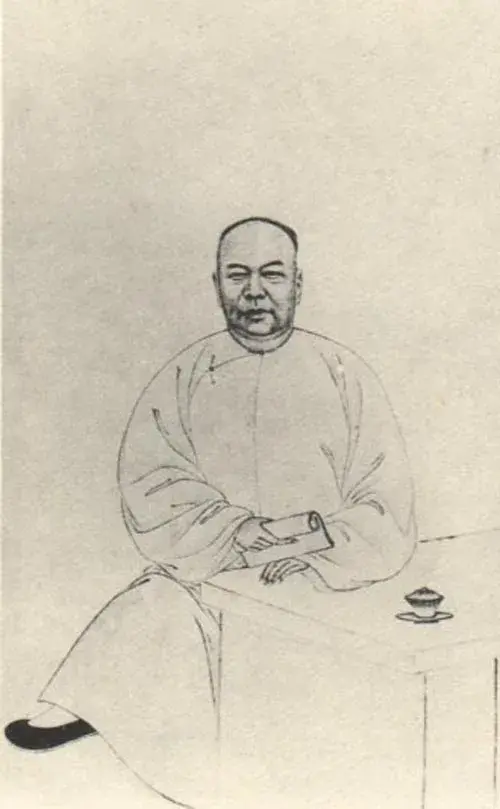
Biography
Youthful Tutelage and Academic Laurels
Wen Tingshi was born on January 21, 1856, in Chaozhou, Guangdong, where his father, Wen Xingrui, was serving as a sub-prefectural magistrate. Immersed in an intellectual environment from early boyhood, Wen exhibited extraordinary photographic memory, mastering classical commentaries and dynastic histories with ease.
In 1872, seventeen-year-old Wen entered the Jupo Academy in Guangzhou to study under Chen Li, the foremost exponent of the Lingnan School of evidential scholarship. Chen synthesized Han philology and Song ethical doctrines with empirical statecraft, training Wen rigorously in epigraphy, historical phonology, and historical geography. In 1882, Wen passed the Shuntian provincial examination, ranking third among regional candidates.
In 1889, participating in the special court examinations at the Hall of Preserving Harmony, his brilliant performance captivated Grand Secretary Weng Tonghe and Vice Minister Wang Mingluan, winning him first place among candidates for Secretariat Scribes. In the 1890 palace examination, the Guangxu Emperor personally elevated Wen to Bangyan (second overall rank), conferring the jinshi degree and appointing him Compiler in the Hanlin Academy.
Leadership in the Imperial Faction and War Opposition
Prior to his metropolitan examination success, Wen had served as a private family tutor in the household of Vice Minister Changxu, instructing his daughters. In 1888, two of these daughters entered the Forbidden City, becoming Consort Zhen and Consort Jin. This shared intellectual pedigree forged an enduring bond of mutual trust between Wen and the young Guangxu Emperor.
In the spring of 1894, during the grand examination of Hanlin academicians, Emperor Guangxu personally ranked Wen first in the empire, promoting him to Reader of the Hanlin Academy, Diarist of Imperial Activities, and Acting Chief Minister of the Court of Judicature and Revision. Revered alongside Wang Mingluan and Zhang Jian as the foremost disciples of Weng Tonghe, Wen stood as the intellectual architect of the imperial reformist faction.
When the First Sino-Japanese War erupted in mid-1894, Wen vehemently opposed the appeasement policies favored by Li Hongzhang. He submitted over twenty consecutive memorials urging unyielding military mobilization, imploring the court to cancel Empress Dowager Cixi's sumptuous diamond jubilee celebrations and divert the millions of silver taels to frontline weaponry. He fiercely denounced Li Hongzhang for cowardice and catastrophic strategic failure. When the humiliating Treaty of Shimonoseki was signed, Wen wept openly in court, rallying fellow officials to block its ratification.
The Strengthening Society and Imperial Ban
Recognizing that fundamental institutional renovation was vital for dynastic survival, Wen collaborated with Chen Chi, Kang Youwei, and Liang Qichao in autumn 1895 to establish the Society for National Strengthening (Qiangxuehui) in Beijing. Leveraging his high court standing, he enlisted influential officials, published reform periodicals, and introduced Western political principles.
However, the rapid growth of the reform society alarmed Empress Dowager Cixi's conservative clique. In February 1896, imperial censor Yang Chongyi, a relative of Li Hongzhang, petitioned Cixi, accusing Wen of clandestine factional ties with Consort Zhen and illicit interference in imperial appointments.
Confronted with Cixi's fury, the Guangxu Emperor was powerless to shield his trusted confidant. An imperial edict immediately stripped Wen of his official titles and banished him from the capital under permanent disqualification from public office. En route south, Wen wrote Qinfeng Yutan and Wenchen Ouji, boldly exposing corruption and treasonous incompetence within the court bureaucracy.
Exile Abroad and Final Scholarly Pursuits
Following the failure of the Hundred Days Reform in 1898 and the execution of the Six Martyrs, Cixi issued orders for Wen's immediate capture. Warned by friends, Wen disguised himself and escaped to Japan.
In Tokyo, Wen investigated the Meiji constitutional order, forging connections with Japanese statesmen Okuma Shigenobu and Inukai Tsuyoshi while studying modern political systems. In the summer of 1900, as the Eight Nations Alliance entered Beijing, Wen returned clandestinely to Shanghai, collaborating with Yung Wing, Yan Fu, and Zhang Taiyan in convening Tang Caichang's Chinese Parliament to unify reformist forces.
When Tang's military insurrection in Hankou collapsed, the Qing court renewed warrants for Wen's arrest. Forced to live under aliases between Pingxiang, Changsha, Nanjing, and Shanghai, he endured poverty and failing health. Confining himself to his Pingxiang library, he spent his remaining years compiling the forty-volume intellectual compendium Chunchangzi Zhiyu.
On August 24, 1904, consumed by grief over China's ongoing tribulations, Wen passed away at his home in Pingxiang at the age of forty-nine.
Major Achievements
Pioneering Reform Thought and Civil Advocacy
Wen was among the highest-ranking and most courageous official sponsors of late Qing institutional reform. In the wake of the catastrophic defeat of 1894, he broke through traditional Confucian conservatism to embrace constitutional modernization.
By founding the Society for National Strengthening, Wen broke the Qing dynasty's two-century-old prohibition against scholar-official political associations. In his treatise Drunken Words of the Luoxiao Mountain Hermit, he coined the famous dictum "Transform to survive; maintain the status quo to perish." He passionately championed constitutional monarchy, educational modernization, railway networks, and legal overhaul, providing a vital bridge between Kang Youwei's early activism and the Hundred Days Reform.
Master of Patriotic Ci Lyricism
Wen was universally acknowledged as one of the preeminent lyric poets of the late Qing era, publishing his verses in Yunkanshuo Cici. Rejecting the superficial, decorative style of the late Zhejiang poetic school, he revitalized the heroic, profound spirit of Su Shi and Xin Qiji while assimilating the allegorical subtleties of the Changzhou School.
His lyric verse reflected the tragic turbulence of the Sino-Japanese War and his subsequent exile. In masterpieces such as Gaoyangtai: Fallen Leaves and Mulanhuaman: Hearing Leaves Falling along the Qinhuai, he intertwined soldierly ardor with heartbreaking dirges for a declining empire. In Cuilouyin, written upon Germany's occupation of Jiaozhou Bay, his passionate outcries established his work as the emotional peak of late imperial patriotic poetry.
Classical Philology and Historical Research
Wen achieved extraordinary standing in historical bibliographic scholarship. An avid collector whose library Zhiguoxuan held tens of thousands of rare volumes, he produced pioneering textual reconstructions.
His six-volume Supplement to the Bibliographical Treatise of the Book of Jin systematically recovered hundreds of lost Six Dynasties titles, remedying a glaring historical void in imperial standard histories. His monumental forty-volume miscellaneous work Chunchangzi Zhiyu spanned astronomy, historical geography, administrative offices, epigraphy, and Buddhist philosophy, earning high praise from 20th-century scholars such as Chen Yinke.