Birth into Eminent Lineage
Born into the prestigious Xiaoyao branch of the Jingzhao Wei clan, son of Sui Minister Wei Chong.
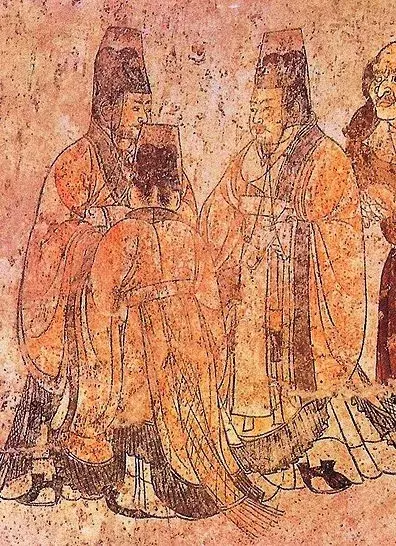
韦挺
Wei Ting (韦挺) (589–646) was a prominent high-ranking minister and strategic administrator during the founding and early Zhenguan eras of the Tang Dynasty, originating from Wannian in Yongzhou (present-day Xi'an, Shaanxi Province), belonging to the noble Xiaoyao branch of the aristocratic Jingzhao Wei clan. He was the son of Sui Minister of Revenue Wei Chong and the father of Tang Chancellor Wei Daijia. Possessing broad…
Wei Ting (韦挺) (589–646) was a prominent high-ranking minister and strategic administrator during the founding and early Zhenguan eras of the Tang Dynasty, originating from Wannian in Yongzhou (present-day Xi'an, Shaanxi Province), belonging to the noble Xiaoyao branch of the aristocratic Jingzhao Wei clan. He was the son of Sui Minister of Revenue Wei Chong and the father of Tang Chancellor Wei Daijia. Possessing broad erudition in canonical histories and administrative statecraft, Wei was an intimate friend of Li Jiancheng (Emperor Gaozu's eldest son) in his youth. Following the establishment of the Tang, he served as Libationer in the Prince of Longxi's headquarters and subsequently commander of the Eastern Palace guards, enjoying the heir apparent's supreme confidence. In 624, amidst the political fallout of the Yang Wengan Incident, Emperor Gaozu blamed the palace counselors and banished Wei Ting alongside Wang Gui and Du Yan to remote Yuexi. Following the Xuanwu Gate Incident, Emperor Taizong magnanimously recalled Wei Ting to the central government. During the Zhenguan era, recommended by Wang Gui, Wei served as Right Vice Director of the Department of State Affairs, Vice Minister of Personnel, and Vice Director of the Chancellery, before being personally selected by Taizong as Censor-in-Chief and created Baron of Fuyang. Wei actively promoted social ethics, proposing reforms to curb exorbitant marriage negotiations among old aristocratic clans and co-compiling the monumental imperial genealogical register Records of Clans (Shizu Zhi). In 645, during Taizong's expedition against Goguryeo, Wei was tasked with directing military logistics; when waterborne grain shipments were delayed by severe river freezes, he was stripped of rank and exiled to Xiangzhou, where he died in grief in 646 at age fifty-eight. Taizong later expressed profound remorse and posthumously restored him as Prefect of Runzhou.
Born into the prestigious Xiaoyao branch of the Jingzhao Wei clan, son of Sui Minister Wei Chong.
Joined Li Jiancheng's princely staff as Libationer after Li Yuan captured Chang'an.
Appointed Heir Apparent's Guard Commander and trusted military counselor to Crown Prince Li Jiancheng.
Blamed by Emperor Gaozu for factional discord following the Yang Wengan Incident and exiled to Yuexi.
Recalled to the capital by Li Shimin following the Xuanwu Gate Incident and appointed Bureau Director.
Promoted to Right Vice Director of the Department of State Affairs upon Wang Gui's recommendation.
Selected personally by Emperor Taizong as Censor-in-Chief and ennobled as Baron of Fuyang.
Co-directed the compilation of the imperial genealogical canon Shizu Zhi alongside Gao Shilian.
Appointed Silver-Blue Grand Master of Radiance and concurrent supervisor of Prince of Wei Li Tai's household.
Supervised military supply routes for the Goguryeo expedition, demoted after winter ice blocked transport.
Defended Gaimou City before dying in exile at age fifty-eight; posthumously honored as Prefect of Runzhou.
Wei Ting descended from the illustrious Xiaoyao branch of the Jingzhao Wei clan, one of the foremost aristocratic families of medieval China whose ancestors had held ministerial offices since the Western Han dynasty. His father Wei Chong had served as Minister of Revenue and Right Vice Director of the Department of State Affairs under Sui Emperor Wen, receiving the title of Duke of Fuyang. Inheriting rigorous family traditions, Wei Ting was composed, dignified, and intellectually acute, dedicating himself to practical administrative governance, military strategy, and statecraft rather than frivolous poetic exercises.
During the final chaotic years of the Sui dynasty, Li Yuan, the Military Commissioner of Taiyuan, marched south from Jinyang and occupied Chang'an, establishing the Grand Chancellor's office. In his youth, Wei Ting had developed an intimate personal friendship with Li Yuan's eldest son, Li Jiancheng. When Li Jiancheng was enfeoffed as Prince of Longxi, Wei Ting was appointed Libationer in his princely headquarters, assisting in military planning. Following the formal founding of the Tang dynasty in 618, Li Jiancheng was installed as Crown Prince, and Wei Ting was elevated to Senior Guard Commander of the Eastern Palace, overseeing the heir apparent's personal guards. Among all palace attendants, Li Jiancheng trusted Wei Ting above all others, relying heavily upon his strategic counsel.
During the unification wars, Li Shimin, Prince of Qin, accumulated overwhelming military prestige through successive battlefield victories, creating intense factional rivalry with Crown Prince Li Jiancheng. In the summer of 624, Emperor Gaozu traveled to Renzhi Palace to escape the summer heat, leaving Crown Prince Li Jiancheng to oversee the capital. Li Jiancheng dispatched recruits to Chang'an under Qingzhou Military Commissioner Yang Wengan while secretly sending armor to Qingzhou. When officers Erzhu Huan and Qiao Gongshan exposed the plot, the explosive Yang Wengan Incident erupted.
Fearing imminent civil war, Emperor Gaozu executed Yang Wengan and resolved to defuse the dynastic crisis by punishing the counselors of both princely households. In the sixth month of 624, Gaozu issued an edict accusing palace retainers of fomenting discord between his sons, stripping Eastern Palace officials Wang Gui and Wei Ting along with Qin headquarters officer Du Yan of their ranks and exiling them to remote Yuexi in the southwestern highlands (modern Xichang, Sichuan). Enduring the harsh climate and tropical diseases of the frontier, Wei Ting remained steadfast, studying canonical texts alongside Wang Gui and cultivating his character amidst adversity.
In the sixth month of 626, Li Shimin executed the Xuanwu Gate Incident and took control of the imperial throne. Demonstrating extraordinary political magnanimity, Li Shimin decided to pardon and integrate former officials of the Eastern Palace. An imperial decree was issued recalling Wei Ting and Wang Gui from Yuexi. Emperor Taizong granted Wei Ting a personal audience, praising his steadfast loyalty and executive competence, promptly appointing him Bureau Director of Imperial Aristocracy (Zhujue Langzhong).
In 627, following Wang Gui's warm recommendation, Taizong promoted Wei Ting to Right Vice Director of the Department of State Affairs (Shangshu Youcheng). The office was tasked with auditing administrative documents across the ministries and coordinating bureaucratic functions. Wei handled administrative business with fairness and decisiveness, curbing bureaucratic irregularities. Soon afterward, he was transferred to Vice Minister of Personnel and then Vice Director of the Chancellery (Huangmen Shilang).
In 631, when the prestigious post of Censor-in-Chief (Yushi Dafu) became vacant, Emperor Taizong disregarded objections from courtiers who cited Wei's past service to Li Jiancheng and personally promoted Wei Ting to head the Censorate, ennobling him as Baron of Fuyang. Taizong summoned him privately, remarking: "My appointing you as Censor-in-Chief was purely my own decision; none of those around me spoke in your favor!" Deeply moved by this imperial trust, Wei enforced strict discipline throughout the Censorate, fearlessly impeaching corrupt officials and elevating administrative standards during the Zhenguan reign.
During his ministerial tenure, Wei Ting devoted substantial attention to reforming social customs. Addressing the breakdown of Confucian family ethics that had persisted since the late Sui chaos, he presented his famous memorial Memorial on Marriage Customs, sharply criticizing the superstitious aristocratic taboo against weeping on certain calendrical days (chenri bu ku) and condemning the mercenary marriage market where old northeastern clans demanded exorbitant bride prices based purely on pedigree. In 636, under Taizong's orders, Wei Ting joined Gao Shilian, Linghu Defen, and Cen Wenben in directing the compilation of the imperial genealogical encyclopedia Records of Clans (Shizu Zhi) in one hundred fascicles, establishing official service and moral achievement as the primary criteria of social standing.
Subsequently, Wei Ting was appointed Silver-Blue Grand Master of Radiance and assigned to oversee the household of Prince of Wei Li Tai. Because Li Tai was favored by Taizong while Crown Prince Li Chengqian exhibited erratic behavior, intense factional maneuvering developed between their retinues. Wei Ting guided Li Tai in patronizing scholars to compile the great geographical work Kuodi Zhi, but was ultimately dragged into palace political crosscurrents. When Secretariat Drafter Du Zhenglun was demoted for leaking palace confidences, Wei was implicated and reassigned to Chief Minister of the Court of Imperial Sacrifices.
Wei Ting possessed a proud and unyielding personality. When he served as Censor-in-Chief, future chancellor Ma Zhou was merely an impoverished, low-ranking investigating censor; proud of his noble lineage, Wei treated Ma Zhou with cold disdain. Years later, Ma Zhou rose to become Director of the Secretariat. When Taizong considered reappointing Wei Ting to the Chancellery, Ma Zhou submitted a confidential memorial arguing that Wei was "arrogant, headstrong, and not of chancellor caliber," prompting Taizong to shelve the promotion.
In 645, Emperor Taizong launched his personal campaign against Goguryeo, facing daunting logistical challenges across thousands of miles of wilderness. Remembering that Wei's father had once served as Regional Commander of Yingzhou and left behind strategic writings regarding Goguryeo, Taizong appointed Wei Ting to direct the military grain transport. Arriving in Youzhou, Wei organized shipping fleets along the Sanggan River. However, sudden winter blizzards and unseasonable drought caused the river to freeze, stranding the transport barges. Furious that grain was delayed to frontline troops, Taizong stripped Wei of his rank, demoted him to commoner status, and ordered him to garrison the forward stronghold of Gaimou City.
Gaimou City stood dangerously close to the Goguryeo stronghold of Xincheng, exposed to relentless day-and-night counterattacks by enemy forces. Cut off from the main army amidst continuous bombardment and demoralized by his sudden disgrace, Wei suffered severe physical and psychological strain. Following the imperial army's retreat, he was banished to remote Xiangzhou (in modern Guangxi). In 646, overwhelmed by sorrow and indignation, Wei Ting fell critically ill and died in exile at the age of fifty-eight. Upon learning the full circumstances, Emperor Taizong felt profound regret for his harshness, issuing an edict posthumously clearing Wei Ting's name and honoring him as Prefect of Runzhou.
During the Zhenguan reign, Emperor Taizong was determined to dismantle the hereditary prestige of old northeastern aristocratic lineages (such as the Cui, Lu, Li, and Zheng clans) who looked down upon imperial authority and monopolized social status. In 636, Taizong commanded Gao Shilian, Wei Ting, Linghu Defen, and Cen Wenben to compile the official Records of Clans (Shizu Zhi) in one hundred fascicles.
Belonging to the premier Guanlong aristocracy, Wei Ting brought deep knowledge of genealogical traditions to the project. He championed Taizong's vision of replacing Six Dynasties pedigree worship with a meritocratic standard based upon moral virtue, military accomplishments, and administrative service (lide, ligong, liyan). Under this system, the Tang imperial clan was ranked in the highest tier, meritorious Zhenguan statesmen in the second, and the arrogant northeastern clans relegated to the third. The promulgation of the Records of Clans fundamentally restructured Chinese sociopolitical hierarchies, legitimizing bureaucratic governance over aristocratic oligarchy.
In 631, Emperor Taizong personally promoted Wei Ting to Censor-in-Chief, placing him at the helm of the imperial supervisory apparatus. The Censorate served as the state's central organ for maintaining statutory obedience and combating official corruption.
In office, Wei discharged his duties with fearless independence, refusing to court favor with powerful imperial relatives. He restructured the supervisory inspection system, sending investigating censors across provinces to audit tax revenues, review judicial dockets, and evaluate local magistrates. Under his stern leadership, the Censorate functioned as an incorruptible watchdog, providing vital institutional support for the administrative excellence of the Zhenguan Reign.
Deeply disturbed by the vulgar superstitions that had infected elite society following the fall of the Sui, Wei Ting spearheaded legal reforms to restore genuine Confucian ethics. He targeted the prevalent practice among capital elites who observed the superstitious taboo of chenri bu ku—refraining from mourning on certain calendar days and even throwing banquets in mourning quarters.
In his Memorial on Marriage Customs, Wei passionately argued that filial mourning for parents should spring from heartfelt grief rather than astrology, successfully urging the court to prohibit such practices by imperial statute. Furthermore, he campaigned against the commercialization of noble marriage alliances. His interventions played a crucial role in reestablishing Confucian filial piety and moral sobriety across early Tang society.
In 642, Wei Ting was appointed to supervise the princely administration of Prince of Wei Li Tai. During this tenure, he coordinated the assembly of leading scholars in the prince's literary academy to compile the massive geographic treatise Kuodi Zhi.
Wei managed bureaucratic coordination and secured imperial archival access, ensuring the successful completion of the geographic survey. While guiding Li Tai's scholarly pursuits, Wei sought to keep the ambitious prince within lawful bounds, counseling moderation amidst growing friction with Crown Prince Li Chengqian.
Tasked with orchestrating logistical supply lines for Taizong's 645 Goguryeo expedition, Wei Ting confronted the formidable challenge of moving hundreds of thousands of bushels of grain across the desolate northern frontier.
Relying on his father's strategic papers, Wei mobilized craftsmen in Youzhou to build cargo fleets, opening hundreds of miles of navigable routes along the Sanggan River. Although unprecedented early winter freezes ultimately immobilized the fleet and brought about his unjust downfall, his technical surveys and logistical preparations laid critical infrastructure for subsequent Tang campaigns across the Liaodong peninsula.
FIGURES ASSOCIATED WITH THIS DYNASTY