Born in Utica
Born on September 22 in Utica, New York, studying natural science and printing typography in his youth.
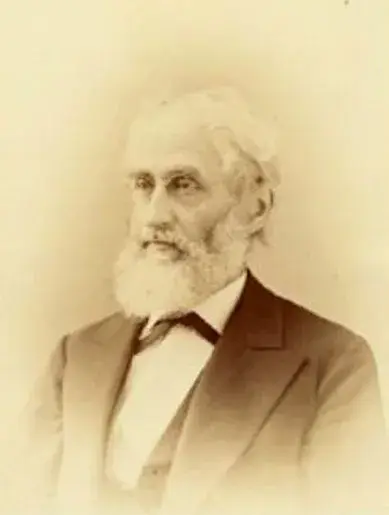
卫三畏
Samuel Wells Williams (卫三畏, September 22, 1812 – February 16, 1884), born in Utica, New York, was a foremost 19th-century American Protestant missionary, diplomat, and the founding father of Sinological scholarship in the United States, as well as its first professional professor of Chinese. Trained early in natural sciences and typography, he was dispatched to Guangzhou in 1833 by the American Board of Commissioners for…
Samuel Wells Williams (卫三畏, September 22, 1812 – February 16, 1884), born in Utica, New York, was a foremost 19th-century American Protestant missionary, diplomat, and the founding father of Sinological scholarship in the United States, as well as its first professional professor of Chinese. Trained early in natural sciences and typography, he was dispatched to Guangzhou in 1833 by the American Board of Commissioners for Foreign Missions (ABCFM) to manage the mission press. There he collaborated with Elijah Coleman Bridgman in editing and printing The Chinese Repository, subsequently directing the journal until its conclusion in 1851. During more than four decades in China, Williams systematically mastered classical Chinese, Cantonese, and Japanese, publishing landmark lexicographical and geographical works such as Easy Lessons in Chinese, Chinese Topography, A Tonic Dictionary of the Chinese Language in the Canton Dialect, A Syllable Dictionary of the Chinese Language, and his monumental two-volume study The Middle Kingdom (1848). Concurrently, he played a crucial diplomatic role across East Asia, serving as chief interpreter for Commodore Matthew C. Perry's expedition to Japan in 1853–1854. Appointed Secretary of the United States Legation in China in 1856, he served nine times as Chargé d'Affaires, helped negotiate the 1858 Treaty of Tianjin—securing the historic toleration clause for Christian missions—and in 1874 accompanied the American minister in presenting credentials to the Tongzhi Emperor on terms of diplomatic equality. In 1877, he was appointed the inaugural Professor of Chinese Language and Literature at Yale University and was elected President of the American Oriental Society in 1881.
Born on September 22 in Utica, New York, studying natural science and printing typography in his youth.
Arrived in Guangzhou on October 26 aboard the Morrison, taking charge of the ABCFM press and assisting with The Chinese Repository.
Sailed aboard the Morrison to return shipwrecked Japanese sailors, surveying the Ryukyu Islands and Edo Bay.
Published Chinese Topography and returned to the United States on furlough to lecture and prepare The Middle Kingdom.
Published his two-volume magnum opus in New York; returned to Guangzhou with his wife to oversee the mission press.
Served as chief Chinese-Japanese interpreter on Commodore Perry's "Black Ship" naval expedition to Japan, facilitating the 1854 Treaty of Kanagawa.
Resigned from the ABCFM to become Secretary and Interpreter of the United States Legation in China, publishing the Canton dialect dictionary.
Participated in drafting the Treaty of Tianjin with Minister William B. Reed, securing the religious toleration article.
Published his monumental dictionary in Shanghai; accompanied Minister Avery in presenting imperial credentials on terms of diplomatic equality.
Resigned his diplomatic post due to failing health and returned to the United States after forty-three years in China.
Appointed Yale University's first Professor of Chinese Language and Literature, the first academic chair of Sinology in America.
Died peacefully at his residence in New Haven, Connecticut, on February 16 at the age of seventy-two.
Samuel Wells Williams was born into a devout family in Utica, New York, on September 22, 1812. He studied botany and geology at the Rensselaer Polytechnic Institute before mastering typesetting and printing. In 1832, when the American Board of Commissioners for Foreign Missions decided to establish a press in China, they selected the twenty-year-old Williams as their missionary printer.
Arriving in Guangzhou on October 26, 1833, Williams joined Elijah Coleman Bridgman and Robert Morrison as one of the few Protestant missionaries residing at the Thirteen Factories. Establishing the Bruin Press and managing the movable type inherited from the British East India Company in Macau, Williams supervised the mechanical production and editorial compilation of The Chinese Repository. Over the next two decades, he contributed scores of scholarly articles on Chinese weights and measures, civil administration, trade statistics, natural history, and imperial geography, laying the groundwork for his comprehensive study of Chinese civilization.
In southern China, Williams mastered both bureaucratic Mandarin and the local Cantonese dialect. In 1837, he joined the voyage of the Morrison seeking to repatriate shipwrecked Japanese fishermen, using the mission to observe conditions in the Ryukyu Kingdom and Edo Bay while acquiring an initial working knowledge of Japanese. Between 1842 and 1844, he compiled practical linguistic manuals including Easy Lessons in Chinese and Chinese Topography, which provided Western residents with an alphabetical guide to administrative geography.
Returning to the United States on furlough in late 1844, Williams delivered over a hundred public lectures to dispel romantic and distorted Western stereotypes of China. Supported financially by American merchants in the China trade, he published his two-volume encyclopedic work The Middle Kingdom in New York in 1848. Comprising twenty-three detailed chapters, the work surveyed China's historical dynasties, imperial bureaucracy, Confucian statecraft, popular religion, civil law, arts, sciences, and international intercourse. Accompanied by detailed engravings and maps, The Middle Kingdom was hailed by European and American scholars as the foremost systematic survey of Chinese civilization produced in the nineteenth century, establishing the academic foundation of American Sinology.
In 1848, Williams returned to China with his bride. When the printing press in Guangzhou was destroyed by fire in 1856, he had already established himself as an indispensable linguistic authority. In 1853 and 1854, Commodore Matthew C. Perry recruited Williams as chief interpreter for the historic naval expedition that forced the opening of Japan. Williams conducted official translations and sensitive discussions with Tokugawa shogunate commissioners, directly contributing to the conclusion of the Treaty of Kanagawa in March 1854.
In 1856, Williams formally severed his missionary appointment to enter the United States diplomatic service as Secretary of Legation and Chinese Interpreter. During the Second Opium War, he accompanied Envoy William B. Reed to northern China in 1858 to negotiate the Treaty of Tianjin. Williams personally drafted and insisted upon Article 29 of the American treaty, which granted religious freedom to Christian missionaries and native converts, a clause subsequently mirrored in treaties concluded with Britain, France, and Russia. In 1859, he traveled with Minister John E. Ward to Beijing for the exchange of treaty ratifications.
Moving to Beijing in 1862, Williams served as First Secretary and Counsellor of the United States Legation. Respected for his calm temperament and balanced judgment, he served as acting Chargé d'Affaires on nine distinct occasions during interregnums between resident ministers. In 1874, he accompanied Minister Benjamin P. Avery to the Forbidden City, where Western diplomats presented their credentials to the Tongzhi Emperor without performing the traditional kowtow, marking a symbolic milestone in Qing diplomatic protocol. That same year, Williams published in Shanghai his monumental A Syllable Dictionary of the Chinese Language, indexing 12,500 characters with pronunciations across Mandarin and six major regional dialects.
In 1876, suffering from chronic ophthalmia and fatigue, Williams retired from public life and returned to New Haven, Connecticut. In 1877, through an endowment provided by his colleague William W. Moss and with the enthusiastic endorsement of Yung Wing (Rong Hong), Yale University established the first chair of Chinese Language and Literature in the United States, appointing Williams as its inaugural professor. Donating his extensive personal library of classical Chinese works to Yale, Williams was elected President of the American Oriental Society in 1881. He died at his home in New Haven on February 16, 1884, at the age of seventy-two.
Williams's two-volume masterwork, The Middle Kingdom: A Survey of the Geography, Government, Literature, Social Life, Arts, and History of the Chinese Empire and Its Inhabitants, transformed Western perception of China from a collection of curious missionary anecdotes into an integrated academic discipline. Spanning twenty-six chapters, the work systematically examined China's physical geography, climate, flora and fauna, institutional history, legal codes, religious philosophies, family ethics, civil service examinations, and agriculture. Eschewing the superficial exoticism of earlier European commentators, Williams grounded his analysis in rigorous empirical observation, offering profound respect for Confucian ethical values while objectively analyzing the aggressive nature of British actions in the Opium Wars and the socio-economic roots of the Taiping Rebellion. It became the standard authoritative reference on China across European and American political and academic circles for generations, praised by John King Fairbank as the direct prototype of modern Asian area studies.
Across four decades of linguistic research in China, Williams produced a succession of groundbreaking linguistic tools, notably Easy Lessons in Chinese, An English and Chinese Vocabulary in the Court Dialect, A Tonic Dictionary of the Canton Dialect (1856), and A Syllabic Dictionary of the Chinese Language (1874). The Syllabic Dictionary, arranged by Latin syllables and meticulously cross-referencing Beijing Mandarin, Cantonese, Hakka, Teochew, and Shanghainese pronunciations alongside classical and colloquial registers, was celebrated by contemporary and later Sinologists as the greatest Chinese-English dictionary of the nineteenth century. It resolved acute lexical shortages for Western scholars and diplomats and established foundational methodological paradigms for modern bilingual Chinese lexicography.
As a central architect of early Sino-American diplomatic relations, Williams served nine times as American chargé d'affaires in China. He played a crucial role in drafting the 1858 Treaty of Tianjin, establishing the permanent American legation in Beijing, and resolving the complex diplomatic audience question. In his later years, Williams accepted the newly endowed chair of Chinese Language and Literature at Yale University—the first professorship of Chinese in the United States. He trained the earliest generation of American students in systematic Sinology, donated his extensive personal library to establish the Yale East Asia Collection, and facilitated the institutional transition of Chinese studies from uncoordinated missionary writings into a recognized university academic discipline, earning renown as the "Father of American Sinology."
Between 1853 and 1854, Commodore Matthew C. Perry led two naval expeditions of steam-powered "black ships" to Japan, inviting Williams to serve as chief diplomatic interpreter and core advisor to the American mission. Proficient in East Asian classical written Chinese (bitan) and familiar with regional customs, Williams drafted all diplomatic communications and official treaty texts in Chinese for negotiations at Yokohama. By precisely translating principles of international law, he mitigated deep-seated cultural mistrust and averted potential armed clashes. His diplomatic mediation contributed directly to the successful conclusion of the Treaty of Kanagawa, which opened the ports of Shimoda and Hakodate and brought an end to over two centuries of Tokugawa isolation. His detailed journals and diplomatic records remain among the most valuable primary sources for studying the opening of modern East Asia.
From his arrival in China in 1833 until its cessation in 1851, the twenty volumes of The Chinese Repository were shaped largely by Williams's editorial labor and prolific writing. After Elijah Coleman Bridgman relocated to Shanghai, Williams assumed sole editorial and typographic management of the journal. Rejecting the imperialist and parochial biases prevalent among Western merchants and missionaries, he applied modern empirical methods to investigate Chinese agricultural systems, salt and iron monopolies, judicial proceedings, benevolent societies, and patriarchal lineage structures. His extensive scholarly articles and translations established The Chinese Repository as the most authoritative Sinological journal of the mid-nineteenth century, providing an indispensable foundation for the subsequent establishment of East Asian research institutes across Western universities.
FIGURES ASSOCIATED WITH THIS DYNASTY