Humble Self-Education
Born into an impoverished commoner family in Shanyang, laboring by day and studying astronomy by night.
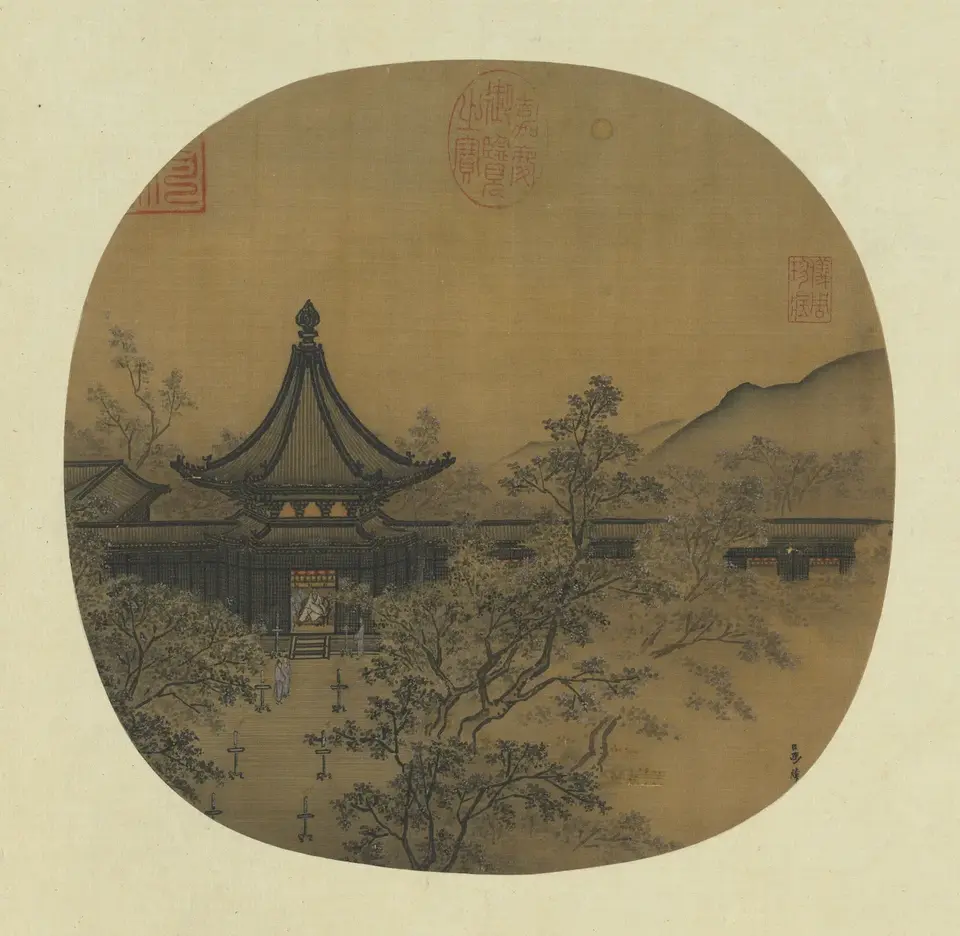
卫朴
Wei Pu (卫朴, dates of birth and death unrecorded, active 11th century during the Northern Song Dynasty) was a native of Shanyang in Chuzhou (present-day Huai'an, Jiangsu Province). He was an extraordinary commoner astronomer, calendrical authority, and blind mathematical prodigy of imperial China. Born into an impoverished family, Wei Pu worked exhausting manual labor by day and studied mathematical and astronomical treatises…
Wei Pu (卫朴, dates of birth and death unrecorded, active 11th century during the Northern Song Dynasty) was a native of Shanyang in Chuzhou (present-day Huai'an, Jiangsu Province). He was an extraordinary commoner astronomer, calendrical authority, and blind mathematical prodigy of imperial China. Born into an impoverished family, Wei Pu worked exhausting manual labor by day and studied mathematical and astronomical treatises by night under dim lamplight, which eventually cost him his eyesight in his thirties. Refusing to succumb to blindness, he developed an astonishing tactile mental arithmetic technique utilizing counting rods, mastering high-order arithmetic progressions to calculate celestial mechanics entirely without vision. During the Xining reign, polymath statesman Shen Kuo took charge of the Directorate of Astronomy (Sitian Jian) and boldly recruited Wei Pu from the Huai River region to oversee the creation of a new national calendar. Undaunted by professional obstruction and technical sabotage from hereditary bureau officials, Wei Pu completed the Fengyuan Calendar (Fengyuan Li) in 1075, which served as the official national standard for eighteen years. His astronomical treatises, including the Detailed Planetary Motions (Qiyao Xihang) and Orthodox Canon of the New Calendar (Xinli Zhengjing), stand as enduring monuments of empirical science and human perseverance.
Born into an impoverished commoner family in Shanyang, laboring by day and studying astronomy by night.
Suffered irreversible ocular damage from reading under dim lamplight, becoming completely blind in his thirties.
Resided at a Daoist shrine outside Huai'an, gaining widespread regional fame for miraculous mental calculations.
Detected a major cumulative error in the official Chongtian Calendar, accurately predicting that the scheduled lunar eclipse on the fifteenth day of the seventh lunar month would not occur.
Shen Kuo assumed directorship of the Directorate of Astronomy and broke bureaucratic convention to recruit Wei Pu to Kaifeng.
Thwarted deliberate interference by hereditary officials who concealed observational data and moved his counting rods.
Completed the new national calendar after three years of intensive computation; Emperor Shenzong officially promulgated the Fengyuan Calendar.
Declined court appointments in Kaifeng and returned to his native Huai River region as a revered independent scholar.
Completed seminal astronomical treatises, including the Orthodox Canon of the New Calendar and Detailed Planetary Motions.
Passed away peacefully in his native home at an advanced age of over seventy; his extraordinary life was recorded in Shen Kuo's Dream Pool Essays.
Wei Pu was born into an impoverished commoner household in Shanyang County, located in the lower reaches of the Huai River basin. From early childhood, he harbored a passionate curiosity regarding celestial mechanics, stellar cycles, and ancient numerical calculations. Whenever he managed to borrow mathematical texts or astronomical manuscripts from local private collections, he would pour all his mental energy into deciphering their algorithmic tables.
Because his family lived in severe poverty, young Wei Pu was compelled to perform heavy agricultural labor throughout the day to earn sustenance for his household. It was only late at night, when physical chores had ended, that he could unfold his treatises under the dim, flickering flame of an oil lamp. Year after year of reading minute tables under inadequate illumination inflicted catastrophic strain upon his optic nerves. By the time he reached his mid-thirties, his eyesight deteriorated irrevocably, plunging him into total and permanent physical darkness.
To an aspiring scientist whose life work depended on observing celestial bodies and writing numerical tables, total blindness was an overwhelming tragedy. Yet Wei Pu refused to surrender to despair. Instead, he channeled all his inner faculties into cultivating auditory perception, mental memory, and spatial tactile deduction. Through extraordinary perseverance over several years, he attained a photographic auditory memory, retaining every classical text and astronomical formula recited to him without dropping a single syllable. He mastered rapid mental arithmetic, executing complex multiplication, division, and square root extractions purely within his mind.
Unable to engage in manual farming following the loss of his sight, Wei Pu supported himself through calendrical calculation and divination, taking up residence within a modest Daoist shrine at Beichen Town outside the northern gate of Huai'an. Local residents and traveling merchants sought his counsel on the agricultural calendar and personal affairs, astounded by the speed and precision of his mathematical judgments.
At his simple worktable in Beichen Town, Wei Pu laid out hundreds of counting rods to perform intricate orbital calculations. Although entirely devoid of physical vision, his tactile sensitivity was astonishingly acute. By merely running his palms lightly across the surface of the desk, he could grasp the exact layout and spatial values of an entire array of calculating rods. When skeptical observers secretly removed a single bamboo rod from the tabletop to test him, Wei Pu immediately recognized the discrepancy upon brushing the surface with his hand, pointing out precisely which decimal rank had been disturbed while reciting complex algebraic steps aloud.
At that time, the official astronomical standard of the Northern Song Dynasty was the Chongtian Calendar, promulgated during the reign of Emperor Renzong. In 1068, court astrologers of the Directorate of Astronomy announced to the throne that a prominent lunar eclipse would take place on the fifteenth day of the seventh lunar month. Conducting independent calculations at Huai'an, Wei Pu detected significant cumulative drift in the canonical tables, concluding that no lunar eclipse could possibly occur on that date. He dispatched a detailed letter to the Directorate of Astronomy in Kaifeng. On the night of the scheduled eclipse, the skies remained completely clear with the full moon shining brightly, perfectly validating Wei Pu's forecast and establishing his scientific renown.
Polymath scientist and statesman Shen Kuo had passed the imperial examinations during the Jiayou era, serving as Magistrate of Shuyang before being commissioned by the court to inspect agricultural hydraulic projects and local tax burdens throughout the Jiangnan and Huai regions. During his travels in Chuzhou, Shen Kuo heard of the remarkable blind mathematician Wei Pu and paid a personal visit to his humble shrine, becoming thoroughly impressed by Wei Pu's brilliant mathematical insight and mastery of calendrical mechanics.
In 1072, during the height of Wang Anshi's New Policies institutional reforms, Emperor Shenzong appointed Shen Kuo to direct the Directorate of Astronomy (Sitian Jian), tasking him with reforming the empire's decaying astronomical apparatus and constructing a new national calendar. Shen Kuo recognized that the existing personnel within the astronomical bureau were hereditary bureaucrats who lacked real mathematical competence and routinely miscalculated celestial phenomena. Resolutely brushing aside aristocratic resistance, Shen Kuo submitted an imperial memorial recommending that the blind commoner Wei Pu be summoned to the capital to direct the mathematical computations for the new national calendar.
This unprecedented appointment provoked immediate indignation among entrenched officials within the Directorate of Astronomy. Accustomed to hereditary privilege, these aristocratic functionaries viewed a ragged, blind commoner from the rural south with intense disdain and envy, actively conspiring to sabotage his work in hopes of orchestrating his disgrace.
Throughout the calendar project, hereditary officials deliberately concealed centuries of celestial observation charts and locked away historical shadow-measuring records, refusing to provide Wei Pu with baseline empirical data. Furthermore, while Wei Pu was engaged in calculating rod permutations, corrupt clerks covertly moved rods across his table to disrupt his computational equations. Yet Wei Pu remained completely unperturbed. With a swift touch of his hands, he instantly identified any displaced rods, restored them to their accurate numerical positions, and shamed his detractors with flawless mental deductions.
Faced with this hostile environment, Shen Kuo provided unwavering institutional and empirical support. Shen Kuo personally supervised the casting of innovative astronomical armillary spheres and gnomons, leading a small cadre of dedicated technicians atop the observatory platform to track planetary paths and lunar motions through exhaustive nightly watches. Shen Kuo delivered these precise, freshly measured empirical records directly to Wei Pu.
Equipped with verified data and employing his innovative numerical methods, Wei Pu worked tirelessly day and night. Over three years of unrelenting computational labor, he overcame immense physical hardship and technical obstacles. In the intercalary fourth month of 1075, the monumental task was completed. Emperor Shenzong examined the new tables with great admiration, officially naming the compilation the Fengyuan Calendar (Fengyuan Li) and decreeing its nationwide enforcement. The Fengyuan Calendar remained in continuous use for eighteen years, representing the pinnacle of Northern Song calendrical science.
Following the nationwide adoption of the Fengyuan Calendar, Emperor Shenzong and the imperial chancellery expressed high appreciation for Wei Pu's extraordinary contributions, offering him permanent bureaucratic rank within the Directorate of Astronomy. However, Wei Pu possessed an unworldly temperament, completely indifferent to political honors and metropolitan prestige. In the winter of that year, as his mentor Shen Kuo departed on a diplomatic mission to the Liao Empire, Wei Pu submitted his resignation, choosing to return to the quiet life of a southern commoner.
Returning to his native Huai River region, Wei Pu spent his later years in serene intellectual contemplation. He continued to reflect upon the mathematical order of the cosmos, dictating his lifelong theoretical discoveries to disciples and compiling several specialized treatises on planetary motions and computational tables, which were preserved in imperial bibliographies.
According to the Song Dynasty scholarly record Mingdao Zazhi and local gazetteers, Wei Pu enjoyed remarkable vitality and lived beyond the age of seventy, passing away peacefully in his native land. Generations of Huai'an residents celebrated him alongside local hermits Shuiqiu Xiucai and Sun Maiyuzhe as one of the legendary masters of the region. Through the enduring pages of Shen Kuo's Dream Pool Essays, Wei Pu's mathematical genius and triumph over adversity remain immortalized in the history of world science.
Wei Pu's crowning historical contribution was serving as chief mathematical architect for the compilation of the Northern Song Fengyuan Calendar. The Fengyuan Calendar introduced revolutionary algorithmic improvements that fundamentally modernized Chinese timekeeping.
Within the Fengyuan Calendar, Wei Pu systematically integrated advanced formulations for synodic and nodical lunar months, vastly elevating the predictive precision of solar and lunar eclipse schedules. He accurately measured the non-uniform velocities of the sun and moon, successfully incorporating anomalies of solar and lunar visual motion into a unified higher-order polynomial interpolation framework.
Promulgated in 1075 during the Xining reign, the Fengyuan Calendar governed civil and ritual timekeeping throughout the empire until 1092 during the Yuanyou reign of Emperor Zhezong. Over its eighteen years of national implementation, its predictions regarding solstitial shadow lengths, daily dusk and dawn divisions, and planetary coordinates matched actual sky observations with unprecedented fidelity.
As one of the rarest blind mathematical prodigies in world history, Wei Pu developed a unique methodology of tactile calculation. Deprived of eyesight, he merged traditional counting-rod procedures with acute tactile-spatial memory, creating an intuitive positioning system executed through touch.
Modern historians of science have demonstrated that without the aid of writing implements, Wei Pu successfully solved problems equivalent to the summation of second-order arithmetic progressions. In addressing the daily non-uniform motions of celestial bodies, he shifted counting-rod intervals to execute finite difference interpolation methods that anticipated key aspects of modern numerical analysis.
Shen Kuo recorded in the Dream Pool Essays: "His table was covered with calculating rods; when he lightly stroked them with his hands, if anyone stole a single rod, he would immediately detect it upon touching them again. He recited multiplications and divisions without the slightest error, with precision beyond description." This seamless synthesis of abstract mathematical reasoning and sensory mastery represents an extraordinary chapter in the history of science.
Wei Pu demonstrated unmatched mastery in the computation of solar and lunar eclipses. In traditional Chinese calendrical science, the ability to retroactively verify the thirty-six solar eclipses recorded in the ancient Confucian classic Spring and Autumn Annals served as the supreme benchmark for validating any mathematical system.
Over the centuries, despite exhaustive revisions by prominent Han and Tang astronomers, none had succeeded in reconciling all thirty-six events. Even the celebrated Tang Dynasty master Monk Yixing, compiler of the famed Dayan Calendar, could only reconcile twenty-nine of the thirty-six recorded eclipses, leaving seven unexplained.
While formulating the Fengyuan Calendar, Wei Pu applied his innovative formulas to re-evaluate the entire pre-Qin dataset, successfully reconciling thirty-five of the thirty-six eclipses. Furthermore, regarding the single irreconcilable eclipse, Wei Pu examined celestial cycles and declared that it was not a calculation error of his system, but an errant scribal omission committed by ancient Zhou Dynasty chroniclers. This daring deduction proved his peerless mastery of ancient chronological and astronomical records.
Beyond practical computations, Wei Pu synthesized his lifelong mathematical theories into systematic treatises that enriched the corpus of traditional Chinese science.
According to the official bibliographical treatises in the History of Song, Wei Pu authored an extensive corpus of astronomical works comprising twenty-six fascicles, including the Detailed Planetary Motions (Qiyao Xihang) in one fascicle, Orthodox Canon of the New Calendar (Xinli Zhengjing) in three fascicles, Outline of Principles (Yilüe) in two fascicles, Instant Ready Tables (Licheng) in fifteen fascicles, and Draft Commentary Accompanying the Canon (Suijing Beicao) in five fascicles.
Among these works, the Detailed Planetary Motions detailed precise algorithmic formulas for tracking the orbits of the Sun, Moon, and the five major planets; the Orthodox Canon of the New Calendar expounded the fundamental theoretical architecture of the Fengyuan Calendar; while the Instant Ready Tables provided indispensable mathematical lookup tables that streamlined astronomical calculations for regional officials. These seminal texts provided the foundation for subsequent Song Dynasty astronomers and served as a vital precursor to Guo Shoujing's famed Yuan Dynasty Shoushi Calendar.
FIGURES ASSOCIATED WITH THIS DYNASTY