Fleeing Eastward
Following Lu Wan's abortive rebellion, Wei Man led over one thousand followers eastward across the Pei River into Gija Joseon.
卫满
Wei Man (卫满, Wiman, fl. late 3rd century to early 2nd century BCE) was a native of the Yan state during the Warring States and early Western Han periods, and the founding monarch of the kingdom of Wiman Joseon (Wei Man Joseon). In 195 BCE, following the rebellion and flight of Lu Wan, the Prince of Yan, to the Xiongnu, Wei Man led over one thousand followers, relatives, and refugees eastward across the Pei River (Peishui)…
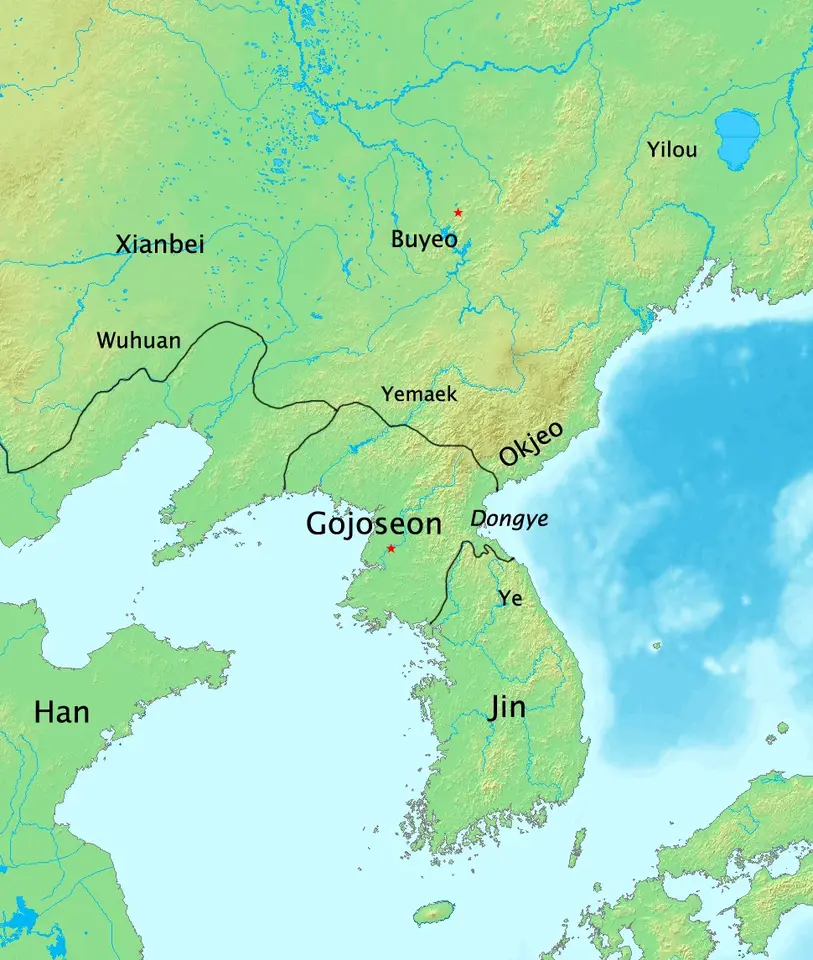
Wei Man (卫满, Wiman, fl. late 3rd century to early 2nd century BCE) was a native of the Yan state during the Warring States and early Western Han periods, and the founding monarch of the kingdom of Wiman Joseon (Wei Man Joseon). In 195 BCE, following the rebellion and flight of Lu Wan, the Prince of Yan, to the Xiongnu, Wei Man led over one thousand followers, relatives, and refugees eastward across the Pei River (Peishui) into Gija Joseon. Gaining the trust of King Jun (Gijun) of Gija Joseon, he was appointed an Erudite (boshi) and enfeoffed with hundreds of square li of western frontier land. In 194 BCE, Wei Man feigned an imminent invasion by Han armies, deceived Jun, and mounted a swift surprise assault on the capital Wangxian City (Wanggeom-seong). Jun fled south by sea to the Han territory, and Wei Man declared himself king, establishing Wiman Joseon. Subsequently recognized as an outer vassal by the Western Han court through the Governor of Liaodong, Wei Man maintained border security, assimilated Chinese iron technology and administrative techniques, and conquered neighboring tribes including Zhenfan and Lintun, expanding his dominion over thousands of square li and leaving a profound mark on early East Asian history.
Following Lu Wan's abortive rebellion, Wei Man led over one thousand followers eastward across the Pei River into Gija Joseon.
Won the confidence of King Jun, received the title of Erudite and a ceremonial jade gui, and was tasked with governing the western borderland of Shangxia Zhang.
Falsely reported a Han military assault to King Jun, led shock troops to seize Wangxian City, and founded Wiman Joseon as king.
Formally concluded an agreement with the Han Governor of Liaodong to serve as an outer vassal protecting imperial frontiers, receiving imperial sanction.
Utilizing advanced iron tools and robust military strength, he subjugated neighboring tribes including Zhenfan and Lintun, extending his realm across thousands of square li.
Wei Man originated from the state of Yan during the late Warring States era. During its apogee under King Zhao of Yan, general Qin Kai had routed the Eastern Hu, driving Yan boundaries far eastward into Liaodong and the northwestern Korean Peninsula, where garrisons and administrative forts were erected. Following the Qin conquest of Yan, this distant perimeter became an external frontier beyond Liaodong Commandery. After the rise of the Western Han Dynasty, because the region lay too far to be easily garrisoned directly, the imperial court merely repaired existing fortifications in Liaodong, designating the Pei River as the frontier under the jurisdiction of the Han vassal state of Yan.
In 196 BCE, Lu Wan, Prince of Yan, was accused of conspiring against Emperor Gaozu of Han. In 195 BCE, imperial armies invaded Yan, crushing Lu Wan's resistance and driving him into exile among the northern Xiongnu nomads. Wei Man, then a military commander or local chieftain in Yan, refused to capitulate to the Han court. Gathering a retinue of over one thousand kinsmen, retainers, and displaced refugees, he resolved to seek sanctuary in the east. To obscure their identities and adapt to local frontier customs, Wei Man and his followers tied their hair into barbarian mallet-shaped buns (chuiji), donned indigenous barbarian clothing, and journeyed past the Liaodong frontier fortifications, braving hazardous terrain to cross the swirling waters of the Pei River into the realm of Gija Joseon.
At that time, Gija Joseon was ruled by its final monarch, King Jun (Gijun). Upon arrival, Wei Man submitted a formal request for allegiance, expressing his willingness to reside in the desolate western border region, rally displaced Chinese refugees, and serve as an outer defensive bulwark shielding Gija Joseon from Han and tribal predations.
Recognizing Wei Man's administrative acumen and military prowess, Jun placed extraordinary trust in him. He appointed Wei Man to the esteemed rank of Erudite, bestowed upon him a ceremonial jade gui signifying authority, and entrusted him with the administration of Shangxia Zhang, a desolate border zone of several hundred square li formerly attached to Qin commanderies. Operating from this strategic redoubt, Wei Man introduced advanced Chinese agricultural organization and iron-smelting weaponry. He quickly gathered thousands of Yan and Qi refugees displaced by the post-Qin wars, constructing forts, amassing grain, and steadily building an autonomous base of military power.
In 194 BCE, having solidified his logistical and military strength, Wei Man resolved to seize supreme authority over Gija Joseon. He mobilized his forces in secret and dispatched an urgent messenger to King Jun, falsely claiming that imperial Han forces were advancing along ten invasion routes across the Pei River, requesting permission to march his vanguard into the capital Wangxian City (Wanggeom-seong, modern Pyongyang) to defend the royal court.
Unaware of the deception, King Jun readily consented to the deployment. Wei Man immediately marched several thousand well-drilled shock troops directly toward Wangxian City. Taken by surprise, Jun hastily assembled the royal guard outside the walls, but his poorly prepared soldiers were swiftly routed by Wei Man's veteran troops, who possessed superior iron weapons. Despairing of victory, King Jun boarded sea vessels with several thousand loyalists and clan members, fleeing south to the Mahan region where he proclaimed himself King of Han. Entering the royal citadel uncontested, Wei Man proclaimed himself King of Joseon, established his capital at Wangxian, and formally founded the kingdom of Wiman Joseon.
When Wei Man established his rule, the Western Han Dynasty was under the reign of Emperor Hui and Empress Dowager Lu. Engaged in post-civil-war economic recovery, the Han central government was reluctant to project direct military force into the remote eastern frontiers. The Han Governor of Liaodong astutely perceived the changing geopolitical landscape and negotiated a pragmatic compact with Wei Man: Han recognized Wei Man as sovereign over Joseon, while Wei Man agreed to serve as an "outer vassal" (waichen) to protect frontier ramparts, prevent border raids by barbarian tribes, and permit tribal envoys to travel freely through his territory to pay tribute in the Han capital. The Governor of Liaodong reported this arrangement to Chang'an, where the imperial court formally ratified the treaty, conferring imperial legitimacy upon Wei Man's rule.
Securing imperial recognition and open border markets, Wei Man imported substantial quantities of Chinese iron farm tools, textiles, and metallurgy, integrating Chinese emigrants with indigenous populations. Leveraging this formidable military and economic superiority, Wei Man initiated aggressive eastward and southward expansion campaigns against adjacent tribes. Small neighboring polities promptly submitted to his authority, and major tribal confederacies such as Zhenfan and Lintun were incorporated into his kingdom. The realm of Wiman Joseon expanded across several thousand square li, becoming the dominant regional power in ancient Northeast Asia.
Navigating the volatile transition from the Qin to the Han dynasties, Wei Man demonstrated remarkable adaptability and political survival instincts. When Prince Lu Wan was vanquished, Wei Man eschewed flight to the northern nomads and instead orchestrated a migration eastward across the Pei River. By adopting the indigenous hair knot and barbarian attire, he disarmed regional suspicions and won the immediate confidence of King Jun.
During his tenure governing Shangxia Zhang, Wei Man effectively secured the western approaches of Joseon while sheltering displaced Han refugees. He introduced advanced Chinese urban fortification techniques, agrarian practices, and metallurgical know-how into the northwestern Korean Peninsula, sparking a seminal fusion between Han migrants and native populations that established an enduring demographic and material foundation for his independent state.
Wei Man's capture of Wangxian City showcased exceptional tactical boldness and strategic opportunism. Assessing that the fledgling Han Dynasty was absorbed in domestic reconstruction and unready for overseas intervention, he exploited the ruse of an impending Han invasion to neutralize King Jun's vigilance and execute a lightning decapitation strike against the royal capital.
The establishment of Wiman Joseon supplanted the decentralized tribal confederation of Gija Joseon with an integrated central monarchy. Establishing his capital at Wangxian, Wei Man instituted administrative structures adapted from Chinese commandery models, employing literate Chinese exiles to oversee scribal administration and treasury accounts while confirming native chieftains in local military commands, thereby creating a highly functional early state apparatus.
Wei Man's most enduring geopolitical triumph was his calculated diplomacy toward the Western Han court. Fully cognizant of the vast disparity in imperial scale, he voluntarily accepted the status of an outer vassal pledged to border defense, successfully transforming potential imperial hostility into diplomatic legitimacy and commercial prosperity. The steady influx of Chinese iron implements and military technology granted Wiman Joseon an insurmountable technological advantage over surrounding polities.
Relying on this technological edge and Han diplomatic backing, Wei Man campaigned aggressively across the peninsula, compelling Zhenfan and Lintun to acknowledge his sovereignty and pushing his boundaries southward toward the Han River basin. He amassed an empire spanning several thousand square li, establishing a dynastic house that maintained power for nearly a century until the reign of his grandson Wei Youqu, who provoked Emperor Wu of Han to mount a full-scale conquest in 109 BCE.
FIGURES ASSOCIATED WITH THIS DYNASTY