Journey to Qin
Traveled from Daliang in Wei to Xianyang to present grand strategies to King Zheng of Qin, analyzing the geopolitical vulnerabilities of the six states.
尉缭
Wei Liao (尉缭, dates of birth and death unrecorded), a native of Daliang in the State of Wei (modern Weishi County, Kaifeng City, Henan Province), was an eminent military strategist, theorist, and master of military statecraft during the late Warring States period. He served as the foremost grand strategist in Qin Shi Huang's historic conquest of the six rival states and the unification of China. In recognition of his…
Wei Liao (尉缭, dates of birth and death unrecorded), a native of Daliang in the State of Wei (modern Weishi County, Kaifeng City, Henan Province), was an eminent military strategist, theorist, and master of military statecraft during the late Warring States period. He served as the foremost grand strategist in Qin Shi Huang's historic conquest of the six rival states and the unification of China. In recognition of his appointment as National Commandant (Guowei), the supreme executive military post in the State of Qin, posterity traditionally referred to him as Wei Liao. In 237 BCE (the 10th year of King Zheng of Qin), Wei Liao traveled west from Wei to Qin to seek an audience with the young King Zheng (the future Qin Shi Huang). Analyzing the geopolitical deadlock between Qin and the six eastern states, Wei Liao observed that rival feudal courts were crippled by internal aristocratic factionalism and susceptible to financial bribery. He presented a bold strategic proposal urging the king to distribute three hundred thousand catties of gold to bribe key ministers and generals in the six states to subvert their strategic alliances from within. Deeply impressed, King Zheng treated Wei Liao with extraordinary deference, sharing identical clothing and cuisine. Although Wei Liao initially perceived King Zheng's ruthless and predatory character and attempted to flee, the king earnestly detained him and elevated him to National Commandant, establishing him as supreme strategic architect of Qin's unification campaigns. In classical military science, Wei Liao authored the renowned treatise Wei Liaozi, later canonized during the Song Dynasty as one of the Seven Military Classics. He pioneered a dialectical military philosophy asserting that "arms take the martial as their trunk and civil virtue as their seed," strictly distinguishing righteous campaigns aimed at suppressing tyranny from predatory raids. He formulated the three strategic dimensions of victory—victory through moral virtue (daosheng), victory through prestige (weisheng), and victory through military force (lisheng)—while establishing rigorous legal discipline and advanced field array tactics. His strategic doctrine not only laid the theoretical and operational foundation for Qin's unification of China but also exerted an enduring influence on traditional Chinese military science.
Traveled from Daliang in Wei to Xianyang to present grand strategies to King Zheng of Qin, analyzing the geopolitical vulnerabilities of the six states.
Advised King Zheng to allocate three hundred thousand catties of gold to bribe ministers of the six states; King Zheng treated him as an equal in food and attire.
Noted King Zheng's predatory nature and attempted to depart; King Zheng detained him with deep respect and appointed him National Commandant.
Coordinated intelligence networks and operational sequences to weaken Han and Wei, leading to the capture of the Handan citadel and collapse of Zhao.
Oversaw nationwide military logistics and operational planning, witnessing the total capitulation of the six states and the birth of the unified Qin Empire.
Synthesized classical military doctrines into the twenty-four-chapter canon Wei Liaozi, revered across subsequent dynasties as a masterwork of military strategy.
Wei Liao traced his lineage to Daliang, the capital of the State of Wei. According to historical traditions, his ancestral forebears had held military and commandant responsibilities in Wei for several generations. During the twilight of the Warring States period, the protracted struggle among the feudal powers reached its climactic phase. While Qin held undisputed military superiority following Shang Yang's legalist reforms and the Battle of Changping, the six eastern states still controlled vast territories and millions of infantry, periodically forming horizontal coalitions that checked Qin's eastward expansion.
From his youth, Wei Liao studied broadly across classical philosophy, excelling in strategic stratagems, legal administration, and the dynamics of state power. He perceived that while the eastern feudal states appeared formidable, their rulers were corrupt and their senior aristocrats selfishly divided, lacking common resolve to face existential threats. Recognizing that historical momentum inexorably favored unified autocratic rule, Wei Liao left Daliang in 237 BCE, traveling west through Hangu Pass to Xianyang to offer his counsel to twenty-two-year-old King Zheng of Qin.
At that moment, King Zheng had recently crushed the domestic insurrections of Lao Ai and the Queen Dowager and removed Chancellor Lü Buwei, actively seeking visionary advisors to guide his continental expansion. In the royal audience chambers, Wei Liao presented his geopolitical assessments with uncompromising clarity, demonstrating the vision of an elite grand strategist.
In his audience with King Zheng, Wei Liao presented an overarching strategic plan for dismantling the eastern states. He incisively observed: "With the vast territory and formidable legions of Qin, the six eastern kingdoms are collectively comparable to merely a single commandery. The foremost danger confronting Qin is that the eastern powers may once again forge a united coalition. Should they strike unexpectedly in concert, this would mirror the catastrophes that brought down Zhi Bo, King Fuchai of Wu, and King Min of Qi."
Wei Liao then proposed a masterstroke: "I pray that Your Majesty will not hoard precious treasure. Expend three hundred thousand catties of gold to dispatch emissaries to bribe the influential courtiers and powerful ministers of the six states. Sowing discord and suspicion among their factions will unravel their joint strategies. In this manner, Qin will expend a modest sum of gold, while the grand coalitions of the feudal lords will dissolve entirely from within!"
King Zheng recognized the brilliance of the counsel. He immediately ordered the royal treasury opened, directing senior officials including Li Si to distribute massive financial bribes across the courts of Zhao, Wei, Qi, and Chu, systematically undermining trust between eastern sovereigns and their loyal generals. Simultaneously, King Zheng extended extraordinary personal honors to Wei Liao. In palace life, the king dined upon identical dishes and wore garments of identical fabric as Wei Liao, deferentially consulting him on statecraft and military affairs.
Despite receiving unprecedented royal honors, Wei Liao maintained acute psychological detachment. Versed in physiognomy and political psychology, he scrutinized King Zheng's conduct and temperament during their daily interactions.
Wei Liao privately confided to his close attendants: "The King of Qin has a high, prominent nose, deep-set elongated eyes, a chest protruding like that of a bird of prey, and a voice like a snarling jackal. Such physical characteristics reveal a man of scant mercy and a predatory heart akin to a tiger or wolf. When he is constrained or needs the help of others, he can humble himself completely before them; but once he achieves his ambitions and dominates the realm, he will treat all humanity as meat to be devoured at will. Today I am a common cloth-clad scholar, yet he bows before me in every matter. If he succeeds in conquering the world, men like us will inevitably become his prisoners! I cannot remain here long."
Wei Liao packed his belongings and slipped out of the Xianyang official quarters to return east. Discovering his flight, King Zheng was alarmed and dispatched fast couriers to overtake him at the frontier. Facing Wei Liao once more, King Zheng offered heartfelt apologies rather than retribution. To secure the strategist permanently, King Zheng issued an imperial edict elevating Wei Liao to National Commandant (Guowei), the supreme commander of Qin's armed forces and military administration. Wei Liao thus became the chief strategic architect of Qin's campaigns of total conquest.
Following his appointment as National Commandant, Wei Liao devoted himself to formulating the operational sequence for Qin's continental war. Working in concert with Commandant of Justice Li Si and veteran commanders Wang Jian and Meng Tian, he established the operational doctrine of "befriending distant states while attacking nearby rivals, dividing coalitions, and destroying states in calculated sequence."
Under Wei Liao's strategic direction, Qin implemented bribery and subversion across eastern courts, notably bribing Zhao courtier Guo Kai to frame and execute the preeminent general Li Mu. Concurrently, Qin launched devastating military thrusts: annexing neighboring Han in 230 BCE, shattering Zhao and capturing its sovereign in 228 BCE, flooding Daliang to conquer Wei in 225 BCE, mobilizing six hundred thousand troops under Wang Jian to crush Chu in 223 BCE, subduing Yan and Dai in 222 BCE, and marching unopposed into Qi in 221 BCE.
Within a single decade, the six eastern states collapsed under Qin's dual-pronged strategy of political subversion and military force. In this grand campaign that forged China's first unified empire, the strategic doctrines and administrative coordination designed by Wei Liao served as the central intellectual anchor.
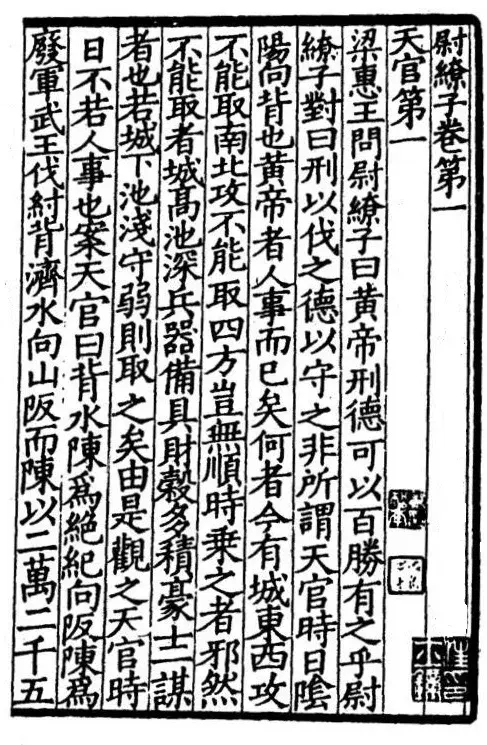
Throughout his campaigns assisting the Qin crown, Wei Liao integrated classical military thought with legalist institutional practice, authoring the comprehensive military masterwork Wei Liaozi in twenty-four chapters.
Wei Liaozi synthesizes the pragmatism of Sun Wu and Wu Qi with Legalist administrative rigor and Daoist adaptability. He emphasized that armed force must be grounded in equitable governance and domestic economic prosperity, rejecting excessive militarism. Furthermore, he articulated a profound understanding of the relationship between commanders and soldiers, stating: "Weigh the enemy and evaluate the general before mobilizing forces; the general is the heart, and the troops are the limbs." This emphasized that a commander must direct his army with unified resolve, just as the mind controls the body. The text was canonized during the Song Dynasty as one of the Seven Military Classics, providing an authoritative textbook for civil and military scholars. Following the unification of the empire, Wei Liao retired from public view, leaving an indelible imprint as a common scholar who guided the founding of an empire.
Wei Liao's paramount strategic achievement was proposing the expenditure of three hundred thousand catties of gold to subvert the six eastern kingdoms from within. In the late Warring States period, joint alliances remained an existential threat to Qin's security.
By elevating diplomatic bribery and psychological espionage to the apex of state grand strategy, Wei Liao systematically dismantled mutual trust among rival feudal courts. This strategy crippled the defensive coalitions of the eastern powers, drastically reducing Qin's military casualties and providing a celebrated historical model of psychological warfare.
As National Commandant, Wei Liao served as the chief strategic architect of Qin Shi Huang's unification wars. He helped King Zheng define the grand objective of "absorbing the vast realm and unifying its institutional systems," moving beyond piecemeal territorial acquisitions.
Wei Liao established the operational sequence: first eliminating Han and Wei to secure central logistical corridors, deploying primary field armies to destroy Zhao, and committing total national resources to crush Chu. This disciplined, sequential planning ensured that Qin retained absolute strategic momentum throughout a decade of continuous warfare.
Wei Liao's authored work, Wei Liaozi, stands as an enduring monument in classical Chinese military philosophy. He introduced the dialectical principle that "arms take the martial as their trunk and civil virtue as their seed," establishing that military triumph is fundamentally rooted in internal administrative justice and economic stability.
In defining the nature of warfare, Wei Liao championed a strictly ethical view of conflict, arguing that armies must only be mobilized to "suppress tyranny and prohibit injustice," unreservedly condemning predatory conquests. He established: "Armies do not assault innocent cities, nor do they slaughter blameless civilians. To murder fathers and brothers, plunder property, and enslave children is the conduct of bandits." This moral framework distinguished dynastic unification from ruthless conquest.
Furthermore, Wei Liao formulated the doctrine of the three victories: victory through moral virtue (daosheng), victory through national prestige (weisheng), and victory through military force (lisheng). Canonized as one of the Seven Military Classics under the Song Dynasty, his treatise remains a foundational text in Chinese military education.
In tactical organization, Wei Liao established rigorous military regulations and combat formations. He insisted that "armies become invincible only after discipline is established," instituting strict mutual responsibility systems and unsparing penalties for battlefield desertion.
Regarding battlefield array tactics, Wei Liao formulated the principle that "forces conquer through tranquility and concentrated focus," demanding that armies strike vulnerable enemy flanks like a crashing wall. He designed an integrated tactical array where soldiers stood in inward-facing and outward-facing ranks, alternating standing and kneeling postures. This disciplined coordination of infantry, crossbowmen, and cavalry has been corroborated by modern archaeological excavations of the terracotta warrior arrays at the Mausoleum of the First Qin Emperor, demonstrating remarkable tactical sophistication.
In military epistemology, Wei Liao exhibited an advanced rationalist and materialist outlook. While contemporary states relied heavily on astrological portents and divination to determine campaign dates, Wei Liao rejected superstition in his chapter on Heavenly Offices, declaring: "Heavenly offices and seasonal dates are inferior to human calculations." He asserted that military victory depends on real power dynamics, civilian morale, and strategic leadership rather than astrology.
Moreover, Wei Liao advocated an agrarian defense economy, noting that "the land produces the nine grains, cities are founded upon them, and when farming and sericulture are unneglected, the state possesses abundant reserves." This emphasis on grain storage and agricultural colonies provided the logistical endurance that sustained Qin armies throughout the decade of unification.
FIGURES ASSOCIATED WITH THIS DYNASTY