Birth in Shangyu
Born into the prominent Wei lineage of Kuaiji; acquired profound mastery of Confucian classics under his father Wei Lang
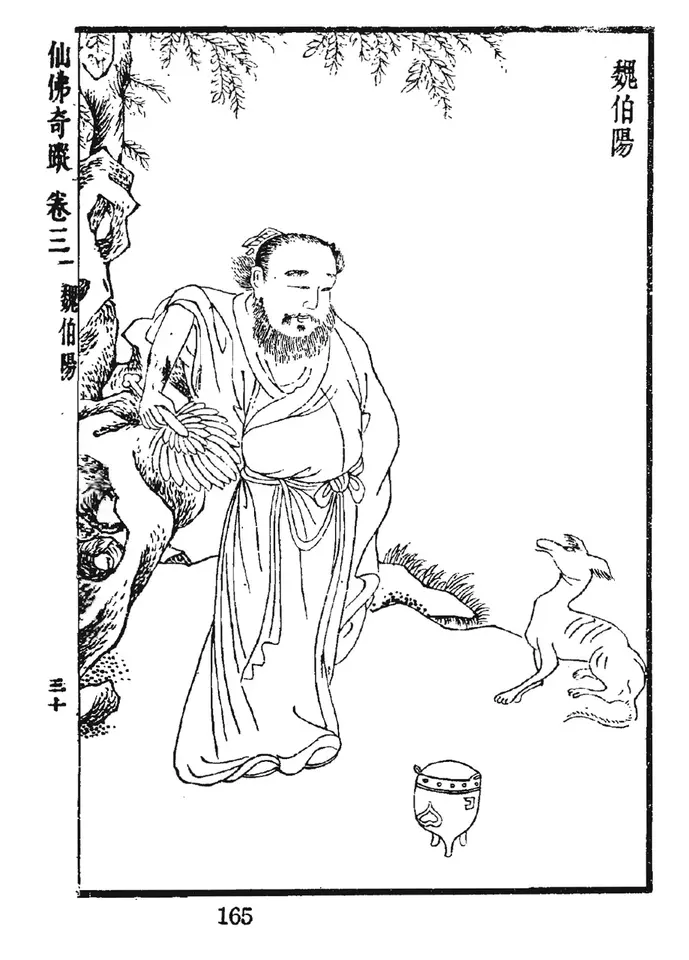
魏伯阳
Wei Boyang, original name Wei Ao with the courtesy name Boyang, was a legendary philosopher, theoretical alchemist, health cultivator, and pioneer of chemistry during the middle-to-late Eastern Han dynasty from Shangyu in Kuaiji Commandery. Born into an elite regional gentry lineage, he was the son of Wei Lang, a prominent upright minister and one of the "Eight Virtuous" who was martyred in the Disasters of the Partisan…
Wei Boyang, original name Wei Ao with the courtesy name Boyang, was a legendary philosopher, theoretical alchemist, health cultivator, and pioneer of chemistry during the middle-to-late Eastern Han dynasty from Shangyu in Kuaiji Commandery. Born into an elite regional gentry lineage, he was the son of Wei Lang, a prominent upright minister and one of the "Eight Virtuous" who was martyred in the Disasters of the Partisan Prohibitions. Profoundly traumatized by the persecution of his family, Wei Boyang renounced all worldly official ambitions, dedicating his life to Daoist philosophy and scientific experimentation. Immersing himself in the cosmological numerology of the Classic of Changes (Zhouyi) and Huang-Lao Daoism, he traveled through sacred mountains before secluding himself in the Fengming Cave on Mount Fengming in Shangyu. Alongside his disciples, he engaged in decades of furnace metallurgy, investigating mercury, lead, and sulfur while cultivating internal vitality. Wei Boyang integrated three distinct traditions into a unified system: the hexagram cosmology of the I Ching, Huang-Lao metaphysical quietude, and metallurgical furnace operations, producing the monumental three-volume treatise Zhouyi Cantongqi (The Kinship of the Three according to the Book of Changes). As the world's earliest extant comprehensive theoretical treatise on alchemy, the work encoded chemical reactions and physiological cultivation under I Ching symbolism, revered for millennia across East Asia as the "King of Alchemical Canons."
Born into the prominent Wei lineage of Kuaiji; acquired profound mastery of Confucian classics under his father Wei Lang
Father Wei Lang murdered in the second Disaster of the Partisan Prohibitions; Wei Boyang swore never to enter imperial office
Fled state persecution of partisan lineages, roaming sacred mountains to study alchemical arts and Huang-Lao philosophy
Settled on Mount Fengming in Shangyu, establishing laboratory furnaces with disciples including Zhou Xie and Feng Liang
Finalized Zhouyi Cantongqi, uniting I Ching hexagram dynamics, Daoist breathing, and laboratory alchemy
Passed away peacefully at seventy-one years of age in the Kuaiji mountains; revered as immortal patriarch Yunyazi
Wei Boyang was born into the celebrated Wei lineage of Shangyu in southeastern Kuaiji. His father Wei Lang was a towering intellectual and Master of Writing (Shangshu) celebrated alongside Li Ying and Chen Fan for relentless resistance against eunuch tyranny, honored across China as one of the "Eight Virtuous." Under his father's rigorous tutelage, Wei Boyang mastered the six Confucian classics, attaining rare insight into archaic philology and cosmological exegesis of the Classic of Changes.
However, imperial despotism shattered his lineage. In 167, Wei Lang was cashiered in the first Partisan Prohibitions; in 169, during the second purge, Wei Lang was brutally murdered by eunuch henchmen. In 176, when imperial edicts expanded the purge to proscribe three generations of partisan families, the twenty-six-year-old Wei Boyang recognized the hopeless corruption of the Han state, renouncing bureaucratic ambitions to seek spiritual liberation in obscurity.
To evade imperial surveillance, Wei Boyang donned straw sandals and traveled across China's sacred peaks. Traditional sources record his travels northward to the Central Plains, Mount Tai, and Mount Changbai, consulting hermits and collecting esoteric texts including the ancient Dragon and Tiger Classic (Longhu Jing).
Throughout his wanderings, Wei Boyang encountered emerging Daoist movements and metallurgical artisans. Recognizing that sterile book-learning could not cure spiritual suffering and that crude folk sorcery was rife with fraud, he resolved to elevate empirical chemical knowledge into an exact science, grounding laboratory transformations upon the cosmological framework of the I Ching.
During the Zhongping era, Wei Boyang returned to his native Shangyu, retreating into the rugged precipices of Mount Fengming. Carving out the Fengming Cave, he constructed specialized alchemical furnaces, collected pure spring water, and procured minerals including mercury, lead, sulfur, and realgar. He pursued rigorous alchemical and meditative experiments with his disciples Zhou Xie, Feng Liang, and Yu Xun.
Ge Hong's Biographies of the Immortals (Shenxian Zhuan) preserves the famous legend of the trial of the white dog: when the golden elixir was perfected, Wei Boyang sought to test his disciples' faith. He fed an elixir pellet to a white dog, which collapsed lifeless. Wei Boyang calmly remarked, "I abandoned home for the mountains; if I achieve not the Dao, with what face shall I return to the world?" He swallowed a pellet and collapsed in apparent death. Two faint-hearted disciples fled in terror; only disciple Yu Xun declared his unwavering faith, swallowed the elixir, and lay down beside his master. Once the unfaithful fled, Wei Boyang, Yu Xun, and the white dog revived in radiant health, ascending into immortal obscurity. This allegory reflected the extreme spiritual discipline demanded by Wei's alchemical school.
Through decades of secluded experimentation, Wei Boyang mastered the chemical properties of mercury and lead: amalgamation, oxidation, sublimation, and reduction. He synthesized these physical transformations with the sixty-four hexagrams and physiological qi flow, producing the immortal Zhouyi Cantongqi.
The title encapsulates his philosophy: "Can" (Three) signifies the harmonization of the I Ching, Huang-Lao philosophy, and laboratory metallurgy; "Tong" (Unity) declares that all three share identical cosmological laws; "Qi" (Tally) asserts their perfect mutual correspondence. Written in ancient four- and five-character rhymed verse, the work encoded chemical reactions beneath cosmological metaphors, purging alchemy of vulgar superstition while constructing the theoretical foundation for Chinese external (waidan) and internal (neidan) alchemy.
Wei Boyang passed away peacefully in 221 at seventy-one years of age. His immortal classic was widely annotated and revered by luminaries including Peng Xiao and Song philosopher Zhu Xi.
Within the Zhouyi Cantongqi, Wei Boyang constructed a remarkably rigorous theoretical model integrating I Ching cosmogony with metallurgical operation. He utilized the Qian and Kun hexagrams—representing the cosmic ontological pillars of Heaven and Earth—to symbolize the furnace crucible and cauldron. He employed Kan and Li—representing water and fire—to symbolize heating fuels and cooling agents. Furthermore, he used Zhen, Dui, Qian, Xun, Gen, and Kun to chart the monthly waxing and waning of the Moon from crescent to full moon and back to darkness.
Wei Boyang innovatively matched lunar phases with alchemical furnace temperatures. He demanded that fire temperatures strictly follow natural yin-yang rhythms: on the third day of the lunar month (Zhen hexagram), nascent yang emerges and furnace fire must be gentle; on the eighth day (Dui hexagram), heat rises steadily; on the fifteenth day (Qian hexagram), pure yang culminates and temperatures reach maximum; beginning on the sixteenth day (Xun hexagram), cooling decrescendo begins. This formulation transformed chaotic metallurgical trial-and-error into a standardized, temporally rigorous science.
Wei Boyang's work was grounded in painstaking physical experimentation with metallic minerals. In the Cantongqi, he elucidated the cyclic laws of chemical transformation governing mercury and lead compounds under hermetically sealed thermal conditions. He termed native mercury the "chaste maiden" or "flowing pearl," and lead-sulfur compounds the "yellow sprout" or "white tiger," accurately depicting the reaction of mercury with sulfur to form red mercuric sulfide (cinnabar), which upon further high-temperature sublimation decomposes back into metallic mercury.
Wei Boyang explicitly stated that attempting to cultivate longevity through consuming ash from vegetative herbs defied natural physical principles. Only stable minerals surviving extreme furnace heat could impart enduring physical stability to human health. His empirical insights provided the historic foundation for the evolution of Chinese proto-chemistry toward modern inorganic chemistry.
Beyond external metallurgy, Wei Boyang was the founding patriarch of Daoist internal alchemical (neidan) philosophy. In the Cantongqi, he posited an absolute correspondence between the macrocosmic rhythms of Heaven and Earth and the microcosmic physiology of the human body. He defined the ears, eyes, and mouth as the "three treasures" of the body, demanding that practitioners seal off sensory distractions, harmonize breathing, and circulate primordial qi along bodily meridian pathways.
Wei Boyang emphasized that true spiritual realization required the simultaneous cultivation of external alchemy and internal vitality, uniting form and spirit. Analogizing the heart to fire and the kidneys to water, he applied I Ching hexagrams to achieve the equilibrium of water and fire, enabling practitioners to maintain physical robustness and mental tranquility amid late Han chaos. Medieval Quanzhen Daoists later developed this into a comprehensive spiritual discipline, revering Wei Boyang as the ancestor of internal alchemy.
Written in dense archaic verse, the Zhouyi Cantongqi circulated as an esoteric manuscript for centuries. During the Five Dynasties period in Shu, the Daoist master Peng Xiao divided the text into systematic chapters and composed the commentary Penetrating the True Meaning of the Cantongqi, revealing its comprehensive architecture to the world.
During the Southern Song dynasty, the supreme Neo-Confucian master Zhu Xi held the Cantongqi in immense esteem, authoring his own critical commentary, Textual Variations on the Cantongqi, under the pen name Master Kongtong, marveling at its mathematical precision. In modern times, the renowned British historian of science Dr. Joseph Needham acclaimed the Zhouyi Cantongqi as "the very earliest systematic treatise on alchemical chemistry in human history," affirming Wei Boyang as a towering pioneer in world science.
Between eighteen and twenty-six years of age, though living at the epicenter of political proscription, young Wei Boyang never neglected scholarship. In seclusion at Shangyu, he collated and edited his late father Wei Lang's philosophical work, Weizi, while immersing himself in New and Old Text classical canons, Three-Sequences calendrical mathematics, and pre-Qin philosophy.
This profound classical training enabled Wei Boyang to apply I Ching hexagrams to physical sciences. Unlike unlettered occult sorcerers, Wei Boyang approached alchemy with the broad intellectual horizon of a classical scholar, purging superstition and earning mainstream literati respect for external and internal alchemy.
Throughout his decades of inquiry, Wei Boyang emphasized rigorous textual collation of ancestral alchemical lore. During his travels across the central plains and Qi-Lu regions, he studied surviving fragments of the pre-Qin Dragon-Tiger Classic (Longhu Jing), which preserved practical formulas but lacked theoretical coherence.
In his Mount Fengming laboratory, Wei Boyang synthesized these fragments with I Ching cosmology. He demonstrated that the ancient "dragon" signified fluid mercury (wood/Zhen), while the "tiger" signified solid lead (metal/Dui). Within the crucible, their mutual interaction mirrored the East-West cosmological opposition of the Sun and Moon, reconstructing fragmented oral traditions into an enduring canonical system.
Wei Boyang's corpus is meticulously verified across official dynastic bibliographies and Daoist records. In the Eastern Jin dynasty, Ge Hong recorded in Biographies of Immortals: "Boyang authored the Cantongqi and Five Similar Categories in two volumes." In the inner chapters of Baopuzi, Ge Hong also logged the Internal Classic of Wei Boyang.
In the Sui and Tang eras, the Old Book of Tang and New Book of Tang recorded his two-volume Zhouyi Cantongqi and one-volume Wuxianglei. In the Five Dynasties period, Peng Xiao divided the text into ninety chapters with accompanying diagrams. This uninterrupted two-thousand-year bibliographical lineage confirms Wei Boyang's preeminent standing as the founding father of Chinese alchemy.
Traces of Wei Boyang's alchemical practice on Mount Fengming remain preserved in local gazetteers and natural landmarks. High upon the cliffs of Fengming Cave sits the ancient "Alchemical Well," excavated by Wei Boyang to draw water for metallurgical refinement, its crystal-clear water flowing steadily through winter and summer.
Over successive dynasties, scholar-officials and poets visited Mount Fengming to compose commemorative inscriptions in honor of this Han pioneer who renounced secular glory for the pursuit of cosmic truth, establishing Mount Fengming as an iconic sacred site in the history of science and Daoism.
Wei Boyang's Zhouyi Cantongqi is the foundational classic of Chinese alchemy and historical chemistry. He elevated empirical artisanal metallurgy into a comprehensive philosophical discipline, systematically describing the cyclic interactions of mercury and lead centuries ahead of Western medieval alchemy.
Wei Boyang innovatively deployed the Qian, Kun, Kan, and Li hexagrams to symbolize the alchemical furnace, crucible, and raw minerals, using the twelve sovereign hexagrams to regulate furnace temperatures according to seasonal and diurnal cycles.
While ostensibly focused upon external laboratory elixir, the Cantongqi articulated the metaphysical cultivation of human essence (jing), vitality (qi), and spirit (shen), becoming the supreme doctrinal text for later Quanzhen and internal alchemy schools.
FIGURES ASSOCIATED WITH THIS DYNASTY