Birth into Gentry
Born in Jiangzhou into the prominent Taiyuan Wang lineage, displaying early intellectual brilliance and chivalric romanticism.
王之涣
Wang Zhihuan (王之涣, 688–742), courtesy name Jiling (季凌), was a preeminent frontier poet of the High Tang dynasty, originating from Jinyang in Bingzhou and later settling in Jiangzhou. Born into an established gentry lineage of provincial administrators, he displayed acute intellect and chivalric flair from early youth, delighting in swordplay, heroic ballads, and uninhibited camaraderie; upon reaching adulthood, he devoted…
Wang Zhihuan (王之涣, 688–742), courtesy name Jiling (季凌), was a preeminent frontier poet of the High Tang dynasty, originating from Jinyang in Bingzhou and later settling in Jiangzhou. Born into an established gentry lineage of provincial administrators, he displayed acute intellect and chivalric flair from early youth, delighting in swordplay, heroic ballads, and uninhibited camaraderie; upon reaching adulthood, he devoted himself to classical canons and historical treatises, earning wide literary renown. However, his early examination career was frustrated by recurring failures. In 726, he entered officialdom through hereditary privilege as Assistant Magistrate of Hengshui in Jizhou, but resigned abruptly after refusing to compromise with corrupt colleagues who subjected him to slander. Following his resignation, Wang Zhihuan lived in reclusion and traveled for fifteen years, journeying through the Yellow River basin and the northwestern frontier. During this wandering period, he forged close literary bonds with Gao Shi, Wang Changling, and Cui Guofu, participating in the legendary Wine Pavilion competition where imperial courtesans sang their verses. It was during these years that he ascended the Stork Tower in Puzhou to compose his immortal five-character quatrain Climbing Stork Tower (Deng Guanque Lou), with its couplet "The white sun sinks behind the mountains; the Yellow River flows into the sea," and penned his celebrated Liangzhou Melodies (Liangzhou Ci). In 742, at the urging of friends, he returned to civil service as Magistrate of Wen'an, governing with fairness and integrity until his sudden death in his official residence at age fifty-five. Although only six of his poems survive in the Complete Tang Poetry, their expansive cosmic scale and heroic vision established him as one of the Four Great Frontier Poets of the Tang dynasty.
Born in Jiangzhou into the prominent Taiyuan Wang lineage, displaying early intellectual brilliance and chivalric romanticism.
Mastered the Confucian classics and ancient rhapsodies in youth, but suffered repeated setbacks in the imperial examinations.
Appointed Assistant Magistrate of Hengshui through hereditary privilege; married the third daughter of County Magistrate Li Di.
Refused to bow to bureaucratic corruption and resigned his post in indignation, returning to his ancestral estate in Jiangzhou.
Traveled to Puzhou and ascended the Stork Tower overlooking the Yellow River, penning his immortal quatrain Climbing Stork Tower.
Traveled through Jimen and the northwestern frontiers, composing the celebrated Liangzhou Melodies, answered in verse by Gao Shi.
Gathered with Wang Changling and Gao Shi at a wine tavern in Chang'an, competing through courtesans singing their poems.
Persuaded by kin to reenter administration, appointed Magistrate of Wen'an, governing with incorruptible fairness.
Succumbed to sudden illness on the fourteenth day of the second month in the Wen'an government lodge at age fifty-five.
Interred on the northern plains of Luoyang on the twenty-second day of the fifth month; memorialized in a stele by Jin Neng.
Wang Zhihuan belonged to the prominent Taiyuan Wang clan, one of the foremost aristocratic houses of northern China. His great-grandfather Wang Xin served as Gentleman of Court Discussion and Editorial Director under the Sui dynasty, later becoming Magistrate of An'yi in Puzhou under the Tang. His grandfather Wang Debiao served as Assistant Magistrate of Yangdi and Magistrate of Wen'an, while his father Wang Yu held office as Magistrate of Junyi in Bianzhou. The family had administered local counties across Henan and Hebei for generations with a reputation for integrity and administrative clarity. Wang Zhihuan was the youngest of four brothers, born in 688 at the family residence in Jiangzhou.
From boyhood, Wang Zhihuan exhibited exceptional intellectual agility combined with a bold, chivalric temperament. During his youth, he embraced the romantic lifestyle of the ancient knight-errant, roaming the suburbs of western cities with aristocratic companions, hunting with falcons, singing heroic ballads while striking his sword, and drinking freely in taverns. However, upon reaching adulthood, he recognized that martial wanderings could not fulfill his deeper aspirations. He withdrew into quiet scholarship, immersing himself in the Confucian classics, historical annals, and classical poetic forms. Before reaching his thirtieth year, he had achieved comprehensive command over classical hermeneutics, earning widespread admiration in Shanxi for prose that synthesized northern vigor with southern elegance.
Despite his extraordinary literary talent, Wang Zhihuan encountered severe frustration in the imperial civil examinations. The competitive examination halls of the High Tang offered few openings, and he failed on multiple occasions to achieve the Jinshi degree. Following the death of his parents in the early Kaiyuan era, the family faced financial hardship. In 726, at the age of thirty-nine, Wang Zhihuan entered civil administration through the hereditary privilege granted to descendants of deceased officials, receiving an appointment as Assistant Magistrate of Hengshui in Jizhou, tasked with managing county registers, official correspondence, and local granaries.
During his tenure in Hengshui, Wang Zhihuan performed his administrative duties with punctilious competence. His superior, Magistrate Li Di of the prominent Bohai Li lineage, recognized his intellectual brilliance and arranged for his third daughter to marry the poet. However, local bureaucratic politics in Hengshui were corrupt and factionalized; Wang Zhihuan's uncompromising integrity and refusal to flatter dishonest subordinates quickly earned him the enmity of petty clerks. Within a year of taking office, he was subjected to malicious slander and bureaucratic sabotage. Disgusted by administrative chicanery, the proud poet refused to compromise, resigning his commission and returning home to Jiangzhou to live as an independent scholar.
Between 727 and 741, Wang Zhihuan lived in comfortable reclusion and open wandering for fifteen years. Indifferent to bureaucratic promotion, he found joy in playing the zither, reading ancient poetry, and exploring the expansive natural landscapes of northern and northwestern China. During this period, he visited Puzhou on the eastern bank of the Yellow River. Ascending the magnificent Stork Tower, which overlooked the roaring torrent and the southern Zhongtiao Mountains, he composed the five-character quatrain Climbing Stork Tower, a monumental poem that established his place in world literature.
Later, Wang Zhihuan traveled northwest along the desert frontier toward Liangzhou and northeast toward the garrisons of Jimen. Experiencing firsthand the desolation of the Great Wall and the hardships endured by garrison soldiers, he composed his two Liangzhou Melodies, prompting his close friend Gao Shi to write a poetic reply. In Chang'an and Luoyang, Wang Zhihuan maintained intimate friendships with fellow poetic masters Wang Changling, Gao Shi, and Cui Guofu.
Around 734, the three poets took part in the famous gathering known as Painting on the Tavern Wall recorded in Xue Yongruo's Records of Unusual Events. While sharing wine at a tavern in the capital, they observed imperial courtesans performing songs. The three poets agreed to determine whose verses were most celebrated by listening to which poems the performers chose to sing. After courtesans sang compositions by Wang Changling and Gao Shi, Wang Zhihuan pointed confidently to the most celebrated courtesan in the hall, predicting that she would sing his work. When she stepped forward, she sang the opening lines: "Far, far away the Yellow River climbs into white clouds..." The three poets laughed heartily, and the musicians bowed in reverence upon discovering they were entertaining the great bards of the age.
After fifteen years of peaceful retirement, Wang Zhihuan was over fifty years old. His relatives and admirers lamented that his administrative brilliance remained dormant in the countryside and urged him to resume public service. In 742, during the first year of the Tianbao era, the imperial government appointed him Magistrate of Wen'an in Hebei. Remarkably, his grandfather Wang Debiao had governed the same county decades earlier, making his appointment an honorable family milestone celebrated by the local gentry.
Assuming executive authority in Wen'an, Wang Zhihuan brought decades of mature experience to regional administration. He eliminated abusive clerical fees, reduced judicial backlogs, and adjudicated criminal disputes with compassionate impartiality. In one famous local investigation, when a village maiden was murdered at night without barking from the household dog, Wang Zhihuan deduced that the culprit was a familiar acquaintance. By staging a theatrical public trial of the dog, he lured the unsuspecting villagers into the courtyard and examined the young men, discovering scratch marks on the true culprit's back and securing a full confession. His fair-minded justice won the deep gratitude of the county population.
Tragically, Wang Zhihuan's administrative career in Wen'an was cut short. Only months after assuming office, he was stricken by sudden, severe illness. On the fourteenth day of the second month in 742, Wang Zhihuan died in his official lodge at the age of fifty-five. The sudden loss of this celebrated frontier poet and benevolent magistrate was deeply mourned across the empire.
In the fifth month of 743, his family transported his casket south to Luoyang, interring him in the ancestral cemetery on the northern plains of Mount Mang. His intimate friend Jin Neng, District Defender of Yongning, composed the inscription for his funerary stele, praising his generous strategic vision, extraordinary talent, and the sorrowful beauty of his border songs.
Wang Zhihuan's enduring status in world literature rests above all upon his twenty-character five-character quatrain Climbing Stork Tower (Deng Guanque Lou): "The white sun sinks behind the mountains; the Yellow River flows into the sea. If you wish to exhaust a thousand leagues of vision, ascend another level of the tower."
The Stork Tower, perched on the bluffs of Puzhou overlooking the Yellow River, was celebrated as one of the great architectural vantage points of northern China. Countless Tang poets composed verses upon its balconies, but Wang Zhihuan's quatrain eclipsed all rivals through its panoramic scale and seamless integration of landscape and philosophy. The opening couplet captures the cosmic movement of nature: the sun setting westward into mountains and the great river surging eastward toward the ocean, encompassing heaven, earth, and water within ten characters.
The concluding couplet transforms visual perspective into a profound philosophical principle: to broaden one's perception and achieve higher wisdom, one must continuously elevate one's spiritual vantage point. Free from ornamentation or sentimental indulgence, the poem radiates the confidence and expansive worldview of the High Tang. Song scholars Shen Kuo and Sima Guang praised it as the finest poem ever composed at the tower, and later critics recognized it as the pinnacle of Chinese five-character quatrains.
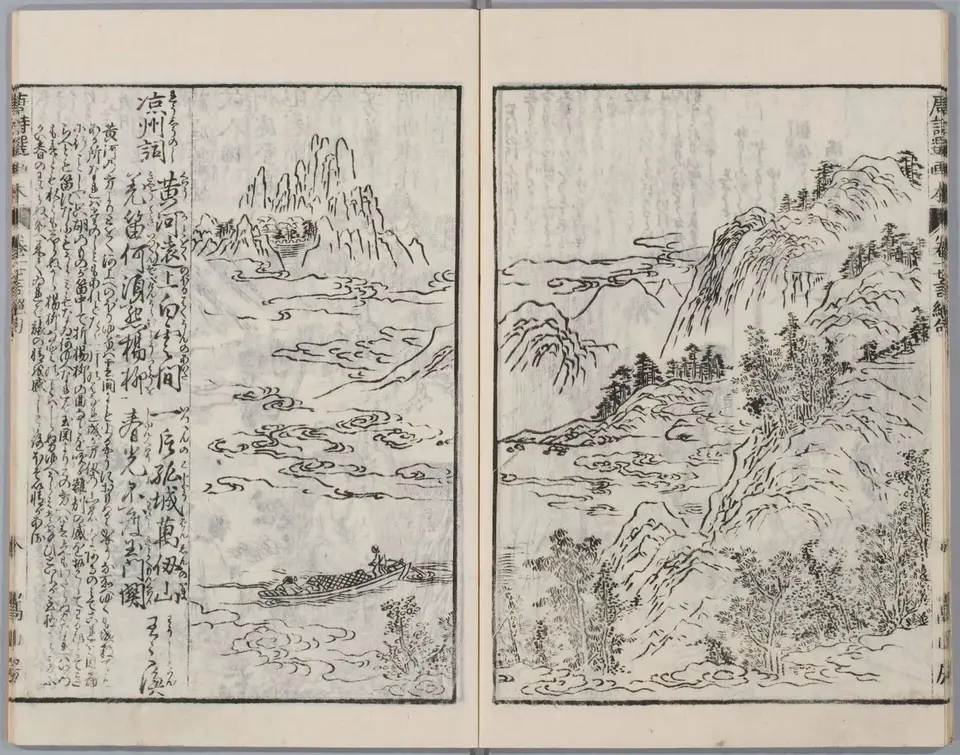
As a founding master of the High Tang frontier school, Wang Zhihuan created a classic archetype of border poetry in his Liangzhou Melodies (Liangzhou Ci): "Far, far away the Yellow River climbs into white clouds, a solitary fortress stands amidst ten thousand fathom peaks. Why must the Qiang flute mourn the willow branches? The spring breeze never crosses the Jade Gate Pass."
The poem opens with an astonishing visual inversion: observing the distant Yellow River winding toward the horizon, the poet describes it as climbing directly into the clouds, contrasting the vast wilderness with a solitary outpost nestled among towering mountains. The concluding lines evoke soldiers listening to the mournful nomad flute playing the tune Breaking the Willow, a melody traditionally associated with parting loved ones. The final declaration—that spring breezes never cross the western mountain passes—subtly reflects the soldiers' isolation while maintaining a dignified, heroic resonance.
Rather than succumbing to despair, the verse exhibits a soaring musical cadence and majestic diction. Qing critic Guan Shiming famously noted that while other poets produced voluminous works, Wang Zhihuan's single masterpiece stood as an independent army on the frontier of Chinese verse, hailed as the finest seven-character quatrain of the Tang dynasty.
The gathering celebrated as Painting on the Tavern Wall in Chang'an alongside Wang Changling and Gao Shi represents one of the most vivid cultural episodes in Chinese literary history. During the Kaiyuan era, poetry was not merely written for personal contemplation; it was set to musical notation and performed publicly by courtesans and imperial musicians in public taverns and banquet halls.
The friendly rivalry among the three poets in the tavern illustrated the popularity of Wang Zhihuan's poetry. His humorous confidence that the premier performer would sing his verse was confirmed when she began with Liangzhou Melodies. The episode revealed how Wang Zhihuan's poetry had penetrated the cultural consciousness of the High Tang, functioning as the preferred lyrics for the finest vocalists of the era.
In the history of classical Chinese literature, great masters typically left extensive literary collections containing hundreds or thousands of poems. Wang Zhihuan represents an extraordinary anomaly: although his works circulated widely during his lifetime, his collected writings were largely lost during subsequent centuries, leaving only six poems preserved in the Complete Tang Poetry.
Despite this compact corpus, his place among the Four Great Frontier Poets of the Tang—alongside Gao Shi, Cen Shen, and Wang Changling—remains undisputed. In modern quantitative analyses of classical literature, such as the Tang Poetry Rankings compiled by Wuhan University, his Ascending Stork Tower and Liangzhou Melodies consistently rank among the top five poems of the entire dynasty. By creating immortal art through a handful of lines, Wang Zhihuan fulfilled the highest classical ideal of aesthetic perfection.
FIGURES ASSOCIATED WITH THIS DYNASTY