Life and Career
Painting Student and Imperial Tutorship
Wang Ximeng lived during the late Northern Song under Emperor Huizong, an era when imperial patronage elevated court art institutions to unprecedented heights. Emperor Zhao Ji established the Painting School within the imperial academy, scouring the realm to recruit youths possessing innate artistic genius.
Born around the Shaosheng era of Emperor Zhezong, Wang Ximeng showed remarkable sensitivity to landscape composition and chromatic balance from childhood. At around fourteen years old, his technical proficiency secured him a place in the imperial Painting School. There, he studied the blue-and-green traditions of Tang masters Li Sixun and Li Zhaodao, while absorbing the monumental monochrome techniques of northern and southern masters such as Jing Hao, Guan Tong, Dong Yuan, and Juran.
Upon completing his academy courses, Wang Ximeng was too young to receive immediate appointment as a Court Painter Waiting-in-Attendance. Instead, he was assigned to the Palace Document Repository, where he was tasked with transcribing and cataloging historical scrolls.
In his spare hours, Wang Ximeng pursued painting with unremitting devotion. Utilizing refined palace silks and inks, he drafted numerous landscape compositions, arranging for palace eunuchs to show them to Emperor Huizong. His initial attempts were somewhat unrefined, lacking the monumental balance required for grand court commissions.
However, Emperor Huizong was an accomplished artist possessing a sharp eye for latent talent. Observing the youth's work, Huizong recognized that Wang Ximeng possessed an extraordinary natural spirit that could be molded into greatness. Breaking imperial protocol, the emperor summoned the teenager to his personal studios to instruct him directly. Huizong taught him the secrets of purifying rare mineral azurite and malachite pigments, layering transparent washes, and organizing panoramic expanses without losing delicate narrative focus.
Arduous Creation and Grand Masterpiece
Empowered by the sovereign's personal mentorship, Wang Ximeng's artistic vision underwent a profound transformation.
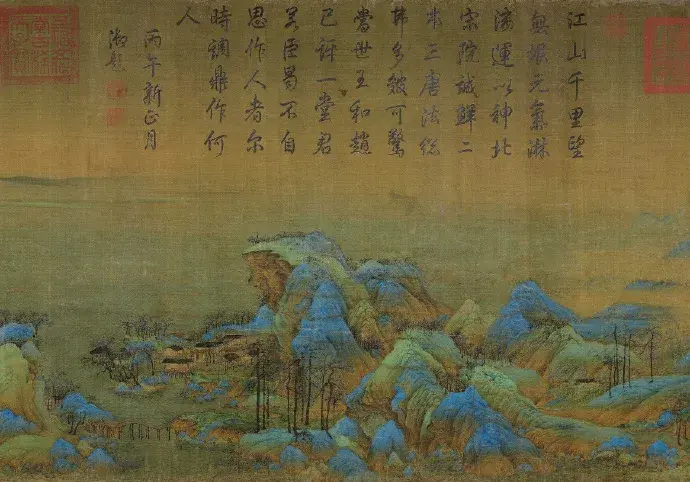
In early 1113, the eighteen-year-old artist was commissioned to execute a monumental imperial project: a panoramic blue-and-green handscroll depicting the vast, prosperous realm of the Song empire.
Wang Ximeng threw his entire being into the composition. He secured a single continuous roll of specially woven palace silk measuring 51.5 centimeters in height and nearly twelve meters in length, alongside precious natural minerals—vibrant malachite green, lapis lazuli and azurite blue, gold powder, and refined ochre.
For half a year, Wang Ximeng labored over his drafting table day and night. Synthesizing traditional heavy mineral pigments with the textured brushstrokes and spatial depth of contemporary monochrome landscapes, he constructed a majestic vision. Majestic mountains soar like emerald spires, broad rivers wind toward misty horizons, and intricate details emerge across the landscape—thatched villages, riverside pavilions, watermills, arched bridges, fishing boats, and travelers.
The coloring technique proved breathtaking: over warm washes of golden ochre, he layered pure malachite and brilliant azurite, achieving a crystalline, luminous quality that evoked an immortal earthly paradise.
In the fourth month of 1113, Wang Ximeng presented the completed scroll to the throne. Unfurling the work, Emperor Huizong expressed unbounded delight, declaring that his pupil had mastered the finest secrets of brush and ink. To honor Grand Councilor Cai Jing, Huizong bestowed the scroll upon him. Deeply moved by the honor, Cai Jing penned a detailed colophon at the end of the scroll, recording the youth's eighteen-year-old artistic triumph.
Fading Meteor and Eternal Legacy
However, genius often extracted a tragic physical toll. The execution of such a massive handscroll required superhuman concentration, and prolonged exposure to toxic mineral pigments in a confined studio drained the young painter's vitality.
Shortly after presenting the masterpiece, Wang Ximeng fell gravely ill. Like a brilliant meteor streaking across the night sky, he passed away around the age of twenty. In his Verses on Painting, Qing dynasty scholar Song Luo commemorated him: "Wang Ximeng served in Xuanhe's inner court, receiving the emperor's secret brush technique; remembering alone the grandeur of his soaring visions, one pities the youth who withered before reaching full adulthood."
Wang Ximeng's life was brief, and A Thousand Li of Rivers and Mountains remains his sole surviving work. Yet this single scroll survived nine centuries of dynastic collapse and imperial dispersion, preserved today in pristine condition in the Palace Museum in Beijing. With the vibrant passion of an eighteen-year-old youth, Wang Ximeng created an immortal monument celebrating the majesty of the Chinese landscape.
Key Achievements
Entrance to Painting Academy and Personal Instruction from Huizong
Admitted to the Painting School of the Hanlin Academy in his youth, later serving in the Palace Document Repository. His extraordinary artistic potential caught the attention of Emperor Huizong, who personally mentored him in classical technique.
Painting A Thousand Li of Rivers and Mountains at Eighteen
Commissioned in 1113 at the age of eighteen to paint the continuous twelve-meter silk handscroll A Thousand Li of Rivers and Mountains, utilizing azurite and malachite to define the zenith of blue-and-green landscape art.
Imperial Commendation and Bestowal upon Chancellor Cai Jing
Presented his finished masterpiece to universal royal praise; Emperor Huizong bestowed the painting upon Grand Councilor Cai Jing, who inscribed a famous biographical colophon on the scroll.
Solitary Masterpiece Ranked among China's Top Ten Famous Paintings
Passed away in his early twenties, leaving behind this single peerless handscroll. Preserved today in the Palace Museum in Beijing, it stands as one of China's Ten Greatest Classical Paintings.