Biography
Loyalist Integrity and Hermit Seclusion
Wang Xichan was born on July 23, 1628, in Zhenze, Wujiang County, Suzhou Prefecture. Reared in a prestigious gentry lineage, Wang demonstrated astonishing mathematical intellect in early youth, devouring classical mathematics including Nine Chapters on the Mathematical Art and imperial dynastic calendars.
In 1644, Beijing fell to peasant insurgents and the Qing army swept south across the Yangtze. Heartbroken by dynastic ruin, seventeen-year-old Wang threw himself into a canal. Rescued by villagers, he launched an absolute seven-day hunger strike, yielding only to the weeping supplications of his elderly parents. He thereupon severed his long hair, swearing a solemn oath never to serve the Qing dynasty nor participate in its examinations, choosing life as a reclusive scholar-hermit.
In 1650, Wang joined Gu Yanwu, Pan Chengzhang, and Wu Yan in founding the Jingyin Poetry Society. Wearing straw sandals and broad hats, these loyalist intellectuals sailed across Lake Tai, coordinating cultural preservation. When Pan and Wu undertook the monumental task of compiling an unofficial History of Ming, they entrusted Wang with drafting the vital chapters on dynastic calendars and astronomy.
In 1663, the Qing government unleashed the catastrophic Zhuang Tinglong History of Ming literary inquisition. Pan Chengzhang and Wu Yan were brutally executed, their families exiled to the northern frontier, and the society was crushed. Shattered by the loss of his dearest comrades, Wang composed heartbroken elegies and retreated into absolute isolation in Zhenze, channeling his patriotic grief into mathematical explorations of the cosmos.
Self-Taught Genius and Nocturnal Star Gazing
During the late Ming, Jesuit missionaries led by Matteo Ricci and Johann Adam Schall von Bell translated Tycho Brahe's planetary astronomy into the Chongzhen Astronomical Treatise. Chinese practitioners were deeply divided: traditionalists clung dogmatically to Guo Shoujing's Yuan dynasty calendar, while court acolytes uncritically accepted Western tables without comprehending their underlying mathematical proofs.
Living in dire poverty, Wang could not afford expensive instruments or rare European treatises. He borrowed books, hand-copying astronomical translations and manufacturing his own wooden quadrants, gnomons, sundials, and armillary spheres. On cloudless nights, he routinely scaled his cottage roof, lying motionless along the ridgepole under freezing winds to track planetary motions with his naked eyes and sighting tubes.
Lacking any formal mentor, Wang relied on pure mathematical intuition to deduce spherical trigonometry and planetary kinematics. He reconciled the ancient Chinese practice of solar terms based on mean motion (pingqi) with Western seasonal divisions based on true solar motion (dingqi). Friends noted that while he remained silent in daily conversation, his face radiated intense ecstasy whenever he unlocked cosmic mathematical equations, calling himself "Tiantong Yisheng" (Born One with Heaven).
Instrument Fabrication and Observational Asceticism
Throughout his decades in Zhenze, Wang Xichan lived a life of rigorous intellectual asceticism. Understanding that astronomy required empirical verification and that theoretical calculations were useless without precise observational tools, Wang overcame acute poverty by crafting his own instruments using local hardwoods, bamboo, and clay.
Adapting classical armillary designs, he fashioned portable wooden armillary spheres engraved with precise divisions matching the traditional Chinese cycle of 365.25 degrees. To determine local latitude and solar noon altitudes, he erected an eight-foot wooden gnomon equipped with an ingenious pinhole aperture, utilizing pinhole optics to eliminate fuzzy penumbral shadows along the solar limb and achieving unprecedented precision during solstice observations.
Lacking European pendulum clocks, Wang designed a multi-chambered inflow water clepsydra, calibrating floating indicator reeds against meridian star transits. Whether enduring bitter winter frosts or humid summer nights, Wang stood vigil beneath the open heavens with his handmade sighting tubes. This tireless combination of instrument engineering and geometric calculation anchored his astronomy upon verifiable observational data.
Authoring the New Method and Mathematical Triumph
In 1667, at age thirty-nine, Wang completed his magnum opus, the six-volume Xiao'an's New Astronomical Method. In this groundbreaking text, Wang corrected systematic errors in both China's Datong Calendar and the Jesuit-introduced Western models, establishing algebraic interpolation methods and parallax formulas that improved eclipse timing predictions to the exact second.
Concurrently, he authored Explanation of the Movements of the Five Planets and Discussions on Calendrics, formulating geometric models for solar, lunar, and planetary orbits. Literati and mathematicians throughout Jiangnan marveled at the profound discoveries emerging from his impoverished cottage.
In 1673, Wang announced through mathematical calculations that a rare transit phenomenon would occur. Staging observations in his courtyard, he successfully tracked and timed both the Transit of Mercury and the Transit of Venus across the solar disc. His recorded data matched modern celestial reconstructions with astonishing precision, marking one of the earliest successful independent transit observations in world astronomy.
Dedication to Teaching and Death in Poverty
In his later years, Wang taught Neo-Confucian philosophy alongside Zhang Luxiang, Lu Liuliang, and Qian Chengzhi, while tutoring private disciples in mathematics, among whom was Pan Chengzhang's younger brother, Pan Lei.
In 1678, the Kangxi Emperor decreed the convocation of the Erudite Literatus Examination. Provincial authorities and grand secretaries competed to recommend Wang. True to his loyalist vow, Wang feigned severe infirmity, firmly refusing all official overtures.
In 1680, Wang met fellow astronomer Xu Fa in Jiaxing to observe a solar eclipse. While the Imperial Astronomical Bureau in Beijing miscalculated the initial contact time, Wang's predictions proved accurate to the second, demonstrating the unquestioned superiority of his method.
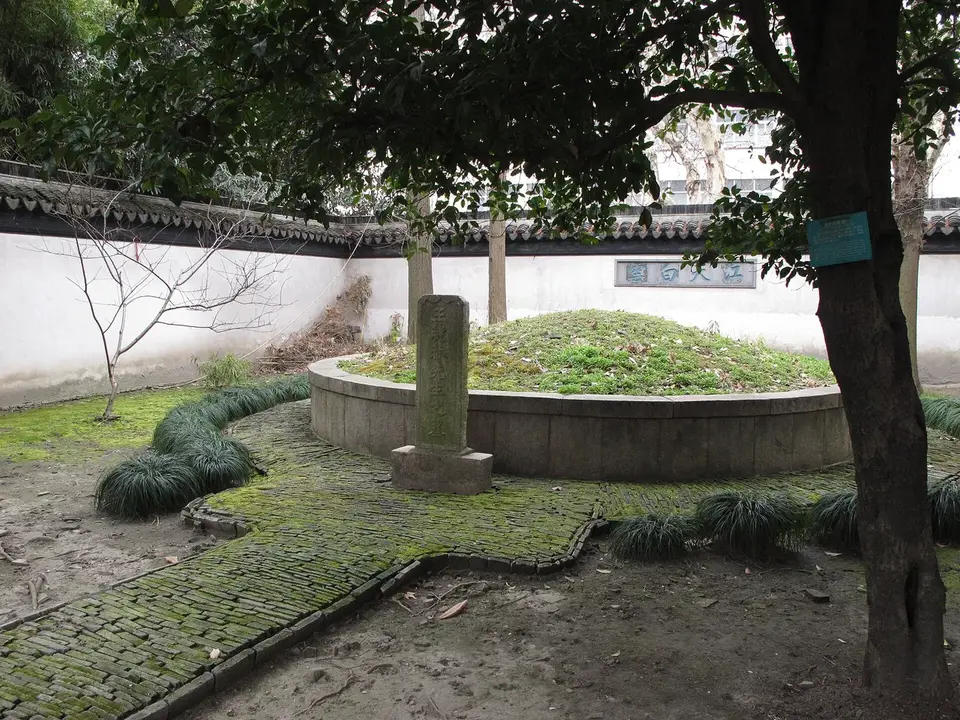
Relentless poverty, lifelong nocturnal exposure to harsh weather, and immense computational strain irreparably shattered his physical constitution. On October 18, 1682, Wang passed away in his Zhenze retreat at the age of fifty-five. He died penniless, leaving behind only chests of handwritten manuscripts. His disciple Pan Lei and friends financed his burial, subsequently spending decades collecting his papers into the monumental Collected Works of Xiao'an.
Major Achievements
Xiao'an's New Astronomical Method and Eclipse Calculation
Wang's foremost contribution was his six-volume Xiao'an's New Astronomical Method, which revolutionized mathematical astronomy in early modern China. The work ended the passive reliance on imported Jesuit calculation tables.
Wang criticized Western astronomers for compiling empirical observational tables without mastering the fundamental geometric proofs governing cosmic motions. In Xiao'an Xinfa, he reconstructed eclipse prediction algorithms, substituting mechanical table lookups with spherical trigonometry and iterative algebraic approximations. His formulas accounted for parallax variations across geographical latitudes, calculating eclipse magnitude, phase duration, and planetary retrogradations with unmatched precision. His methods were later incorporated into the official Qing compendium Yuzhi Lixiang Kaocheng.
Development of Spherical Solutions and Trigonometry
In mathematics, Wang was one of China's earliest independent pioneers of spherical trigonometry, systematically articulated in his monograph Spherical Solutions (Yuanjie).
Without access to complete Western geometric treatises, Wang relied upon classical right-triangle theory and geometric circle-division techniques to deduce fundamental spherical formulas for arcs, spherical angles, and celestial ecliptic-equatorial coordinates. By projecting spherical triangles onto two-dimensional planes, he created rigorous computational tools that underpinned his astronomical work, inspiring high Qing evidential scholars such as Dai Zhen and Ruan Yuan.
Independent Observation of Planetary Transits
Wang was the first Chinese astronomer to predict and record the Transits of Mercury and Venus using self-developed mathematical models.
In Explanation of the Movements of the Five Planets, Wang boldly revised Tycho Brahe's geo-heliocentric planetary system. Discarding solid crystalline spheres, he envisioned planetary movements influenced by dynamic mutual attraction akin to magnetic force, avoiding the mechanical collisions inherent in Tychonic orbits. In November 1673, his empirical observations of Mercury passing across the solar surface established a milestone in independent observational astronomy.
Correcting the Tychonic System and Iterative Eclipse Algorithms
Wang's paramount breakthrough in assimilating Western astronomy lay in his theoretical corrections of Tycho Brahe's planetary model and his algebraic innovations in eclipse calculations. While the Tychonic system was superior in computing solar and lunar parallax, it contained structural contradictions regarding planetary orbital intersections.
Scrutinizing the astronomical data system of Tycho's disciple Christian Severin Longomontanus, Wang mathematically demonstrated that Tycho's solar equation of the center suffered from systematic angular deviations. In response, Wang formulated a novel multi-stage interpolation algorithm incorporating continuous algebraic iterations. In calculating the precise moments of eclipse contact and maximum obscuration, he abandoned crude tabular lookups in favor of successive approximation.
This method eliminated observational latitude errors, yielding timing predictions that diverge from modern calculations by only seconds. Wang extended these iterative equations to planetary latitude perturbations for Mercury, Venus, and Mars, providing mathematical models that were subsequently incorporated into the official Qing compendium Yuzhi Lixiang Kaocheng.
Synthesis of Chinese and Western Astronomy
Wang formulated the foundational methodology of Qing mathematical scholarship: synthesizing Chinese and Western traditions through rigorous empirical criticism. He rejected both xenophobic rejection of foreign science and servile acceptance of Jesuit authority.
Advocating that scholars must "master the underlying principles while eliminating errors," Wang harmonized indigenous Chinese computational ingenuity with European geometric models. Paired with Xue Fengzuo as "Wang of the South and Xue of the North," he propelled Chinese astronomy into modern empirical science, recognized by international historians as one of the seventeenth century's greatest mathematical minds.